Category: Weekday Homilies

  • Towards a healthy and holy human relationships

    Towards a healthy and holy human relationships

    November 4, 2020 – Wednesday of the 31st Week in Ordinary Time

    Click here for the readings (https://bible.usccb.org/bible/readings/110420.cfm)

    Homily

    Why do some human relationships cause more pain and harm than joy and peace in us? Why do some human relationships fail and eventually hurt us for the rest of our life? We have seen how broken human relationships bring people towards desperation, loneliness, bitterness, anger and hatred. The jealousy, unfaithfulness, insecurities, betrayal and irresponsibility can cause havoc and damage to our human relationships whether at home, at work, among lovers and couples, among friends and communities.

    But if we would really look at its roots, we will surely find “selfishness” as the active agent that corrupts our human relationships. Our tendency to advance our personal agenda, to prioritize what is only good for ourselves, to secure benefits for ourselves alone and to satisfy our personal desires above others will eventually make us very toxic to our relationships.

    Thus, a selfish lover or spouse will turn out to be abusive and emotionally manipulative. A self-centered parent can become controlling and even violent in words and actions towards the children. A self-centered friend can be constantly seeking recognition and praise from others or could be insisting to always consider his or her comfort but unwilling to compromise for the sake of others. These are just few examples of possible actions and tendencies of selfishness that can certainly destroy and cause damage to our relationships.

    That’s why, we also long for a relationship that will truly help us as persons and mold us to become better persons. The readings today have very important message for us and for our human relationships.

    For our human relationships to have a grounding and a better foundation, our relationships must be rooted in God not to our personal preferences and selfish intentions. This means that becoming a disciple of Jesus leads towards a healthy and holy human relationships. This is what Jesus meant as he said, “If anyone comes to me without hating his father and mother, wife and children, brothers and sisters, he cannot be my disciple.”

    Though hating one’s family member seems to be so harsh for us today, but Jesus did not mean the English word “hatred.” This is a Jewish idiom that meant for “preferences.” Thus, Jesus meant that when we give more preference or priority to others than God, then, we cannot be his disciple. Our human relationships too will lose a good foundation.

    Hence, Jesus also said, “everyone of you who does not renounce all his possessions cannot be my disciple.” The possessions, which could be our wealth and material things, self-image and fame, position and influence, achievement and status in the community, may possess us to the point that they become our priority rather than God and loving others through service.

    God asks us today to make Him as our priority over our other priorities. What is more beautiful here is God’s invitation for us to make our relationship with Him as the “life and soul” of our human relationships. It is from our relationship with God that, hopefully, we will become responsible and generous persons especially as we relate with others as a parent, sibling, a child, a friend or as a professional or whatever work, profession and status we have now.

    This is what Paul also expressed in his letter to the Philippians. A community that lives in the presence of God and rejoices in God’s presence “will shine like lights in the world.” Therefore, giving priority to God and making God the very center of our human relationships will transform us like lights in the world.

    Consequently, we will also witness how a couple whose relationship is grounded in God becomes loving and inspiring to others. A family whose relationship prioritizes God becomes a source of comfort, security and joy, becoming a true home. A friendship where the Lord plays the most important part among friends becomes welcoming and discerning.

    This is how the Lord moves us as we make God the very priority of all our human relationships. We may all work on this so that we will also become less and less self-centered and selfish and become more self-giving and life-giving. Hinaut pa.

    Jom Baring, CSsR

  • God has so much to offer for us

    God has so much to offer for us

    Advertisements

    November 3, 2020 – Tuesday of the 31st Week in Ordinary Time

    Click here for the readings (https://bible.usccb.org/bible/readings/110320.cfm)

    Homily

    God has so much to offer for us. In God’s infinite love for the world and for every creature, God became man and expressed in a loving service the love that redeems and gives the fullness of life. The Letter of Paul to the Philippians contains this early Christian hymn to Jesus, the Lord. In this hymn, God’s desire for us to have the fullness of life, the Son became man and lived a human life. The Lord “emptied himself” to show us how Jesus did not cling to his divinity so that we will be able to see his face.

    God broke the barrier that separated us from him. Because we cannot come near to God, and God came to be with us. This is how the loving service of Jesus became more life-giving. He was most willing to offer his life so that we may have the fullness of life.

    This is what our Gospel also reminds us today. The parable that Jesus gave reinforces this desire of God to offer us the fullness of life. As the master of the house also called the presence of the poor and the crippled, and blind and the lame and of those living in the highways and peripheries, God also invites us the wounded and the brokenhearted, the sinners and guilty. All of us.

    God, certainly, has so much to offer us. However, just as the invited guests found excuses not to go to the banquet, we could also become dismissive and indifferent to God’s daily invitations for us. Our lame excuses of having other affairs, of having fears and anxieties, of having other priorities, in overwhelming our hearts with anger and hatred, in filling up our mind with selfish intentions,  and in clinging to our habitual sins will surely prevent us to joyfully accept God’s invitation.

    God calls us to empty ourselves from all these unnecessary distractions and to fill our hearts and mind with God’s presence so that we may grow in that desire of God to experience the fullness of life in the here and now with our community. Hinaut pa.

    Jom Baring, CSsR

  • PRAY. LET GO. LIVE FULLY.

    PRAY. LET GO. LIVE FULLY.

    Advertisements

    November 2, 2020 – Monday, All Souls Day

    Readings from MASSES FOR THE DEAD

    2 Maccabees 12:43-46 (He acted in an excellent and noble way as he had the resurrection of the dead in view.)

    A reading from the second Book of Maccabees

    Judas, the ruler of Israel, took up a collection among all his soldiers amounting to two thousand silver drachmas, which he sent to Jerusalem to provide for an expiatory sacrifice. In doing this he acted in a very excellent and noble way, inasmuch as he had the resurrection of the dead in view; or if he were not expecting the fallen to rise again, it would have been useless and foolish to pray for them in death. But if he did this with a view to the splendid reward that awaits those who had gone to rest in godliness, it was a holy and pious thought. Thus he made atonement for the dead that they might be freed from this sin.

    Psalm 103:8 and 10, 13-14, 15-16, 17-18

    R. (8a) The Lord is kind and merciful.

    Merciful and gracious is the LORD, slow to anger, and abounding in kindness. Not according to our sins does he deal with us, nor does he requite us according to our crimes.

    As a father has compassion on his children, so the LORD has compassion on those who fear him. For he knows how we are formed, he remembers that we are dust.

    Man’s days are like those of grass; like a flower of the field he blooms; The wind sweeps over him and he is gone, and his place knows him no more.

    John 14:1-6 (In my Father’s house there are many dwellings.)

    + A reading from the holy Gospel according to John

    Jesus said to this disciples: “Do not let your hearts be troubled. You have faith in God; have faith also in me. In my Father’s house there are many dwelling places. If there were not, would I have told you that I am going to prepare a place for you? And if I go and prepare a place for you, I will come back again and take you to myself, so that where I am you also may be. Where I am going you know the way.”

    Thomas said to him, “Master, we do not know where you are going; how can we know the way?” Jesus said to him, “I am the way and the truth and the life. No one comes to the Father except through me.”

    Homily

    Since the lockdowns and community quarantine, funeral masses and burial rites have been deprived to many. Even our own Redemptorist Brother (Bro. Dominic Alcover, CSsR who died of heart failure) was deprived to be dressed properly for burial, was also deprived to be given a dignified funeral mass. Bro. Dominic served many years in the missions and in many parts in Visayas and Mindanao. It was just so sad that we couldn’t bid our goodbyes before he was laid to rest.

    Moreover, a friend’s mother died in September but was in the Intensive Care Unit for more than 100 days. She died without a loved on her side. Though, she died uncertain of Covid-19, but she was unceremoniously cremated immediately without the presence of her family. There was no funeral wake as the whole family was locked up in their home though they never had contact with their mother. It was heartbreaking experiencing this kind of grief.

    One could just imagine that while grieving the death of a loved one, we will surely be overwhelmed too with frustrations and disappointments because of the many restrictions. These are just two of the many situations happening today. Many families who lost their loved ones since this Covid-19 time, whether of the virus or not, underwent this kind of difficulty.

    To celebrate properly, with devotion and affection the death of our loved ones reminds us of the sanctity of life. Equally, we also celebrate their memories and the gift of life of our loved ones. This is the reason why frustrations and disappointments will also overwhelm us because of the deprivation of celebrating these rituals, something embedded in our faith and culture.

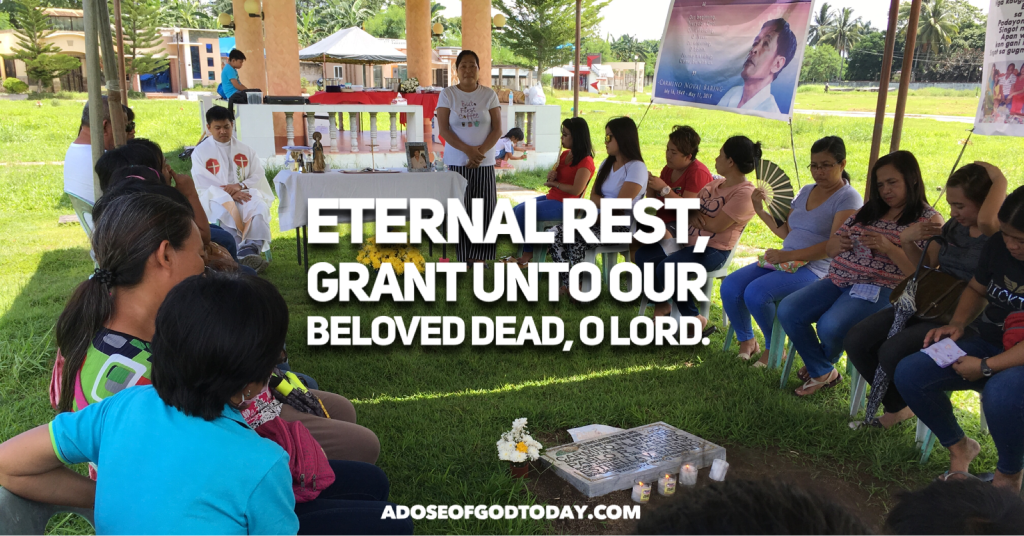
    Today, on this All Souls’ Day, we remember in a very special way the memories of our beloved dead. Others could have still feel the grief particularly with those whose loved ones just recently died. And today even, we too are prohibited to visit the cemeteries as a measure to contain and not spread any further the Corona Virus. However, all these should not prevent us also from celebrating this day of Commemoration of the All the Faithful Departed.

    As we remember them, how do we celebrate in a simple but wonderful way the All Souls’ Day? There are there invitations for today.

    First. Gather as a family and pray together at home and in the Church. Our readings today from the Second Book of Maccabees tells us of this devotion of praying for the dead. We are told how a sacrifice was made to the Temple for the dead, for the forgiveness of their sins. This is a belief of the resurrection and life beyond death. Indeed, our beloved dead continues to be present in spirit. Thus, as we remember them, pray for them and pray with them.

    Second. Let go of our troubles and guilt. Others are sometimes haunted by their guilt when a loved one died because they have not done enough for them, because they have not loved them enough, because they were not able to ask for forgiveness. Jesus told his disciples not to be troubled anymore but to trust the Father, to trust Jesus. Holding on to our troubles, worries and guilt will do no good to us and to our beloved dead. We give peace to ourselves and peace to our beloved dead, as we embrace God’s mercy and compassion for us. Trust the Lord’s embrace.

    Third. Live life to the fullest and celebrate the fullness of life. As we remember the life of those who have gone before us through the precious memories left in us, we too are invited to live our life and celebrate life to the fullest. Thomas asked Jesus, “We do not know where you are going, how can we know the way?” Yet, Jesus also said, “I am the way, the truth and the life.” Jesus is basically telling us, to live life fully is to follow me, to know me and to live in my life. Indeed, we shall be able to live life fully with joy, with peace and with satisfaction as we learn the way of Jesus, as we embrace the person of Jesus and we live day by day the life of Jesus.

    Thus, living our life today to the fullest is a way of honoring and giving more importance to the our beloved dead who made significant impact in our life. To play dead while still alive, or to become indifferent while being on earth, is certainly a violation of God’s generosity and gift of life. By becoming contented and happy, free from fear and anxiety, then, we give praise to our Creator who shall call us someday to join with Him in eternal life. Hinaut pa.

    Jom Baring, CSsR

  • Places of Honor and Self-Entitlement

    Places of Honor and Self-Entitlement

    Advertisements

    October 31, 2020 – Saturday of the 30th Week in Ordinary Time

    Click here for the readings (https://bible.usccb.org/bible/readings/103120.cfm)

    Homily

    Jesus must have been a very observant person. He noticed the attitudes of the people who were invited in an event. He saw how each one sought to secure for themselves places of honor at the table. If we would imagine, the guests must have been fighting to sit near the host since that would tell everybody that he is higher in status or more important than others. To occupy a place of honor is to insist that the person is entitled to it because of that status, or relation, or influence he has.

    We must have heard or met people who demanded others to give them special treatment. Or we might be the very person also who seek to be given privileges and special recognition because of our status, successes and achievements, profession or degree, influence and wealth or because of our relation to someone who is important in the community, in our workplace, or organization or even in the Church. We fall into the temptation to be self-entitled just like the people Jesus was talking about, when we are filled with arrogance and self-importance.

    Self-entitled persons are very demanding and think too highly of themselves. Thus, when we turn to be self-entitled we demand respect from others rather than earn respect. This is how we will become demanding in our relationships. Yet, we become critical of people around us and tend to only see the wrong in the other person. We will become stingy of our time and energy and ungenerous of our resources and presence to those who ask for our help. Most of all, we become indifferent to people around us and indifferent to God.

    Thus, what Jesus also criticized and called for conversion is the “indifference” among self-entitled persons. Because of their self-importance and demand to be respected, a self-entitled person becomes indifferent to what others feel and to what others need. What is more important for a self-entitled, is self-satisfaction and recognition from others.

    However, this attitude does not worship God. Such attitude would even demand God to be gracious because of his righteousness.

    Jesus warns us, anyone who exalts himself will be shamed because God does not favor a self-entitled. A self-entitled person is hated in the community. We may be praised because we demand it, but we are despised because we are truly not deserving. God, rather, takes delight with the humble because the humble connects and relates with others, with sincerity and honesty.

    Thus, God exalts the humble because of the awareness of the person of his needs and shortcomings. May we grow, then, in humility and get rid of any form of self-entitlement in our hearts. Hinaut pa.

    Jom Baring, CSsR

  • Our Loving Response

    Our Loving Response

    Advertisements

    October 30, 2020 – Friday of the 30th Week in Ordinary Time

    Click here for the readings (https://bible.usccb.org/bible/readings/103020.cfm)

    Homily

    Paul’s letter today reveals how warm his heart to people who were significant in his life. The Philippians who were Paul’s converts had a special place in his heart. This is how Paul also expressed his affection and longing of friendship with them. Moreover, Paul was even more grateful for the friendship he had with the Philippians, something that gave so much confidence and strength to Paul.

    This tells us how friendship supports and gives assurance to people especially in difficult times. Paul was in prison, probably in Rome or in Ephesus, when he wrote his letter to them. While in prison, Paul must have a hard time. However, his friendship with these people was a source of comfort to him. Remembering them gave him joyful memories that must have eased the pain and loneliness while being persecuted.

    Paul, indeed, gave life to this community through his ministry of preaching of the good news. In return, the community also gave him the Spirit of friendship and love.

    This is a true loving response between people bounded in their friendship with the Lord. Paul’s deep friendship with the Lord compelled him to preach Jesus and bring the Risen Lord to the communities he encountered. Those communities like that of the Philippians developed such friendship too with one another and with Paul that mutually guides, supports and gives life to them.

    Such loving response is the prayer of Paul also to the Philippians, he said, “and this is my prayer: that your love may increase ever more and more.”

    This kind of loving response is what we also witnessed in today’s Gospel. Jesus seeing a man suffering from dropsy was moved to heal and free the person. Jesus had so much affection for this man that he could not stand anymore seeing him suffering. The Lord’s desire was for every man and woman to have the fullness of life.

    Despite the very situation of Jesus, he took the risk of healing the sick man in front of the those powerful people, the Pharisees. Though the Pharisees were silent when Jesus asked them, “Is it lawful to cure on a Sabbath or not?,” but their silence was filled with malice and hostility against Jesus.

    Jesus took the risk because what he had was a loving response to a person in need. What matters most was his action to love and to assure the person that God has not left him.

    This is what Jesus is also reminding and calling us today. We are called to respond in love and show our affection to people. Like Paul, let us also show with confidence our love and affection to those who are special in our life. Like Jesus too, let us not forget to assure, even the strangers, that as Christians, we are here to love and show concern to those who are in need. Hinaut pa.

    Jom Baring, CSsR