As Jesus reminded his disciples that a master need not be grateful to his servant and so is God need not be grateful to us. Like the servant in today’s Gospel, we too do not earn anything. Our good works and even expression of our devotion do not merit anything.
Do you think that this is too bad? Well, if our mindset believes that our relationship with God is like when we are working, that what we do must be compensated with some wages, then, this really looks bad. However, our relationship with God is not something like this where we do good works, love others and love God, do our prayers and Church obligations and expect something good in return from God. God has no obligation whatsoever to us. We do not need to be compensated for our good works on earth.
Nevertheless, our relationship with God is entirely based on “grace.” God’s grace is not a compensation to us, not a reward and not a merit given to us. God’s grace is a sheer gift given to us because God is generous, because God is pure love.
If God would rate and give points to the way we live our life, all of us may fail for God’s standard is not like ours. However, this sheer gift of God’s grace is given to us as God’s expression of love. It is not that God is indebted also to us because we adore and worship God, but because God’s love naturally overflows and God indeed is the fullness of love.
Thus, just as Jesus reminded again his disciples, we too are “unprofitable servants,” yet blessed and loved by God. Should we not be grateful then?
We are called to be grateful. This is our response to that pure gift of grace from God. Paul tells us that as the grace of God has appeared to us, then, we are to live our lives having self-control not driven by our selfish-intentions and impulses, to be honest in our words and deeds and to live a holy life. In this way, then, we are to express our gratitude to the Lord who is all good and generous to us for God is full of love. Hinaut pa.
Today is a joyful and wonderful day that aside from celebrating the Feast of the Dedication of the Lateran Basilica, which is the Cathedral of Pope Francis, and which is also called as the “Mother and head of all churches of Rome and the world,” we Redemptorist Missionaries are also celebrating our 288th birthday!
On this day, St Alphonsus together with the first members of the Redemptorists, founded the Congregation in the Island of Scala, Italy in 1732. For 288 years, God’s faithfulness and generosity manifested in the life of the Congregation in many ways. This experience with God has been shared in many missions and apostolate of the Redemptorists throughout the world.
One of the most important missions of the congregation where God’s faithfulness, generosity and abounding love being shared, is the Youth Ministry. That is why, this livestreaming mass today is dedicated to our Redemptorist Youth Ministry, who in many parts of the Philippines have gathered today to celebrate November 9 as a Day of Prayer.
Yes, today is a Day of Prayer of the young gathered physically and virtually. This gathering is so significant because this Day of Prayer, on this wonderful day, it invites all of us to remind ourselves that we are God’s Temple and God’s holy people. Our readings today expressed this identity in us that we are indeed God’s Temple and God’s holy people.
For us to remember this and make this Day of Prayer more wonderful and powerful for us today, I have three invitations, something that you can bring and something you can celebrate.
First, BE YOUNG. Pope Francis reminds us that “God is Young and is always New.” This means that God really brings surprises and freshness in us because God is ever young. God will never have an expiration because God is always new. That is why, all of us who are God’s building and God’s Holy Temple as what St. Paul reminds us in his first letter to the Corinthians, are called to be always young. Remember, we may grow old in age, however, to be “young at heart” is not limited to a particular age group. We may be young in terms of age, but when our heart is filled with anger and hatred, with bitterness and indifference, then, we have surely grown old. Moreover, to be advanced in age does not also mean that we will never be young at heart. Even when we have grown in age, a senior citizen may still be young at heart when he or she remains welcoming, warn-hearted, joyful and alert of God’s daily invitations. Let us remember the words of Pope Francis, “True youth means having a heart capable of loving, whereas everything that separates us from others makes the soul grow old.” Thus, be young and celebrate being young at heart.
Second, BE RENEWED. As God is always new, God also brings fresh graces and fresh experiences. Our true relationship with God is always fresh, it will never be spoiled. Prophet Ezekiel tells us in the first reading that the water from the temple overflows and it reaches the barren and dry desert, and the water brings life. Salt waters also turn into fresh waters where every living creature shall live. This means that when we allow God’s love to transform us, to challenge and to call us, then God brings renewal into our dry and empty hearts. Hence, allow God today to reach our hearts to transform, challenge and call us so that we will be renewed.
Third, BE LIFE-GIVING. Jesus came to give us life. Jesus manifested his life-giving mission in his ministry. That’s why when there were people who suck the life of others, Jesus also expressed dismay and disappointment. This is what happened in today’s Gospel. Jesus drove out the merchants and money-changers who were sucking up the life of the poor through their scandalous and oppressive business inside the Temple area. When we turn out to be driven by our selfish desires and selfish intentions, we will also become vicious in our relationship with people around us. When we are more concerned in bloating our ego then we turn out also to become abusive and corrupt because our heart has become indifferent to God.
However, such way of life is lonely because we will constantly be haunted by insecurity and fear. Certainly, there is no life here but sadness. Pope Francis in his latest Encyclical, Fratelli Tutti said, “go outside the self in order to find ‘a fuller existence in another.’ ” Meaning, that when we begin to think less of ourselves, to step outside our comfort zones, and outside our insecurities and fears, then, we also discover the fullness of life with the people around us. Thus, to experience truly what life is, is to be able to give life. When I commit myself fully to love another then I find joy and meaning in life. When I generously give something to someone in need, I do not only help a person but also experience the joy of helping another. Therefore, to live life joyfully and truly, is to be life-giving.
Now, may I repeat the three invitations on this Day of Prayer and birthday of our Congregation, BE YOUNG, BE RENEWED AND BE LIFE-GIVING. Hinaut pa.
When we are in distress, in pain and in great confusion because of some difficult situation in our life, the people who come to share our troubles will surely bring comfort in us. Even when our friends cannot be present with us physically, but, their expression of being with us spiritually also brings confidence in our distressed hearts.
While Paul was in prison, the people who became his friends never left him. The Philippians who were converts of Paul’s mission travels, remembered him. They had been Paul’s supporters in joys and sorrows. And when Paul was captured by those who were hostile against the Christians, the Philippians made sure to bring aid to Paul in whatever way they can. Paul was being persecuted. His prison cell must had been a terrible place to stay. However, to be alone in there could have been more lonesome and grim.
That is why, Paul expressed in his letter to his friends, the Philippians, his gratitude to them. Indeed, his friendship with them brought comfort in his distress. Paul said, “It was kind of you to share in my distress.” To be remembered by friends and to have friends who are ready to empathize with us certainly brings confidence in us. Thus, more than the material gifts he received, Paul rejoiced for the gift of friendship with them.
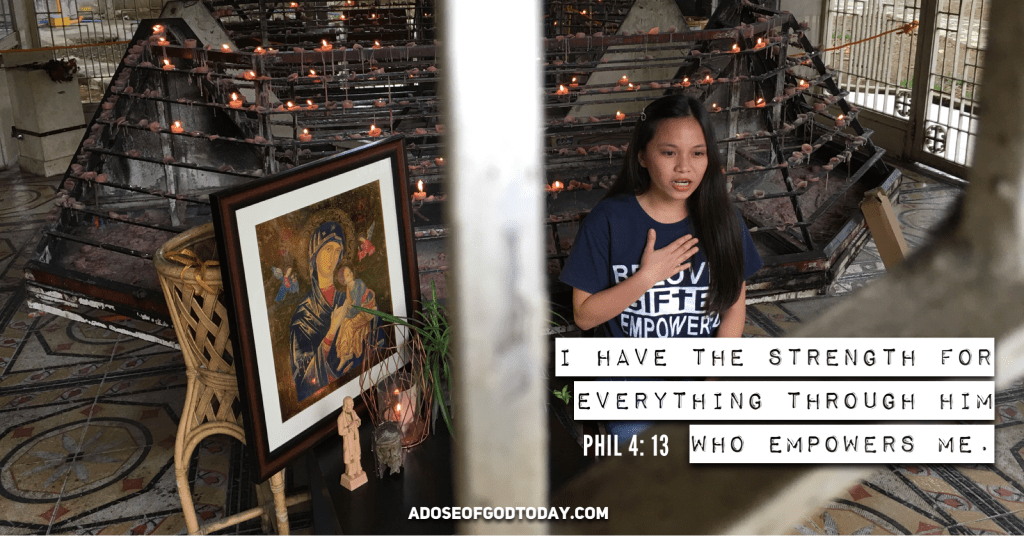
Moreover, Paul also recognized that what gave him more strength was his friendship with the Lord. Paul expressed with confidence, “I have the strength for everything through him who empowers me.” This is also Paul’s invitation to the Philippians, that they too will grow more in their friendship with the Lord Jesus who shall give them the strength for everything.
The Lord, indeed, gives us the strength for everything. Paul learned how to adjust in every situation in his life and how to make every difficult situation bearable because of his faith and confidence in Jesus, the Lord.
This is the invitation for us today, that we become generous givers and gracious receivers of gifts. The Philippians became generous givers to Paul because they had been gracious receivers from Paul’s teaching and preaching. Paul, as well, became a gracious receiver of friendship from them because he had been a generous giver to them.
This is the very value that Jesus reminds us in today’s Gospel, that we may not be possessed by our resources but become charitable. To become truly charitable is to become trustworthy even in small matters because we do not allow our hearts to be corrupted by the desire to have more and to keep more for ourselves alone.
Hopefully, we may grow in our consciousness of becoming aware of the needs of others and to be more generous in giving our ourselves to those friends who need help. We may also grow to have a welcoming and humble heart to receive the help from our friends and become grateful more of our friendship. Hinaut pa.
We have a puzzling gospel reading today. The master in the story praised the dishonest steward. But does it mean that Jesus also praises those who are dishonest? Certainly, no! It was not the dishonesty of the steward that was praised neither by the master in the story nor by Jesus but rather the ‘prudence’ of the steward.
Let us look again how the steward acted prudently. The steward faced with a crisis, he was about to lose his job for being dishonest to his master. In his mind he couldn’t go on by becoming a labourer by digging or by begging. What he did, then, was to take away the commission that he would usually get from the debtors of his master. That is why he asked one debtor to make 50 for the one who owed 100 measures of oil and 80 for the other who owed 100 bushels of wheat. Surely, those debtors would be very happy of being unburdened of such debt. The steward had just thought about his future so that when he will be fired, there will be people who would hire him for a job out of gratitude to him.
This is what Jesus tells us today, that as Christians, we are challenged to be prudent enough. We are challenged particularly in using and spending our material possessions in the hope of making our relationship with other people to be better. For this reason, we are called to be careful that we may not be ‘possessed’ by our own possessions which will only bring us into the danger of indifference and oppression towards the lowly and the poor.
Consequently, we are also called to be fair and to be generous enough as we deal with those who are economically struggling. Thus, it would be a big help to support local vendors and local businesses, to buy products from local peddlers and show fairness with our own business too. Our material possessions can be best employed also in reaching out to others by feeding the hungry and clothing the naked especially those who are being affected recently by the super typhoon Rolly.
Indeed, these are ways of recognizing God as the generous giver of graces. By being grateful to the Lord, may it move us then to be generous also to the needy. This is a way of building relationship with one another, building friendship and helping one another as a community of believers. Hinaut pa.
I find it disturbing that while Jesus was trying to bring people to conversion, to freedom and closer to God, there was a group of people also who grumbled and complained because of Jesus’ actions. The parable of the lost sheep and of the lost coin are images of God searching for those who along the path of life have lost their way, distanced from the community and from God. Yet, God longs and desires the presence of those who lost their way. Thus, these two parables tell us really how dear each of us in God’s heart. God will not rest and will not surrender until God wins us back and finds us again.
However, such image and nature of God, was received with hatred by those who wanted to control God. The Pharisees and scribes complained and grumbled because Jesus was eating with sinners and being friendly with them. They did not want a God who forgives and redeems sinners and the lost. They wanted a God who condemns.
This was the reason of their grumbling because they wanted a condemning God. Having this kind of God, then, they can easily incite fear among the people and control people according to their agenda and selfish intentions.
That is why, Jesus’ presence was indeed a threat against these people, because Jesus was turning the table against them. Jesus revealed the true face of God, a loving and forgiving God.
Hence, while Jesus tells us of God’s embrace and God’s longing for us, we too are reminded of our tendency to reject God. The Pharisees and the scribes represent that tendency in us to reject whatever is of God’s. However, just as the shepherd never stopped until he found the lost sheep and just as the woman searched carefully until she found the lost coin, God also continues to call and invite us, to search and to find us until we allow God to embrace us.
This is something that Paul also realized. His letter to the Philippians recounted his past where he thought that he was already in the right path. Yet, Paul was a lost soul believing that righteousness based on the law was enough. However, when Jesus found him, Paul also found himself and gained everything in Christ.
May these parables always remind us of this God who longs and desires for our presence, for our conversion and for our freedom. Moreover, may it move us too to be more embracing, accepting and welcoming of our brothers and sisters who need a lot of understanding and loving because of unfortunate circumstances in their life. Hinaut pa.
Jom Baring, CSsR
Please take more doses of God today. The only side-effect is for you to become holier.
February 18, 2026 – Ash Wednesday Click here for the readings (https://bible.usccb.org/bible/readings/021826.cfm) Many of us today could have become busy fixing our outward life. For many young people, we fix our social media posts. We fix our appearance before going out. We fix our schedules, our plans, and our budgets. This means, there is a…
February 15, 2026 – Sixth Sunday in Ordinary Time Click here for the readings (https://bible.usccb.org/bible/readings/021526.cfm) What keeps you going? What makes you wake up every morning? Your answers will surely vary. For some, it is their family. For others, it is their children’s future, their work, their dreams, or simply the hope that tomorrow will…
February 15, 2026 – Sixth Sunday in Ordinary Time Click here for the readings (https://bible.usccb.org/bible/readings/021526.cfm) “Do you believe in chain letters? or nowadays we may call it as Copy-Paste & Post OR-ELSE…. Facebook, Messenger, or Twitter posts?” At times, I have been asked about this, & I find myself giving the same answer. I say:…










 A DOSE OF GOD TODAY