Category: Weekday Homilies

  • Life and Living Life is to Give Life

    November 21, 2020 – Memorial of the Presentation of the Blessed Virgin Mary

    Click here for the readings (https://bible.usccb.org/bible/readings/112120.cfm)

    Homily

    This celebration of the Presentation of the Blessed Virgin Mary has no historical basis. This cannot be found even in the Gospel or in any letters of the New Testament. However, the Church has celebrated for more than a thousand years. There must be something so important and significant in this feast of Mary that moves us to celebrate it year after year.

    This tradition can actually be found in the unofficial scripture called as the Protoevangelium of James. Though this feast is not a historical event, but this is spiritually and theologically important for us. According to that scripture of James, the parents of Mary, Joachim and Anne offered their daughter to God in the Temple at the age of 3 years old. The action of Joachim and Anne was an expression of their gratitude to the Lord. This old couple who was given a daughter in their old age, offered back to God the very gift that they have received from God. The shame of having no child, as it was believed at that time, turned into joy at the birth of Mary.

    Certainly, this joy moved them to give. This was out of deep gratitude to the generosity and faithfulness of God in their life as husband and wife. This sacrifice and offering became the way in the consecration of the life of Mary to God. At a very young age, Mary became aware of God’s presence in her life which she first realized in the life of her parents. This tells us now how God transforms a sacrifice into something wonderful and beautiful. The life of Mary, became the beauty and the wonder that the world longed to see. Indeed, through Mary, a child was born for us, the Emmanuel. Through the life of Mary given to God, life was also given to us, through Jesus.

    This, feast then, actually prepares us to celebrate wonderfully the Solemnity of Her Immaculate Conception and the Birth of her Son, Jesus. That is why, this feast is so significant to us. What we honor after all, is God who consecrated the life of Mary and from whom we too are being blessed.

    Through this feast, we are reminded today that life is not about accumulating things or securing something for oneself. Life and living life is to be able to give life which Joachim and Anne did and which Mary did and ultimately which Jesus did to us.

    This is contrary to what the Pharisees and teachers of the law wanted to happen. They were so concerned on what they could get from others in this life. That is why, they asked a malicious question to Jesus, to trick him and embarrass him. Yet, Jesus knew their hearts. They were filled with malice and selfish desires. This attitude reflected in the very situation they presented to Jesus, of a woman marrying the seven brothers when one after another died without having any child.

    Today on this feast of Mary, as we live life day by day, be more life-giving.

    Thus, as husband and wife, give back to God your marriage life and make God the very center of your marriage so that you will be able to give life to your children and to the community around you. As a family, give to God your joys even your sacrifices and pains so that God can transform you into blessing to others.  As a professional, give to God your work, your passion and even your and failures so that God will bless you to be an inspiration to your co-workers.  As a young person and as a student, give to God your struggles, your dreams, hopes and even your fears and anxieties of the future so that you become an influencer of confidence and trust in God. As a senior citizen, offer to God your good old days, including your good and bad memories, offer your routine and even your illness and uncertainties in life so that you become a witness of God’s faithfulness and generosity. Hinaut pa.

  • When sweetness has turned sour

    When sweetness has turned sour

    November 20, 2020 – Friday of the 33rd Week in Ordinary Time

    Click here for the readings (https://bible.usccb.org/bible/readings/112020.cfm)

    Homily

    We must be familiar with a relationship that was so affectionate and loving at the beginning yet has turned cold and abusive later on. We must be familiar also of a friendship that from its fun-loving adventures and source of comfort outside home has become a source of insults, gossips and slandering. There are also organizations that had been inspired to make a difference in the lives of others through service and charity but has become a source of fraud. Elected leaders too could be so promising at the beginning yet later on has become a lapdog and corrupt.

    On a personal level, we could have done something good and enjoyable for ourselves as a way of coping, yet, that something could develop into a bad habit and even into an addiction. These are images and situations of something good and sweet at the beginning but through time has become sour.

    What could have gone wrong? There must be something wrong along the way. This is something that we must recognize in order to warn ourselves and bring our hearts and minds into the center, into God, whose voice echoes today to call us back.

    The Book of Revelation tells us about this. John, in his vision saw an angel and was told to take and eat a small scroll. John was told, “Take and swallow it. It will turn your stomach sour, but in your mouth it will taste as sweet as honey.”

    John tells us of God’s word and promise to us. Indeed, as the Psalm proclaims today, “How sweet to my taste is your promise!” However, for those who turned unfaithful and indifferent towards God’s word and promise will taste a bitter and sour judgment. God also will hold us accountable for what we have done with our life and with our neighbors.

    This is what we have heard in today’s Gospel. The Temple that was built as a house of prayer was turned into a den of thieves. Merchants and others who made business and profit in the temple area desecrated the house of God. They took advantage of those who went to pray there. Just imagine, the businessmen at that time put a high price on every item but with a low exchange rate of money. They made agreement with the Temple authorities where only the animals sold inside the temple area will be accepted as offering and only temple money was accepted in buying and selling. Thus, people needed to change their Roman coin into a temple coin but for a low exchange.

    These businessmen had surely made profit out of the ignorance of the poor. What they were doing was a plain stealing. With this, Jesus was furious. Jesus expressed his righteous anger over these people who became indifferent and profit-oriented. And so, Jesus drove them out of the temple, in the same way he drove out demons from those who were possessed.

    All of this happened not just because of one person or few people but because of many who turned a blind eye to what was unjust and abusive. Many have become indifferent and accepted such abuses and corruption as part of their way of life.

    However, for Jesus, enough is enough! There is an end to everything that is evil and unjust. The righteous anger of God will be delivered upon us. Yet, God’s anger will be a time of renewal and cleansing of our hearts. It is a time of centering and focusing our gaze on Jesus, the merciful Lord.

    Thus, we are invited that as we end this week – to recognize our attitudes that has become indifferent thus leading us to develop forms of addictions or bad habits. Look at our various efforts including our work-attitude in our workplaces and in our ministry if we have yielded also to apathy and abuses. Look at our relationship with one another and with God if we have become cold and sour because of our self-centered heart and self-absorbed ego.

    Let us allow now the Lord to call us and challenge us. Let his voice be heard into our hearts and conscience as we strive to live today to be more like Jesus. Hinaut pa.

  • A Weeping God

    A Weeping God

    November 19, 2020 – Thursday of the 33rd Week in Ordinary Time

    Click here for the readings (https://bible.usccb.org/bible/readings/111920.cfm)

    Homily

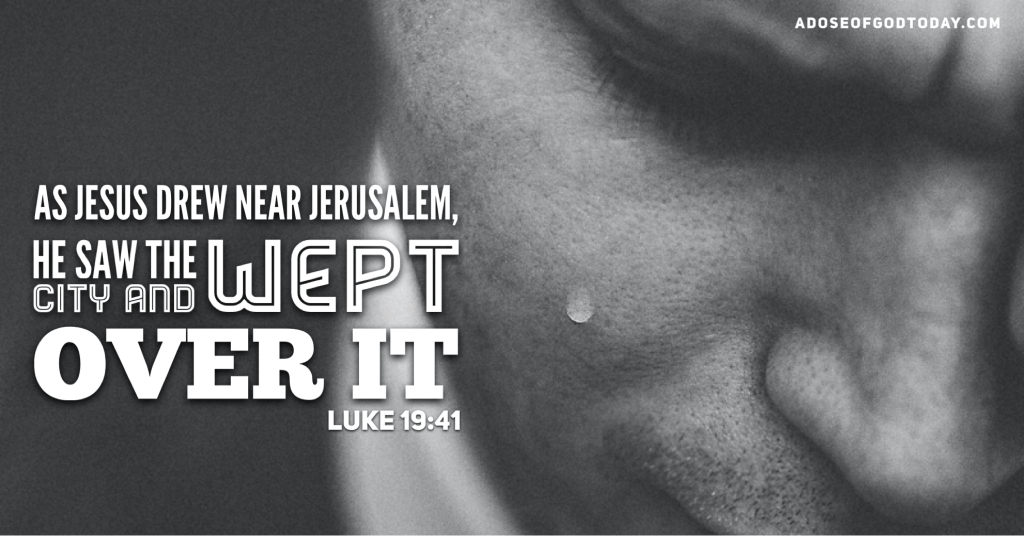
    There were only two occasions when Jesus was described in the scriptures to have wept. The first was at the death of his close friend, Lazarus. At that time, he was moved to tears because he saw the grieving family of Lazarus. The people even said that the tears of Jesus was an expression of his love to a friend. Another account is this Gospel we have heard today. Jesus wept over Jerusalem, because of its coming death and destruction in the future which really did happen.

    A weeping Jesus presents to us the human face of God. Indeed, God weeps. Jesus feels. He gets disappointed, frustrated, angry and also able to feel joy and happiness. This scenario in Luke’s Gospel affirms these qualities in Jesus.

    But why did Jesus wept over Jerusalem? Jesus realized that Jerusalem, its people, the authorities and others had not come to believe and recognize him as the Messiah. In fact, Jerusalem refused to believe in him despite his miracles and preaching of the Kingdom of God.

    This reality brought Jesus in a very emotional state. He wept. He was crying because he loved the people. Jerusalem did not accept him and did not recognize that in him, God has visited them. Because of such action, Jerusalem will suffer a consequence. She will be destroyed. The city and the temple shall be shattered to the ground. In the year 70 AD, Jerusalem was surrounded and invaded by the Roman Army. Everything was destroyed. That was the consequence of rejecting the Lord, his love and faithfulness to his people.

    What does it say to us now? The Lord always desires that each of us and as a community be united in him. To be united in God means to recognize God’s presence manifested in us. We are called and invited by the Lord to accept him as our savior, our Messiah. We are only able to recognize and accept the Lord as God and savior when we are also conscious and aware of God’s visitation in us. God visits us in our lives in many ways. Both in joyful and sad events in our life can be occasions where the Lord visits us. It is a challenge for us then to make ourselves be accustomed to the workings of God in our life.

    Likewise, what was really the difficulty of Jerusalem in recognizing Jesus as the Messiah? Jerusalem as the city-center was portrayed to be powerful. It is independent and dominant. These qualities made Jerusalem, the authorities and its people to be self-absorbed, arrogant and selfish. Jerusalem did not need God that’s why she refused and rejected Jesus. The ones who recognized Jesus as the Lord and Messiah were those at the margins, the sick, the blind, the lame, those who were oppressed and deprived, the poor and the abandoned. These were the powerless and vulnerable people who were able to recognize God’s visitation.

    I am indeed reminded how Jesus showed his own vulnerability by weeping, a human condition that expresses the emotions of love and compassion. Jesus indeed will be deeply saddened when we refuse to accept him and not to recognize his presence in our life. Thus, to be arrogant, to think that we can do things on our own, to refuse help from someone and to be in control of everything in our life are forms of blatant denial of God’s visit and presence. This  brings us to self-centeredness, self-absorption and to our own destruction as a person.

    It is the call then to each of us and as a community to be vulnerable and powerless. Not to be afraid of our own insecurities, weaknesses and pains but to embrace them so that Jesus will be able to accompany and heal us, that he may become our healer, comforter and savior. That he becomes the center of our lives, and his love and mercy on us become the power of our hearts.

    The celebration of the Eucharist is a concrete expression of our personal and communal confession that Jesus is Lord and our savior. Together we give thanks to the Father, we break and share the bread in remembrance of him who offered his life for us and who has come to visit us again so that we may be fully alive. Hinaut pa.

  • Why do we worship? Who should we worship?

    Why do we worship? Who should we worship?

    November 18, 2020 – Wednesday of the 33rd Week in Ordinary Time

    Click here for the readings (https://bible.usccb.org/bible/readings/111820.cfm)

    Homily

    We can be in the Church the whole day but not worshipping. We can be kneeling during the whole hour but not worshipping. We can be singing in the Church but not really worshipping. We can be in a particular ministry but not worshipping God at all.

    Why do we really worship God? To worship God is to express our belief and to live what we believed. Worshipping the Lord our God is a celebration of God’s gift of Himself to us. Jesus as the very image of the Father, is God’s ultimate gift of presence to us.

    Moreover, to worship the Lord is not just limited in our worship services in the Church. Worship is basically a way of life. The way we live our life according to God’s desire is an essential part of our personal and community worship.

    The Book of Revelation tells us of the right attitude of worship. The twenty-four elders, who can be the representation of the twelve sons of Israel and the twelve apostles, are worshipping the one who sits on the throne, the Lord our God.

    John also described to us how they worshipped the Lord our God. The elders who were honored greatly in heaven, have thrown down their crowns before the throne to exclaim the glory, the honor and the power of God. This means that these elders did not cling to their own crowns but letting them go to worship the giver of their crowns.

    Thus, when we learn to let go of our own glory, of our achievements and successes, then we also learn to truly worship the Lord our God who is the source of everything that is good. To worship God, then, is actually to celebrate also our life, to celebrate our giftedness, to celebrate who God is and what God has done to us.

    Besides, worship allows us to focus on the Lord. That is why, even when we are in pain and confused, in worship, we re-channel our gaze from bitterness to God who strengthens us. In worshipping God, we regain our balance by reminding ourselves that we are unworthy of God’s grace yet, we are blessed because we are loved.

    This is what we also find in today’s Gospel, in the Parable of the Ten Gold Coins. Those who truly worship the Lord are those who are productive and fruitful in their lives. The servants who used well the gifts given to them have lived and celebrated wonderfully the King’s gifts.

    However, the unproductive servant lived in fear. He decided to hide the gifts given to him because he was afraid. He was afraid actually of losing them, because he could not let go of those, so he kept them. As a result, this servant turned to worship his fears because he lived in fear. This was how he lost the opportunity to celebrate life, to celebrate his gifts and to celebrate with the King.

    Each of us today, we are called to truly worship God by living not in fear or in bitterness or in our arrogance or in our personal glory but by living and celebrating our life with God.

    Thus, as we come to church and proceed with our daily affairs, let us also remind ourselves that we worship the Lord our God and not some other “gods,” that we worship the Lord by living honestly and generously, that we worship God by celebrating life and we worship God by making God’s presence more alive in us.

    Let us be inspired today through Mary, Our Mother of Perpetual Help, so that like her, our decisions in life including our words and actions may become our very worship to God. Hinaut pa.

  • Be Careful of an Indifferent and Lukewarm Heart

    Be Careful of an Indifferent and Lukewarm Heart

    November 17, 2020 – Tuesday of the 33rd Week in Ordinary Time

    Click here for the readings (https://bible.usccb.org/bible/readings/111720.cfm)

    Homily

    The Book of Revelation warned the Church of Laodicea of its “LUKEWARMNESS.” Laodicea, because it was a center for commerce and finance, and of medical discoveries at the time, became affluent. The Christians living in that City have been influenced greatly by the prevailing culture of the City. The prosperity that they experienced made them to “somehow feel independent from God.” In fact, there must be a feeling that because of their success they did not need God anymore.

    This was how their hearts became lukewarm, passive and indifferent to God’s call of conversion. Relationship with God is a constant calling to grow, and that is to change and be transformed always. Yet, the people did not want to be challenged anymore. The people seemed to become comfortable with their way of life. Hence, the people’s hearts became “rich and affluent that they have no need of anything.” The lukewarm heart of the people led them to reject and ignore God. Their success and wealth became their “new gods.”

    Consequently, the vision of John tells us that when our heart also turns lukewarm and indifferent, God shall spit us from His mouth. However, God does not want this to happen to us. The vision of John tells us that “those loved by God shall be reproved and chastised. We are called to be earnest and to repent.”

    Moreover, the Gospel of Luke tells us about the best example of this, of a person who did not allow himself to stay indifferent and remain lukewarm. This person took the risk to leave behind what was comfortable for him including his bitter past in order to live his life with meaning and with real purpose.

    This man was Zacchaeus, a chief tax collector and a wealthy man. Being wealthy, Zacchaeus could have remained in his seat and not bother anymore to see and meet Jesus. However, he made concrete steps to meet the Lord. He committed himself to change and to repent.

    As a Jew working with the Romans, Zacchaeus must have been despised by his fellow Jews because he represented their oppressors. Being a short man, he must have experienced bullying from his friends. His limitations must have been a subject of discrimination. Yet, he found ways to be on the side of the Romans, and became a trusted man to be promoted as a chief tax collector. Though he was despised by his fellow Jews, being a chief tax collector was his best way in taking revenge to those who maltreated him before. He had power at this time to oppress those who oppressed him. He had the chance now to bully them by making them pay high taxes.

    Yet, deep within, Zacchaeus was restless. He was in search of something that will truly satisfy his longing for acceptance and for unconditional love. His wealth and influence could not satisfy that. Only God and he knew that. That is why, when Jesus was passing by, he did everything to meet the Lord and let Jesus find him. Though he was short, but he did not give up easily. Though it was crowded and people prevented him, yet, he moved to change his perspective. Until he found a tree to climb. That was how the Lord found him and thus, Zacchaeus also found acceptance and unconditional love from God.

    The story of Zacchaeus invites us today not to remain lukewarm in our relationships or indifferent towards others, towards ourselves and towards God. There is no growth in being lukewarm and indifferent.

    As we face life today, do not allow our comforts to control us to become stagnant. Never allow our limitations and painful experiences to drown our hearts into anger and bitterness. Allow rather the Lord to challenge us today, to call us and to move us and to always choose Jesus in all our decisions and actions in life. Hinaut pa.