Category: Weekday Homilies

  • PRAY. FAST. GIVE.      

    PRAY. FAST. GIVE.      

    February 14, 2024 – Ash Wednesday

    Click here for the readings (https://bible.usccb.org/bible/readings/021424.cfm)

    The Church begins today the first day of the Season of Lent. Changes in our liturgical celebrations are also applied. We now use the color purple that symbolizes sorrow for our sins and repentance. Our music becomes mellow and subdued. We don’t sing now the Gloria or the Alleluia as Gospel Acclamation. Even colorful flowers are removed from the sanctuary.

    These changes in our liturgy direct all of us to look deeper into our lives, the kind of heart we have so that we may discover our own sinfulness and begin to repent. Hence, on this Ash Wednesday, the ashes that will be imparted on our forehead reminds of these two important messages. First, “to repent and believe in the Gospel.” The Lord in his mercy and compassion calls us now to come to him. God invites us not to be afraid anymore because the Lord desires to embrace us and heal us.

    Second, “we are from dust and to dust we shall return.” As the Lord God made out of clay and formed the man, he also breathe the spirit into his nostrils. The was how life was given. This reminds us of the frailty of human life and the certainty of our death, yet of the beauty as well because we are one with the earth and God is our creator.

    These reminders bring us now to enter fully into the Season of Lent. And welcoming this season calls us also to observe this 40-day journey faithfully and with open heart. The Church invites us now, as the Gospel of Matthew told us of the three ancient spiritual practices to guide us towards a renewed self and a transformed heart.

    The first of this, is PRAYER. Lent calls us to pray more and to pray better. To give more importance to prayer and to pray daily. Now, to pray is not limited with our memorized prayers or those that we have become so familiar with like the recitation of the Rosary or our Novenas. To pray, rather, is to be more aware of God’s presence among us. To pray is to be constantly conscious of God’s spirit working in our lives. That is why, it is an invitation for us to find ourselves praying even while at work, while traveling, while eating, while encountering and meeting people.

    Second, FASTING AND ABSTINENCE. To deprive ourselves from eating a full meal is an ancient spiritual practices that is also common in other religions. Fasting allows us to not just make us aware of our physical hunger but also our other different forms of hungers. Our hunger for love, for concern, for justice, for peace and to work for it. This makes us to have a focus on what lies within our heart. Abstinence, is to refrain ourselves from enjoying those things that we like and we love. By law, the Church only requires 18 years old up to 60 years old to fast on this Ash Wednesday and on Good Friday except for the sick. And starting at 14 years old and above, we are required by law to abstain from eating meat on this day and in all Fridays of lent and on Good Friday. This leads us to make ourselves free from anything that may prevent us being close to God and others.

    Third is to GIVE ALMS. To be charitable or to express our generosity is an important component of this Season. Our good works or our kindness is not limited to few coins that we give to the poor, but by making actions life-giving for others. Through our generosity others may find hope and blessing.

    As we begin the Season of Lent, may this 40-day spiritual journey may truly become a time of grace, of renewal and transformation of our hearts. Hinaut pa.

  • Bringing Nothing but Blessing

    Bringing Nothing but Blessing

    Click here for the readings (https://bible.usccb.org/bible/readings/020124.cfm)

    Ten years ago I was sent abroad for a mission exposure, I was told that I got 30 kilos of baggage allowance for my flight. Few nights before my flight, I had my own inventory on what I should bring for the one year mission experience in Indonesia. I kept looking at my things worried that I might forget something important and something that “I might need.”

    Aside from clothes, I prepared small things, vitamins and preventive medicines against malaria, books, camping and survival kit, treats and sweets for my sweet tooth and many other small things. Unsurprisingly, my luggage was overweight and I had to pay a few thousand pesos for that.

    Indeed, the worries and anxiety that I might need this and that made my luggage heavy and overweight. I was also overburdened as I carried my luggage. After all, when I was in the mission area, there were many things that I brought but I was not able to use them. I realized I had more than enough.

    Such a situation may also be true in other aspects of our life. One may be overburdened in his or her relationship because of the emotional baggage the person brings. An emotional baggage such as trauma from the past, guilt, shame, fear, anger, hatred or other insecurities could make our life more difficult and at times overwhelming and suffocating.

    This is how I find today’s Gospel passage to be so meaningful and significant. Jesus sent out the Twelve, two by two. They were given power to cast out unclean spirits and heal the sick. However, in their journey, Jesus told them “to bring nothing except a walking stick.” They were “allowed to wear sandals but not a second tunic.”

    This journey sounds a bit harsh and difficult. A disciple could feel so vulnerable and insecure for not having other things in the journey. Yet, Jesus “gave them authority.” That authority is power. And that power is to bring blessing.

    Despite the poverty they had, the small things they possessed, the very presence of God among them and the power given to them suffice what they need. Moreover, such attitude to bring nothing but a walking stick was a invitation. There are two invitations here.

    1. First, to trust the generosity of God. The Lord shall provide the needs of His friends. The ever abiding presence of God is with them and to fully trust in God’s Providence is truly an act of faith. This is the realization of David at the end of his life. He learned to let go and entrust everything to God who is good and merciful. He is going the way of all flesh, as he said. God
    2. Second, to trust the generosity of the people. The reason why they were to bring nothing was to allow themselves become companions and friends of the people whom they were to encounter. They may have the power given by God to them, yet, they were not above the people or apart from the people. They were equal in status as companions and friends. They were to live among the people and be immersed in the life of the people. This is where the generosity of the people is welcomed and received with gratitude.

    Indeed, may we also learn and trust more the generosity of God and the generosity of people around us. That generosity may not be always material but also as an expression of support and understanding, warmth and affection, friendship and intimacy, care and compassion, mercy and forgiveness.

    Hence, as we move forward in whatever phase, track, or path we are in this journey of life, may we bring blessing to others. Hinaut pa.

  • Trusting God’s Strength vs Trusting a Man’s Strength

    Trusting God’s Strength vs Trusting a Man’s Strength

    Click here for the readings (https://bible.usccb.org/bible/readings/013124.cfm)

    To rely solely in our human strength, knowledge and wisdom can be so tempting especially when we want immediate results of what we desire. Becoming too proud of what we have achieved, gained and accumulated could make our heart arrogant making us adamant towards the grace and presence of God. This is the concern when we have less trust in God’s strength and put more trust and confidence to our human strength. This is the case in today’s readings.

    David was doubtful of God’s promise to aid him in a hundredfold of people. This was the reason why he ordered the census in order to be certain of his military power. However, doing so means not trusting the strength of God given to the people of Israel. Hence, David’s decision was an insult and a sin against God.

    Such action of David resulted to punishment of which he chose the third, and that was the pestilence over the city. This cost the lives of 70,000 people who died in the plague. However, David chose this because he realized the mercy of God. Though, his actions and wrong intentions directed only for his power and authority, but cost the lives of many. It was the people who suffered because of the failure of a leader.

    This doubt of David in God’s strength somehow reiterated among the neighbors of Jesus. The Lord who went home, preached and taught in his native place was received with offence and indifference.

    His own people, those whom he probability played with, worked with and his relatives doubted his capacity. They doubted his wisdom. They doubted his authority. They doubted his power. They took offense at him, as the Gospel said, because his own people, they who were very familiar with Jesus, only saw him as a son’s carpenter. He was too ordinary for them. Indeed, familiarity breeds contempt.

    As a consequence, the people did not believe despite what they have heard and seen. This was also the reason why Jesus can only cure few sick people by laying his hands on them, because of the lack of faith of many. That lack of faith prevented them to recognize God’s strength in Jesus. It prevented them too to acknowledge God’s wisdom and grace in Jesus.

    This is the invitation for us today and that is to grow more in our faith and trust in God’s strength to work in us. Though God gifted us with human wisdom, knowledge and strength may we not become too proud of what we have achieved. Rather, may we become more open and receptive of God’s power and strength even when that grace appears to be so ordinary and simple in our eyes and understanding. Hinaut pa.

  • A Touch may kill, A Touch may heal

    A Touch may kill, A Touch may heal

    Click here foe the readings (https://bible.usccb.org/bible/readings/013024.cfm)

    Human touch depending on our intention may bring death or may bring life. When our human touch is filled with malice, hatred and violence, then, it will surely bring destruction and pain to others around us. However, when touch is filled with grace, with love, affection, concern, and compassion, then, our touch may bring healing, peace, freedom and life.

    This is the case that we have heard in today’s readings. In the Second Book of Samuel, we were told of the tragic event of the death of Absalom, the son of David. Absalom led a rebellion against his father, King David. He wanted the throne for himself. Yet, his rebellion did not come out of the blue. There was already a steaming tension of hatred and violence within the house of David. His first-born son, Amnon, raped his half-sister, Tamar. Indeed, the touch of Amnon towards the beautiful Tamar, was filled with malice and lust.

    Though, the full brother of Tamar, Absalom did not also speak out, but kept quiet, leaving Tamar to suffer in silence. Yet, this became a venue for Absalom to foster hatred towards his half-brother Amnon, and also towards his father King David who turned a blind eye on this. This was the beginning of more violent actions within the house of David.

    Later, Absalom plotted to kill his half-brother and rebelled against his father. Even though, Absalom was able to get some army and territories of his father, yet, at the end, he was killed as told to us in today’s reading. With his death, David mourned over the loss of his son. Nevertheless, David’s grasped and insecurity over his throne and power led to the death of his sons and destruction of his own family.

    However, in the Gospel of Mark, we have heard different forms of touch. This time, the touch brings healing, freedom and life. There were two forms that I would like to emphasize.

    First, humanity’s touch to the Divine. This was the experience of the woman afflicted with hemorrhages for twelve years. In hope and faith she  reached out in order to touch even the cloak of Jesus. And indeed, her touch of the Divine brought her healing. Jesus affirmed her “courageous and daring faith.” She did not give in to desperation and hopelessness but to faith. This made her to touch the Divine and became a recipient of grace.

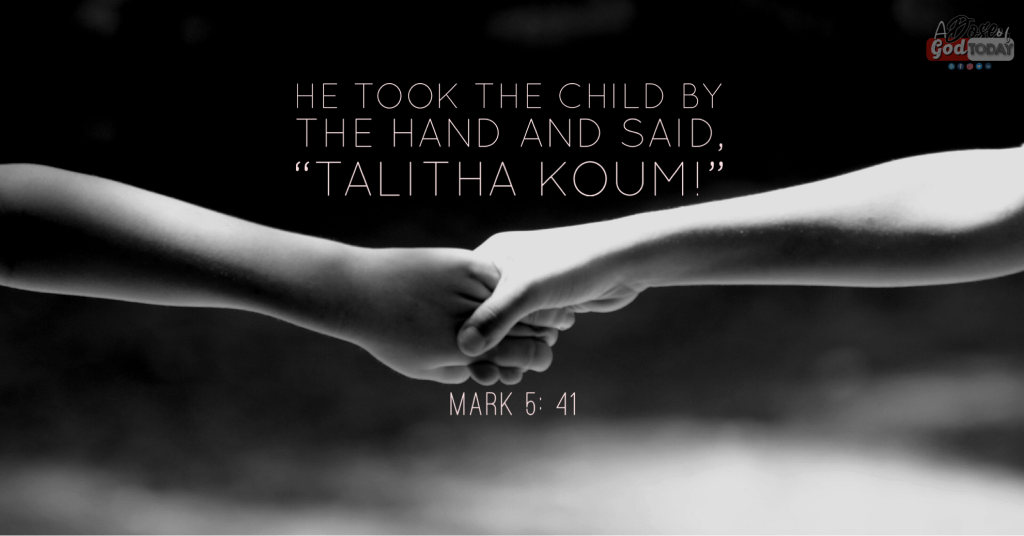
    Second, God’s touch to humanity. This was witnessed by Jairus, his wife as well as Peter, James and John. Jesus “took the child by the hand” and said to her, “Talitha koum!” At that, life was given back to the dead girl. The touch of Jesus was more powerful than death and grief transforming them into life and joy.

    This reveals to us now how our touch can actually become a channel of grace and blessing. We too are reminded that the Lord would always allow us to touch him. Let us not be ashamed or fearful in reaching out to God. The way we touch sacred and holy objects in our church is even our way of expressing it already. The sacraments we have in the church are God’s way of making us aware that we are welcome to touch the Divine and be touched by His grace.

    Let us also see and evaluate the way we touch others if this is filled with malice, insecurity, selfishness or hatred. Such intentions will only bring violence and death. Rather, let our touch be more of faith, love, concern, mercy and compassion so that we too may become channels of grace, blessing, healing and life. Hinaut pa.

  • MOTHER’S YES

    MOTHER’S YES

    December 20, 2023 – Wednesday of the 3rd Week of Advent

    Click here for the readings (https://bible.usccb.org/bible/readings/122023.cfm)

    Whenever we reflect on our childhood memories, our dear mother is always there present. Be she young or old, dark or fair, how else would we be here now, if our mother did not make our well-being her life and vocation. The relationship we share with our mother is special and sacred, and is based on a bond of mutual love. It was our mother, who is the first person loved us, took care of us, committed herself for us, assured us that she will always be there whatever happens, and would willing die for us so that we may live. It is our Mother, who first said, “Yes” for you. She is “the Mother of all “Yes”es in favor of you, who first opted and chosen YOU. Through our mother we also heard first God’s Promise, “I will be there for you always”.

    No wonder then that Mary is at the center of today’s gospel, which gives us a simple but moving account of the greatest message ever delivered to us – “the Lord is with us”. In it we are told simply and plainly that there was a young maiden, who knelt down at the angel Gabriel’s mysterious message and, in freedom of her heart, gave the total gift of herself to God, saying: “Yes, let it Be done unto me according to thy Word.”

    The Annunciation was the moment when God first revealed a mystery that he kept secret for endless ages. It is true that his love for us is so great that he wants to become one of us. And in doing so, Mary was needed by God. Mary was asked to co-operate with God, and be the mother of Christ. And the moment she said, “Yes” to the angel, salvation dawned on us all. However, Mary did not say “Yes” to God on only one occasion. She had to confirm that “Yes” many times during her life. The moment she said, “yes” to God’s invitation life was never the same again for her. She became a refugee in Egypt and some thirty years later, a witness her son die the death of a common criminal. And through all these events in her life, she did not abandoned her son, stood by Him, always present and supporting Him whatever it takes.

    Christmas is almost upon us and, our thoughts turn to our mothers who said “yes” for us so that we may live, and to our mother Mary who listened and responded in cooperation with God’s will. Mary’s life shows us that to be a Christian is to be a person who keeps our ears open to what God is calling us to do today, so that we can answer Yes to His call and to cooperate with His will.

    Perhaps we ask ourselves: To what extent are we available to God? Do we see what he wants us to do in and through us? If God asks you for favor now, how would you respond?

    Today we are shown the marvelous example of Mary. Even if she did not see clearly all it implied, she accepted her mission to become the mother of the Savior. Mary’s yes offers us salvation. Our own mother’s yes brings us life. May our Yes, our own response and cooperation with God brings life and salvation to others. We pray then that like Mary, we may have her listening and responding heart to God’s call so that we can be as ready and as willing to cooperate in bringing Christ into others. So May it be done to us according to God’s word. Amen