Category: Weekday Homilies

  • To be Touched by the Grace of the Holy Spirit

    To be Touched by the Grace of the Holy Spirit

    October 19, 2024 – Saturday of the 28th Week in Ordinary Time

    Click here for the readings (https://bible.usccb.org/bible/readings/101924.cfm)

    Do we find it difficult not to move forward from our past? Does our past experiences affect greatly how live today? Indeed, some might find themselves trapped in this kind of situation when one cannot let go of our past.

    Our thoughts and actions and even our perspectives in life may have been tightly tied up by our painful memories or by our glorious past. When this becomes our way of life, we also become detached from the realities of the present.

    Our perception of the reality in the present may become distorted because what we see and recognize were always in the past. Our relationships could suffer greatly because we will fail to appreciate and affirm what we have at present. We would always compare what was before or we could also be suspicious with an air of mistrust to others because of something ugly that happened in the past. It will be a challenge also to correct our misconceptions and wrong practices because we are so disconnected with reality. We refuse to listen, to believe to what others see and thus, refuse to change.

    This is the image of finding ourselves in the difficult situation of moving forward, finding healing, peace and freedom. When we are trapped in the cycle of the past we might believe that we are beyond hope. This is precisely how a psychological trauma can also affect a person.

    Now, the invitation for change and transformation, for healing and forgiveness can be quite challenging because such actions can also be interpreted as threats to what we have been used to. This was how Jesus’ call for conversion was actually treated by those in power and the influential. The Pharisees and the scholars of the law were threatened by the call of Jesus and so they too denied him and did not recognize the presence of God in Jesus. In fact, they too became hostile towards his presence.

    Yet for Jesus, this  kind of reaction can still be forgiven. But, when one blasphemes against the Holy Spirit, then, this is beyond forgiveness.

    What does it really mean? Blasphemy against the Holy Spirit is a conscious denial or rejection of the presence of God. This is a willful act of rejecting God. This is not even about the belief in the non-existence of God. In fact, the person believes in the presence of God but deliberately denies God’s presence and also of God’s grace.

    The person chooses to be separated and alienated from the grace of God, thus, becoming indifferent towards God. This surely is blasphemy because such decision and action worship not God but something or someone else. It cannot be forgiven because the person does not ask or welcome the grace of forgiveness. Total indifference, indeed! However, being separated from the grace of God will only bring us into oblivion and endless misery, to meaninglessness and hopelessness.

    However, the Lord does not want this for us. God’s desire for us is to live life in its fullness. This will only be possible when we too our open and welcome the Divine Presence to work in and through us, to challenge and change us.

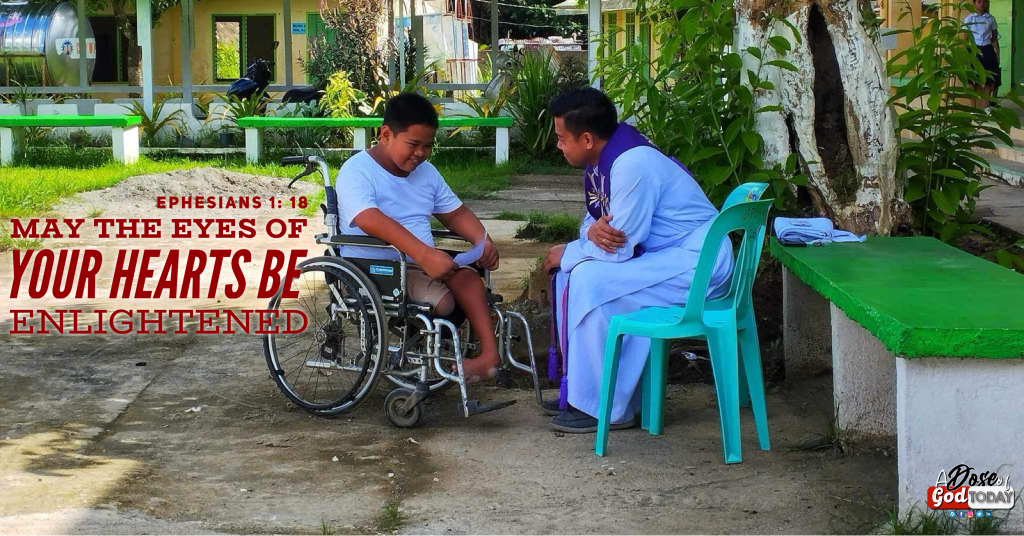
    This is what Paul means in his letter to the Ephesians, as he said, “ I pray that the God of our Lord Jesus Christ, the Father of glory, may give you a spirit of wisdom and revelation as you come to know him, so that with the eyes of your heart enlightened, you may know what is the hope to which he has called you…”

    The call and invitation for us today is to allow the Lord to reach out to us and so allow our hearts to be touched by the grace of the Holy Spirit. May our hardened and callused hearts caused by pains and hurts, anger and hatred, be renewed by the power of the Spirit that we may be able to bring transformation and healing, forgiveness, freedom and peace. Hinaut pa.

  • Healing, Friendship & Blessing

    Healing, Friendship & Blessing

    October 18, 2024 – Friday; Feast of St. Luke, the Evangelist

    Click here for the readings (https://bible.usccb.org/bible/readings/101824.cfm)

    For the past days, our sub-mission team in Barangay Opong, in the Municipality of Catubig, Northern Samar (Diocese of Catarman), has been visiting houses and conducting house blessings. Since Monday, the Sacraments of Anointing of the Sick to several old and sick persons, Reconciliation/Confession to countless residents, Baptism to 4 children, Confirmation to 2 couples and their Marriage and the First Communion of elementary pupils and several high school students were celebrated this week. The participation in the Holy Eucharist celebrated daily since Sunday increased day by day as well.

    Despite the short days spent in this Christian Community, the many encounters I had with the people, allowed me as well to develop rapport and some kind of friendship among them and not just with the team. This is the wonder and the beauty as we bring and share the Gospel and encounter Christ who is already there in the hearts of the people. As one of the Mission Volunteers, Rizza Mae Malalay, has shared, we are “meeting God in between.”

    This very encounter, indeed, allowed me to meet God in the “in between” where the Lord brings healing, friendship and blessings. I am certain that this is also the very ground experience of St. Luke, an evangelist, whose feast the whole Church celebrates today.

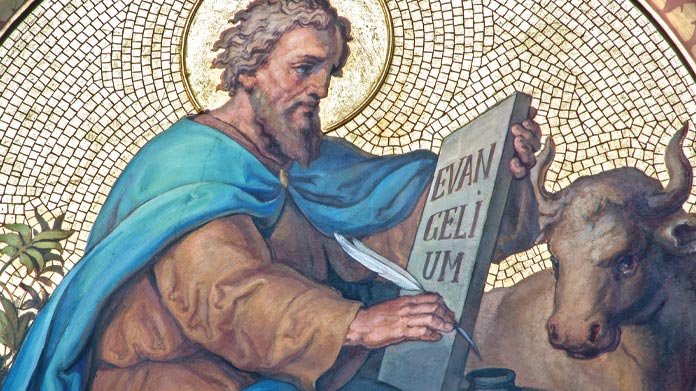
    St. Luke who is known as Patron of Physicians and Surgeons, was himself a healer, a doctor. Though it was believed that Luke was actually a slave, but it was common at that time in the antiquity that even slaves were educated in the service of their masters. Hence, Luke as a healer met God in his ministry of healing. This must be the very reason why Luke recorded many healing stories in his Gospel. Luke realized that healing not just in our physical bodies but also our spiritual and emotional healing bring us to the fullness of life. Salvation and the promise of freedom is certainly integral and whole.

    St. Paul in his Second Letter to Timothy expressed the many difficulties and struggles he went through. Many had left him and persecuted him because of the Gospel, yet, only one remained to support and help him. It was Luke who became a faithful friend and companion of Paul. Through Paul, Luke also met Christ. Even though Luke was a Gentile, a Greek from Antioch, Syria, yet despite the cultural and religious differences between them, Christ became the bond of that friendship.  Indeed, this very friendship formed between these two great men made them more convinced of their friendship and closeness with Jesus, whose Gospel they preached with joy.

    St. Luke was also well-educated in classical Greek. He himself was a writer, no wonder, why the Gospel was written and the Acts of the Apostles. Thanks to him we have another angle of the life and ministry of Jesus. This was how Luke brought blessings to many until today. In fact, the very Gospel on his feast tells us of the 72 disciples sent by Jesus two by two in order to bring peace and blessing. The visitations of the disciples were to prepare the people of the coming of Jesus. This is meeting God.

    Celebrating now the feast of St. Luke also calls us to these three points. First, we too are called to bring healing. Let our words, our actions and presence become channels of healing especially to a friend, family member, co-worker or anybody who need healing. May we not be a source of pain and hurts in homes and communities and so we ask the Lord himself also to heal any wounds in us so that we can bring that grace to others.

    Second, we are called to develop and nurture friendship. Our presence may also become a source of comfort and assurance to those who feel alone and lonely. Let us also develop our friendship with Jesus through the sacraments and Holy Scriptures. May we not be a source of division and tension then.

    Third, we are called to bring blessing. Let our presence also be a blessing and not curse. May our encounter and visits to people then, will also become God’s visitation to others. We do this as we also allow the Lord to work wonders through us.

    Indeed, may we be channels of healing, friendship and blessing. Hinaut pa.

  • How do I respond when confronted?

    How do I respond when confronted?

    October 17, 2024 – Thursday 28th Week in Ordinary Time

    Click here for the readings (https://bible.usccb.org/bible/readings/101724.cfm)

    When another person confronts me because of my mistakes and failures, how do I respond? When a friend or a colleague tells me of my weaknesses, how do I feel? When we are confronted of our wrongdoings and sins, how do we react?

    Being confronted, corrected or even reminded of our failures and weaknesses may not be easy to accept and embrace. It is even more difficult when the one who does it is someone who is not superior to us. When we too feel that we are superior and above others in many ways because of our achievements, entitlement or position in the company or community, the more it becomes difficult to accept such criticisms.

    Moreso, when our heart becomes arrogant, believing that we are far better than others and that our ideas, decisions and actions are superior, then criticism are almost unwelcomed. Our mind and heart will be rigid and unwelcoming and at the same time will also become vicious and violent towards those whom we believe are threats to our image and person.

    We experience this even at home from own parent or sibling. The family will then feel tensed and any other voice is suppressed because of one family member who believed that he or she has the monopoly of making decisions and making actions. This also is a reality even at our workplaces, organizations or communities – civic or religious. A colleague, or co-worker, or co-member or confrere, who think highly of himself/herself finds it difficult to accept feedback. It becomes a tension as well in our relationships. This is how manipulations, violent words and actions and malice towards those who would dare to confront them will be experienced.

    This is not far from what Jesus did and experience among the leaders of that time. Some of the Pharisees and scholars of the law who grew entitled and influential at that time thought and believed of their superiority and righteousness. Because of their meticulous observance of the law and superior knowledge, they thought that they were perfect enough.

    Nevertheless, their hearts where filled with malice. Hence, Jesus confronted them how their actions were inconsistent with what they taught and believed. Like their forefathers, these men remained hostile towards the prophets whom God had sent in order to correct and bring them back to God. They murdered all those who confronted them of their sins and failures precisely because they did not want to be corrected.

    Likewise, Jesus did again what the prophets did in the Old Testament, and in the same way, the hearts of these men were filled with malice. The Gospel reminds us that they were hostile against Jesus.

    Indeed, the Lord continues to confront us not in the sense of humiliating and bringing us down, but to correct us and brings us back to the grace of God. Thus, humility and honesty are very important as well in our Christians life. To be humble and honest enough to recognize our failures, mistakes, and sins would even help make ourselves better and our relationships healthier.

    Today, Jesus comes to us to confront us and the Lord does it in many ways. We are, then, called to be welcoming of others who would dare to confront, correct and give constructive feedback and criticism to us. We ask the grace from the Lord that we may be humble and honest enough.

  • SIGNS AND MEANINGS

    SIGNS AND MEANINGS

    October 14, 2024 – Monday 28th Week in Ordinary Time

    Click here for the readings (https://bible.usccb.org/bible/readings/101424.cfm)

    Everywhere we look at, there are many signs around us. Depending on its intended us, a particular sign will tell us what it is about. For example, a red light in an intersection, would tell us that cars should stop and let those other side of the intersection pass through since they have the green light. In a water dispenser, a red colored faucet means hot water while the green or blue means cold water.

    There are also natural signs around us. When we see thick and dark clouds above us, most likely rain will come in few minutes or hours. After an earthquake, when the sea would recede quickly, surely, there will be a tsunami after.

    Aside from these, there are also human emotional signs that we have to be aware of. When a person who withdraws into the recesses of his/her room, feeling sad or anxious and lonely, the person might be already undergoing depression. A person who feels afraid and terrified over particular  another person, event or place, the person might have a traumatic experience associated in those things.

    These are just few examples of different signs around us and of their meanings. And it is also important that we are able to understand them and so respond appropriately to every particular situation.

    In today’s Gospel, we too are reminded of signs. Jesus was asked by the people to give them sign before they believe in him and in what he showed them. The people seemed to believe rather that Jesus was like a magician who would do out of this world signs that would entertain them. Their demand to give them a sign was rather, a sign as well, that they have not able to understand the greatest sign already given to them.

    Jesus was the greatest sign ever revealed by the Father. Yet, their unbelieving and malicious hearts made them close-minded. Even when the sign was in front of them, they refused to see and recognized God’s greatest sign of love and salvation.

    St. Paul in his Letter to the Galatians reminds us that such attitude and way of life is a sign that these people still like with the yoke of slavery. It was slavery of hatred and indifference, the slavery of malice and selfishness. Hence, they were not free.

    However, Jesus desires that we indeed become free. Again St. Paul told us, “for freedom Christ set us free.” The very presence of Jesus in us brings us to freedom!

    Thus, as we come to understand the many signs around us, may we also become more attuned and familiar to the signs the Lord gives us. These signs from the Lord, and his presence revealed to us may not be extra-ordinary or spectacular, but simple and ordinary. Let us be discerning and patient then and make ourselves free from anything that would prevent us from recognizing and embracing God’s many manifestations in our life and relationships. Hinaut pa.

  • Ash Wednesday Reflection MERCY.

    Ash Wednesday Reflection MERCY.

    February 14, 2024 – Ash Wednesday

    Click here for the readings (https://bible.usccb.org/bible/readings/021424.cfm)

    Lent is all about God’s Mercy. As we begin the season of Lent today, better for us to have a good understanding of God’s mercy & forgiveness being continuously offered us.

    Often, we think of Lent with dread because we often associate it with giving up something. “I have to give something up” we habitually reflect during these times. But giving up something during Lent is more than just about self-denial, self-discipline, and imposition of burden.

    Giving up something, (that is, by praying, fasting, doing works of mercy) is an invitation towards God’s mercy. It is about entering & experiencing God’s mercy & forgiveness once again & anew
    on a much deeper & intimate level.


    We observe Lenten discipline of prayer, fasting & works of mercy by giving up something so that we may be predisposed to experience once anew God’s love and mercy into our lives.

    Lent, we remember is all about receiving, benefitting from & sharing with others God’s mercy rather than just giving up something through self-denial, self-discipline, or imposing burden to oneself & others.

    In other words, Lent is our chance & our way to be silently, secretly, personally & closely intimate with our loving & merciful God once again & anew for we do believe that “our Father who sees in secret will repay us” with His love & mercy.

    As we receive the ashes today, we are challenged to “Repent & Believe the Gospel”. This is a constant invitation for us to renew
    our faith-relationship with God, by changing & updating our normal ways, and be open once again to receive God’s ways & will for us now so that we may experience God’s mercy & forgiveness anew.

    Lenten season then is all about experiencing God’s mercy anew along with our Lenten discipline & renewal of faith. Rather than our giving-up of something ourselves, Lent is all about our giving-in to His graces & blessings.

    “Lord, Have Mercy”. Perhaps this should be our prayer these times as we do need now His mercy especially during these times of imminent-threat of war & division, natural & human disasters, poverty, sickness & others.

    Let this be our prayer during this Lenten season:

    Ginoo, Maluoy ka sa Amon.

    Ginoo, Kaloy-I kami.

    Panginoon, Maawa ka sa Amin.

    Chunim, chabirol bepososo.

    Kyrie, Eleison.
    Lord, Have Mercy on us.