Category: Sunday Homlies

  • Our possessions can possess us

    Our possessions can possess us

    August 4, 2019 – 18th Sunday in Ordinary Time

    From the Book of Ecclesiastes (1:2; 2:21-23)

    Vanity of vanities, says Qoheleth,
    vanity of vanities!  All things are vanity!

    Here is one who has labored with wisdom and knowledge and skill,
    and yet to another who has not labored over it,
    he must leave property. 
    This also is vanity and a great misfortune. 
    For what profit comes to man from all the toil and anxiety of heart
    with which he has labored under the sun? 
    All his days sorrow and grief are his occupation;
    even at night his mind is not at rest. 
    This also is vanity.

    From the Letter of Paul to the Colossians (3:1-5,9-11)

    Brothers and sisters:
    If you were raised with Christ, seek what is above,
    where Christ is seated at the right hand of God.
    Think of what is above, not of what is on earth. 
    For you have died,
    and your life is hidden with Christ in God. 
    When Christ your life appears,
    then you too will appear with him in glory.

    Put to death, then, the parts of you that are earthly:
    immorality, impurity, passion, evil desire,
    and the greed that is idolatry. 
    Stop lying to one another,
    since you have taken off the old self with its practices
    and have put on the new self,
    which is being renewed, for knowledge,
    in the image of its creator. 
    Here there is not Greek and Jew,
    circumcision and uncircumcision,
    barbarian, Scythian, slave, free;
    but Christ is all and in all.

     From the Gospel of Luke (12:13-21)

    Someone in the crowd said to Jesus,
    “Teacher, tell my brother to share the inheritance with me.” 
    He replied to him,
    “Friend, who appointed me as your judge and arbitrator?” 
    Then he said to the crowd,
    “Take care to guard against all greed,
    for though one may be rich,
    one’s life does not consist of possessions.”

    Then he told them a parable. 
    “There was a rich man whose land produced a bountiful harvest. 
    He asked himself, ‘What shall I do,
    for I do not have space to store my harvest?’
    And he said, ‘This is what I shall do:
    I shall tear down my barns and build larger ones. 
    There I shall store all my grain and other goods
    and I shall say to myself, “Now as for you,
    you have so many good things stored up for many years,
    rest, eat, drink, be merry!”’
    But God said to him,
    ‘You fool, this night your life will be demanded of you;
    and the things you have prepared, to whom will they belong?’
    Thus will it be for all who store up treasure for themselves
    but are not rich in what matters to God.”

    HOMILY

    According to the study of OXFAM International, an independent non-governmental organizations, one in three persons lives in poverty[1] and in their 2018 report on the Word’s wealth, Oxfam found that the richest 1% people in the world have 82% of the world’s wealth. Moreover, Oxfam also reported that the 26 wealthiest people in the world possessed 1.4 trillion USD and this is just equivalent to the wealth of the 3.8 billion poorest people in the world.[2]

    The world has so much wealth and resources for all of us but then only few are possessing them. To possess material wealth is not in itself evil. Material wealth is God’s gift to us. However, material wealth becomes a problem if we would allow this to possess us. We might believe that to possess so much wealth will give us security and joy.

    However, this is not the case because the more we possess things, the more we also become insecure and anxious. Just observe ourselves. The more a person possess wealth, the more the person also becomes defensive. High walls are built to protect a rich house, sometimes with electric current running 24/7 on barb wires and with a 24-hour security personnel. And when the person becomes unaware of his/her unquenchable desire to possess more, then the heart turns greedy and insecure, and even corrupt and oppressive.

    Our readings this Sunday have something to tell us. The Lord invites us to examine our attitudes towards our material wealth, the resources that we have gained and received, and the riches that we possessed. Even though we may not be part of that 1% wealthiest people in the world, but then, the possessions that we have may have already possessed us. This may prevent us from being grateful to the source of blessings and generous to those who are in need. Let us explore then our readings and see how God unfolds his invitations for us today.

    The author of the Book of Ecclesiastes tells us that what we possess now and our worldly achievements could not guarantee satisfaction to our desires. Qohelet says, “Vanity of vanities! All things are vanity!” Indeed, everything will be in vain when we become too focused on material possessions and when our heart becomes materialistic. With this attitude, we will lose the essential things in life and that include our relationships.

    This is the reason why Jesus warns us of our tendency to be greedy. Greed comes from a heart that believes in self-containment and self-satisfaction and that desires total independence from God. But then, material things could never quench our greatest desire to be satisfied and fulfilled. Thus, a person will tend to accumulate more and possess more even at the expense of others.

    This is how the cycle of corruption and oppression happen. When our desire becomes unsatisfiable, we become greedy of many things, who will tend to collect as many material things and wealth us much as possible.

    Such attitude will not just appear in our heart out of nowhere. Sometimes, this has something to do from our childhood memories. A child who has been deprived from many things particularly of essential things in the child’s development such us food, shelter, toys and clothing and even affection and love from parents may become a form of emptiness in the heart of a child. When the child becomes adult, that kind of experience could give the person the anxiety to be deprived again. Hence, in order to gratify such anxiety the person could become a hoarder who accumulate things and possessions.

    When this happens too, a hoarder or a greedy person is blinded to see the needs of others. It will be difficult for the person to open up and be generous to those who are in need around him or her because the person feesl insecure every time he or she gives.  The person would only look at his/herself and never to others. This is now an attitude of the heart that is truly being possessed by possessions.

    Thus, Jesus said, “Take care to guard against all greed, for though one may be rich, one’s life does not consist of possessions.” Jesus tells us that our life is more than our possessions. Consequently, St. Paul in the second reading calls us “to put to death parts of us that are earthly.” These are attitudes that are driven by greed.

    Be mindful, then, of our possessive attitudes because these may affect and endanger our relationships with our families, friends and colleagues.

    We may ask, what is it that possessed me? What are those that kept me from being free? We do not have to think of millions of pesos because even a single smartphone may possess us. Remember, when we put so much focus and attention to a material thing, it could make us indifferent, ungenerous and unkind towards others. Our attachment to a single smartphone may indeed, prevent us from giving more time, attention and focus towards our studies (for the students), or may prevent us from giving our affection and presence to our loved ones.

    We believe that what gives us true satisfaction, freedom, joy and contentment is a life with God. Thus, Jesus calls today to have a life with Him and to let go of whatever that possessed us because this is the way of making ourselves free for Jesus. Then, by being free for Jesus, we shall be able to let ourselves be satisfied truly by the Lord himself. And in response, our self-satisfaction from the Lord will lead us to recognize that everything we have is God’s blessing that must be shared to others. Hinaut pa.

    Jom Baring, CSsR


    [1] https://www.oxfam.org/en/about)

    [2] https://time.com/5508393/global-wealth-inequality-widens-oxfam/

  • God relates in Love and Mercy not in Fear and Violence

    God relates in Love and Mercy not in Fear and Violence

    Solemnity of the Most Holy Redeemer (Third Sunday of July)

    July 21, 2019

    How did you experience God in your childhood?

    I am sure that each of us has our own experiences of God. Our God experiences and even image of God during our childhood would somehow paint the picture of God’s image as we grow old. Indeed, our early thoughts about God would somehow color also on how we relate with Him.

    To share with you a story, when I was growing up I was introduced to a God who was rather strict. God was someone that everybody should fear. I was told that this God punishes a naughty boy and rewards a good boy. As a young boy, I tried to be good to avoid God getting angry at me and punish me later on.  Unconsciously, I became fearful to God.

    What motivated me then, to do good was out of fear from being punished rather than out of love.  I imagined God like an old man holding a stick who is ready to strike a boy who has been naughty. This image of God definitely haunted me. This was my very experience also at home from my parents who were ready to strike me with a stick whenever I become naughty and disobedient.

    However, later on when I became conscious of my faith-relationhsip with God that I realized that God’s true character is not the one that I first thought of. Experiences would actually tell me that God is kind and generous, loving and forgiving.

    This is the kind of God that our first reading and Psalm proclaim respectively. Our first reading told us how Yahweh made an everlasting covenant with His chosen people. God makes the initiative to relate to us in love. Our Psalm even reminds us about the faithfulness of God that we should rather not fear God but trust Him because God is our strength.

    This kind of revelation tells us that God “relates” to us in the most personal and intimate way. This is what we affirm today as we celebrate the Solemnity of the Most Holy Redeemer.

    The scriptures tell us that the God who created the world is a God who hears the cry of the poor and the entire creation. This God is neither apart nor alien to us but a God who is near and close to us. This God is not “somewhere out there” but rather “here with us” who tirelessly journeys and lives with us from the beginning.

    Thus, despite our sinfulness, stupidity, and unfaithfulness to God and to each other, God never surrenders on us. As St. Paul says, “where sin increased, grace abounded all the more.”

    As I deeply experienced God with my family and friends, I came to know and became confident that God loves, and in His kindness, God reveals his gift of presence to us in the most intimate way where we could feel Him. When we allow God to reveal himself to us, then God brings healing and reconciliation. This is what our Lord Jesus did.

    Our Gospel reminds us that God “so loved” the world that he gave his only Son. In our pains and struggles in life, God stays with us. With Jesus, God walks and speaks to us. God even laughs with us and cries with us and to the point of suffering and dying for us.

    Though God is almighty and all-powerful but God never threatened us with His power of control and dominance. But rather, God builds intimate friendship with us, showing care and compassion, offering healing and salvation. This is basically what this feast of the Holy Redeemer is all about. It is about relationship with a God who desires to be with us and to share life with Him.

    That is why, we who believe and experience God’s loving and redeeming concern in our life, are also called to express that in our life – that we too will also live in friendship with others, by showing concern and love, offering healing and peace.

    We have to be watchful when we gain power over the others and tend to exercise control and dominance over them. Because most of the time, we will tend to abuse the weak and that instead of building bridges, we build walls, instead of developing friendship, we promote fear. As a result, we will be inclined to be indifferent to the struggles of others and intolerant to the mistakes of those who are around us. This is not what God wants us to be.

    God wants us to make friends, to show our affection and concern in the way Jesus makes us his friends, shows his affection and concern to us so that we may have meaning, purpose and joy in this life.

    Now, as God’s own people, we may become God’s instrument of healing and reconciliation in our community amidst suffering from war and killings, hate and indifference, hunger and poverty caused by conflicts, selfishness and greed for power. Hinaut pa.

    Jom Baring, CSsR

  • God visits us today and He comes to bless us

    God visits us today and He comes to bless us

    July 21, 2019 – 16th Sunday in Ordinary Time

    From the Book of Genesis (18:1-10a)

    The LORD appeared to Abraham by the terebinth of Mamre,
    as he sat in the entrance of his tent,
    while the day was growing hot. 
    Looking up, Abraham saw three men standing nearby. 
    When he saw them, he ran from the entrance of the tent to greet them;
    and bowing to the ground, he said:
    “Sir, if I may ask you this favor,
    please do not go on past your servant. 
    Let some water be brought, that you may bathe your feet,
    and then rest yourselves under the tree. 
    Now that you have come this close to your servant,
    let me bring you a little food, that you may refresh yourselves;
    and afterward you may go on your way.” 
    The men replied, “Very well, do as you have said.”

    Abraham hastened into the tent and told Sarah,
    “Quick, three measures of fine flour! Knead it and make rolls.” 
    He ran to the herd, picked out a tender, choice steer,
    and gave it to a servant, who quickly prepared it. 
    Then Abraham got some curds and milk,
    as well as the steer that had been prepared,
    and set these before the three men;
    and he waited on them under the tree while they ate.

    They asked Abraham, “Where is your wife Sarah?”
    He replied, “There in the tent.” 
    One of them said, “I will surely return to you about this time next year,
    and Sarah will then have a son.”

    From the Second Letter of Paul to the Colossians (1:24-28)

    Brothers and sisters:
    Now I rejoice in my sufferings for your sake,
    and in my flesh I am filling up
    what is lacking in the afflictions of Christ
    on behalf of his body, which is the church,
    of which I am a minister
    in accordance with God’s stewardship given to me
    to bring to completion for you the word of God,
    the mystery hidden from ages and from generations past.
    But now it has been manifested to his holy ones,
    to whom God chose to make known the riches of the glory
    of this mystery among the Gentiles;
    it is Christ in you, the hope for glory. 
    It is he whom we proclaim,
    admonishing everyone and teaching everyone with all wisdom,
    that we may present everyone perfect in Christ.

    From the Gospel of Luke (10:38-42)

    Jesus entered a village 
    where a woman whose name was Martha welcomed him.
    She had a sister named Mary
    who sat beside the Lord at his feet listening to him speak. 
    Martha, burdened with much serving, came to him and said,
    “Lord, do you not care
    that my sister has left me by myself to do the serving? 
    Tell her to help me.” 
    The Lord said to her in reply,
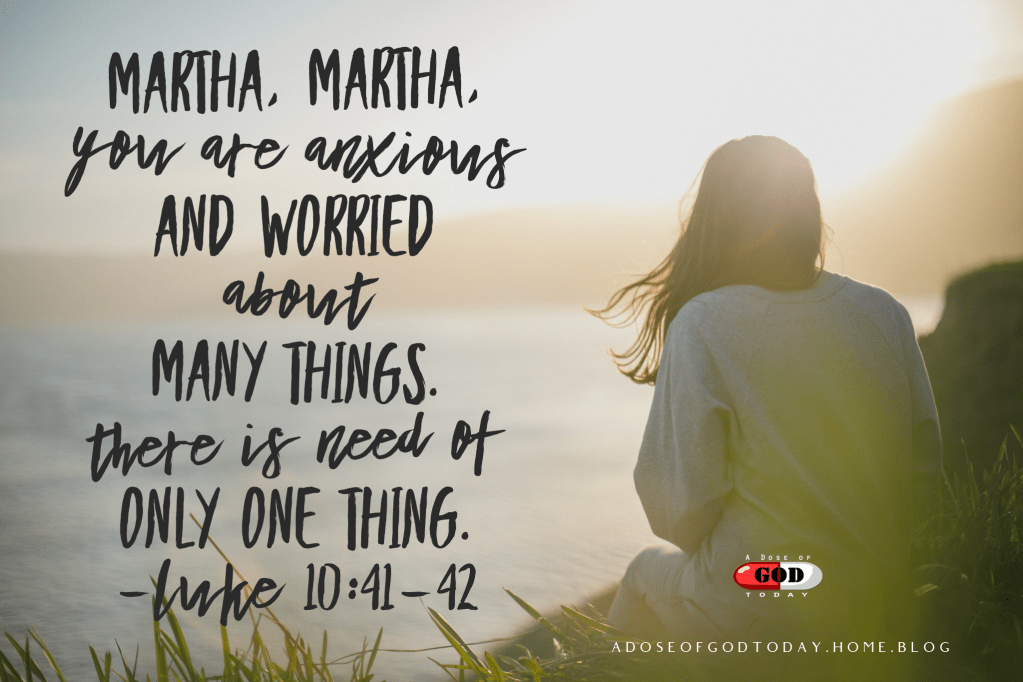
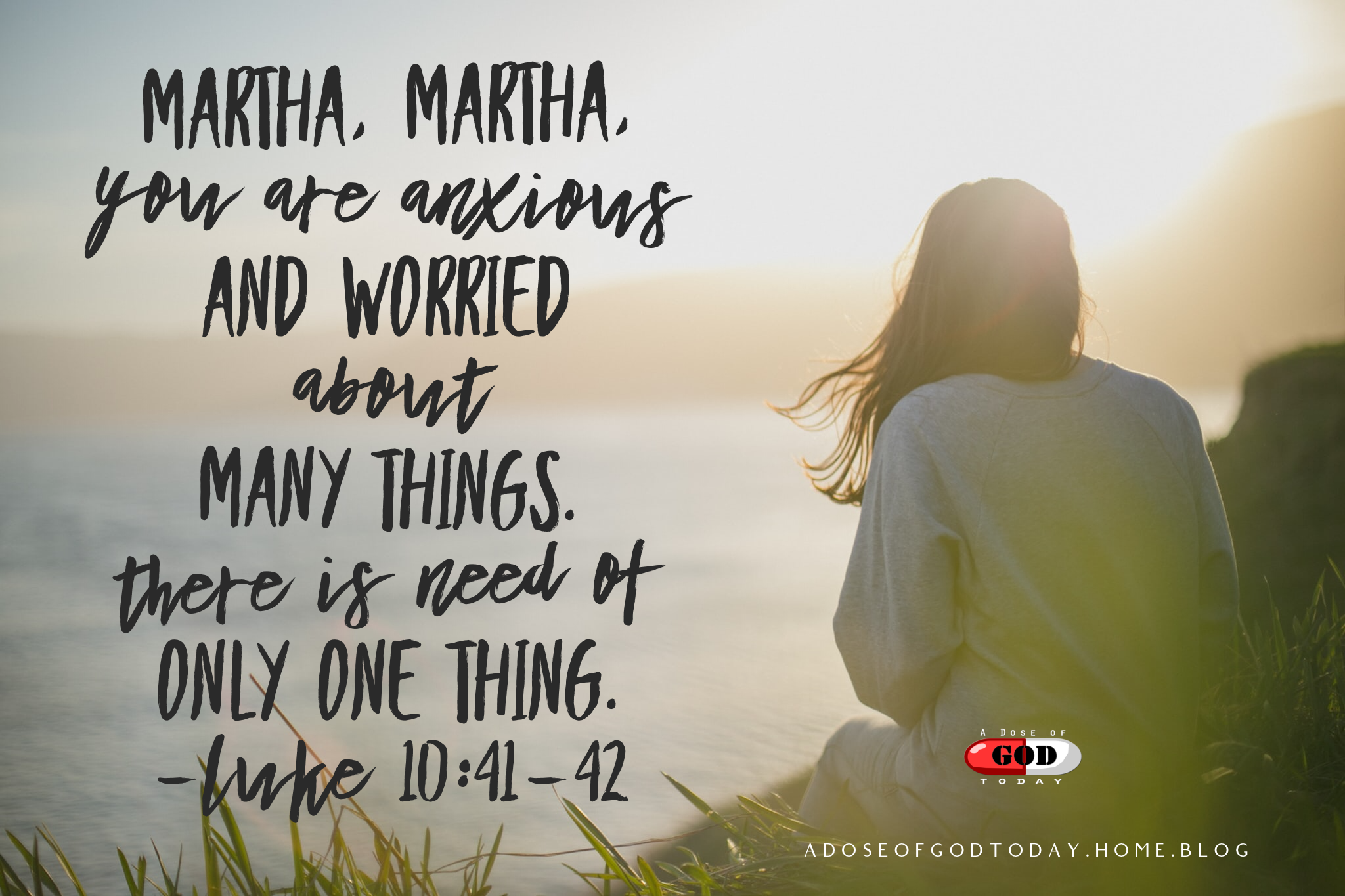
    “Martha, Martha, you are anxious and worried about many things. 
    There is need of only one thing. 
    Mary has chosen the better part
    and it will not be taken from her.”

    HOMILY

    When a close relative or a close friend would pay us a surprise visit, this makes us feel uneasy. Our things might still be scattered around the house. We do not want a visitor to see how disorderly our place that is why, if a surprise visit happen we would also feel embarrass. However, despite the embarrassment that we would feel, we still welcome the visitor with grace and warm hospitality.

    However, what if strangers will come and visit us? Are we still going to be hospitable and kind?

    In today’s readings we have also heard about such surprise visits which brought blessing to those who were visited. In the Book of Genesis, Abraham was visited by three men. They were strangers to Abraham yet he welcomed them with kindness and openness. Abraham must have felt how tired and hungry those men were. He was sensitive to their needs.

    However, Abraham did not know that these men were angels of the Lord. Through Abraham’s welcoming and kind attitude towards these strangers, the Lord blessed him and his wife. This blessing was the promise of a son.

    This story tells us that even God would visit us also in a surprising way. And God’s visit will bring us blessing. Thus, it is also important that we remain welcoming and accepting of God’s surprises for us.

    But then, God may also may visit us not just through strangers but also though ordinary people or even those to whom we are already familiar with. This is the story that we have heard in the Gospel today.

    Martha and Mary who were sisters of Lazarus were good friends of Jesus. The Lord showed his affection towards them by visiting these women. And it is very interesting on how each of them responded to Jesus’ presence.

    Martha was certainly a very good woman. She related with kindness to people around her. This was shown on how she would make herself busy in providing and making sure that everything was alright. She was indeed, sensitive to the needs of others. With this attitude, she surely welcomed Jesus with great kindness and warmth.

    Nevertheless, there was something that troubled Martha. She was also a woman who easily get anxious and worried. She was caught with so many things that when Jesus visited them, she was overwhelmed with her anxieties on how to make Jesus feel provided and comfortable. Sad to say, her anxieties prevented her to have a deeper encounter with Jesus and making herself closer in the presence of the Lord.

    As a result, she became complaining. She complained to Jesus on why her sister Mary was not helping her in the kitchen. She might have expressed bitterness towards her sister for not being sensitive to her. However, Jesus confronted her of her own anxieties and worries.

    We would surely find ourselves too in this situation. We might find ourselves worrying and becoming anxious of personal struggles such as your failures and unfulfilled dreams and desires, or the overwhelming loads of our work and business, or the issues that our relationships are facing today, or the great demands that your family life is requiring you to do, or the illness of a loved one that pains you.

    When we let these one or more issues to overwhelm us, then, we will certainly become disturbed. We will be out of focus. Like Martha, we might also become complaining. Consequently, our relationship with others and even with God will be affected. We could become negligent of our self-care and inattentive to our other relationships because our worries and anxieties have grabbed us to what are more essential and important.

    Jesus is teaching us today through the person of Mary. Mary though she appeared passive and insensitive to her sister Martha, was praised by Jesus. Mary realized the greatness of the presence of the Lord. Mary realized also that Jesus wanted their presence that is why she chose to be closer to Jesus and sat at his feet. Mary found peace and true confidence with Jesus

    This tells us that the Lord does not want us to keep ourselves busy and filled with worries and anxieties. As Jesus visits us, he desires that we become sensitive to his presence, attentive to his invitations and welcoming to his words.

    This is also the same with our other relationships. We might need more awareness for ourselves, and a quality time to spend with our loved ones. With these, then, we will also see and realize what is more important and essential in our life.

    Jesus invites us today not to allow our worries and anxieties to take us over but rather to allow the Spirit to make our hearts ever welcoming and warm to God’s visits.

    Hopefully, by being able to learn these attitudes of Mary and Abraham, we too shall have a true and deep encounter with the Lord who comes to bless us today. Hinaut pa.

    Jom Baring, CSsR

  • Who is my neighbor?

    Who is my neighbor?

    July 14, 2019 – 15th Sunday in Ordinary Time

    From the Gospel of Luke (10:25-37)

    There was a scholar of the law who stood up to test Jesus and said,
    “Teacher, what must I do to inherit eternal life?”
    Jesus said to him, “What is written in the law?
    How do you read it?”
    He said in reply,
    “You shall love the Lord, your God,
    with all your heart,
    with all your being,
    with all your strength,
    and with all your mind,
    and your neighbor as yourself.”

    He replied to him, “You have answered correctly;
    do this and you will live.”

    But because he wished to justify himself, he said to Jesus,
    “And who is my neighbor?”
    Jesus replied,
    “A man fell victim to robbers
    as he went down from Jerusalem to Jericho.
    They stripped and beat him and went off leaving him half-dead.
    A priest happened to be going down that road,
    but when he saw him, he passed by on the opposite side.
    Likewise a Levite came to the place,
    and when he saw him, he passed by on the opposite side.
    But a Samaritan traveler who came upon him
    was moved with compassion at the sight.
    He approached the victim,
    poured oil and wine over his wounds and bandaged them.
    Then he lifted him up on his own animal,
    took him to an inn, and cared for him.
    The next day he took out two silver coins
    and gave them to the innkeeper with the instruction,
    ‘Take care of him.
    If you spend more than what I have given you,
    I shall repay you on my way back.’
    Which of these three, in your opinion,
    was neighbor to the robbers’ victim?”
    He answered, “The one who treated him with mercy.”
    Jesus said to him, “Go and do likewise.”

    HOMILY

    I grew up in a community where neighbors know everybody. I have enjoyed playing and fighting with other kids. As kids, we were welcomed to take something to eat and even sleep no matter whose house would that be.

    I have enjoyed very much my childhood when we have to make our own kites and toy cars, build our small houses, running around and getting hurt and dirty with other kids. Those days that I had were the foundation where I was able to relate and socialize with others. And most importantly, these early years of playtime and growing up of a child are the opportunities also where a child will develop his or her sense of responsibility, creativity and sensitivity to people around him or her.

    That is why, we also find neighbors helping one another in times of need and sorrow and sharing their joys in times of abundance and blessing. We understand that our neighbor is someone who is close to us, somebody we know and someone we are familiar with. And we consider those outside this circle as strangers to whom we could easily show an indifferent attitude.

    However, this kind of understanding of neighbor is being challenged today. This is what we have heard from the Gospel of Luke.

    There was a lawyer who asked Jesus on how he would be able to attain eternal life. What he asked was not just actually about what lies after death but also of the present moment. Eternal life then means eternal joy and this joy can already be found now.

    The lawyer knew the answer, that is why, he also answered his own question to Jesus. This joy can be attained by loving God and loving one’s neighbor. This love of God can only become concrete when a person also shows the same love to his or her neighbor. And so it means, that these two are inseparable.

    IMG_0404

    But, the lawyer asked Jesus again and clarified, “who is my neighbor then?” And Jesus’ answer must have left the lawyer speechless. In the parable that Jesus gave, a neighbor is somebody who is in need regardless of the persons’ belief, culture, race or status.

    This is the reason why the victim in the story was portrayed to be naked and unable to speak because he was half-dead. The person had no particular culture or race, or language or belief. The person then symbolizes anybody.

    Moreover, a neighbor is also a person who responds to those in need. A neighbor is a person who feels the suffering and pain of the other and because of this, a neighbor is moved to extend help and assurance to that person in need. This is done out of generosity and kindness.

    Thus, the priest and the Levite in the story who merely showed indifference to the dying person were not neighbors. Their fear of becoming unclean and not being able to enter the Holy Temple or perhaps fear to do something that it might be just a trap of the thieves, prevented them to extend their hands to the person. They must have surely felt pity for the victim but then they remained in the feeling and did not move into action.

    That is why, to only feel pity for the person in need without changing anything from us, is empty. True pity leads to mercy which also leads to kindness, a generous action.

    This is how we realize also that being a believer in God, your faith and my faith does not mean to be static or passive. Faith is not dependent on letters or traditional practices and rituals as shown by the priest and Levite. But faith is dynamic and pro-active because it is about a relationship. This is what the Samaritan showed.

    Therefore, true faith builds relationship, friendship. It is sensitive and generates kindness, generosity, mercy and compassion. In other words, action!

    Thus, Jesus invites us today that to attain eternal life or eternal joy is also to build relationship. The Samaritan despite the discrimination against him by the Jews as heretic, impure and lowly was able to build relationship by recognizing that victim as his neighbor. He did that because he recognized God in that person.

    This is the invitation for us. We are called to accompany and mentor the young by inculcating in them the value of building and creating relationships. Our young people indeed need companions, friends and mentors who will assure them that they are not alone. We are able to do this when we also become a true neighbour to the young who will assure of them of our company, of our presence and friendship.

    Today, one of the biggest difficulties of the young is the tendency to be lonely and alone. As a result, high rate of suicide among our young people is evident. Let our young people know and feel that they are not alone and that God and our community are much bigger than their problems and struggles. Each of us is called to be a companion and a friend and a neighbour of the young and of one another especially with those who are suffering for being abandoned, discriminated and oppressed.

    This will only be possible when we also learn how to treat each other as neighbors, with love, understanding and compassion. Let our differences, biases, fears and hesitations go so that we will be able to express our faith in God actively and lively by becoming a true neighbor to the young and to whoever they are. Hinaut pa.

    Jom Baring, CSsR

  • If we have Jesus in us, then, we are agents of peace and healing

    If we have Jesus in us, then, we are agents of peace and healing

    July 7, 2019 – 14th Sunday in Ordinary Time

    From the Book of Isaiah (66:10-14C)

    Thus says the LORD:
    Rejoice with Jerusalem and be glad because of her,
    all you who love her;
    exult, exult with her,
    all you who were mourning over her!
    Oh, that you may suck fully
    of the milk of her comfort,
    that you may nurse with delight
    at her abundant breasts!
    For thus says the LORD:
    Lo, I will spread prosperity over Jerusalem like a river,
    and the wealth of the nations like an overflowing torrent.
    As nurslings, you shall be carried in her arms,
    and fondled in her lap;
    as a mother comforts her child,
    so will I comfort you;
    in Jerusalem you shall find your comfort.When you see this, your heart shall rejoice
    and your bodies flourish like the grass;
    the LORD’s power shall be known to his servants.


    Responsorial Psalm        PS 66:1-3, 4-5, 6-7, 16, 20

    R. (1) Let all the earth cry out to God with joy.
    Shout joyfully to God, all the earth,
    sing praise to the glory of his name;
    proclaim his glorious praise.
    Say to God, “How tremendous are your deeds!”
    “Let all on earth worship and sing praise to you,
    sing praise to your name!”
    Come and see the works of God,
    his tremendous deeds among the children of Adam.
    He has changed the sea into dry land;
    through the river they passed on foot;
    therefore let us rejoice in him.
    He rules by his might forever.
    Hear now, all you who fear God, while I declare
    what he has done for me.
    Blessed be God who refused me not
    my prayer or his kindness!

    From the Letter of Paul to the Galatians (6:14-18)

    Brothers and sisters:
    May I never boast except in the cross of our Lord Jesus Christ,
    through which the world has been crucified to me,
    and I to the world.
    For neither does circumcision mean anything, nor does uncircumcision,
    but only a new creation.
    Peace and mercy be to all who follow this rule
    and to the Israel of God.From now on, let no one make troubles for me;
    for I bear the marks of Jesus on my body.The grace of our Lord Jesus Christ be with your spirit,
    brothers and sisters. Amen.

    From the Gospel of Luke (10:1-9)

    At that time the Lord appointed seventy-two others
    whom he sent ahead of him in pairs
    to every town and place he intended to visit.
    He said to them,
    “The harvest is abundant but the laborers are few;
    so ask the master of the harvest
    to send out laborers for his harvest.
    Go on your way;
    behold, I am sending you like lambs among wolves.
    Carry no money bag, no sack, no sandals;
    and greet no one along the way.
    Into whatever house you enter, first say,
    ‘Peace to this household.’
    If a peaceful person lives there,
    your peace will rest on him;
    but if not, it will return to you.
    Stay in the same house and eat and drink what is offered to you,
    for the laborer deserves his payment.
    Do not move about from one house to another.
    Whatever town you enter and they welcome you,
    eat what is set before you,
    cure the sick in it and say to them,
    ‘The kingdom of God is at hand for you.’”


    Homily

    Do you also desire peace and prosperity for your family and for our community? I am sure that each of us desire this kind of life. With all the troubles that we experience in life such as personal problems, failures and struggles; family demands, conflicts and grudges; and crimes, disasters and corruption in the community, we want peace. If only we have peace within ourselves, in our families and communities, then, our life would be very different.

    Such promise of peace and abundance had been prophesied by Isaiah. We have heard it from the first reading on how Isaiah had seen the day when Jerusalem will be comforted with peace and prosperity. The people of Israel agonized much from oppression and slavery. Wars had been waged left and right and the people suffered greatly from these devastations.

    Yet, God is not blind of this suffering. In God’s goodness, peace and prosperity will be upon his suffering people. That is why, the message of Isaiah is, “rejoice and be glad.” God will see to it that He will comfort the grieving and suffering people. God’s comfort will surely bring joy, peace and satisfaction.

    Similarly, Paul in his letter to the Galatians also expressed his experience of peace and confidence in Jesus. Despite the many trials that he underwent, Paul found peace and confidence in Jesus. Even the conflicts within Christian communities will never destroy the peace that he received from the cross of Jesus which he was boasting about. Nothing will trouble Paul because he has Jesus with him.

    In that cross of Jesus, Paul experienced tremendous love and forgiveness. Because of this, Paul also found his true self and became a witness of Jesus. This moved Paul to preach the Gospel, and in fact, to preach to others the peace and confidence that he received from Jesus.

    Moreover, Jesus sent 72 people in pairs to bring peace to the homes that they will visit. Jesus is aware that homes are in need of peace. Even though that the 72 went ahead of him to prepare the people of his coming, yet, the peace that they were giving to the people was Jesus himself.

    This is the promise fulfilled in Jesus as what has been prophesied by Isaiah. Jesus is the peace, the comfort and the confidence that God has promised. This peace brings openness to God’s friendship and healing.

    IMG_0372

    But notice also, Jesus employed the help of his disciples to bring peace to whatever house they enter. This tells us now that preaching and being a witness of Jesus is not just limited to the close group of the 12 apostles. This means that everyone of us is being sent by the Lord to preach and bring peace and healing to wherever we shall go.

    Indeed, the promise of peace, confidence and prosperity are not fulfilled outside of us but, through us and within us. The confidence and peace that Paul was telling about was not an outside experience, but rather, Paul himself experienced it personally. It is through his personal encounter with the risen Jesus.

    The 72 people were able to bring peace to many homes, not because of an outside influence but coming from their personal relationship with Jesus. The presence of Jesus in their life allowed them to be agents of peace and healing.

    This is the invitation for us this Sunday. Jesus calls us and sends us to be part of that fulfillment of the promise of peace and abundance in our families and communities. The Lord, certainly, fulfills his promise through us and with us. Peace is achieved not outside of us. Confidence is attained not apart from us. This tells us again that God’s wonders are made through us.

    That is why, God desires that we become part in working wonderful things. This involved in bringing peace and healing to our troubled and wounded homes, relationships and communities. Jesus reminds us too that being part of God’s work, let not material things trouble us. Paul also did the same thing. He did not allow anyone and anything to trouble him and remove him from the peace that he experienced from Jesus.

    Let us not allow our complains and anger, hate and bitterness and even our insecurities to steal from us the peace that Jesus has given to us. Let us rather allow the joy of having Jesus in our life to empower us in bringing peace and healing. Hinaut pa.

    Jom Baring, CSsR