
Category: Sunday Homlies

  • God growing in us

    God growing in us

    Advertisements

    July 19, 2020 – 16th Sunday in Ordinary Time

    Click here for the readings (http://www.usccb.org/bible/readings/071920.cfm)

    Homily

    Who among us here have witnessed the actual growing of a seed, or any plant or of a person? We could have claimed that we have witnessed it just as parents looked closely as their child grows, or just as a farmer tends everyday his plants and animals. Yet, because growing is a process, it takes time and very slow. That is why, we don’t usually see with our own eyes how a seed begins to sprout and becomes a tree, or how a flower begins to grow and bloom or how a person develops physically and grows old. We only notice the gradual changes as time also goes by.

    However, thanks to our latest technology because a camera can capture this process of growing particularly of a plant or changes that happen in our nature. Through a photographic technique called “time-lapse” we can witness how a seed begins to sprout, take its roots and come out from the soil and become a full bloom plant. This always amazes me to see that.

    I want you to watch this short time-lapse of a growing seed in silence to bring yourself also into reflection and into calmness in the midst of noise, stress and anxiety that are around us today. (Click the link below)

    With this amazement and wonder of the process of growing, this brings me into reflection for this Sunday’s Gospel. Jesus tells the people about the three parables of the Kingdom of Heaven. These are the parable of weeds among the wheat, the mustard seed and of the yeast.

    In all these three parables, what is common among them is the theme of growing. From here, I would like to invite you that we dwell deeper into these three parables and recognize how God invites us today and how God is growing in us.

    I would like to begin with the parables of the mustard seed and of the yeast. Indeed, these are invitations of God for letting us grow, to be mature and to develop.

    We understand GROWING or GROWTH to be dynamic. It involves changes, adaptations, shedding off of what was old and transforming into something new. Meaning, growing is a form of transformation.

    Both parables, tell us of the process of growth in a non-aggressive way because growth is gradual, silent and calm. Moreover, it is empowering and life-giving.

    This reminds us too of the wonder of creation. Creation is silent and relaxed, yet, destruction is noisy, distressful, aggressive and violent. In destruction, there is no growing because it suppresses and destroys. Surely, this is how we would find life distressful, filled with anxiety and worries, because when we do not grow or when we stop growing then, it leads us to destruction.
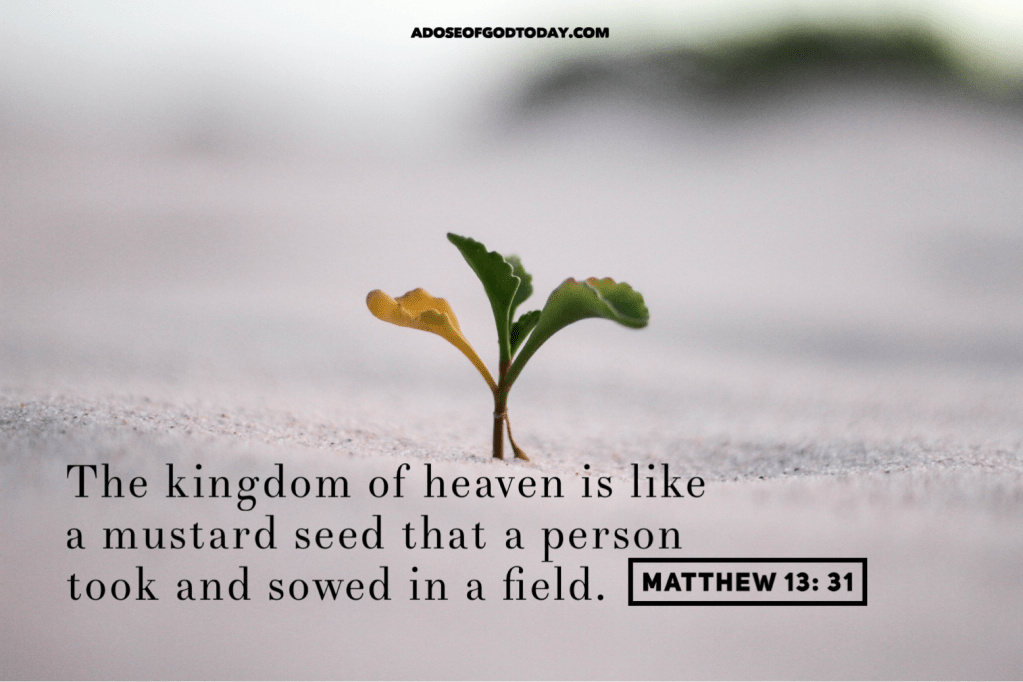
    And this is not what God wants us. God’s desire is that we develop into our full potential as what has God desired us to be. Thus, we are called to continue growing no matter how our hair have turned into white or our wrinkles have become more visible.

    Likewise, growing also leads us towards maturity. The first parable of the weeds among the wheat leads us into this invitation, MATURITY. Remember, the owner of the good seeds waited for the wheat to mature before weeding out the weeds, that were sowed by the enemy. To weed out the weeds when the wheat are still young, it will endanger the life of the young wheats. The owner has to wait when the wheat becomes mature and ready for harvesting.

    This means that only when we have grown and become mature that we also gain wisdom to recognize what is bad and good, what is unhealthy and healthy, what is from the evil one and what is from God.

    This tells us that the Kingdom of Heaven is already in us because God is with us. The seed has been planted on earth as Jesus was born for us. The Lord is already in our hearts as we are being baptized. Moreover, the Kingdom of Heaven is manifested in us when we also become mature in our faith and relationships with God and with others.

    How do we recognize that we have become mature? It is by being able to recognize the works of God and the works of the evil one, the works of kindness and the works of selfishness and to choose freely God.

    Now, these are the signs as well as the invitations for us to recognize the Kingdom of Heaven and to let God to grow in us.

    First, as the mustard seed grows and the flour reacts with the yeast, the kingdom of Heaven also begins in HUMILITY not in any form of aggression or arrogance. It is humble and simple. Thus, the kingdom of heaven can be very present in a family who makes the effort to pray together, in a couple who expresses their faithfulness despite their differences, in a person who shows true concern and generosity to another who is in need of help.

    Advertisements

    Second, the kingdom of heaven is empowering and life-giving.  The kingdom of heaven is present when our community empowers the weak. A community that discriminates, judges, condemns and indifferent never empowers but it oppresses the weak. However, when our community empowers, then it also gives life. Let us also remember that to be able to give life is to give more chances and opportunities for growth. To give life is to give hope. Therefore, our community is truly a kingdom of heaven when we uphold and protect every life to survive and to mature.

    As we recognize the Kingdom of Heaven in us today, let us also allow the Lord to grow in us, to bring changes and transformation in ourselves, in our attitudes and relationships and in the way we look at things in life. As we continually grow and become mature, we may also become individually, a person for others and also a community for others that gives life, that gives hope and allows chances and growth for the weak and the helpless. Hinaut pa.

    Jom Baring, CSsR

  • LISTEN TO HIM

    LISTEN TO HIM

    Advertisements

    July 12, 2020 – 15th Sunday in Ordinary Time

    Click here for the readings (

    Homily

    As we struggle with the day to day challenges CoVID 19 virus has posted us, perhaps we also wonder what would be the best guidance and advice God is giving us at this time. Life amidst CoVID 19 virus has been constricted and stressful. We find ourselves mostly reactive to the reality that we think about whether our actions are in sync with God’s will and plan. So, what would be the best  way for us to be always online with God?

    Our Scripture and Christian faith tradition have a very simple instruction: LISTEN TO HIM.

    We remember many instances in Jesus life that the challenge of us listening to Him has been clearly given importance. At the beginning of His public ministry to proclaim the good news of salvation, Jesus said: “Today these words come true as you listen.” Also during the Lord’s transfiguration, the disciples heard God instructing them: “This is my beloved Son, whom my favor rests. Listen to Him”. And in our gospel today, in telling and explaining to us the parable of the sower, Jesus challenges us “Whoever has ears ought to hear”.

    Our listening is indeed crucial to our faith-life. By listening to Jesus – God’s word for us, as our first reading suggest, we are part of and in line with God’s work of salvation and can benefit from the fruits of His labor. Paul reminds us that being connected with Christ assures us that “the suffering now are nothing compared with the glory to be revealed.” Jesus in our gospel made known to us how blessed and privilege we are for our faith makes us see and hear what “many prophets and righteous people longed to see what you see but did not see it, and to hear what you hear but did not hear it.” Same way as any loving relationship, good listening and communication are very important to our faith relationship with God.

    Simple as it maybe, but we do have some problems with listening. Experience teaches us that in life it is not always easy to listen. We may have heard what has been said but we may have not listened to it. Or, it could happen that the other have not yet fully said what he wants to say or we may not yet have fully listen to him, we are already thinking of what and how are we going to respond to the other. It could also happen that while we are listening to the other, there are a lot of noisy things and concerns that we are also listening to and hearing with. It is very true that we do have limited listening span and selective hearing. Meaning, we listen only in our limited ways, and listen to what we want to hear from what was being said. That is why selective and limited listening or not enough listening would resort to conflict, tensions and misunderstandings. We heard what has been said but do we listen to it? We may have heard it but are we listening to what has been said?

    For instance, our gospel today is not anymore new to us. We are already familiar and have known about the Parable of the Sower. Surely many times we have already heard this parable. In fact, of all the parables that Jesus have already told us, the parable of the sower is among the few parables which he gave an explanation. True we may already heard this parable before and may have already understood its meaning. But did we listen to it? Are we listening to it? If we don’t see and hear it calling us to listen, then we are not listening and don’t get it.

    Long before it was written and read, God’s words are primarily spoken and proclaimed to us and are meant to be heard and listen by us. The mission of Jesus is to speak, preach and proclaim the God’s Word, the Good News of Salvation. Meaning, our rightful response to God’s Word being preached to us is first to listen to it. Only through our listening that we could understand, and in effect benefit and enjoy the fruits of God’s salvation. Like David, if we want to taste and see God’s glory and salvation, we should learn how to listen intently to God’s Message and Plans through Jesus, His word. For those who listen well, they bear much fruits.

    Jesus has thus already done and doing His part in Proclaiming God’s words. Ours now is to do our part in listening and obeying God’s Word. Let anyone of us then who have ears: Listen, and heed what we hear.

    Amidst our now noisy worrisome and depressing pandemic world, may we be more sensitive to listen God’s message & plans, thus be guided and inspired to rightly respond to its challenges for our trying times. Amen.

    (By: Fr. Aphelie Mario Masangcay CSsR, a Filipino Redemptorist  Missionary stationed in Gwangju South Korea, though now still stranded in Cebu until further notice for available flights.)

  • In need of a friend? Come to Jesus

    In need of a friend? Come to Jesus

    Advertisements

    July 5, 2020 – 14th Sunday of Ordinary Time

    Click here for the readings (http://www.usccb.org/bible/readings/070520.cfm)

    Homily

    What burdens are we carrying now? What makes us worry at the moment? What are those that we are most afraid of? These questions are surely relevant to us. They tell us about our dispositions and even would tell us about what we are hoping for. We hope to be liberated from our burdens, to be free from worries and anxieties. And usually we want them to disappear immediately.

    At the beginning of the quarantine, many have thought that the situation will die down soon. Yet, when we were under the Enhanced Community Quarantine and people began to lose their jobs and business, we began to worry and became anxious. As the Corona Virus infection continue to rise in our country, we become more afraid. As we have been confined in our homes for months now, some have become paranoid and depressed. At present, these can really be our worries and anxieties.

    As we pray to God to hear our pleas and answer our prayers many of my friends and those I know have become impatient of this situation we have now. I wanted even all these things to end very soon. Others might have been thinking also that all their suffering will end at once. But, there is a danger around here. There might be a temptation in us to think of a God who does magic and can take away all those concerns that burden us.

    Contrary to what we think of God like a magician, our readings today reveal the true character of God. God does not offer us magic but what God offers us rather, is his gentle, merciful and understanding kind of friendship.

    This is what the first reading reveals to us today. The Hebrew people were burdened by their current situation. They were subjected to foreign powers. They became slaves and were taken out from their own land. Thus, they hoped for a savior who will free them from that suffering. They have expected of a savior, a king who will bring armies and slaughter all their enemies. However, the prophecy of Zechariah was different from what people hoped for. The savior or messiah will come to bring peace not another war; he rides on a donkey not on a battle tank. The messiah conquers by humility not by violence. This means that the messiah transforms the community from within, and brings inner peace.

    This is what St. Paul tells us in the second reading. When the Spirit of God dwells in us, we are transformed from inside. Jesus gives inner peace when we allow the Spirit to dwell in us. This is the Spirit of God who raised Jesus from the dead, who brought him out of darkness and misery into the joy of freedom and resurrection.

    The prophecy of Zechariah had been fulfilled in Jesus Christ. He is the king, the messiah who rides on a donkey, who lives in humility and brings inner peace and freedom. Our savior and king tells us today, “Come to me all you who are tired and lonely and those of you who are overburdened!” Jesus invites us to come to him and to welcome him in our life.

    He is neither a king who terrorizes us with his power nor a master who subjects us with his influence nor a wizard who waves his wand to remove all our difficulties at once. Jesus gives us a humble invitation to come to him as our friend – a true friend who is gentle, humble and compassionate, willing to walk with us.

    Thus, when we come to Jesus and trust him to be our friend, then he offers us his yoke.  During the time of Jesus, the yoke is that which is put on the necks of two animals to plow the field for planting. There are usually two cows so that the weight becomes lighter and the plowing is easier and faster. Yes, the yoke that Jesus speaks about is from this image. That yoke actually symbolizes the Gospel that we receive today – and that Gospel is Jesus the Lord himself.

     It is in this way that Jesus offers himself to be our friend who will be with us. He is not promising us to remove all troubles in life at once, as his life was also filled with pain and suffering. He tells us today that though life may be filled with problems, with worries and anxieties, with fears and self-doubt, with failures and insecurities, with shame and guilt, yet, we will never be alone in our struggle.

    Advertisements

     Jesus invites us to carry those troubles with him, to pull our burdens with him, to share our trials with him, to draw strength from him and to allow him to help us. In truth, the Lord does not do good things for us, but rather, he does great things with us. He does not do miracle for us but he does it with us. In this way, we may attain inner peace, freedom and confidence with the Lord no matter what burdens we are carrying at this moment.

     But let us also remember that our experience with Jesus as our gentle and compassionate friend is not meant to be for us alone. Each of us who have experienced that friendship is called to be a friend to others. Therefore, in return that experience with the Lord will allow us to become willing and generous friends – who is ready to cheer up a friend filled with doubts, who is ready to give comfort to a friend suffering from grief and sorrow, who has a listening heart to a friend who needs someone to talk to, so that we too will become God’s instrument of brining freedom and inner peace to our overburdened brothers and sisters. Hinaut pa.

    Jom Baring, CSsR

  • How welcoming am I?

    How welcoming am I?

    Advertisements

    June 28, 2020 – 13th Sunday in Ordinary Time

    Click here for the readings (http://www.usccb.org/bible/readings/062820.cfm)

    Homily

    When I was younger, I used to play, eat and even sleep at my playmates’ house or them in our house. I grew up in this environment being assured that I was welcomed. I also witnessed how the adults at that time would do the same where they also felt welcomed. Indeed, that culture made me realize how a community becomes more compassionate and generous as every house and every person welcomes others.

    This brings me to what our readings this Sunday is reminding us, that is, the call of hospitality or the invitation to be welcoming.

    Our first reading tells us of the story of Prophet Elisha who was welcomed by a rich woman but childless and whose husband was old. Elisha, though a stranger, was welcomed into their home. In their culture at that time, a childless couple would surely suffer shame for having no child. Elisha who was very aware of this feeling of the couple particularly of the woman, prophesied something that would made them truly happy. Elisha promised the couple that by the following year she will certainly have a child.

    Thus, though it seemed that it was only Elisha who was welcomed by them but in fact, Elisha on his part also welcomed the desire and the longing of this couple.

    This tells us now that welcoming others into our homes or into our lives, brings grace. Making ourselves open for others allows the grace of God to also work in our lives. This is what Paul wrote in his letter to the Romans.

    Paul reminds us that baptism is a way of welcoming God into our lives. Moreover, it is also God’s way of welcoming us into God’s divine presence. That is why, Paul told us that as we were baptized we also join in the death of Christ. But how? Christ died for our sins. And in baptism, our sin dies because we are being forgiven. Through that forgiveness then we also rise into a new person just as Christ rose from the dead.

    The grace of baptism lies here because as we welcome God into our life and God welcoming us, this becomes a “mutual welcoming.” When welcoming becomes mutual then true relationship begins to form and develop. Consequently, God is our Father, and we are God’s children.

    This is the same also when we take the risk in welcoming others into our life. True friendship only develops and strengthens when there is a mutual welcoming of each other. This mutual welcoming involves sharing of stories, sharing of pains, sharing of joys as well as sharing of hopes and dreams.

    Recently, a dear friend visited me after months of lockdowns. Since our movements now have been eased for a bit, compared to the situation during the Enhanced Community Quarantine, we had an opportunity to catch up with each other personally even for a short period of time. Such simple encounter was indeed a form of mutual welcoming.

    However, we also know that in welcoming others we may get hurt. This happens when there is no mutual welcoming in our relationship. A relationship that is colored with manipulation or abuse or betrayal or pretensions is such a toxic relationship. This kind of relationship gives us pain and trauma which could lead us to sadness and misery in life.

    Advertisements

    This happened to a friend who welcomed a person in her life. Yet, unknowingly she was not welcomed at all in the life of that person whom she loved. She was just used and abused for the sake of personal pleasure of the other.

    But then, the Gospel of Matthew tells us and assures us the kind of relationship Jesus is offering to us. Jesus offers us a relationship that gives and promotes life and joy. Although the Gospel sounds a bit harsh for it suggests to hate our parents, but it actually means to place our relationship with God as the first or the beginning.

     Making God as the first priority in our every relationship gives us a good foundation to our other human relationships. The more we become in touched with our relationships with the Lord, the more we also become in touched with our human relationships.

    Consequently, Jesus calls us today to be welcoming, to allow ourselves to open up even though that would mean that we become vulnerable. Jesus said, “Whoever welcomes you, welcomes me, and whoever welcomes me, welcomes him who sent me.” Meaning, welcoming others with the intention of loving is welcoming God.

     Making ourselves vulnerable to welcome others is a way of losing our life, yet, in welcoming others, we also realize the beauty of loving and finding our life. Therefore, today, Jesus calls us to be welcoming as we are being welcomed, to be loving as we are also being loved.

    Today also, let us seek forgiveness and reconciliation with those whom we have hurt because of our selfishness, dishonesty and indifference. May we truly welcome others in our life too in the way of loving truly and not as a form of manipulating or using others for our own advantage and pleasure. Hinaut pa.

    Jom Baring, CSsR

  • Of Being Social-Distanced

    Of Being Social-Distanced

    June 28, 2020 – 13th Sunday in Ordinary Time

    Click here for the readings (http://www.usccb.org/bible/readings/062820.cfm)

    Homily

    Not until the first quarter of this year that we come to experience and be familiar with the term: “social distancing”. To protect ourselves from Corona Virus infection, nowadays we normally resort to social distancing. To avoid being infected by others or possibly infect others as well, we now set apart and maintain a safe distance from others as we assume that the world around us is getting sick, and we can easily get sick.

    Safe and practical it is and would be, social distancing is never been that easy as observed and practiced. Simply because social distancing is particularly painful to us  for it requires of us not only the physical bodily distance but also the  experience of being and feeling isolated, lonely and cast-out/cast-off from one another. Being physically quarantined, isolated, set apart, distanced, marginalized, suspected, and monitored could make us also personally feel marginalized, segregated, ostracized, stigmatized, outcasted, feared, unwelcome, abandoned, lost and forgotten. With or without viral pandemic, physical and social distancing has always been painful and difficult (even traumatic) experience for all of us for it deprives us of our need for personal intimacy, closeness and relationships. In other words, social distancing hurts because it is not only physical but also personal.

    It is but natural and life-giving for us to connect, relate and interact as persons. More just being social animals, social inter-actions and interpersonal relationships are very important dimension of our lives. And a song would insist, “No man is an island.. No one stands alone.” We are not just being with others but we are human PERSONS with others. We grow, live and thrive in life as community of persons: Persons related and relating with others personally. That is why to live life alone, distance, and isolated is difficult, painful and discouraging indeed.

    Our readings today reminds of the great value of our interpersonal relationships both in life and faith. Jesus in our gospel today appeals for us to “receive me”, “love me”, “follow me”. He invites us to have a personal intimate relationship with Him. Like any of us, he wants us to be close to Him as much as He wants to be close with us personally.

    Being Christian, as Paul emphasized, we are WITH Christ: personally related with Jesus in death, life and resurrection. And like in the first reading, to be personally welcoming  and hospitable host to our guests would blessed and graced us with the gifts of their person, to receive and love the person Jesus in our lives personally is to personally be with and share with His divine life with our Father.

    Personal intimacy, closeness and connected with Jesus and with one another as community is indeed promising and life-giving. While social distancing and isolation is sickening and life-threatening indeed.

    While we suffer physically and personally with social distancing  for safety and protection from infection nowadays, we may take this trying times as opportunity for us to review, reflect and renew the quality of our personal relationships with God, with our family and friends and our community. Just because we are physically constrained and apart, it does not mean we are not and cannot anymore be connected with one another personally. Distancing thus could also be a chance to improve the quality of our faith, personal life and inter-personal relationships.

    For instance, social distancing may have deprived of us to celebrate Sunday Eucharist and worship as community of faith, but it could also make us improve the quality of our Spiritual Communion with Jesus and our participation as we hope and look forward to the coming opportune time for celebration. We also may find more quantity and quality time and improved lifestyle with our own selves and with our loved ones now, and thus be in touch with most essential and important in ones life.

    In other words, since social distancing is personal, so let us make it more personal, let us get more and Better Personal…. And improve the Quality of our personal, social and spiritual life during this time.

    On my fifty-ish age and nearing my silver years as Redemptorist missionary priest, perhaps my five-year old musings below could be of assistance in reflecting about our experience of social distancing nowadays:

    “Paradox of being with others”

    Along the way, we suffer two things being with others: too much & too little – of closeness and distance. Too much and too little Closeness & too much and too little Distance. Coping with these both blocks our growth in relationships as well as forms and sharpens us to be better person for and with others. Ultimately it moves us to be intimately independent as well as independently intimate with one another.

    As we are personally in faith with the Lord, may we communally not be separated from Him and one another,  and  may we not lose life but rather find Life meaningfully. Amen.

    (By: Fr. Aphelie Mario Masangcay CSsR, a Filipino Redemptorist  Missionary stationed in Gwangju South Korea, though now still stranded in Cebu until further notice for available flights.)