Category: Sunday Homlies

  • PROPHETS IN OUR MIDST

    PROPHETS IN OUR MIDST

    July 11, 2021 – 15th Sunday in Ordinary Time

    Click here for the readings (https://bible.usccb.org/bible/readings/071121.cfm)

    Being rejected is a terrible experience. When someone you love, a friend or family member rejects you for being who you are and for what you have done, is painful. This experience creates emptiness in us and feelings of not being loved and not being accepted. This makes us feel worthless and useless, thus, traumatic. This can also be experienced in workplaces when a co-worker and/or your employer gets angry at you and shows sour attitude towards you. Or when your work has been rejected or a proposal has not been approved because of their biases with you.

    In our community, there are many forms of rejection also that sometimes we are not aware of. We could just reject those whom we think are useless. We could easily not pay attention to those who do not belong in our circle of friends. We could just dismiss a person just because of appearance, education, family background or culture.

    Moreover, there is another form of rejection also that can be traced in the Bible. This is the rejection experienced by people who spoke in behalf of God, who preached and taught what God wanted for the community. Prophets are usually rejected by people because their words and presence disturb the peace and comfort of the rich and the powerful.

    This is what our first reading from the Book of Amos told us. Amos was rejected by Amaziah, the priest of Bethel because Amos was prophesying the destruction of the Northern Kingdom of Israel. Amos prophesied this by also pointing out the reasons behind. The Northern Kingdom who enjoyed prosperity and abundance also turned out to be oppressive to the poor and the weak in their society. Thus, Amos spoke of the injustice committed by the rich and the powerful against the poor.

    Consequently, Amos irked the Amaziah who enjoyed influence and wealth from this kind of life. That is why, Amaziah wanted Amos to go back to Judah, the Southern Kingdom and do his prophesying there while earning income. For Amaziah, being a priest of the temple and being a prophet was just about earning something and enjoying privileges.
    However, being a true priest or a prophet is not about earning something or enjoying the comfort of wealth and influence. A prophet is God’s voice that penetrates the heart of every man and woman, that penetrates and disturbs the heart of the community that has become indifferent and complacent, unjust and oppressive.

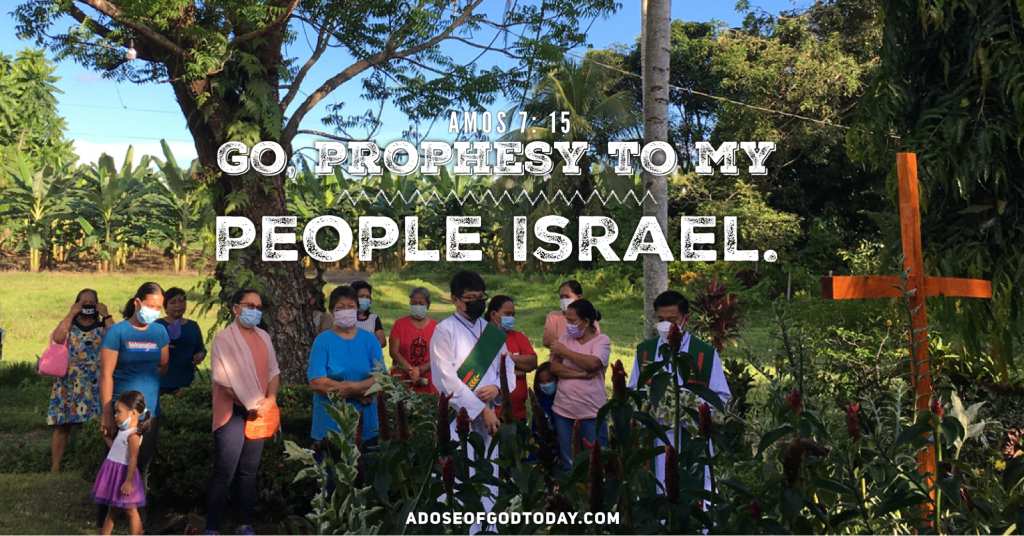
    That is why, Amos who was a shepherd was called by the Lord to speak on God’s behalf and deliver God’s message. He was commanded to “Go, prophesy to my people, Israel.” Though he did not come from a family of priests or from a lineage of prophets, yet, God chose him. Being God’s prophet after all is not about what we have attained or achieved and not about an excellent family background.

    This is what the Gospel of Mark also revealed to us. Jesus sent out the twelve Apostles, two by two, whom he chose. These men where not from any family background that one would expect. Yet, Jesus saw something beyond the ordinary life of these men. This was how God worked wonders in them. And thus, Jesus gave them authority to free people burdened and oppressed by the unclean or evil spirit and to cure the sick. This means that they have been given the gift to heal and free people.

    However, they have “to take nothing” for the journey. This calls every Apostle to fully trust in God’s providence expressed through the generosity of the people around them. To take nothing for the journey will allow them to be free from any unnecessary burden whether physical, material, psychological or spiritual.

    Yet, as they proclaim peace and grant blessing to many homes, it is expected that not all will accept. Rejection is part of life of a preacher and of a prophet who proclaims what God wants to be proclaimed. People won’t easily accept God’s invitation and God’s presence.

    And the reason? God demands change or transformation of our heart and of our whole life.

    Change can be thought by many of us as a mere “disturbance” to what we have already become comfortable and familiar. But then, the danger of complacency and indifference could grip our hearts to the point that we become unmoved in from of the suffering of those around us.

    This reminds us of the life of Fr. Rudy Romano, CSsR, a Redemptorist Missionary who spoke about the crimes of injustices committed against the poor in Cebu. His voice and presence became a “disturbance” to the powerful, the rich and the privileged. Like Amos and many prophets in the Holy Scripture, he too was rejected and martyred. He was even told by his own father to only focus on his sacramental duties as a priest. But, Fr. Rudy responded to his Dad’s letter, that he won’t be a worthy priest anymore if he would follow his father’s advice.

    Fr. Rudy chose to stand with the oppressed and committed himself to speak what God wants him to speak and to live the life of a prophet as God called him to be.

    In consequence, Fr. Rudy was abducted on this day, July 11, in 1985 in Cebu City. For the past 36 years, his body was never been found. Such is the fate of a prophet yet relentless in his words and eternal is his spirit.

    The confidence and the faith that Fr. Rudy showed must have been what St. Paul spoke about in his letter to the Ephesians. Paul proclaimed that God the Father blessed us with every spiritual blessing and this was made possible because of His Son, Jesus Christ our Lord.

    These spiritual blessings must have grown in the heart of Fr. Rudy. These spiritual blessings which St. Paul proclaimed are the grace of being chosen by God, the grace to be holy and without blemish, the grace of being an adopted child of God, the gift of redemption and freedom, the gift of forgiveness of sins and the grace to share in the mystery of God.

    For us today, each of us, regardless of our background or profession or achievements and failures in life is called to be God’s prophet in the bigger picture of our society and even within our small sphere of influence like our homes, schools, workplaces or organizations.

    As a prophet shall arose in our midst, hopefully, we too shall welcome now and learn to discern the words and the presence of the prophet among us whoever he or she may be. May the prophet’s voice and life disturb our complacency and indifference.

    Let our conscience then, be guided also by our faith in God, be inspired by love and be moved by our hope to bring change and transformation into our life and in our community that will bring healing and freedom. Hinaut pa.

  • Trust in God

    Trust in God

    July 11, 2021 – 15th Sunday in Ordinary Time

          + Emmanuel T. Cabajar, C.Ss.R. D.D.

    Click here for the readings (https://bible.usccb.org/bible/readings/071121.cfm)

    Jesus sends his disciples to announce the Good News of God’s Kingdom and cast out demons and heal the sick. With a great deal of trust and courage they obey Jesus and venture into the unknown. They take nothing and go two by two in their mission. The disciple is never alone as the Lord chooses another to accompany him. Because of their “yes” the Lord’s message spreads and the world begins to change.

           Evaluating the dismal results, a parish evangelization team realizes that focusing on mission logistics leads to the message becoming buried. Getting engrossed with the means leads to neglect of the Good News!     

          Fidelity to the core of our baptism allows God to carry out His mission through us. We don’t have to worry about material needs. The almighty opens the hearts of believers to provide for His preachers. The important thing is to obey the Lord and proclaim the Good News. We preach His Cross and find consolation and joy in our trials. 

           We accomplish God’s work as community and always with reference to His will to preach the Kingdom of God. In His name, we cast out demons and heal the sick!

           Heavenly Father, we do not rely on human resources in our ministry. You will always provide for whatever it takes to be Your humble and faithful disciples. We trust You in word and deed as one Body of Christ, united in spirit and in truth. We receive communion with fervor and allow You to make us channels of Your healing love so that others may find hope, freedom and life in the Kingdom You prepare for all of us.


    Brothers and sisters, we witness to the joy of the Gospel in word and in deed. Amen.

  • Reluctant Prophets

    Reluctant Prophets

    July 4, 2021 – 14th Sunday in Ordinary Time

    Click here for the readings (https://bible.usccb.org/bible/readings/070421.cfm)

    The gospel we have just heard and proclaimed to us is the Good News of our Salvation. However, there is something disturbing about our gospel today that may make us wonder and even suspect whether it is really Good News. 

    Because as it is narrated to us, our gospel today basically tells us how Jesus was rejected in his own country. Yes, here we heard how Jesus was despised in his own country and by his own people. It describes to us that while he continued His Mission to preach the Good News for all & everybody, and as he preached the Good News particularly in own hometown, Jesus experienced humiliation. He suffered persecutions and rejection in his own country and by his own people “sano” that, in effect, made it difficult for him to continue his work of salvation. Because of this experience, Jesus said: “Prophets are not without honor except in his native place and among his own kin and in his own house”. Good news has been preached and shared, miracles has been revealed and accomplished already, but were all rejected and wasted by his very Own people. Good new as it may be, our gospel today is certainly disturbing as well.

    Now, is it true that a prophet is not without honor except in his own home? Is a prophet honorable except in his own house and his own family? Experience tells us there is truth in this. Based not only on the experience of Jesus experience but also on our experience, to share the Good News of Christ to one’s own household or community is a difficult assignment and mission. Tough and challenging indeed, to bring God’s message and do wonders and miracles in our own home. Why? Why is it hard to be a prophet in our own home? What makes it challenging to proclaim Christ and share the Good news within our own family where sometimes (or even always) parents complaining about their children, children blaming their parents, brother and sisters accusing each other? Or even within our community or church where we do tend to complain with & about one another?

    Somehow, we could identify in our gospel today two stumbling blocks that make it hard to be a prophet in our own home. First, our prejudices. Like the people who saw Jesus as only the carpenter’s son, it is also our tendency to prejudge others, as if we already know them, that make us blind to recognize prophets in our midst. We tend to downgrade, belittle others, and measure or to limit others by our own standard. “Ka-menos ba.”  Comments like: He is only that, or he is just a ..” And because we judged, we boxed in, that person by our own standards, we want them to behave as we expect them to behave, no more no less. Comments like, “you are just my junior, don’t disobey (“Anak, lang tika, ayaw’g supak” or “Magulang baya ko ha.”) At the same time, we tend not only to belittle others but also we undervalue ourselves. “Unsaon ta man, pobre man, manghod lang man, dili man ko pari, wa man ko kaeswela. Ordinaryo man lang ko, dili man ko dato.” What can I do, I’m just ordinary, poor, undereducated person.

    There is much truth then to the saying: “over familiarity breeds contempt”.

    The second stumbling block to our being a prophet in our own turf is our lack of faith. In our gospel today, Jesus was not able to work miracles in his own country because of the people’s unbelief – their lack of faith.  Usually it is slow for us to believe.

    If I may ask you: How many of you believe that you, yourself are called and sent to be today’s Christian prophet? Those who believe that you are a Christian prophet, please raise your hands. You might think “Me a prophet, no way. Maybe him, but not me”, or Father must be crazy, I am just a simple ordinary unworthy Catholic Christian. How can I be a prophet I cannot even confront my problematic son? How can I preach Good News to my irresponsible drunkard uncle? Or how many of you here believe that your son or daughter or your helper is also a prophet? You might think, how my son or daughter could be a prophet – they cannot even make their own room. My helper a prophet? she cannot even read her own letters. Yes, we tend to be slow to accept that we are God’s sons and daughters. It is hard for us to believe that by virtue of our baptism – our baptismal consecration, every Catholic Christians share the dignity, identity, and responsibility, gifted to be Christ’s Prophets today. Remember, every Christian is baptized to be a prophet.

    Yes, tough & hard it is to be today’s prophet in our own home and community because of humiliations, persecutions, neglect and rejections that we may encounter caused by our prejudices and our lack of faith in Christ, others and in ourselves. Like the sano/townfolks of Jesus, we may have rejected and wasted the message and the miracles-offered because of our prejudices and lack of faith in the messenger.

    To proclaim the Good News is indeed threatening. But beyond and regardless of these difficulties and stumbling blocks, the message of salvation is remained humbly preached, shared, and fulfilled through the witnessing of ordinary people like us.  As St. Paul would say as well: “I am content with weaknesses, insults, hardships, persecutions and constraints for the sake of Christ; for when I am weak, then I am strong.” And the good news is, despite these difficulties and hardships, God continues to send prophets who will preach his salvation to others whatever it takes. And usually he calls and sends those who are weak, ordinary, young, mayokmok in our standards. And mayokmok we maybe, He sends us to be His prophets of Good News to our world today. Reluctant & hesitant prophets we may be in our own home, we still do our part in believing & proclaiming our faith that there is God’s prophet amongst us, for the Lord said: “Whether they heed or resist, they shall know that a prophet has been among them.

    Even we are slow to believe and as limited we may be, let us now renew and proclaim our faith…as we say….

  • INTERRUPTIONS INTO LIFE-GIVING ENCOUNTERS

    INTERRUPTIONS INTO LIFE-GIVING ENCOUNTERS

    June 27, 2021 – 13th Sunday in Ordinary Time

    Click here for the readings (https://bible.usccb.org/bible/readings/062721.cfm)

    As this pandemic brought significant changes in our lifestyle and way of gathering, the online platform is now commonly used. However, I cannot help but get irritated of the many interruptions happening during our online seminars, recollections or meetings. A knock on my door, a telephone call or unnecessary noises in the background, or a participant who still struggle to use the online platform would get into my nerves. I get irritated by these interruptions.

    Speaking of interruptions, honestly, I hate it also when I am interrupted from my work. Yet, there were times also when some interruptions and disturbances turned into life-giving encounters that made me wonder and reflect deeper.

    I remember while I was busy with office works in our parish in Iloilo City, I was interrupted by a young lady brought by her father. This young lady was shaking and I thought she was having seizure. However, she became hysterical. Her eyes turned red and her finger nails were scratching the walls of my office. Her face showed fear and claimed that “they” were there around watching her. She seemed to see evil spirits that I could not see.

    I have to stop from what I was doing. If people would judge what was happening at that moment, certainly, they would say that it was a devil’s possession. The father actually thought that her daughter was possessed by the devil. If one would look at her, she really looked possessed. The father begged me to help his daughter. He did not know what to do with her anymore.

    I was terrified having encountered such case for the first time. Yet, when she calmed down, I ask the father to leave us in the office so that I can talk to her personally. I addressed her by her name but she just looked at me, fiercely. I asked her if she believed that God is with her. She responded with a big, NO! She did not believe that God is with her. She was filled with so much anger. She claimed that there were people haunting her. And they were there at that moment in my office.

    That was creepy! And so I asked her, who are they? She did not answer and seemed so fearful. I asked her again but with a different question, “Who are these people hurting you now?” There was a long pause from her and she began crying, with tears in her eyes she named them. The people who were hurting her was her mother who abandoned them when she was little, her father who was so controlling to her, her siblings who did not respect her, her classmates who bullied and shamed her. In her imagination these people who have hurt her, turned into evil spirits, haunting her day and night even when she’s asleep.

    She suffered so much trauma and pain from family and friends. She felt unloved and unaccepted.  She felt empty. She could not believe that there is God who loves her. She opened up and it was her first time to talk to someone and shared her pain and anger. It was when she was able to name those people who caused pain to her that she began also to relax. She began to understand her pain.

    I told her that her journey towards healing has begun. She won’t be haunted anymore and will not fear them because she already knew who they were. I assured her that I am her new friend whom she can trust.

    I told her too that we will pray together. So I asked her what she wanted to ask from God. She wanted peace, assurance of love and friendship, that the evils and her pain will go away and never come back. So together, we prayed for her intentions. Her tears were dripping while I was praying for her. After the prayer, I asked her, how are you now? Her response touched me very much, she said, “I feel, God is talking to me right now!”

    I myself have been touched by this encounter. It was not a mere encounter of a possessed lady but an encounter with a lady who suffered so much trauma and turned to be a person who found hope and love from a loving God.

    This interruption reminds me now of the Gospel today. Jesus was on his way going to a place when he was interrupted by an official of the synagogue. This man interrupted Jesus to beg him to heal his daughter. Yet, on his way to the house of the official, Jesus was again interrupted by another woman who touched the end of his cloak so that she may be healed from her sickness.

    This Sunday, Jesus is teaching us about these interruptions. When he was interrupted by the official and by that woman who suffered bleeding for 12 years, Jesus did not show an indifferent attitude to them. Jesus responded to them gracefully and generously. These interruptions actually turned into “life-giving encounters.”

    In the Gospel, it was not Jesus who touched first the sick. The father of the child, Jairus, called Jesus’ attention and Jesus was touched by that interruption. The sick woman also touched Jesus so that she may be healed. Jesus allowed them to touch him and that is why those interruptions became life-giving.

    My own encounter with that young lady taught me how powerful it is when we learn to stop for a person in need and discover how God works through us. This brings us now of Jesus’ invitation today and that is to be welcoming and to be life-giving in our many encounters with people, with our family members, relatives, friends and strangers. This calls us not to be indifferent with those who call for our care and attention, who seek our help and our presence. Like Jesus, when we are able to learn to stop and welcome interruptions, then we shall also discover how God unfolds His grace and healing power through us. This makes an interruption into a life-giving encounter. Hinaut pa.

  • Musta na? Howdy?

    Musta na? Howdy?

    June 27, 2021 – 13th Sunday in Ordinary Time

    Click here for the readings (https://bible.usccb.org/bible/readings/062721.cfm)

    “O, Kamusta na? How are You? Are You Ok?”

    Usually whenever we meet each other, we greet one another with these words. Through these words, we commonly express our concern for each other’s health and wellbeing. We acknowledge as well that human as we are, we are all prone to hurts, diseases, and sicknesses. Even the healthiest of us live with fear of accidents and diseases that can suddenly render us limited on the sidelines. Nobody likes to get sick. But nobody can claim that he/she has never got sick before. Easy for us to say “Bawal magkasakit? (It is not allowed to get sick), but tayo ay nagkakasakit (we do get sick). Sickness cannot be denied. To get sick is part of our human nature. So, since we are subject to sickness, it is natural for us to ask about the health and wellbeing of others, especially those we have not seen for awhile.

    But what does it mean to be sick? Based from our experience, to be sick is more than just an experience of physical illness but a wide range of emotional, mental, psychological, and spiritual diseases and discomforts. Whenever we get sick, we become incapacitated. Normal for us to feel limited, dependent, depressed, irritable, helpless, and sometimes alienated or outcasted from God and others whenever we are sick. We know that it is not easy to get sick, especially when we are used to live our life independently and always in-control. Sickness is indeed a dreadful experience, as what was also described in our Gospel today.

    Our gospel today shows us as well that to be sick may be a horrible human experience but could also be opportunities for growth and a chance for life anew.

    First, sickness can be the opportunity to be converted. Jairus and the woman with hemorrhage came to Jesus. Coming to Jesus is an experience of conversion – a humble turning toward instead of turning away from Jesus. Whenever we get sick, we usually cease from our usual routine, go home and take a rest. It is in sickness that we break from our selfish ways and turn back towards God’s love and concern. Others would say that when we are sick, we desire and come to acknowledge God’s presence and appreciate God’s love in our lives. When we are healthy, we say, “Disco, Disco” but when sick, we say, “Dios ko, Dios ko”.

    Sickness can also be the opportunity to have faith and trust in God and others. Jairus begged to Jesus, “Please come lay your hands on her, that she may get well and live”. The woman aspired “If only I could touch his cloak, I shall be cured”.  To be helpless and dependent of others are not normal for us. We rather be in-control and not needing others. But to be sick is humbling for you really need and have to trust on others. In sickness, we surrender ourselves and humbly ask for God’s mercy and rely on God’s providence, and the help of others.

    Sickness can also be the opportunity to be cleansed and be healed by God. In sickness, we witness God’s mercy, love, goodness, and miracles working in us. That through our faith and Jesus’ concern for us, God’s power and love is made known to all. In our weakness and sickness, God’s power and glory is revealed to you & to all.

    Sickness can be also opportunity to hear once again & anew our vocation and mission life. When the woman was healed, Jesus calls her to “go in peace and be cured of your affliction” which means to be reconciled with herself and others who may have caused her afflictions. The girl is called to “arise” which mean to stand up from despair and have hope in life. Being healed from your sickness is a reminder that you are given another life – another new chance in life to make things right and better than before.

    And lastly sickness can be an opportunity to proclaim our faith. Just like the cured woman and girl, our healing from sickness makes us express and share our faith to others, and through our healing, others will see and witness God’s love revealed through us and come to believe more in Him. 

    To be sick then can be the opportunity to be converted, to have faith and trust in God, to be cleansed and be healed, to renew life-commitments and mission, and to proclaim our faith for others to believe.

    Yes, no one wants to get sick. But whenever you got sick, take it not as disgrace but opportunity for God’s glory to be revealed in You. In other words, “A blessing in disguise”. So, Kamusta na? How are you coping? Perhaps God is healing us & through us, God is revealing something better for all of us in life.

    During these pandemic times, in times of sickness, discomforts, & distress, let our prayer be like that of Jesus, saying: “Father, take this cup of suffering away from me, However, not my will, but Your will be Done.” Always & Forever.

    Siya Nawa. Hinaut pa unta. So be it. Amen.