Category: Season of Advent

  • God Works Even When We Are Already Laughing in Doubt

    God Works Even When We Are Already Laughing in Doubt

    December 19, 2025 – Fourth Day of Misa Aguinaldo

    Click here for the readings (https://bible.usccb.org/bible/readings/121925.cfm)

    Let me begin with a story many Filipinos can relate to. There is a common scene in our families, especially when there is a reunion or a fiesta. A relative, most often, an auntie would ask, “Kanus-a man ka magminyo?” or “Kanus-a man mo magka-anak?” And usually, the one being asked would just laugh and reply, “Ay, wala pa man gyud,” or “Murag wala na gyud.” In this seemingly simple conversation everyone would laugh. Then, the question is brushed off.

    Yet deep inside, sometimes there is also pain, longing, or a prayer that has been carried quietly for many years by those who have been asked. This is perhaps because of the expectations of people around and the pressure that one could feel from our family members.

    Well, as Filipinos, we know how to laugh even at what hurts. Humor often becomes our way of surviving disappointment and frustrations. We smile, we joke, but we also hope. And this is where today’s readings meet us and invite us to discover God’s gentle calling for us on this 4th Day of the Misa de Aguinaldo.

    The story from the Book of Judges tells us about a woman who could not conceive. In that culture, childlessness was a heavy burden. It was not only personal pain but also a social shame. And yet, God saw her. An angel appeared and announced something impossible that she would bear a son. That child would be Samson, someone set apart for God even before birth. Here, God was already at work long before anyone noticed.

    The Gospel gives us a similar story, but with a familiar twist. Zechariah and Elizabeth were righteous people. These couple followed God faithfully. They were deeply religious, always praying. But one thing was missing. They had no child. And now they were old. Very old. If they were Filipinos today, they would probably say, “Tama na, Lord. Okay na mi. Di na mi mag-expect oi.” They had learned to live with disappointment and shame.

    For Elizabeth, in the culture before, she carried more shame because of the social pressure since she was barren. It was even believed that having no child was a form of God’s punishment because of sin committed.

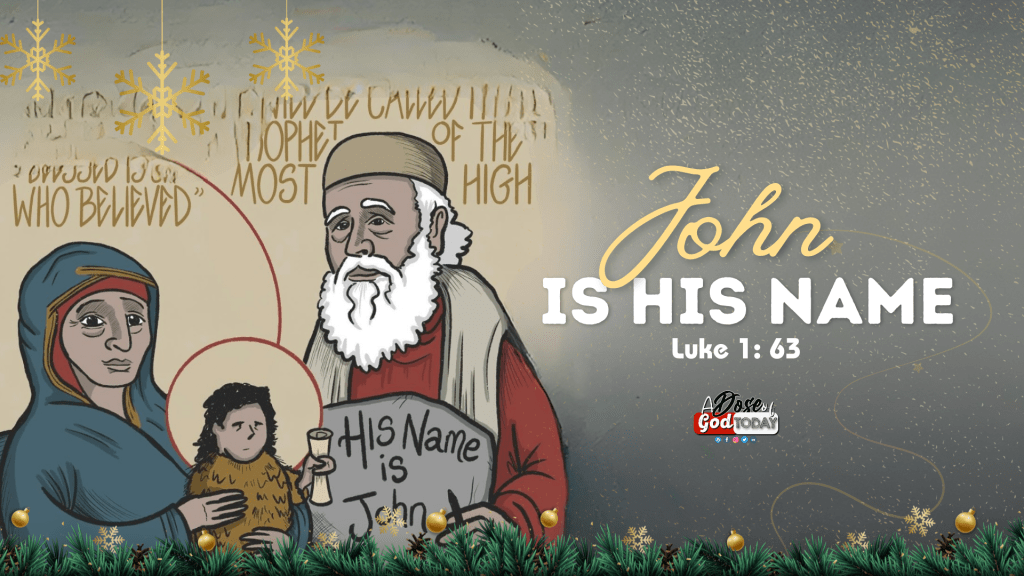
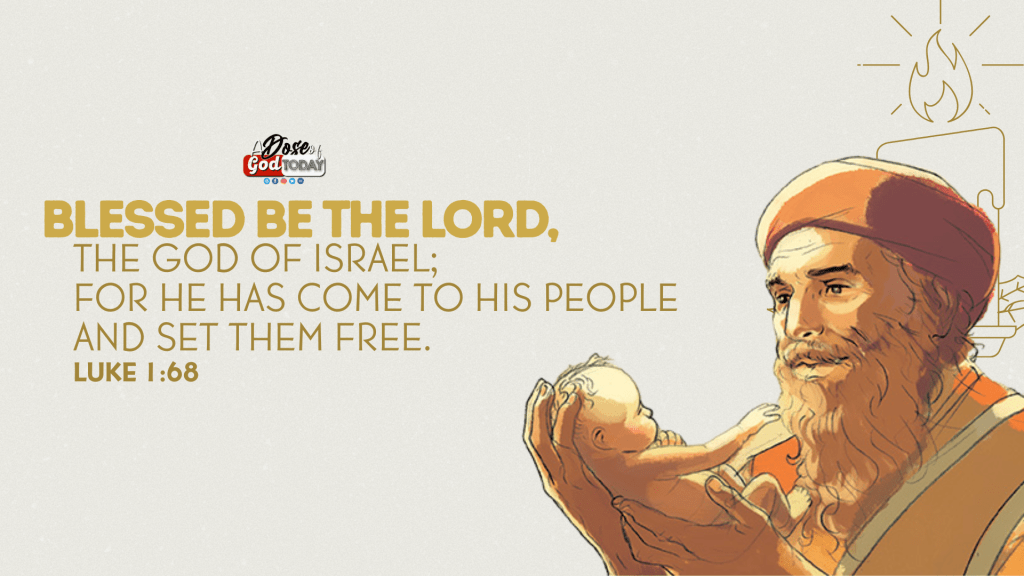
    Then suddenly, while Zechariah was doing his duty in the temple, an angel appeared to him. Gabriel announced that Elizabeth would bear a son. And his name would be John. The name John actually means “God is gracious!”

    And this child would prepare the way of the Lord. It was good news, indeed. In fact, a very good news. However, Zechariah could not help it. That good news was overwhelming and too much to bear and accept. Too good to be true for that matter. And so, the old Zechariah doubted. He asked, “How shall I know this?” In other words, “Sigurado ka ani, Lord? Tigulang na mi oi.”

    And because of his doubt, Zechariah was struck mute. He could not speak. There is something almost funny here. A priest of the Temple who preached the Word of God suddenly lost his voice. By muting Zechariah, God was saying, “Zechariah, enough talking. It’s time for you to listen well.” Thus, sometimes God allows silence not as punishment, but as a lesson for us.

    In both readings, it tells us something very important. That, indeed, God works even when we think it is already too late. God acts even when we have stopped expecting and hoping. And God remains faithful even when we laugh in doubt.

    Psalm 71 captures this beautifully. “You are my hope, O Lord.” From the womb to old age, God remains faithful to us. This psalm reminds us that our story does not begin with our success, and it does not end with our failure. God has been present all along in each of us and as a Church.

    What makes these stories powerful is not just the miracle of a child being born. It is the patience of God. It is because God waited and listened to prayers whispered for years. And when the time was right, God acted and revealed His grace.

    This makes us realize that Zechariah’s silence became a space for reflection. In that silence, God was working. And so, Elizabeth conceived and life began to grow quietly. We see that God did not rush and the Lord did not explain everything at once. God simply fulfilled His promise.

    Now, advent teaches us this same lesson. Many of us are waiting. And we wait for many things in life. Indeed, some of us have been waiting for so long that we no longer expect anything. We just laugh it off. “Bahala na ka Lord oi.” But deep inside, our prayer is still there.

    Today, the Lord remind us that He does not forget delayed prayers. The Lord does not abandon faithful hearts because God certainly, works in His time, not ours.

    Like Zechariah, we will have our doubts and questions. God may even lead us into silence. But silence does not mean absence. In fact, silence is often where God works best.

    As we wake up early for Misa de Aguinaldo, tired and sleepy, let us remember this: God is already at work, even when we do not see results yet. God is faithful, even when our faith is weak. God turns long waiting into unexpected joy. So, do not lose hope. Do not stop praying. Do not think it is already too late.

    I leave you now two simple takeaways for today.

    First, when prayers seem unanswered, do not give up. God is surely preparing something greater than you imagine.

    Second, learn to be quiet before God each day. In silence, God speaks and acts. So, allow the Lord to reveal His grace, in His time. Hinaut pa.

  • Learning to Wait and to Dream with God

    Learning to Wait and to Dream with God

    December 18, 2025 – Third Day of Misa Aguinaldo

    Click here for the readings (https://bible.usccb.org/bible/readings/121825.cfm)

    A few weeks ago, a friend shared something very touching and moving for him. He said that for the first time in his life, he dreamed of the Lord. In his dream, Jesus entered their gate in simplicity and gentleness. My friend welcomed Him inside. And as he stood there before the Lord, he suddenly began to cry. The Lord’s goodness and kindness made him realize how unworthy he is. He remembered his sins and failures. Yet, at the same time, his heart was filled with deep joy and gratitude because the Lord came to him. The Lord visited him. That dream awakened in him a new awareness that God is truly present, and that God reveals Himself in ways we do not expect.

    That experience helps us understand the message of today. Because sometimes, when our words fail, when our life is confusing, and when our hearts are tired, God speaks in our dreams. God speaks when we are quiet and at ease. Indeed, God speaks when we are patient enough to listen.

    Now, the word “patient” has two meanings. As a noun, a patient is someone who receives medical treatment, hoping to be healed. As an adjective, a patient person is someone who can endure delays, problems, and suffering without losing hope. These two meanings are closely connected. When we are sick and confined in a hospital, we learn that healing is not instant. We wait. We trust the process. We allow time and care to do their work.

    Life teaches us the same lesson also. We do not have control over everything. Even if our world today moves faster than before, not everything can be rushed. Some things take time. And If we refuse to accept this, impatience slowly consumes us. We become anxious and irritable. We lose peace over traffic roads, long lines, slow learners, and unmet expectations. This is how impatience damages our relationships. It also exhausts our heart.

    Yet, deep inside, many of us are waiting. Waiting for healing. Waiting for clarity. Waiting for dreams to come true. Waiting for change in our family or in ourselves. And waiting is never easy. That is why patience and waiting are not weaknesses. They are part of our Christian faith.

    This is what we realize today in our readings. The Old Testament is a story of waiting. God made a promise, and the people waited for generations. In the first reading from the prophet Jeremiah, God promises a righteous branch from the line of David. A king who will do what is right. A king who will save and bring peace. This promise did not happen overnight. It took time and required trust.

    So we ask today, “What is this promise? Or better, who is this promise?” The answer is Jesus. His name means “Yahweh saves.” Jesus is the fulfillment of God’s promise. This is God’s assurance that God has not abandoned us.

    But the way this promise was fulfilled was not smooth or comfortable. It was surrounded by scandal and misunderstanding. The Gospel tells us that Mary was found to be with child before she lived with Joseph. In a small town like Nazareth, this was enough to destroy a woman’s life. Gossip spreads fast and judgment comes easily. Mary was labeled without explanation.

    And so, Joseph suffered deeply too. He was a good and gentle man. And he knew their Jewish law. He knew Mary could be exposed to shame and even death. He had only two options whether to expose her publicly or to divorce her quietly. In his pain and confusion, Joseph chose mercy. He decided not to disgrace Mary.

    It was in this painful moment that God revealed His divine plan. God did not speak while Joseph was arguing, worrying, or forcing his own answers. God spoke when Joseph was asleep. Through a dream, an angel revealed the truth. “Do not be afraid,” the angel said. What seemed like scandal was actually grace. What looked like failure was God’s faithfulness unfolding there in that very mess.

    This detail is very important. God spoke to Joseph in a dream, when Joseph was rested. It was when he let go of control and he trusted enough to sleep. This means that to fall asleep in God’s presence is an act of patience. It is surrender. If Joseph had allowed anxiety to consume him, he would not have rested. Just like us, when worries and our anxieties keep us awake at night and make dark eye bags for us.

    And so, when Joseph woke up, everything changed. He saw and realized Mary’s situation not through fear and anger, but through faith. He saw it through God’s eyes. Joseph realized that God was present in the middle of confusion and pain. God did not remove the difficulty. But God revealed meaning within it.

    This is the patience we are invited to learn. Patience that waits. Patience that listens. And patience that discerns.

    Joseph’s life did not become easier after that dream. He still faced hardship, danger, and responsibility. But his patience was now rooted in trust. He knew that God was with him and that God was faithful to His promise. With this, Joseph became more confident because God is Emmanuel.

    This is also true for us. God still speaks to us today. Sometimes through Scripture. Sometimes through people. Sometimes through events. And sometimes through our dreams. The question is not whether God is present. The question is whether we are patient enough to notice and to realize God’s comforting presence because God comes often quietly and unexpectedly. And often when we are waiting.

    As we continue our 3rd Misa de Aguinaldo, let us bring to God our waiting as well as our dreams, our fears and our unanswered questions. Like Joseph, may we learn to trust that even when we do not fully understand, God is surely at work.

    And so I leave you again two simple takeaways today.

    First, when life asks you to wait, do not rush God. Be patient and trust that the Lord is working even in silence.

    Second, make space each day for quiet and prayer. God often reveals His plan when we learn to listen.

    And so, may we learn to wait with faith, to dream with hope, and to trust that God truly saves. Ok lang? Sana all.

  • From Our Family Broken Stories, God Brings Life

    From Our Family Broken Stories, God Brings Life

    December 17, 2025 – Second Day of Misa de Aguinaldo

    Click here for the readings (https://bible.usccb.org/bible/readings/121725.cfm)

    Today, very early this morning, we come again to the altar carrying our lives, our tired bodies, and our stories. We come as families. We come as sons and daughters. We come as people shaped by where we came from. And that is why the readings today speak deeply to our hearts. They speak about family, about history, and about how God works quietly but faithfully within our human family stories.

    When I was still a college seminarian, I remember one evening seeing my late father seated quietly at a table. He was carefully writing names in a record book. The names were unfamiliar to me. At first, I honestly thought it was a list of “utang” to be collected. So I asked Papa what was it about. My father smiled and told me he was tracing our family tree. He was writing down the names of our relatives, our great-grandparents, as far back as he could remember. He wanted to keep a record of our family history.

    Since our family is originally from Cebu, and I also studied there, my father would often tell me, “When you are there, visit this family, visit that family.” But to be honest, I was not excited about doing that. I was quite indifferent. I did not see the importance of reconnecting with relatives. But to my father, knowing our past mattered. He would tell me funny stories about our family, but also painful ones. Stories of shame, of mistakes and broken relationships. For him, our family history was not something to hide. It was something to remember.

    That simple experience helps us understand today’s readings. On this Second Day of Misa de Aguinaldo, we are invited to reflect on the gift of our family and the healing of our family history.

    Each of us is a product of a long and complex family story. Yet, we are not chained or doomed by the past. But we are shaped by it. Our families carry stories of joy and sorrow, success and failure, faithfulness and sin. Our family history is part of who we are. It forms our identity. That is why it is important to be in touch with it, not to glorify it, but to see how God has been present in our family stories.

    And so, let us discover the invitations of the Lord through our readings today.

    The first reading from the Book of Genesis shows Jacob calling his sons and blessing them. Among them was Judah. And Judah was not the most perfect son. Yet, from him kings would come from like King David. And from that same line would come Jesus. This blessing already points us to God’s plan unfolding through a human family.

    When we look closely, the family of Jacob was also far from perfect. And the Gospel today does not hide that. Matthew presents the genealogy of Jesus, a long list of names, a family tree filled with broken people and sinful stories. There was Judah, who sold his brother Joseph. There was David, who committed grave sins of adultery with Batsheba and the murder of her husband. There was Rahab, a prostitute. There were kings who practiced idolatry. King Ahaz and his grandson, King Manasseh burned their sons as sacrifices to the pagan gods. Indeed, this is not a clean or ideal family history. Yet, God did not abandon them.

    Matthew carefully lists forty-two generations, arranged in three sets of fourteen. In Jewish tradition, seven is the number of completeness. Fourteen is double seven. And repeating it three times is Matthew’s way of saying this that God is at work, perfectly and faithfully, even in imperfect human history. God writes straight even on crooked lines.

    The genealogy of Jesus is God’s message to us. God chose to enter human history not through a perfect family, but through a wounded one. Jesus was born into a family with a complicated past. This tells us something very important. God does not wait for us to become perfect before He comes to us. He enters our mess. He walks with us through our sins and failures. God indeed embraces our humanity fully.

    This is good news for us. Because when we look at our own families, many of us carry wounds while others have deeper and more painful wounds in the family. For certain, some carry trauma from violence or abuse. Some families are divided because of inheritance and money left by their parents. Some are struggling every day because of poverty. Others carry shame, guilt, or deep resentment passed on from one generation to another. And these are real, yet, God also sees them.

    Today, God invites us not to deny these realities, but to bring them to Him. Just as God worked patiently through the broken history of Joseph’s family where Jesus was born, God continues to work in our families today. He brings healing where there is pain. God brings reconciliation where there is division. And God brings hope where there is shame and discouragement.

    As Christmas draws near, God invites us to allow Him to be present again in our family stories. Not only in the happy moments, but especially in the wounded ones that we have. When we allow God to enter there, healing also begins. Slowly, quietly, but truly.

    As we continue this Misa de Aguinaldo, let us carry our families in our prayers. Let us trust that God has not abandoned our story. Now, I leave you two simple invitations as your takeaways.

    First, take time to pray for your family history. Name before God, the good and the painful, and ask for healing.

    Second, choose one simple act of reconciliation in your family. This can be through a message, a visit or to start a conversation that heals. Let God begin something new in your families.

    May this Misa de Gallo lead us to a Christmas filled not only with lights and songs, but with healed hearts and grateful families. Ok lang? Sana All.

  • Called to Shine: Young Hearts Bearing God’s Light Today

    Called to Shine: Young Hearts Bearing God’s Light Today

    December 16, 2025 – First Day of Misa Aguinaldo

    National Youth Day | Isaiah 56:1–3, 6–8 | John 5:33–36

    Maayong Good Morning! As we begin this first day of Misa Aguinaldo, the Church also celebrates National Youth Day. What a beautiful grace to begin our nine-day journey to Christmas by celebrating the hearts, dreams, and even wounds, and hopes of our young people.

    Today, we focus on one truth that even in the darkness of our times, God calls the young to shine.

    To help us enter this sacred story, we first welcome a young sharer. Her story becomes our doorway into the Word of God on this First Day of the Misa Aguinaldo. Her voice represents for us this morning the many Filipino youth who are also questioning, struggling, hoping, searching for love, and searching for God.

    And so, as a community celebrating the gift of the young to the Church, let us welcome Miss Allysa Joie Ambos.

    (Guide Questions for the Youth Sharer)

    1. As a young Catholic today, what is the biggest struggle or challenge that makes it hard for you to feel close to God? (This brings out real battles like pressures, family issues, identity, faith crisis, loneliness.)
    2. Despite these struggles, when and how have you experienced God reaching out, guiding, or comforting you?
    3. As you look forward, how do you hope to shine God’s light in your family, school, friendships, or Catholic Community despite being young and imperfect? (Invites hope, mission, and  desire to grow as a young disciple.)

    Faith Sharing of Allysa

    I grew up having few friends to spend time and play with. And this has made me feel insecure. As a child, I often wondered what was wrong with me. I felt alone and detached from people. I became guarded and judgmental. There was even a point when I accused God to be the cause of what I thought were my misfortunes in life.

    I never really liked socializing just to fit in. However, I exactly did so with the intention of being seen and accepted. I hated being ignored so much, that I was desperate to do the things that are against my will. But even when I had a lot of friends, I felt uneasy, sensing that something was amiss.

    You see, I had a very poor understanding of who God is. I’m not sure when I had recognized it. My thirst to knowing Him came from a need, a calling, a search that I thought unrealistically must be satisfied, followed and found.

    At first, I relied upon books to know Him. Later on, I switched to fishing affirmations and chasing people. Up to this point, I’m still confused.

    In the loudness and overpopulation of our modern world, I realized He is actually nowhere to be found.

    To know someone, you must be able to converse and soak in their presence. But God’s language is the hardest to learn. You have to really listen, because He speaks in silence.

    I nearly thought this treatment implies His lack of love and care. I’d often ask when praying, “Why do you hide yourself from me?” I figured I was unworthy and that if even God doesn’t love me, who will?

    It took me a couple of years to realize and admit that it was me who was in hiding. I was too focused on myself that I failed to consider what others might feel because of my dismissive words and behavior. I subjected myself to the wrong kind of introspection and censure, overemphasizing on my faults and lapses. I was worried I couldn’t keep up with the fast paced world. I felt helpless and anxious as I thought how uncertain I am of Him and even of myself. I was scared and terrified.

    But God has always been there. Whenever I secretly starve myself as punishment for my unpreparedness or poor performance at school, my family would always remind me to take care of myself. My mom and sister Janna personally cooks me delicious meals that’s hard to resist. Whenever I’m dejected and in isolation, my Kuya AJ knocks on my door, offering his weird humor and comforting presence. He is the reason why I joined CSO. Although I had the intention of avoiding house chores then, God has indeed, a way of transforming our hearts.

    Sojourning with my family and peers in CSO has taught me invaluable lessons. They taught me that faith does not mean we know all the answers; that in spite of the uncertainty, we still dare and have the courage to let our questions be asked, unafraid, to be convinced of the reliability of God. And that the service we offer in helping each other to believe may be the best and authentic service we can render.

    After listening from a young person speak, we cannot also ignore that our youth today are carrying heavy and often silent burdens. Recent youth studies in the Philippines reveal that…

    1 in 5 Filipino youth aged 15-24 wrestles with depressive symptoms, anxiety, or emotional distress.And most consider ending their lives by suicide.[1]

    Many also face family instability—broken families, long-distance parenting, financial strain, or domestic conflict.[2]

    With 8 hours and 52 minutes online per day,[3] youth battle comparison, insecurity, identity confusion, cyberbullying, and disinformation.

    Many struggle with self-worth, nomophobia[4] or smartphone addiction, pornography, or the pressure to appear “okay” even when they are breaking and hurting inside.

    A significant number feel far from the Church, saying faith seems distant from real-life problems. Yet,Filipino youth are more and more looking for authentic expressions of faith that they would not necessarily find in conventional practices or conventional piety.[5]

    And so countless youth worry about their future, education, safety, jobs, and mental well-being.

    These ate realities that can create darkness. Sometimes quiet and sometimes overwhelming where many young hearts would whisper, “Lord, am I enough?” “Do I still belong?” “Is there a place for me?”

    Now, allow me to bring you into our readings today and let us also realize how God invites us.

    Isaiah speaks to a wounded community who have just returned from exile but broken, unsure, and feeling unworthy. Some believed they didn’t belong in God’s house because of their status or imperfections.

    But God proclaims in the Book of Prophet Isaiah something radical and touching. God says, “My house shall be a house of prayer for all peoples.” Yes, for all peoples not just the perfect, not just the strong, and not just the holy.

    This is God’s message to the Filipino youth and to everyone. You belong. You are welcome. You are seen. Yes, your struggles do not disqualify you. Your wounds do not push you away. And your doubts and questions do not make you unworthy.

    Isaiah’s prophecy tells us now that belonging comes before perfection. God gathers first then God heals us. This speaks powerfully to a generation longing for acceptance, for identity, for a safe place to return to, and for a home to be embraced.

    Moreover, in the Gospel, Jesus describes John the Baptist as a “burning and shining lamp.” John is not the Light but he reflects the Light he receives. Jesus affirms that God’s work in the world is shown through our real action of healing, loving, welcoming, lifting people up.

    This is the invitation for every Filipino youth now that you do not need to be perfect first to shine. Just receive God’s light and share it. Our young generation longs for authenticity. You are indeed, searching for faith that heals, not just teaches; a Church that listens, not just speaks; and a community that embraces, not just corrects.

    John the Baptist shows that shining for God is not about age, power, educational attainment or status. Bringing light is about courage, our honesty and humility, and our heart willing to love and be loved.

    Our readings today, Allysa Joie’s faith story, and the realities of our time converge into one powerful truth that God certainly, calls young people to shine not later, but now.

    And your context is there in  our families struggling with tension, in schools full of pressure, in online spaces filled with noise and disinformation, and in a society hungry for justice. These are the spaces that the youth can be God’s light.

    Remember that your compassion, your creativity, your voice for peace, your desire for truth, all these can illuminate the darkness around you. You are not the Church of tomorrow. You are the Church of today. This is what Pope Francis had told us, and now Pope Leo reminded us. God calls you now to witness, to serve, to love, to hope, and to shine.

    With all of these, I leave you now two takeaways.

    First, grow in God’s Light. You may choose one small spiritual commitment this Misa Aguinaldo. This can be a short daily prayer, or reducing online noise, in forgiving someone, or helping at home. Remember, small lights change dark rooms.

    Second, share God’s Light. You may do one act of kindness or honesty each day. You can encourage a friend, listen without judgment, stop online negativity, or say a sincere “thank you.” Be a lamp so that others can follow.

    Indeed,may this first dawn of Misa Aguinaldo awaken our young people and inspire every generation present this morning. Embrace this now that – You belong. You are loved. And You are light. Hinaut pa.


    [1] https://www.uppi.upd.edu.ph/news/2022/pinoy-youth-in-worse-mental-health-shape-today

    [2] Donna B. Dioquino, UNRAVELING LIVES: THE FAR-REACHING CONSEQUENCES OF BROKEN FAMILIES, https://eprajournals.com/pdf/fm/jpanel/upload/2024/December/202412-01-019460

    [3] https://www.meltwater.com/en/blog/social-media-statistics-philippines

    [4] Nomophobia is the fear of having no smartphone or losing it.  See https://www.sciencedirect.com/science/article/pii/S2590291120300243

    [5] From Jayeel Cornelio, see https://preda.org/young-filipinos-keep-the-faith-but-shun-conventional-piety/

  • Rejoice, God is near and working even in our waiting    

    Rejoice, God is near and working even in our waiting    

    December 14, 2025 – Gaudete Sunday

    Click here for the readings (https://bible.usccb.org/bible/readings/121425.cfm)

    We, Filipinos, know what it means to wait. We wait in long lines for government services. We wait for traffic to move. We wait for our salary and benefits to come in. We wait for relief goods after a disaster. We wait for healing when sickness enters our home. We wait for loved ones who work abroad, praying that they come home safe.

    Even in our personal lives, we also wait for many things. We wait for our parcel to arrive. We wait for our relationships to be repaired. We wait for our friend to speak to us again. We wait for our anger to cool down, for peace to return to our hearts. We wait for our debts to be paid. We wait for our dreams to come true. We wait to be loved, accepted, and embraced again.

    However, we also realize that some people wait longer than others. And the longer we wait, the more discouraged we become. And so we lose patience. We lose peace, become anxious, irritated, tired. Some even begin to stop moving forward, to stop dreaming, to stop hoping because it has been already exhausting to wait.

    These are our very real experiences. Many are exhausted emotionally. Some feel lifeless, controlled by bitterness or guilt within the heart. Others feel stuck, as if nothing will ever change.

    This is why today’s readings are so beautiful because God speaks directly to people who are tired and exhausted of waiting.

    The prophet Isaiah, in the first reading, spoke to a people who had suffered for decades. The Israelites were exiled to Babylon. It was about 1,700 miles away. They were forced to walk for months in misery. They believed it was because of their failures and the failures of their leaders and forefathers.

    They waited for God to rescue them. But years have passed and nothing changed. They felt abandoned and miserable. Yet, deep within the heart, there was that voice of hope that continued to pray, “Lord, come and save us!”  This is what our Psalm proclaims today.

    Indeed, many of us could have felt that way too. And so Isaiah stood  up and proclaimed with a loud voice, “Be strong, fear not! Your God will come and save you!”

    And then Isaiah painted images of hope, “the blind seeing, the deaf hearing, the lame leaping, deserts blooming, sorrow and mourning fleeing away.” These images are God’s promise of healing, reconciliation, restoration, and freedom. This is why Gaudete Sunday is all about JOY because God has not forgotten His people. In fact, this is symbolized by the third candle in pink which reminds us to rejoice!

    St. James, in the second reading, taught us something important, “Be patient.” He used an image we understand well referring to the life of a farmer. A farmer cannot harvest tomorrow what he planted today because everything takes a process.

    And certainly, healing is a process. Forgiveness is also a process. Reconciliation is also a process. And so growth takes time. Healthy relationships take patience.

    James taught us now to trust God’s process and to trust God’s grace working slowly but surely in our lives. Powerfully, James also added, “Do not complain about one another.” Why? Because complaining, bitterness, and negativity in the heart blind us. They make us forget that God is actually moving and working.

    Moreover, John the Baptist in the Gospel was also tired and discouraged. John was already in prison this time. John was surely suffering. And he asked Jesus, “Are you the one who is to come? Or should we look for another?”

    This is the cry of hope from a man who is barely holding on, at the brink of giving up. Have you also ever prayed like this? “Lord, are You really there? Are You really coming to help me?”

    Jesus replied in the most tender and powerful way; “Go and tell John what you see: the blind see, the lame walk, the deaf hear, lepers are healed, the poor receive good news.” In other words, Jesus was saying: “John, do not lose hope. I am already working. Salvation is already happening.”

    We realize now that Gaudete Sunday is not a denial of suffering. It is not pretending that everything is fine. Gaudete Sunday is courage. It is choosing to rejoice even when life is difficult not because our problems are solved, but because God is already here, moving quietly, faithfully, and lovingly.

    Realize this too because there is an even greater truth that Jesus becomes present today when we become more like Him. Meaning, when we choose to heal instead of hurt, when we choose to reconcile instead to remain angry, when we choose honesty over corruption, when we help the poor and encourage the discouraged, then we become signs of the Messiah in our communities. We become Christmas for others. And that is a real reason to rejoice.

    I leave you now three concrete invitations as your takeaways on this Gaudete Sunday.

    First, encourage one person who is tired of waiting. Send a message or make a short visit and remind the person, “God has not forgotten you.”

    Second, do one small act of healing. Forgive someone, greet someone you avoid, or pray intentionally for someone you struggle with.

     Third, spend 5 minutes in silence and say: Lord, You are near. Teach me to trust Your timing.” Let this prayer soften your heart and make room for joy.

    And so, rejoice, not because life is perfect, but because God is near. God is faithful and God is already at work in our waiting. Hinaut pa.