Category: Reflection

  • BOOK REVIEW: A Heart That Does Not Cease to Dream – A Missionary’s “Jagged” Life Journey

    BOOK REVIEW: A Heart That Does Not Cease to Dream – A Missionary’s “Jagged” Life Journey

    By Fr. Antonio Ma. Rosales, OFM

    A Book Review

    “A Heart That Does Not Cease to Dream – A Missionary’s “Jagged” Life Journey”

    Author: Fr. Ramon O. Fruto, CSsR

    Publisher: Claretian Publications Foundation, Inc., 2023

    The title of the book impressed me immediately.  But the subtitle, A Missionary’s “Jagged” Life, was puzzling because of the word “jagged,” which means “having a sharply uneven edge or surface” or “having a harsh, rough or irregular quality.”  This word is properly used to describe the events in this book.

    With introductions by the Archbishop Emeritus of Davao, Most Reverend Fernando R. Capalla, D.D., the Provincial of the CSsR Cebu Province, Very Rev. Fr. Edilberto Cepe, CSsR, and Bro. Karl Gaspar, CSsR, the 153-page manuscript has three parts: the first being “From Boyhood to First Assignment,” with 17 chapters: the first three are about his early life; four to nine are on his experiences during the Second World War; and 10 to 17 are on the birth and development of his Redemptorist vocation, ecclesiastical studies and first assignments.  

    This first part was like entering a dining area with a buffet lunch, with everything for everyone.  The narrative is replete with emotions told in graphic, awe-inspiring, bone-crunching, teeth-rattling incidents that I did not always know whether to smile, laugh, grind my teeth or just hold on to my seat and enjoy the ride, symbolically speaking.  And I am talking only about his childhood.  

    The chapters on the Second World War were like going up a mountain and reaching the top, one catches one’s breath, heaves a sigh of relief and marvels at the breath-taking panorama around, as if trying to drown the horrible effects of war, that we have seen in films or get more realistic details from what’s going on between Russia and Ukraine.  If I was able to relate to his childhood, I could relate even more to his experiences of the war years, even if I was only as old as one of his younger brothers.  

    I was struck by how tenderly and even lovingly Fr. Ramon wrote of his childhood, an approach that is common in most life stories, and even – for us – when we speak about that stage in our lives.  Somehow those years appear larger than life or reality.  We find this in the lives of heroes, whether of myth or history, and even in the infancy narratives of the Lord.  As we look that far back, we see those years shaded in a mist of idealism, innocence, the promise and vision of a future… one that we find verified in the next pages of Fr. Ramon’s book.    

    The next chapters are on how his Redemptorist vocation came about, the priests and brothers who inspired him, partly because life in the seminary after the war was more stable, predictable and with somewhat even better food and accommodations, all through the years of his formation, partly in Bangalore, India.  In India, he got used to the weather, the food, the community life, and the unmistakable scent of curry coming from the pores of people.  There were also the strict academic formation and some pastoral exposures when he had to speak Tamil.  The much-appreciated trips to  ancient temples and surroundings were highlights of his stay in that country. 

    His return to Cebu after almost eight years was exciting as he was welcomed in Mandaue like a pop star or a winning politician with a motorcade, fireworks and all the perks our culture offers to a good-looking young priest who had studied abroad, and with the special distinction as the first Filipino Redemptorist priest.

    Though Part One covers more than one-half of the manuscript, it is good read.  In the 13 chapters of Part Two, “Experiences as a CSsR Missionary in the Field,” Fr. Ramon wrote of  his assignments in the Redemptorist community, some pastoral work, and further studies abroad.  His experiences added spice and flavor to the responsibilities entrusted to him as formator to generations of Redemptorist and diocesan seminarians, as well as in different offices related to administration.  In whatever assignment or responsibility he was asked to undertake, Fr. Ramon showed wisdom, practicality, humor and a spirituality that is both down to earth and insightful.    

    The narrative of Part Two is more somber than that of Part One, mostly serious stuff but captivating nonetheless, like Fr. Ramon’s work with the Redemptorist team to revise the traditional program of the mission days conducted in parishes or communities, mostly in Mindanao.  The revision was done more than once, thus showing his openness to respond to new challenges and situations.  Two poignant episodes stand out: one involving a lady working with him who was gunned down in her home, on suspicions of being a leftist; Fr. Ramon called her a martyr.  Then there was the lady in California, USA, in the same bus with him.  Though with no particular religion, she perceived him as a man of God.  Such incidents are scattered in Part Two, to reveal a less evident aspect of his spiritual depth and maturity.  

    Lest we fail to see the forest because of the trees, it is in Part Three where Fr. Ramon shared what he had in his heart, “That Does not Cease to Dream,” as the title of the book says.  The first of the four aptly titled “Faith Reflections,” is on the vow of poverty.  It is enlightening, as both the spirituality involved and the practical suggestions are down-to-earth.  The reflection on Lay Empowerment: the CSsR Lay Cooperation reveals his insight on Synodality, the current direction of the Church.  

    The third reflection: The Ascension and Leave-Taking on relationships and separation reveals an undercurrent of a sense of loss that does not lead to an empty sense of fatalism and despair, but to a hope, nurtured by faith.  It is a touching piece that offers the human experience of separation a comforting assurance that a reunion is waiting beyond the grave.  The last reflection, “Four for the Road,” is not just a sentimental take on what’s ahead for Fr. Ramon and his surviving batchmates, but a veiled affirmation of their undying love for their Redemptorist vocation. 

    This book can enkindle the flickering flame of a mission spirit to become a lamp on a lampstand, to inspire the candidates to the Redemptorist Congregation and its coworkers. They will find here a simple but captivating summary of what it means to be a Redemptorist.  From the life testimony and reflections of Fr. Ramon, they can stand tall and face the future, shaped by recent developments in the world, the Church, in the Redemptorist Congregation, in our local church and in our country.  These are developments that need a stronger moral stand for justice, peace and the defense of the environment.  

    As they continue to read the signs of the times in the light of the Gospel, they will discover how to develop the new wine skins in which to pour the new wine of the Spirit, as Fr. Ramon and the Redemptorists of his generation have done.

    (Fr. Antonio Ma. Rosales, OFM, is a distinguished Moral Theologian who has taught in a number of seminaries and theological institutes like the St. Aphonsus Theological and Mission Institute in Davao City.  At one time in his life, he served with the Department of Foreign Affairs in the Philippine Embassy in Rome and as parish priest in the Franciscan parish in Makati City. He has also authored a number of journal articles and books. He is now part of the community of OFMs administering the San Vicente Ferrer Parish in Cebu City..)

    Books are sold at P400/copy available at St. Clement’s Retreat House in Iloilo City (where Fr. Ramon will sign copies on March 12), Redemptorist convent in Iligan City (where Fr. Ramon will sign copies on March 4), and in the Redemptorists parishes in Cebu and Davao.


  • IN SEARCH OF THE TRUE MEANING OF THE FEAST OF THE EPIPHANY

    IN SEARCH OF THE TRUE MEANING OF THE FEAST OF THE EPIPHANY

    The Epiphany of the Lord

    Many decades ago as we were growing up, January 6 was celebrated by the Christian world as the Feast of the Three Kings. The event being celebrated was the arrival of Melchor, Gaspar and Balthazar in Bethlehem to offer gifts of gold, frankincense and myrrh to the newly-born child whom they came to worship.

    Today, liturgically this is known as the Feast of the Epiphany (referred to as Theophany for Eastern Christians). Epiphany means the manifestation of a divine or supernatural being and for us Christians this feast celebrates the revelation of God incarnate in Jesus. Instead of referring to the three visitors as Kings, they are now more popularly known as Magi or Wise Men.  Across the world the celebration can range from January 6 to whatever is the Sunday nearest this date.  Thus in our country, it would be celebrated on January 8.

    Except for Matthew (Mt 2: 1-23), the narrative involving the three Magi does not appear in the accounts of the three other Evangelists. It is a very brief account where the tyrant ruler Herod is also mentioned.  There are very few details that help us know the wise men better except that they were from the East and that their journey to Bethlehem was guided by a star. Otherwise, the narrative ends up as a mythical story shrouded in mystery thus leading to all kinds of conjectures.

    Consequently, many have deconstructed the text and provided a deeper meaning to this narrative. Just this year on the Feast of Epiphany (celebrated at the Vatican with Cardinal Luis Tagle presiding and Pope Francis giving the homily), the Pope provided us his own reflection of the meaning of the Epiphany. Thus, his words:

    “The Magi’s restless questioning and continuous journeying in dialogue with the Lord finds its end in the worship of God… Like the Magi, let us fall down and entrust ourselves to  God in the wonder of worship. Let us worship God, not ourselves; let us worship God and not the false idols that seduce by the allure of prestige and power…  let us love God and not bow down before passing things and evil thoughts, seductive yet hollow and empty.

    The purpose of everything is not to achieve a personal goal or to receive glory for ourselves, but to encounter  God. To let ourselves be enveloped by his love, which is the basis of our hope, which sets us free from evil, opens our hearts to love others, and makes us people capable of building a more just and fraternal world.”

    We can further reflect on how this narrative relates to our contemporary life in our own society and focus our reflection on who were these wise men? The biblical reference indicates they were from the East, which should make it interesting for us Filipinos as we are in this part of the world – the East or the Orient. Some writers theorized that they came from the nearby countries of Israel, namely Persia (now Iran) even as far as India.

    But why were they referred to as wise men? Relying on ethnographic data providing us data  on the Oriental civilizations existing long before the West entered into its Industrial Revolution, there were advanced societies already existing in the Orient from China to India to the Arab countries. They had developed the various fields of philosophy and science, much earlier than the Western world.

    Thus, we can conjecture that Melchor, Gaspar and Balthazar – as they were guided by the star – had knowledge of astronomy if science had developed to that extent during that era. There is, however, one better explanation that anthropologists would posit. Could they be shamans who had developed the gift of communing with the supernatural?

    If they were coming from the East, what faith traditions have evolved in their societies? While there were established religions already during the reign of Herod in other parts of the world and in Israel (Hinduism, Judaism, etc.), Islam and Christianity were still to evolve. But were the magi also shamans who served as ritual officiants of their communities which were ensconced within an indigenous belief system?  We know for a fact that across the world and through the centuries, shamans have developed a keen sense of understanding the mystical realm.  Could this have been the case of the three wise men?

    Perhaps it is futile to have the answer to this question even if there theologians who would like to pursue this question in dialogue with anthropologists. However, we can expand the search of meaning and link it with our attempts to better pursue some of the pastoral challenges in our post-Vatican II Church especially in the discourses of inter-faith dialogue and inculturation.

    A fundamentalist reading of the Matthew text would insinuate that as the magi worshipped the child as God, they had abandoned whatever faith tradition they belong and embraced a new faith. On the other hand, a progressive reading of the text allows for an encounter of faith traditions in dialogue with each other. Thus the Matthew narrative would be very useful for advocates of inter-faith dialogue, as one of the first events in Jesus’ early life pointed to the possibility of faith traditions entering into a dialogue with each other.

    In this day and age, when there are still countries where different groups of believers – Christians, Jews, Hindus, Muslims, Buddhists and others –  are engaged in conflicts leading to the eruption of violence, the encounter of Jesus and the Magi provide the hope that a day will come when all faith traditions would learn to embrace the gift of an encounter that brings peace!

    When that moment arises, all of earth’s people of goodwill can truly celebrate all together a feast of the Epiphany no matter what faith tradition they worship God (in whatever God’s name is invoked!).

  • THE MOST PRECIOUS CHRISTMAS GIFT!

    THE MOST PRECIOUS CHRISTMAS GIFT!

    For those who have the means, one cause of stress during the Christmas season is what gifts to give to one’s loved ones? This is especially so if they seem to have all that they need and are not wanting for anything else. We do not want to give gifts that will only end up in the cupboards or recycled as gifts to others.

                Godparents get perplexed when having to think of the appropriate gifts to their godchildren who do expect something from them during the Christmas season. It is easy enough when they were kids, as there is a variety of toys to choose from. And kids love any toy that they receive especially the ones popular at the moment.  But when they reach adolescent or early adulthood, one wonders what gift they would appreciate. To be safe, godparents resort to just giving gift cards of superstores or outright cash.

                OFW parents are even more pressured if they are not at home for Christmas. To compensate for their absence during this season, they spoil their kids and it could turn out to be expensive as kids demand gadgets that could cost a fraction of their salaries. But it is not just their children expecting gifts but the whole clan which explains the phenomenon of those big Balikbayan boxes that flood our airports at this time of year.

                And additional source of anxiety these days is the impact of inflation and the ensuing  high prices of commodities on one hand, while salaries have no correspondingly increased. Some companies even could no yet afford to give a 13th month bonus. Considering the high costs of Christmas with demands for a delicious noche buenas and other expenses, there is hardly left to buy gifts.

                On the other hand, there is also an interesting development in terms of undermining the crash commercialism that has characterized the Christmas holiday season. To make sure that they are not held captive by the pressure to go to the malls and shop till they drop, they refuse to even buy anything. Instead the more altruistic ones would rather distribute goods to the needy or give their money to charitable institutions or cause-oriented groups.  We can only hope that this kind of movement would expand and more people are involved in spreading Christmas cheer among our less fortunate sisters and brothers.

                If there is someone out there who wonders how best to respond to the question – what gifts to give to loved ones? –  let me offer this reflection. At a most recent time when I thought I was already destined to depart from this earth, I asked myself what was it that I would miss most? Or what would I have no difficulty letting go?  I realized I could let go of:

    –         Ice cream, halo-halo and all those wonderful pastries in bakeshops

    –         A really delicious meal in a fancy Vietnamese restaurant

    –         Bagel, croissant, pretzel and those freshly-baked bread

    –         A swim in the warm waters around the islets of El Nido, Palawan or in a lagoon underneath a waterfalls

    –         A fabulous sunrise or a gorgeous sunset with the wind caressing the coconut trees

    –         A climb up the mountain and then viewing a sea of clouds

    –         Travels to Baguio and Bali, Paris, New York or Rio de Janiero

    –         Films of Kurosawa and Trauffaut, concertos of Mozart and Bach

    –         The best of Filipiniana films, music, art and literature

    –         Songs of Simon and Garfunkel, the Beatles and Frank Sinatra

    –         Gardening, reading Booker prize-winning novels, writing fiction

    –         And a few more favorite things to do

    Photo by Sandino Madelo, Christmas 2021

    It goes without saying that I would not let go of my faith in the Triune God and of God’s plan of salvation that continues to unfold. To have been gifted with this faith has led many to a meaningful life allowing me a glimpse of what is God’s promise for humanity. It has also brought me to many communities where I could inter-act with peoples of great charm and generosity. It allowed me to experience moments of peace and great joy. And it brought into my life many co-believers to be able to constitute communities of mutual support, deep affection and compassion for each other.

    Then I realized there was one thing I would not let go for I would miss this very much. And it is this: the love and affection of family, confreres and the closest friends especially those whose friendships have lasted a lifetime. Who I am today and what I have accomplished in my life may be due to their support, encouragement and prayers.  The wonderful moments I have enjoyed through my life – especially at certain special occasions – were in their company. There was utter happiness that could only arise in their presence.  If there are memories to keep in my heart, their faces would appear.

    Indeed, the gifts of kinship, confrereship and friendship are the most precious gifts for me. And these are gifts given from Christmas season to Christmas season as well as throughout the years. These need not be wrapped in fancy paper and silk ribbons for these are offered from the heart. Every Christmas, I have always felt blessed because I knew I continue to receive these precious gifts. If I have these gifts, really what else do I need?

    So, dear reader, do not worry what gift to give your loved ones.  By embracing them in  your heart, wishing and praying for their well-being, assisting them in their times of need and loving them in a manner that makes them feel deeply appreciative – you would have given the most precious of gifts!

    And it is a gift that goes beyond Christmas!

    A blessed Christmas to one and all!

  • A Reflection of a Pastoral Counseling Volunteer

    A Reflection of a Pastoral Counseling Volunteer

    In July 2021, I committed myself to being a volunteer pastoral counselor at St. Clement’s Pastoral Care and Counseling Ministry. I knew about this program from the ministry’s Facebook page. I am happy knowing that counselors whom I know (since we are from the same university) are volunteers of this program. It caught my attention, and I felt a bit of interest in being part of this worthwhile community service.

    God truly knows my heart’s desires, so when one of the inspiring people, one of the people behind this program, Dr. Baby Rose Robles, invited me to join their group, I was overjoyed. And this is it! I never hesitated, and I said, “Sure, I want to.”

    It was still in the midst of the pandemic, and we counselors were grappling with this alternative mode of counseling, which is tele/cyber/online counseling. God prepared me for this when, at the height of the COVID-19 pandemic, professionally all I could do was attend webinars in this mode of counseling.

    There came my first client in the ministry in August, then another, and several more. Because He prepared me for this, I was able to trust my competence. I fervently prayed and hoped that I would be able to help them, help themselves.

    Now, my two Sundays every month are dedicated to this service to the community. I loved going to St. Clement’s Church and, more so, to the Pastoral Care and Counseling Ministry Office with its homey atmosphere for face-to-face sessions. In spite of the exhausting weekly tasks that I attend to, I eagerly look forward to seeing clients, listening to them, and probing together for solutions to the circumstances they experience. How good it is to have this rewarding feeling at the end of the session, hearing how they have been relieved of the heavy emotions that have tormented them for some time.

    Forrest Gump said, “Life is like a box of chocolate; you never know what you’re going to get.” Yes, it’s true; every time I enter the center, I know that I will hear issues, concerns, dilemmas, challenges, traumas, and emotional wounds, but it is still for me to find out how deep those are.

    For almost all of them, circumstances have threatened to be overwhelming. In the respite of silence during my sessions with them, I feel a tickle of hope. How I thank you, Lord, our Emmanuel, for showing them the way to our ministry. I see You in the various faces and pitches of pain. As much as I am able to help them, I have been helped as well, as I have come to many realizations about life and suffering. How, despite everything, knowing You’re with us makes everything bearable.

    God is like our leader; we do our tasks as members, and we do not worry if there is more to do, and if we fall short of our abilities; trust our leader; He is in control,” I always tell my clients. Then, I saw a grin, and, sharing the same confidence, we both smiled. My faith in God has been my protective factor, as I personally affirm what the studies say: that people who trust in His faithfulness can easily cope with stressful life circumstances and are able to find meaning and see hope.

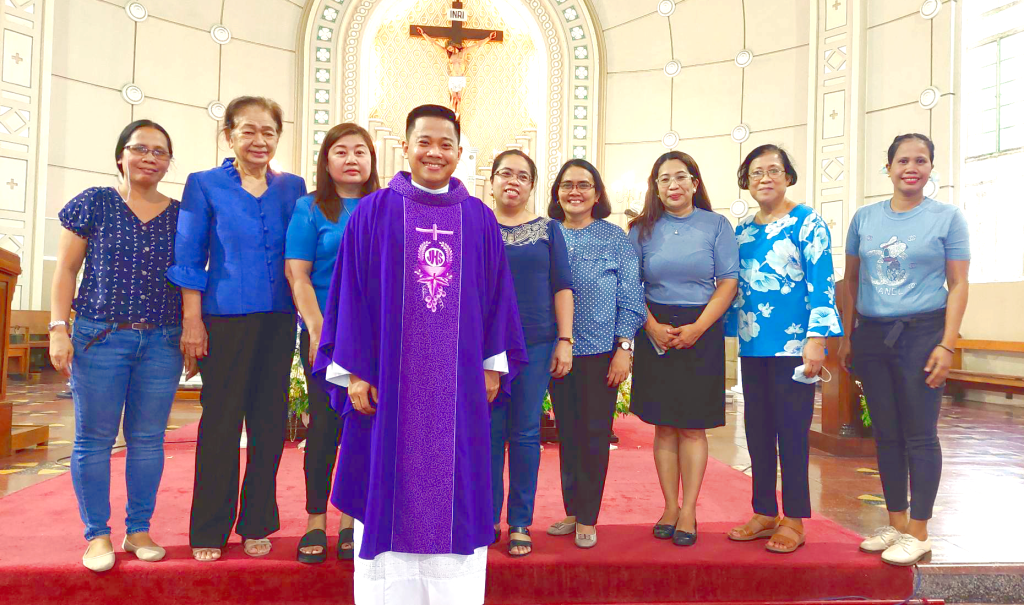
    With Fr. Jom Baring, CSsR and the Pastoral Counselors after their Renewal of Commitment to the ministry.

    From the various faces of suffering that we are facing today—emotional and psychological wounds, traumatic pasts, and haunting guilt, among others—God, who is with us, is inviting us to the safest space where we can run—to His arms. “Praise be to the God and Father of our Lord Jesus Christ, the Father of compassion and the God of all comfort, who comforts us in all our troubles, so that we can comfort those in any trouble with the comfort we ourselves receive from God.” (2 Corinthians 1:3). His arms hold security and affection. Who doesn’t want to belong, then?

    He is telling us to further trust the process. What we endure right now can be very challenging and at times very exhausting, but haven’t we been assured of the outcome? How can we be afraid of the battles that we are currently in when we know that ultimately we will win them? God has assured us of strength, wisdom, and redemption. Let us let go and have faith that things will work out as they were intended to in their ripe and perfect timing. Although this process is lengthy and rigorous, it renews our attitude and character to be pleasing to Him. 

    Lastly, He invites us to surrender and commit our lives to Him. Remembering His promise in Isaiah 40:29–31 “He gives strength to the weary and increases the power of the weak.” Even youths grow tired and weary, and young men stumble and fall, but those who hope in the Lord will renew their strength. “They will soar on wings like eagles; they will run and not grow weary; they will walk and not be faint.”

    Moreover, our kindergarten days would let us recall, the childlike faith that we have, through this song,

    “ Ang mga pispis nga nagalupad, gin- atipan sang Diyos
           Nagahimo pugad…
      Ang mga isda nga nagalangoy, gin-atipan sang Diyos
          Wala nagnguyngoy…
      Ang mga kahoy nga nagasanga, gin-atipan sang Diyos
          Madamo ang bunga…
      Ang mga subay nga nagkubay, gin-atipan sang Diyos
         Wala nagsu-ay…
     Labaw kita sa ila kay larawan kita sang tagtuga
          Indi magkasubo, mga utod ko …”

    My childhood days are indeed the best days of my life. It’s where I am so carefree, happy, and peaceful because my mother and father are there to oversee my needs. Well then, God’s invitation brings us to this state; who would want to refuse serenity and contentment?

    Thank you for lending me your ears as I share with you my reflections as a volunteer pastoral counsellor in this momentous occasion. My gratitude Father Jomil Baring for giving me this opportunity to share my thoughts.

    About the Author I Marie Rosette Lacuesta-Cainday
    ( She is Licensed Guidance Counselor who volunteers and gives her time and presence for the St. Clement’s Pastoral Care and Counseling Ministry, Iloilo City)
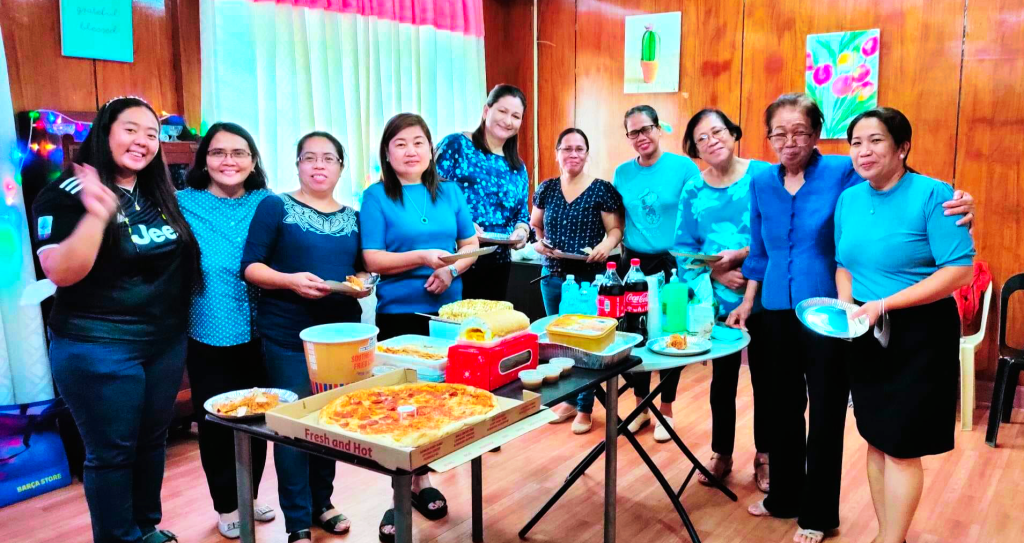
    Volunteer Pastoral Counselors with Maam Rosette at the far right.
  • IN GOD’S OWN TIME

    IN GOD’S OWN TIME

    As we approach the end of the Advent season and embrace the spirit of the Christmas season, let me offer this reflection. 

                Because we Christians have regularly entered into the four-year period of Advent for a very long time through the centuries, there are times when we hardly give full attention to the significance of this period.  This is especially here in the Philippines where we anticipate Christmas so early that we begin to already prepare by September, looking forward to the festivities and celebrations that come with Christmas and New Year.

                I confess that I am no exception especially since our work in the missions keep us so busy that there really is very little time to do serious reflection.  However, it was different for me this year on account of a serious and life-threatening illness requiring hospitalization. As the Advent season began I went through an agonizing ordeal in an ICU in a hospital in Manila.

                The days went very slow as there were complications in the medical procedures including undergoing two operations so I could be provided the means towards a peritoneal dialysis system. This meant  having to endure the pains, the inconveniences and boredom of being confined in a room without a window. For the next three weeks, there was no end in sight, no definite word from the doctors as to when I could be discharged.

    Thus the waiting, what seemed like an endless waiting.  Waiting for the pains to subside. Waiting for the moment when I can drink water again and be fed solid food.  Waiting for the wounds to heal. Waiting for a sign that I was on the road to recovery. Waiting for the moment when I can talk and walk again. Waiting for the doctors to finally announce that I could be released from this confinement. Even as the body pains were quite excruciating, the waiting in itself was a source of agony.

                It was in the midst of these sufferings that it dawned on me that the Christian world had just entered the Advent season and I was provided a rare opportunity to reflect on its true meaning vis-à-vis my current experience of waiting.  In my mind, I recalled the biblical narrative of God’s promise to send the Messiah to God’s chosen people. However, they waited and waited and no Messiah appeared in their midst. Generations after generations from Abraham to just before the birth of Joseph  waited.

                As per the genealogical account in Matthew (which is read during the second day of the Aguinaldo Masses), there were 14 generations from Abraham to David, another 14 generations from David to the Babylonian captivity and another 14 generations from this captivity to Joseph.

    Thus, forty-two generations of the Chosen people waited and waited until finally God fulfilled God’s promise.

                Waiting is never easy, in some countries there is such value attached to punctuality that latecomers can be penalized in various ways. In countries like ours, we may not be so insistent on punctuality but still we do get pissed off if we have we wait too long.  It is so easy to become impatient once we are forced to wait.

                Today we are confronted with global, national and local problems that we hope could be resolved soonest. Thus we ask questions like: When will this pandemic totally end so that there are no more infections and we do not have to wear masks anymore? When will the Ukraine war end? When will oil prices stop increasing which has resulted in increases in costs of living not to mention causing havoc for households in need of adequate heating in countries now in the grip of winter? When will human rights violations end in authoritarian regimes? When will we stop destroying our common home and to finally cut down on the use of fossil fuels? When will there be an end to the dislocation of indigenous peoples from their ancestral domain? And so on, and so forth.

                We have prayed so long so that these problems could be resolved and yet things seem to worsen. We have stormed the heavens seeking God’s intervention and yet at times we believe God no longer listens to our prayers. We’ve waited and waited for God’s mercy but we are almost at the point of despair and there is still no sign that the light will soon take over the darkness. And like Jesus on the cross we ask God: why have you abandoned us?

                It was while lying on my hospital bed asking God when my pain and suffering would end that a thought came to my mind. Human beings have a way of reducing God into our anthropomorphic status, that is, as if God’s existence is the same as mortal beings. God is God and God’s ways are different as ours. In terms of existential reality, God is Almighty and thus is above it all. Everything takes place in God’s own time, and not within our own timeframe.

                This I thought was the significance of Advent. That God’s promise would be fulfilled in the fullness of time, in God’s own time. And it did when Joseph and Mary needed to journey and ended up in Bethlehem. Humanity just has to wait until God’s time is up!  Meanwhile, we might have to take full advantage of the moment of waiting to be ready for the eventuality of the fulfillment of our hearts’ desire.

                That became a source of comfort for me even as the agonizing ordeal in the hospital persisted. For I knew that in God’s time, my confinement would end. And it did, a month after in time for the celebration of the Christmas season!