Category: Reflection

  • WHEN A CONFRERE TOUCHES ETERNITY

    WHEN A CONFRERE TOUCHES ETERNITY

    An Elegy to a Brother who didn’t get a chance to say Goodbye

    A dark cloud passes overhead as I write this elegy. In the past month, Cebu City has been enveloped in sweltering heat and at high noon, one runs the risk of being melted under the heat of the sun if one goes outside in the cement streets. But as the clouds hide the sun since early this morning, the city is cooler.

    One hopes the April showers will come sometime today as the parched earth is desperately hoping for some rains to fall. But even as the promise of rain brings a temporary relief, the day – with the dark clouds above – is gloomy.

    We wake up to the news that an esteemed and highly cherished confrere-brother – Fr. Alfonso “Fons” Suico, Jr. – left our ranks at 5:38 this morning. Last Monday, April 10 the Holy Redeemer Provincial Center community members went on a post-Easter picnic at a beach outside the city. (I am a member of this community but as I had dialysis sessions during the day, I didn’t join). An accident took place as he and a few others rode a banana boat.

    He fell off the banana boat and nearly drowned at past 2 pm. It took a while before he got rescued and brought to a nearby hospital. By 9 PM, he was transferred to Chung Hua Hospital which had better facilities and was confined at the Coronary Care Unit. The doctors for a week tried to desperately keep him alive, despite the serious damage in his brain. He was on incubator and provided all the medical assistance, even as he stayed in coma and remained unconscious.

    A decision has to be made whether or not to prolong the medical interventions as he – like most of us in the congregation – had signed a document stating his wish that when there is no hope for survival, all medical interventions should cease. Eventually our superiors and the doctors left the decision to his surviving sister, Sharmaine.

    Arriving from the US past midnight of April 17, she rushed to meet Fr. Fons at the hospital and they were able to spend time together in silence. The caregivers still managed to give him a bath at past 4 AM; an hour later, he passed away. He was 47, having celebrated his last birthday with us in the community only last March 23. His family are from Mandaue, Cebu City, although most of his family members migrated to the US.

    I vividly recall that day when he celebrated his birthday for the last time. There were wonderful flowers – big pink carnations, red roses, lilies and baby breath in a beautiful bouquet placed on the table. There was a big feast to which everyone – confreres, staff, gardeners and carpenters – were all invited to partake in this banquet. The food was sumptuous with pancit, lechon, fried chicken, ice cream and a carrot cake! Fr. Fons was effusive during that meal time and we certainly enjoyed the birthday celebration!  Who knew then that less than a month after,  Fr. Fons will later partake of the feast in heaven!

    This was how the official news –  that followed shortly –  characterized Fr. Fons: “Fr. Fons was a brilliant and compassionate missionary, medical doctor and professor in moral theology who has touched and transformed the lives of many.” Professed as a Redemptorist on March 22, 2003, he was ordained a priest on March 25, 2008. Before joining the Redemptorist, he had finished his medical studies and immediately passed the Board examinations.
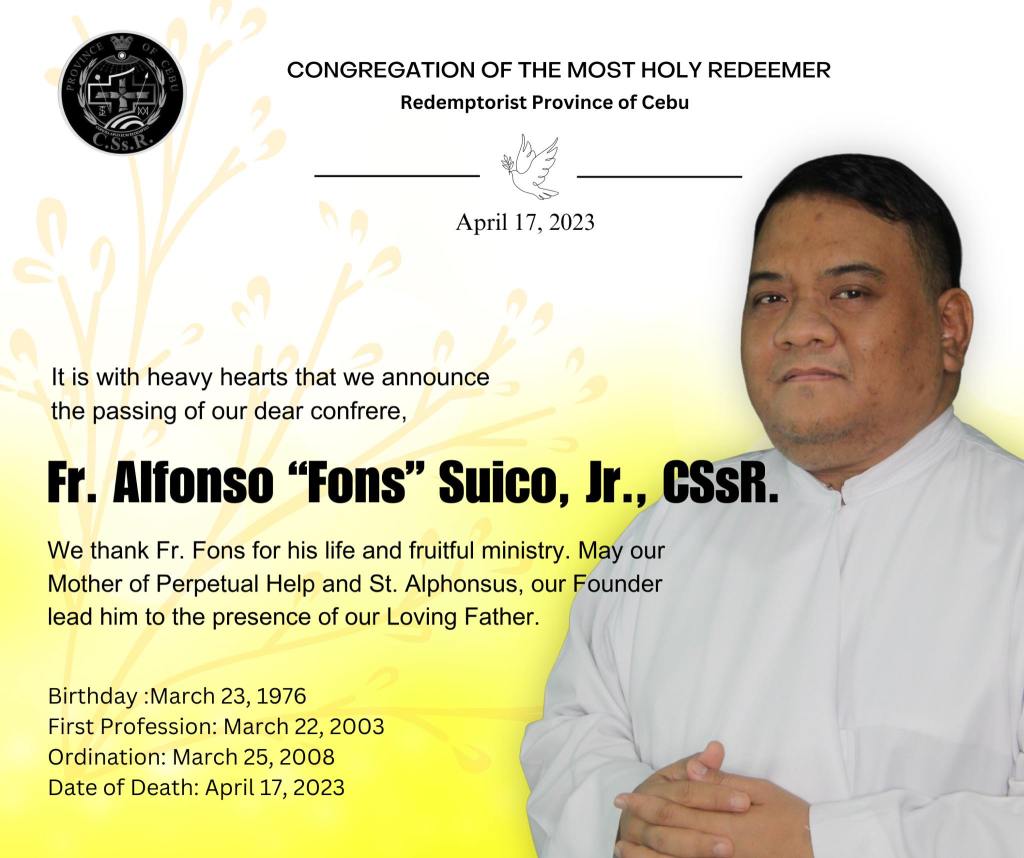
    He held two doctorates, as a medical doctor and later secured his PhD in Moral Theology at the Jesuit School of Theology in Berkeley. He had been teaching Moral Theology subjects at the St. Alphonsus Theological and Mission Institute in Davao City for the past decade. He has mentored many SATMI students for their synthesis papers and dissertations. He has also been giving talks at various fora and conferences.

    But for us Redemptorists, he was a well-loved confrere-brother. Much younger that those of us who are years older than him, he followed-up our health bulletins to make sure we did our regular medical check-up and followed doctors’ orders for medication.  As we shared the same kidney problems – and years after I began my dialysis in 2016 he also began to undergo the hemodialysis procedure – we constantly were in touch with the progress of our medication.

    When I had my life-threatening health issue last November, he was first to make sure I had the needed medical intervention. Up until I was released from the hospital – after a gruelling three-week stay in two hospitals – he made sure I had the best medical treatment. At the infirmary of the HRPC, he did his best to monitor the caregivers so that they offered the best help to those of us who have been sick.

    One can get used to the easy and secured manner that he looked after all of us that we can now ask the question: what happens now that he is gone? His death comes at a not so opportune time, given the changes of our assignments starting on May 1. In the list of assignments issued by our superiors after Palm Sunday, his name appeared as the next Rector of HRPC.  Those of us who were going to stay here at the HRPC were all delighted with this news and we looked forward to being with him as our Rector.

    When death claims a loved one, the heart constricts and one is at a loss of words. This is especially so if death – like a thief in the night – comes so unexpectedly! The benefit of a long illness is that we are prepared for the eventually if the loved one finally takes a step towards eternity. There is grief but a sudden death is something else; it pierces the heart as heavier emotions flood our thoughts and feelings.

    No matter if words of comfort are immediately relayed by friends and – even as confreres tighten their ranks for mutual support in this time of bereavement – the pain is deep and might linger on for a while. One can seek solace in tears and prayers and the thought that – with God’s mercy – Fr. Fons is now in a much more peaceful, happier and painless space reserved for those whose life was lived fully!

     Parting – Shakespeare once wrote – is such sweet sorrow!  But it takes on an added shade of sadness if the loved one does not get a chance to say goodbye. Lucky are we if there are premonitions of Death arriving at our doorstep; but oftentimes, our intuitions do not work. Even if we are staying in the same monastery and our rooms are just a few meters away, I have taken it for granted that I will bump into him every day.

    The last two weeks are a blur of shallow memories. On Holy Tuesday, we had taken the car, together with two ICM nuns to go to San Carlos Major Seminary for a forum on Synodality. He had arranged the sandwiches we were to share at the forum. On Holy Thursday, he joined the community for our penitential rite. On Good Friday – after I and two companions went on a visita iglesia, I met him at the corridor when we came home and casually told him our visita iglesia was most interesting.

    He had reminded me that after the Holy Saturday Easter vigil we were going to have a Gaudeamus, but the following morning as I greeted him Happy Easter I told him I couldn’t join the Gaudeamus because of my dialysis schedule. During our Easter celebration evening of Easter Sunday, he had taken full responsibility preparing the sumptuous meal and even hiding Easter eggs and chocolate for us to find in different parts of the common room. One could tell he was delighted that we all enjoyed the search for the eggs and chocolates!

    I didn’t get to thank him for the lavish meal as I needed to leave the celebration earlier due to my dialysis session. The following morning he had gone early for his dialysis procedure so I didn’t get to meet him and since I didn’t join the picnic, I was not there when the accident took place. Last time I met him was at the Coronary Care Unit of Chung Hua Hospital last Thursday, April 13, after my own medical check-up. He was unconscious and I couldn’t stay too long in the room as I was very much affected by how he looked.

    We stormed the heavens for God’s mercy so Fr. Fons could be healed. And when the doctors gave their diagnosis of the extent of the brain damage we prayed for a miracle to Our Mother of Perpetual Help!  Each day since Monday, we had waited in  bated breath for the next medical report on how he was surviving. Until finally, the sad news came at dawn today. It seems as if Fr. Fons was just waiting for his sister Sharmaine to arrive from the US so they could still have a few hours together before his departure.

    When I met Sharmaine hours later at breakfast, I embraced her so that I could condole her. But I couldn’t control my tears so she  instead was the one who comforted me. His remains will be cremated tonight and will be brought to their home in Mandaue where the will hold the wake from April 17 to 19. After that his remains will be transferred to the Redemptorist church where the wake is scheduled on  April 19 to 22, after which it will be interred at our parcel of land at the Caretas Cemetery.

    At this juncture, part of what we – the ones left behind – grapple with is to find meaning in the occurrence of an unexpected death. For some time now, I have thought that there comes a time in our lives when we become much more conscious that we are on borrowed time; that we have entered a pre-departure area and we can only be at peace if we realize that each day is a gift and needs to be lived to the full! There much be deep meanings why we are gifted with life even as this can just snap out any second. But perhaps the meaning is as simple as what Franz Kafka had written: “The meaning of life is that it stops!”

     We are still in the Easter Week and we believers are supposedly reminded that our life is like a seed; it is sown at one moment, and if lived well could produce so much fruit but only to fade away in some future time. However, as we are promised by no less than the Redeemer who offered his life so we may have life everlasting, we have no reason to fear death. And every step leading us to eternity should be taken with a deep confidence that the end of the journey is the home that we are all destined to reach when time is up!

    And in that place out there beyond the skies which Fr.  Fons right now has claimed as his own, a grand welcome awaits him and us who will follow in the fullness of time. And one is consoled at the thought that this is a truly delightful place with flowers and food, laughter and good cheer, with music and dance – all the good things that one associates with the plentiful blessings!

    And Kahlil Gibran gives us this assurance:  “For what is it to die but to stand naked in the wind and to melt into the sun? And when the earth shall claim your limbs, then shall you truly dance.”

    May the light and joy that Fr. Fons  left this world radiate through us as we continue to carry and share his beautiful memories. 

  • EASTER HOPE AND ASPIRATIONS

    EASTER HOPE AND ASPIRATIONS

    I always find writing my reflection for “A Dose of God Today” therapeutic and invigorating. Earlier, after praying the rosary as a family, I was led to pause and ponder on the beauty and meaning of the Easter season. I then jotted some key words in one of my favorite notebooks. Mind you, at 51, I still love to collect note pads and notebooks. These are very handy in keeping myself organized amidst a hectic schedule as a counselor-educator with an admin role in the Graduate School. Perhaps, my desire to be a true witness of the Risen Christ inspired me to share my third article in this valuable and beautiful blog of Fr. Jom, CSsR.

    The Easter season reminds us that HOPE should never be lost. The road that we may have taken is rough and bumpy, yet surely we will reach our destination. With the Risen Christ as our companion and guide, it will be a joyful and interesting ride. We simply have to allow Him to accompany us in our journey. How do we do that?

    Possibly, sharing my personal encounter with a faithful God may shed light to this. My daily travel to and from my workplace is an opportunity for me to commune with God in prayer. Riding in a taxi, bus or public utility jeep seems challenging given the traffic jam in the major roads going to the city and heading back home. Passing by the scenic view of the sea and looking up at the skies – I always feel that God is present in His beautiful creation. This allows me to whisper a prayer in silence, entrusting my day to Him. Most of the time, I just close my eyes so that my mind will be attuned to God’s message for me. I know God speaks volumes in the silence of my heart.

    During evenings, I take this opportunity to review what transpires during the day. A moment to say my thanksgiving to Him for staying close to me and for sending people who are constant in my life – my family and close friends who love me unconditionally; to repent for my flaws and shortcomings during the day and to think of ways on how to become better the next day. This, I may say, becomes a habit of mine. This practice will surely be carried out throughout this Easter Season and beyond.

    This is my first and major ASPIRATION during this meaningful season. To continue to commune with God most of the time – to take time to listen to Him in the midst of our daily struggles to fulfill our role and responsibilities – to carry out our vocation and mission in life.  

    For me, the best time for new beginnings is during this Season of Easter. We used to make New Year’s resolution at the start of a new year so why not formulate them right now? For this season is also known as the Season of New Birth.

    Earlier, I said that my major yearning is to be in touch with God most of the time. This may be difficult to do at first, and with constant practice, this will surely be a second nature to us. Being prayerful and highly spiritual made wonders in my life. It allowed me to trust fully in God’s will and the Holy Spirit promptings.

    In moments of despair and confusion and in arriving at a crucial decision, my deep faith expressed through prayer and communion with a loving and faithful God is my first recourse. This greatest gift God has bestowed upon me –  my FAITH propels me to walk my talk and be a dedicated, loving and compassionate public servant – being a counselor educator in a state university.

    my FAITH propels me to walk my talk and be a dedicated, loving and compassionate public servant

    This brings me to my second aspiration during this Easter Season. Some people seem not to like me and my dealings with them, yet deep in my heart I know I am trying to be empathetic and loving so that many people may experience the unconditional love of God through me. When one is in the position of authority and influence, one will gain more friends and haters alike. Implementing the graduate school policies fairly is no easy job. Yet, in my desire to treat each student equally, I have encountered a lot of challenges. Nevertheless, deep in my heart I know that I have done my best to practice fairness and justice. I may have my lapses, but with God’s grace, I will try my best to be a living witness of Christ’s resurrection. That He is truly RISEN and ALIVE!

    I have shared my two major aspirations during this important Liturgical Season in the Church. These may be GRAND yet these are attainable. With my deep faith in a LOVING, FAITHFUL RISEN CHRIST, I have nothing to FEAR.

    Surely, my longing to be attuned to God’s will for me will be realized for I always believe in a God of surprises. I simply have to clasp my hands in PRAYER, in JOYFUL HOPE and celebration that God is truly risen. He is alive and present within us, among us and amidst us.  And YOU? What’s your Easter hope and aspirations?

    Sending my fervent prayers and love to all readers of this blog who need these most.  May all your prayers and aspirations be fulfilled. A blessed Easter Season to all!!!

  • IN THE FOOTSTEPS OF THE RISEN LORD

    IN THE FOOTSTEPS OF THE RISEN LORD

    Footsteps.

    When we walk, we hardly take cognizant of the footsteps we take unless – like the Buddhists – we are so mindful of the here and now, the precious present moment.  It is only when one focuses on the movement of his feet while walking down a path, that one is struck with the importance of taking footsteps.  For as the Chinese proverb posits: A journey of a thousand miles begins with a single step!

    As we celebrate Easter Sunday today, it might do as good to reflect on the value of taking footsteps vis-à-vis our faith as followers of the Risen Lord. After all, his admonition – “Come follow me!” – involves literally moving our feet as we go after the Redeemer!

     Jesus lived on earth at a time when people could only move from place to place by walking. In some cases, horses and donkeys assisted them as they travelled. Unlike today when the advancement of transportation technology allows us to travel long distance through planes, boats, trains, buses, cars, even the lowly habal-habal, those living in the first century had to rely on their feet if they wanted to be in another place.

    Being an itinerant preacher-healer, Jesus himself walked practically all over Israel. While born in Bethlehem, he grew up in Nazareth. When his public life unfolded and he went out to preach the Good News, he travelled from Nazareth to Bethany, Bethesda, Capernaum, Cana of Galilee, Jerico, reaching the Jordan River and the Sea of Galilee. In his three-year public life, he walked more than a thousand miles.

    Some of the footsteps he took would take on biblical significance! Among these were those footsteps traversing the desert for forty days when he needed to get ready for his mission, his walk cum ride-the-donkey from the countryside to Jerusalem, his walk across the seashore as he met the fishermen who would become his loyal followers and later when he appeared to them after rising from the dead, and his walk with two forlorn followers on the road to Emmaus.

    The most dramatic, of course, were the footsteps he took from the garden of Gethsemane to the palace of King Herod, to the court of Pontius Pilate until he ended up on Calvary Hill. This route  – now labelled the Via Dolorosa –  has become the focal point of interest for tourists who fortunately find their way in Israel on Good Friday. 

    On top of this mournful hill, the carpenter from Nazareth – reviled by the Pharisees as a false prophet;  who hobnobbed with drunks, sinners and prostitutes;  who the powers-that-be considered a rebel out to subvert the established regime and tortured by the Roman soldiers as a means to warn other potential would-be “terrorists,” – was subjected to a crucifixion on a cross, fit for criminals!

    That last step Jesus took as he faced death, eventually ended his earthly life.

    At dawn of Eastern morn, the sound of footsteps echoed across the graveyard where Jesus and others were buried. These were footsteps first of women, later followed by a few of the more courageous apostles curious as to the women’s testimony that the tomb was empty! And most interesting, it was a woman – Magdalene – to whom Jesus first appeared as the Risen Lord!

    After Jesus appeared to more of his main followers and trusted disciples, he gathered them together for what is now known as the Great Commission (Matthew 28:19-20) and left them with these words:  “Therefore go and make disciples of all nations, baptizing them in the name of the Father and of the Son and of the Holy Spirit, and teaching them to obey everything I have commanded you. And surely I am with you always, to the very end of the age.”

    Gifted with the Holy Spirit on Pentecost, many of them, including a new convert – Paul of Tarsus – walked to many directions beyond Israel to give witness to the life and teachings of the Lord.  And despite the passage of time and the great advancement of transportation technology, in many Third World countries today, those who bring the Good News to the hinterlands, follow the way of the early disciples. They walk miles to reach the isolated villages.

    It is thus, very appropriate that in 2021 Pope Francis inaugurated what would be a synodal Church for these present times. To be a synodal church involves getting all the baptized to journey together as one in the footsteps of the Lord, with great effort exerted to make sure that those who for so long have not been afforded a place in the Lord’s banquet, can finally find themselves in the place of honor!

    This was Jesus way; moving from village to village, his focus was to journey with his society’s excluded, the sinners considered unclean and worthless. He avoided the elite, the powers-that-be, the ones who oppressed the poor even as he did not exclude them from his circle if they showed an openness to repent and make amends!  He disdained pomp and pageantry, he lived simply without benefit of having a place to stay, comforted the widows and healed the sick. In the process, the Good Shepherd smelt like the sheep!

    Alas, when Christianity shifted to Christendom and the Church’s memory of the way of life of Jesus faded, the ugly head of institutionalization and clericalism penetrated the walls of churches, monasteries and convents. Patronized by kings and emperors. ensconced in palaces to enjoy the perks of power, the Church’s heads veered away from the footsteps of the Lord! And the Gospels they preached held no relevance anymore to the lives of the majority who remained in the margins and disenfranchised of their human rights.

    If the Church today hopes to return to the dangerous memory of Jesus’ act to save humanity, she has to embrace Pope Francis’ synodal agenda. The question is: how many of our  church leaders and engaged laity are making sure that this agenda is not lost in the quadmire of a Church’s struggle to remain relevant in these post-modern times?

    In the VUCA (Volatile, Uncertain, Complex and Ambiguous) reality of the world today, Christianity is faced with a major challenge to return to its roots. Jesus presented the model of a synodal church – his footsteps made possible his journeying with society’s excluded – which challenged an established religion that was hijacked by those who would promote a faith that was blind and obedient to those in power. It was in this context that Christianity was born. If we are to redeem what Jesus founded, we, too, in our times will need to do our best to help build a synodal Church, in spite of the reluctance of our leaders to forge this kind of journey with the rest of us!

    Along with Pope Francis, we take the footsteps towards this goal buoyed by the Risen Lord! Happy Easter everyone!    

  • Peter on that Good Friday

    Peter on that Good Friday

    Peter was a man who have many inconsistencies. If you remember, it was him who first realized that Jesus was the Messiah, the Son of the Living God. Because of the close friendship with Jesus, Peter knew in his heart that this man Jesus is someone bigger. Yet, it was Peter also who was scolded by Jesus and was told, “Get behind me Satan!”

    After confessing that Jesus is Lord and the Messiah, Peter also wanted to prevent Jesus from doing the will of the Father by not undergoing pain and suffering. Peter wanted Jesus to escape from pain and suffering. This was how he was named Satan at that time because Satan will always tempt us to take a short-cut, to prevent us to go through pain and suffering. Yet, at the end, Satan will only bring us to destruction and death.

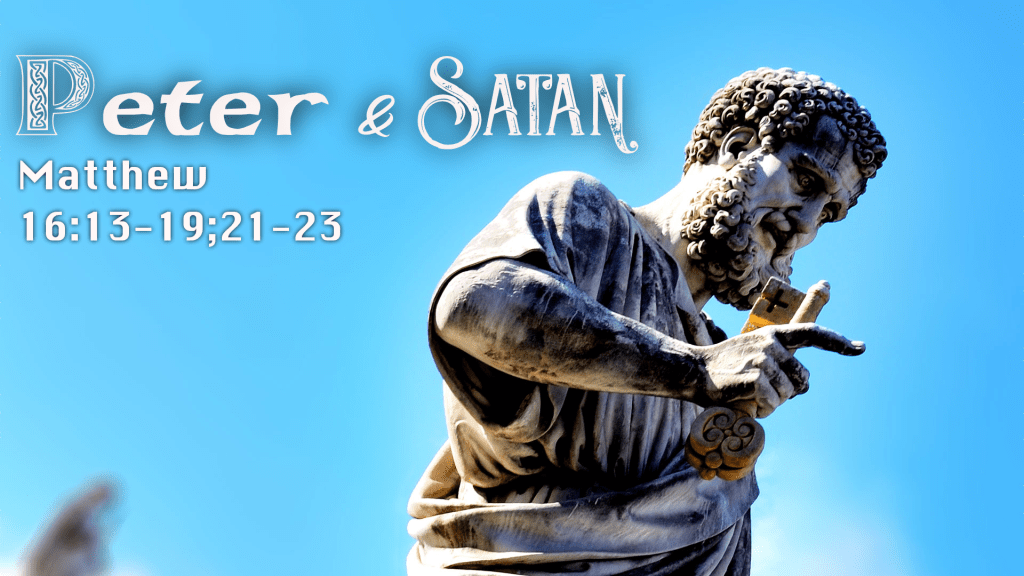
    Peter and Satan: A Reflection[1]

    With this particular attitude of Peter, let me ask these questions to you.

    Who wants a life without suffering, without sacrifices and difficulties? That would be nice, right?

    We dream of a life that knows only comfort, that is easy, and that we’ll always feel good. Today, we are actually being offered with different ways to make our life comfortable, fast, easy and smooth.

    There is actually nothing wrong of dreaming a life filled with comfort and without sacrifices and difficulties, to always feel blessed and good. This is a desire from us to feel secured. Nevertheless, the danger lies within the heart that denies sacrifice and suffering as part of our life, and as part of our Christian way of living.

    I remember a story being told to me when I was in college. There was a boy who went out into their garden and found a cocoon. It was so timely that he saw how the cocoon moved. The butterfly was about to come out from its cocoon. However, the butterfly was struggling. The boy felt pity for the butterfly. And so, the boy immediately, ran back to his room, got a pair of scissors. He wanted to help the butterfly and so, with scissors in his hand, he cut the cocoon carefully in order not to wound the butterfly. He was so successful that the butterfly was in her perfect shape and out of her cocoon.

    But then, something was wrong with the butterfly. She did not fly. Why? She couldn’t fly because her wings were too weak. When the boy cut the cocoon, the butterfly lost the opportunity to make her wings strong. She was supposed to go through in that struggle, in that difficulty of coming out from her cocoon. Because of the easy way out, her wings were not made strong to enjoy the wind as she was supposed to fly.

    You know, Jesus scolded Peter when he denied that Jesus should suffer and die. Even though, Peter confessed that Jesus is indeed the Messiah, the Christ sent by the Father, but then, Peter did not understand the commitment of being sent by the Father.

    Peter only knew of the victorious image of the Christ who will bring salvation and glory. Peter held on to his belief that in Jesus, there will be only blessings, power, and praises. This means that to follow Christ is not just about feeling good, feeling blessed, with abundance and material prosperity.

    This was the mistake of Peter. He couldn’t accept that Jesus will undergo suffering, persecution and death. He couldn’t accept of a vulnerable and weak God. This caused Peter to be scolded by Jesus and even called Satan because Peter only wanted an easy one, an easy life. Peter only considered what he wanted, not what God desired.

    This is also the consequence when we encounter Jesus. Before Peter was being rebuked by Jesus, the Lord actually asked the disciples, “Who do you say that I am?

    This question of Jesus was a question of commitment. And Peter responded this question with conviction. Peter said, “You are the Christ, the Son of the Living God.” Like Peter, if we confess that Jesus is the Christ, our Lord and Savior, then, this confession implies commitment and risk.

    After all, when we commit ourselves to somebody we love, risks and sacrifices are implied. We are reminded neither to fear nor deny the reality of making a sacrifice, of experiencing pain and difficulty in our life. Life is found when we go through the process of struggling. Never cut the cocoon or else there will be no life. When we experience pain, struggles, and difficulties never lose those opportunities because those are ways where we too shall find life, meaning and purpose.

    When we are called to make a sacrifice for others, never fear, because life is brought forth there. Take the example of parents and to mothers especially, giving birth is painful and excruciating, but the beauty of life is found when the baby finally comes out.

    Hence, do something concrete this Holy Week that would best express your faith and knowledge of Jesus. Hopefully, having this consciousness, this will further help us in knowing Jesus all the more because it is in knowing him that we also grow in our faith, in our commitment and relationship with God and with one another.

    Peter and His Denials

    When Jesus was arrested, Peter was confronted by the people and recognized him as a disciple of the Lord. However, Peter denied Jesus three times which can be found in all four Gospels (Mt. 26:33-35; Mk 14:29-31; Lk 22:33-34; Jn 18:15-27).

    He denied the Lord because he was afraid of going through the same pain and suffering of Jesus. But then, Jesus never condemned Peter. Jesus only looked at Peter in the eyes.

    In the same way, Jesus also looks at us lovingly. Individually, he looks at our eyes, calling us by our name. The gaze of Jesus is an assurance to us that we are not judged and we are not condemned.

    Even though we might consider ourselves as unworthy and useless, yet, Jesus would never point his finger on us condemning us for being sinful and unfaithful. Rather, Jesus looks at us with affection and love, wanting us to be with him.

    With that look of Jesus, Peter realized what he had done. He denied the Lord because he was afraid and did not have the courage to stand and be true to his faith. Peter was filled with shame and guilt. But then, Peter also realized that he was sorry.

    With that look of Jesus, he found not condemnation nor judgment from the Lord. Peter only saw forgiveness from Jesus. This moved Peter to come out from his fear and accept God’s forgiveness. That is why, Peter was given the gift of Jesus after the resurrection to lead the Church because Peter acknowledge his failure and sins, but also he accepted God’s forgiveness. With this, it transformed Peter into a better person.


    [1] Matthew 16:13-19;21-23 (He said to them, “But who do you say that I am?” Simon Peter said in reply, “You are the Messiah, the Son of the living God.” Jesus said to him in reply, “Blessed are you, Simon son of Jonah. For flesh and blood has not revealed this to you, but my heavenly Father. And so I say to you, you are Peter, and upon this rock I will build my church, and the gates of the netherworld shall not prevail against it. I will give you the keys to the kingdom of heaven. Whatever you bind on earth shall be bound in heaven; and whatever you loose on earth shall be loosed in heaven.” n From that time on, Jesus began to show his disciples that he* must go to Jerusalem and suffer greatly from the elders, the chief priests, and the scribes, and be killed and on the third day be raised. Then Peter took him aside and began to rebuke him, “God forbid, Lord! No such thing shall ever happen to you.” He turned and said to Peter, “Get behind me, Satan! You are an obstacle to me. You are thinking not as God does, but as human beings do.”)

  • Jesus in the life of Judas

    Jesus in the life of Judas

    Judas was most probably the most practical and at the same time the brightest among the disciples of Jesus. Why? Judas was assigned to be the treasurer of the group. He held the money bag. Jesus had confidence in him because of the qualities he saw in the person of Judas. Judas must have shown dedication in his work.

    Yet, in the Gospel of John[1], it was mentioned how the heart of Judas also was corrupted by jealousy and insecurity. When Mary the sister of Lazarus poured an expensive perfume on the feet of Jesus, Judas complained about it. For him, it was better to sell the perfume and given to the poor. However, it was not really his intention. Judas intended to use the money for himself and not for the poor. He was jealous of the action of Mary to Jesus because Judas did not experience such kindness from that lady. He also did not benefit anything from that expensive perfume.

    Judas turned bitter and corrupt even though he was with Jesus for at least the past 3 years of public life of Jesus. He was there with the other disciples to witness the many miracles of Jesus, in healing the sick, forgiving sinners and raising the dead. He was there in the preaching sessions of Jesus. He heard about the coming of the Kingdom of God and that it belongs to the humble like the children. He too was there in the Last Supper of Jesus, he shared the meal with Jesus and with his co-disciples.

    However, deep within, Judas failed to see that there was more in the person of Jesus. Perhaps, Judas found Jesus to be just an interesting charismatic leader. it was fun to be with him and to be with the other co-disciples. Yet, Judas also was able to benefit from those times of being with Jesus. He held the money bag. He kept the resources given to Jesus and for the group for the ministry. Nevertheless, it was also an opportunity for him to become dishonest.

    This was the reason why, it was so easy for him to sell Jesus to the chief priests of the Temple. For him, betraying Jesus and selling his whereabouts to the chief priests was an opportunity to gain something, materially. Judas believed that the thirty pieces of silver will give him satisfaction and contentment. But he was wrong.

    We can also ask why. Why would Judas do that to the person who has only shown kindness and generosity to him and to the people around?

    Judas though was chosen to be one of the close friends of Jesus and disciples had these two attitudes that motivated him to betray the Lord and to sell him for thirty pieces of silver.

    First, Judas never believed that Jesus is the Lord and the Messiah, the Son of God who is sent into the world to redeem the world and save the people from their sins and evil ways. Judas never believed in Jesus but only thought that Jesus was a mere teacher. Thus, Judas never called Jesus as Lord but only Rabbi, which means teacher.

    Second, Judas did not have a close, personal and intimate relationship with Jesus. Because Judas never believed in Jesus as Lord, it also followed that Judas had never developed that close relationship with the Lord. Thus, Judas actually failed to build true friendship with Jesus and so failed to recognize God in Jesus.

    These attitudes of Judas may also be present in us. When we do not believe or refuse to believe in Jesus as our Savior and Lord, who has come to love and forgive us, then, we too shall have the difficulty of not being able to build a personal relationship with God. Failure to recognize God in our life leads us to an estrange relationship with God.

    This is also true with our human relationships. Failure to believe in the person, to a friend, to your husband, or wife, or child will lead us to a distanced relationship. This failure of knowing the person and building personal and intimate relationship with others will lead us to easily discard those people around us, to easily hurt them, to easily leave and abandon them, abuse them – because we are never committed in that relationship.

    Thus, we are called rather now to know better the person that we are in relationship with, our friends and those people around us because it is in knowing them that we also come to recognize their importance and believe in them. And again, this shall also move us to commit ourselves in that relationship by developing a close and intimate relationship with others and with God.

    Judas and the Influence of Satan

    The Gospel of Luke recounted how Satan entered into Judas (Luke 22:3). In the Gospel of John, it was said, that the devil had already induced Judas (John 13:2). In the same Gospel, it was also described that as soon as Judas took the morsel, Satan entered him (John 13:27). The intentions of the heart and actions of Judas were already leaning towards the evil spirit, hence, it was easy for Satan to get hold of Judas and brought him deeper into darkness and sin. This was how the devil influenced the mind, decisions and actions of Judas.

    This was symbolically recounted also in John’s Gospel, “So he took the morsel and left at once. And it was night.” (John 13:30) This was an action, a decision being made to go into darkness. A very dangerous thing. Judas must have thought that his desires and longings will be fulfilled through these decisions and actions of him. Yet, he was wrong. He was controlled and manipulated. He was not himself anymore. His mind and heart were clouded by the darkness of human greed and insecurity.

    However, the moment he realized what he had done, he deeply regretted it. Though he realized that Jesus was entirely innocent and he had sinned, yet, Satan who got hold of his heart and mind led him deeper into despair and hopelessness. Judas could not see himself anymore. He could not see God and even believe that God can still forgive him. The Gospel of Matthew told us that Judas, after returning the 30 pieces of silver to the chief priests and elders of the people, he left and hanged himself (Matthew 27:5).

    Judas was in total darkness. Satan was controlling him, perhaps, even without realizing that the evil spirit was already manipulating and dictating him further away from the grace and light of Jesus and closer to darkness and death. This led him to that pitiful death.

    The Eucharist and Betrayer

    Even though this was what happened to Judas, it cannot be denied that at the Last Supper of Jesus, his Body and Blood were given also to a disciple, a friend and a companion who betrayed him on that night. In fact, the Eucharistic Prayer II says, “At the time he was betrayed…” and similarly, Eucharistic Prayer III also says, “For on the night he was betrayed…” – both prayers recognize that important point in our salvation history in which Jesus offered his whole life for Judas and for all the potential Judases (in the words of Bishop Ambo David in his Facebook Post – In Defense of Judas) that we might be. As Bishop David wrote in his post, “the Eucharist is Jesus’ option to transform that night of betrayal into a night of forgiveness.”

    This is how we realize that unconditional love of the Lord and his fundamental mission to continuously offer and grant mercy, forgiveness, freedom and new life. Kabay pa.


    [1] John 12:1-11 (Six days before Passover Jesus came to Bethany, where Lazarus was, whom Jesus had raised from the dead. They gave a dinner for him there, and Martha served, while Lazarus was one of those reclining at table with him.  Mary took a liter of costly perfumed oil made from genuine aromatic nard and anointed the feet of Jesus and dried them with her hair; the house was filled with the fragrance of the oil.  Then Judas the Iscariot, one of his disciples, and the one who would betray him, said, “Why was this oil not sold for three hundred days’ wages and given to the poor?” He said this not because he cared about the poor but because he was a thief and held the money bag and used to steal the contributions. So Jesus said, “Leave her alone. Let her keep this for the day of my burial. You always have the poor with you, but you do not always have me.”)