Category: Reflection

  • FORGIVENESS: A RADICAL LOVE

    FORGIVENESS: A RADICAL LOVE

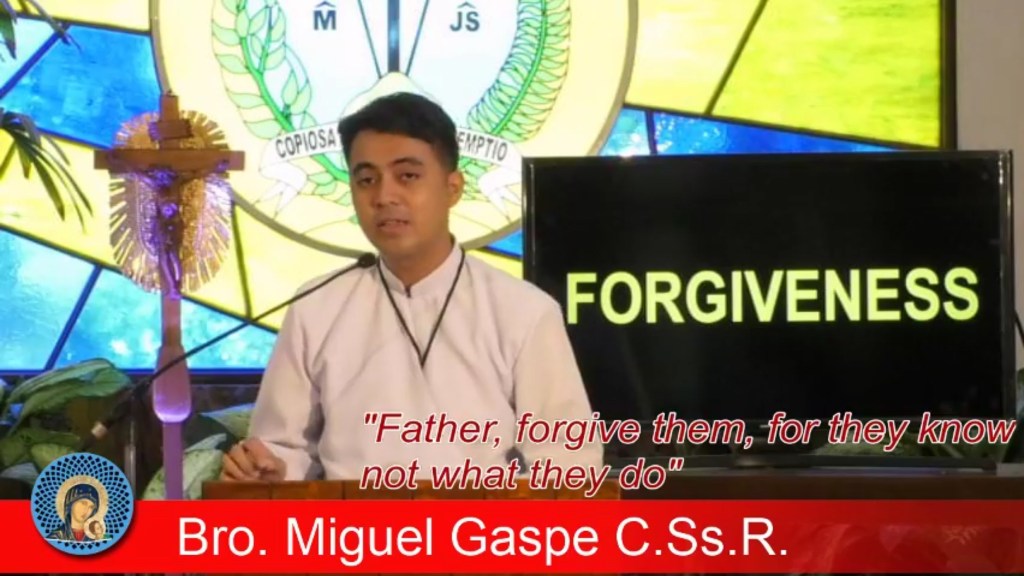
    FATHER, FORGIVE THEM, FOR THEY KNOW NOT WHAT THEY DO (Luke 23:34)

    The first of the Seven Last Words of Jesus on the Cross.

    Shared by Bro. Miguel A. Gaspe, CSsR on Good Friday, the Siete Palabras.

    Click here for the link of the Video (https://www.facebook.com/OMPHRedemptoristDavao/videos/2986892808037601/)
    Forgiveness, indeed, is of God, and it is only through His grace that we may be able to give it to persons who have wronged us. 

    “Radical Love” is a documentary on forgiveness and healing of Ms. Cherry Pie Picache. Cherry Pie, is a Filipino actress, best known for her dramatic roles in Movies and Television. The film captures her experience of meeting her mother’s murderer five years after the dreadful event. One of the highlights in that film features the most heart-wrenching scene where Cherry was able to forgive her mother’s murderer. As she underwent the process of healing, she affirmed how difficult and challenging it is to forgive the person who literally “broke her life.” 

    In her words, “It took me a lot of courage, strength, and prayers from God to be able to forgive the person who murdered my mother.” Painful though it is, She took the road of forgiveness for her to be healed and move on. Her story is indeed exceptional, but for many who are drenched in pain, grief, and revenge, to forgive is such a rare thing do. What does it mean to forgive and how to forgive?

    We look back to the scene where Jesus uttered these words, Jesus at this hour was on the brink of death, nailed to the Cross with the Roman soldiers at his feet. As he addressed these men, we could picture how exhausting the scene was. By this time, these Roman soldiers had been executing many criminals and had seen death day after day.  They are reduced to mere functionaries. They have no choice and freedom to do what is just and right at that moment as they were only following orders.  Familiarity with violence and brutality causes these soldiers to be numb and deaf with their emotions. Their society has allowed them to be stripped of their dignity as human persons gifted with freedom and compassion. It is in this human frailty and desperate condition where Jesus uttered to them, “Father, forgive them for they do not know what they are doing?

    Like us, Jesus understands what it means to be a human person. He showed in his life that a human person is a being created, loved, and cared for by God.  Jesus believes that in every human person, there lies within goodness. Despite our weaknesses, short-comings, and sinfulness, each has the capacity to go beyond our human conditions. Each of us is called towards goodness. Each of us can share this innate goodness to our fellow beings. When Jesus addressed “Father, forgive them…” these are not words of condemnation and self-righteousness. Instead, these are words of prayers addressed to his Father. Even in suffering, He went beyond our underlying tendency for revenge and offered a path for us to be reconciled with God, our Creator. Forgiveness, for Jesus, is an act of prayer and unselfish concern for the good of the other.

    Does forgiveness also mean to forget? I think we are familiar with the phrase “to forgive is to forget.” Forgiveness, to some, may come in the non-recognition of the wrong done. Or to forget, others would condone the transgression in exchange for shallow healing and reconciliation. But if we look into the truth of its meaning, forgiveness in Greek means “to send away.” A word used for commercial language meaning “to release from an obligation or to cancel one’s debt.” That is why in other translations of the “Lord’s Prayer,” sin or transgressions is equated with debts. In Matthew, it says, “forgive us from our debts as we forgive our debtors.” To cancel one’s debt includes a thorough acknowledgment of the debt owed by that person.  In other words, from every transgression we commit with ourselves and with others is a debt we owed to God. And this debt has to be paid in full. 

    Here comes the Good News. The debts we owed to others, to our environment, and God, are now paid in full, with and through, Jesus our Lord. His life, death, and resurrection are in itself the entire process of what it means to forgive and be forgiven. Forgiveness is a process where it involves acceptance of undergoing pain, anger, and grief which in the end will lead to an experience of “resurrection.” What it requires is our openness and obedience to the movements of God’s Spirit already working within us. 

    In the film’s last scene, as Cherry was able to meet the Convict, both of them were in tears. She could not imagine doing such an impossible thing of finding the grace to forgive. What is most striking in their encounter was that she was able to bless and pray for the healing of her mother’s murderer. She forgave not only for her good but to the person who wronged her, who is significantly in need of healing as well. 

    Watching that scene made me realize that it only brought into reality what Jesus’ words on the Cross truly meant. Forgiveness, indeed, is of God, and it is only through His grace that we may be able to give it to persons who have wronged us. 

    My brother and sisters, today is a time of grace, let these words of Jesus penetrate in our hearts. Let his words be a reminder that God, our Father, is madly in love with us despite and in spite of our human conditions. And in realizing this truth, may we see that innate goodness which moves us to a genuine reconciliation with our brothers and sisters in Christ. My friends, let us ask to our Father for that grace.

  • The Deafening Silence of Black Saturday

    The Deafening Silence of Black Saturday

    April 11, 2020 – Black Saturday

    Advertisements

    Have you ever tried being in a silent place? Away from the noise of the city streets and market, away from any music or audio and even away from the chirps of birds around?

    It is deafening being in that kind of place! It becomes deafening because we have become so accustomed to noise. For that reason, we feel strange when we are confronted with silence. With that strangeness we create other noises to ignore silence. We do not dwell on silence because it is unfamiliar and uncomfortable.

    However, the whole Church calls this day Black Saturday in which we observe the MAGNUM SILECIUM meaning, the great silence. What we have today is the great silence from heaven, the great silence from God who died on the cross. 

    Advertisements

    This is symbolized now by the unavailability of the sacraments and closing of churches. Today, with the situation brought about by the pandemic Covid-19, the more we feel this great silence. Common worship and prayers including masses and reception of communion have all been suspended. We truly feel the sadness of Black Saturday. We certainly feel the silence that this day is calling us to dwell.

    Thus, as Jesus died on the cross and was buried in the tomb, the silence of the tomb is no less than deafening. The disciples who fled at the arrest of their Master, especially Peter who denied the Lord three times, are also all silent and afraid except the women. The tomb has become a witness to the dead Messiah wrapped in linen cloth.[1] In that tomb, God remains silent. As Jesus died on Friday, today is total silence. God was nowhere to be found or to be heard. 

    Nevertheless, in this kind of silence, something is happening. The tomb of Jesus will become a sign of promise in which suspicion and amazement learned to speak in the full radiance of what had to take place on Sunday morning. 

    In this perspective, only the walls of the tomb were able to witness what was happening. If only they could speak, perhaps, their words won’t be enough to describe the wonder of God working on this day and in the following day. This is where we too are invited to dwell and to discover how God works in our own tombs of sadness, fear, anxiety and sin.

    Silence, then, is the only language of the walls of the tomb. Moreover, it is also from this silence that God raised Jesus from the dead. For in and from silence, God fulfills His promise of victory over death and the beginning of a new creation.

    As Black Saturday calls us to dwell deeper on silence, certainly, God has done marvelous things in and through silence. There is nothing to be afraid then, of silence for it is a sign of God’s presence. From here, Jesus introduced to us the God of silence, ever with us.

    Advertisements

    A feeling of abandonment might be felt in times of sorrows and great trials like that of Jesus on the cross, but it is also in that silence that God continually invites us to put our trust and confidence before him. Jesus’ complete surrender to the Father is a prototype of such close relationship with God. Pope Benedict XVI said,

    “Jesus teaches us that God also speaks to us, especially at times of difficulty, through his silence, which invites us to deeper faith and trust in his promises. Jesus is our great teacher of prayer; from his prayer we learn to speak with confidence to our heavenly Father as his beloved sons and daughters. In this filial dialogue we are also taught to recognize God’s many gifts and to obey his will, which gives meaning and direction to our lives.”[2]

    This is a hope given by Jesus to us. This is not a false hope, the scriptures would attest to this as the story of silence in the tomb leads us into that realization of a God of silence who brings justice, healing, life, mercy and compassion into our world. Hinaut pa.

    Jom Baring, CSsR


            [1] cf. Lk 23:53; Jn 19:40; Mk 15:46; Mt. 27:59.

            [2] See Pope Benedict XVI, “On the Silence of Jesus.”

    Join 2,860 other subscribers
  • WHAT MAKES GOOD FRIDAY, GOOD?

    WHAT MAKES GOOD FRIDAY, GOOD?

    April 10, 2020 – Tenebrae: Morning Prayer of the Passion of the Lord

    Sermonette Shared by Bro. Vincent Chloe Que, CSsR

    “And have faith in the resurrection, have faith that better days will come in God’s perfect time.”

    Greetings of Peace!

    We are in the liturgical time called Holy Week, and today is Good Friday. But what makes this week Holy? Or this day Good? Is it not that were are reminded today of a terrible suffering, an unimaginable fate that befalls Jesus, our Lord? In fact, this morning’s prayer is called Tenebrae, which is a Latin word that means “darkness.

    Brothers and sisters, what makes it holy and good is precisely presence of Jesus, even in darkness, even in suffering. Suffering is a human reality that many have tried to explain. Yet Jesus never explained it, instead he willingly suffered so that in our suffering we will meet him there. Amidst this Pandemic, we find ourselves vulnerable and in great suffering:

    • As we are confined in our homes, under quarantine, we may experience anxiety and fear. Yet last night we remember Jesus in the garden sweating blood in deep anxiety and fear for death is lurking around.
    • Because of physical distancing and travel bans we may be separated from our loved ones or unable to hug and kiss our elderly parents and young ones, we may feel lonely. Yet we remember how lonely Jesus was when his friends abandoned and even denied him.
    • Our “frontliners” come face to face with danger on a daily basis, their burden is compounded by the lack of support for them. Yet we remember Jesus facing Pilate, scourged, mocked, and sentenced to death.
    • When our daily-wage earners are forced to stay home even if it means losing their means of sustenance, today we remember Jesus forced to carry his heavy cross.
    • And when we are sick or when we feel God has abandoned us, the voice of Jesus reechoes: “my God, my God, why have you forsaken me.”
    • And yes, even in death, Jesus is there.

    But also, two days from now, Jesus is also present in Easter: in our recoveries, in the heroism of our frontliners and our daily victories in fighting this pandemic. Yes Jesus is present in our Joys and in our triumphs! Indeed the cross would not make full sense without the empty tomb. 

    Today we begin the paschal triduum. Pascha or Pesach means passage. A capuchin priest, Fr. Cantalamessa referred to this as: “the passage of the Jewish people from slavery to freedom, the passage of Christ from this world to the Father, and the passage from sin to grace for those who believe in him.”

    John the evangelist also sees the passion, death, and resurrection as one event, one moment. Let us bask in Hope, something that these days’ celebration brings. Hope, Pope Francis says, is not an illusion, if we put our hope in Christ, it is never wasted.

    Therefore, brothers and sisters, a great invitation is before us in these trying times and as we celebrate the Holy Week, let us unite our suffering with the suffering of Jesus, allow these to purify us and bring us back closer to God, let us entrust to him our anxieties… rest assured that He understands us. And have faith in the resurrection, have faith that better days will come in God’s perfect time. This is what makes this week holy and this day good, we are celebrating a perfect act of Love by our God who, even in our sinfulness, will never ever abandon us. 

    Have a blessed days ahead!

  • Just being grateful – Celebrating a New Year

    Just being grateful – Celebrating a New Year

    December 31, 2019 – New Year’s Eve Mass –

    -Liturgy of the Solemnity of Mary, the Mother of God-

    Click here for the readings http://www.usccb.org/bible/readings/010120.cfm

    Homily

    I would like to ask you first to look at the person beside you now, on your right and on your left. Look at that person and say “thank you.” 

    The expression “thank you” can also be altered by saying, “I (really) appreciate you.” This means that the expression extends and recognizes not just the act or object given but also the giver himself/herself. This is a recognition of the presence of the person.

    In Bahasa Indonesia, thank you is translated as “terimakasih.” This comes from two words, terima and kasih, which literally means “receive or accept and heart or love.” Saying terimakasih means I receive/accept your heart/love for me. This is basically saying that I accept the person or receive the person into my life. This does not just make the object/gift/action as part of the recipient but the giver too has become part of the recipient.

    It is just fitting for us to say thank you to people around us; to be grateful to the people who have been part of our journey. And so please take time to express your gratitude to your friends and classmates, to your teachers and friends, to your parents and siblings, cousins and other relatives, and of course to God the source of all blessings.

    Now, as we will be welcoming new year, there might be a new environment to explore, new people to meet and encounter, new experiences to behold, new realizations and discoveries that will mold us, and mistakes and failures that will teach us lessons.

    As we go forward, I invite you that we remember always to have an attitude of gratefulness, of just being thankful as a person. So, if I would ask you, “With all the pains and joys, successes and failures, sins and graces of the past year 2019, how grateful am I? How grateful are you now?”

    Gratefulness makes us see what surrounds us, both the good and the bad. Gratefulness allows us to be embracing and accepting of the things and people around us. It is when we are grateful too that we become joyful persons and will tend to see the goodness and uniqueness of others. 

    Through this joy within us, we also become aware of God’s tremendous generosity to us despite our weaknesses and sins. And when we become joyful, we also become generous of ourselves towards the people around us, no matter who they are, whether they are our friends or strangers.

    However, if our heart is ungrateful, bitter and complaining, then, we become close-minded, rejecting, and even vicious in the way we relate others and with God.

     We might find ourselves also worrying and becoming anxious of personal struggles such as our failures and unfulfilled desires, or the overwhelming loads of our work and business, or the issues that our relationships are facing today, or the great demands that your family life is requiring you to do, or the illness of a loved one that pains you. When we let these one or more issues to overwhelm us, then, we will certainly become disturbed.

    When complaining and bitterness becomes an attitude or a habit, we are very difficult to live with. When we become like this, we tend to be negative with what surround us. We also tend to see what is ugly and imperfect. We become sensitive to failures and mistakes, with ourselves and with others. And because we seemed to seek perfection, then, we are also difficult to satisfy.

    This has been my experience this year. I have realized that I have become rejecting, complaining and bitter. Early this year, I was very excited to be transferred from my previous assignment in Iloilo to another place. I have planned on what to do in my next assignment. I have longed for it and prepared myself for it. But then, a day before I was supposed to bring my things for my new assignment, I was told that something has changed. I was re-assigned to a different place in order to fill up an empty position. And so here I am in Davao, the least of the areas that I wanted to be assigned. Deep inside, I was rejecting this assignment. In my first months, I was restless and always felt bored. I did not see any reason for being here. I was not happy. I had a heavy and resisting heart.

    Moreover, the night before my flight for Davao to take over my assignment, my father died. I felt guilty and in pain for not being able to embrace papa and to assure him that I love him while he was still alive. My flight to my next assignment was very painful. I could not stop but cry during that flight.

    I asked God why would he be so ungenerous this time for not extending the life of papa even for few days. I asked God, but it seemed that he did not listen to me that time. I was hurt and so questioned him in my heart.

    All of these clouded my heart and rather turned ungrateful and bitter. I have realized that when we become ungrateful we also take for granted the giver of gifts, and thus, the presence of God in our life and we refuse to recognize that everything we have is a gift.

    Moreover, I have come to realize also that God has been so good to me despite my ingratitude. My present assignment is after all a blessing in disguise. Being here allowed me to be near my family and to be with them especially in times of our grief for losing papa.

    Thus, God calls us today to be more grateful of the gifts and blessings that we have received each day, no matter how small would that be. But if we have received so much also, be more thankful and be more generous. Remember, a grateful person is a person who goes forward, because when we are grateful we also become contented of the present, whatever there is. We also become reconciled with the past, whatever that was. And we become hopeful and positive of the future, whatever there will be.

    So, may I ask you again, What are the gifts/blessings that you are grateful for?

    I want you to recognize individually your gifts/blessings that you have received. Remember, gifts/graces/blessings are not just limited with material things but also people or relationships, events and experiences in your life. So, as an exercise, I want you now to count your blessings in 60 seconds. Are you ready?

    60 seconds countdown.

    God visits us in surprising ways. And God’s visit will bring us blessings. Thus, it is also important that we remain welcoming and accepting of God’s surprises for us. God may also may visit us not just through strangers but also though ordinary people or even those to whom we are familiar with. This is the story that we have heard in the Gospel today.

    There are two visits that we can find in the Gospel, first, God’s visit upon his people. Jesus was born in a family of Mary and Joseph. God is telling us that he dwells in our families. The second visit is the shepherds visiting God. The shepherds have visited Jesus, Mary and Joseph and what they found was great joy. Despite the difficulty of their life, they have seen how God has shown his faithfulness and love to them.

     It is only rightful also that as we hope for more blessings to come in this New Year, let this Solemnity of Mary’s motherhood be a reminder to each of us. God has already blessed us with good things and plenty, let us be grateful then. Hinaut pa.

    Jom Baring, CSsR

  • Christmas Message 2019

    Christmas Message 2019

    and the Word was made flesh, and dwelt among us… John 1:14

    (This Christmas Message prepared by Fr. Mario Masangcay, CSsR – Filipino Redemptorist Missionary in Korea, will be shared by Gwangju Archbishop Hygino Kim during Christmas Day Mass with all the migrant workers and residents in Gwangju City, South Korea.)

    For the secular consumerist world today, Christmas celebration is all about shopping, year-end bonus, parties, holiday break and others. But for our whole Christian world, it has a deeper meaning, because Christmas is our celebration of our Lord’s birth into our lives. For us who believe in Jesus Christ, Christmas is God’s incarnation – “the Word made flesh, and dwelt amongst us”. It is about God’s child and our Lord Jesus. 

    Through the birth of Jesus, God visits our world and decided to stay with us, and we welcome Him into our lives. Pope Francis said: ‘For us Christmas has always been about this: Contemplating the visit of God to his people”. Christmas then is all about God as our guest, visiting us and we, as His hosts welcoming Him into our lives. Thus, Christmas is our joyful celebration of meeting God into our world, through His Son, our Lord Jesus Christ. 

    Here we come to know and proclaim our God as a Migrant God, who came into our lives and decides now to live with us. Jesus, the beloved Son of God, who is not of our world but now in our world, resides in us & becomes part of our lives. While our world today considers immigration as a social issue, problem and concern, Christmas is our reminder to the world today that through migration God came and visits us, and lives with us now, as a Migrant God. What then we may considered as problem could be and may have been God’s saving way of meeting us, sharing us His grace and redemption. 

    Also we come to know and proclaim here that our God is a missionary God. The Lord Jesus visits our lives for a mission. He is with us and in our world today on-mission and at-work. He came to share the world God’s love, introduce us God’s kingdom, and invites us to join him in spreading God’s grace to the whole world. Jesus thus migrated into our lives on mission, purpose and work to share us our Father’s love and way. While our world today is becoming godless & unknowing of God, Christmas reminds us that God is always in our midst and at work in our lives.

    This is how meaningful and blessed Christmas is, for us followers of Christ: our migrant and missionary God is always with us and at work in us, and thus we now share in God’s life.  Again Pope Francis proclaims: “Christmas reveals the immense love of God for humanity. From that flows also the enthusiasm, the hope of us, Christians, that in our poverty, we know that we are loved, we are visited and accompanied by God.” Christmas – the birthday of Christ, God’s visitation, our meeting with God, welcoming our migrant and missionary God in our lives, marks the beginning and gives way to our story and history of our salvation. 

    Our Christmas celebration this year somehow invites and challenges us to contemplate the presence and mission/work of migrants in our midst. Somehow migrants residing and working with us now in our lives remind us of the meaning and blessing of Christmas in our lives and into the world. Being here abroad as Christian, we are invited to welcome and be welcoming to host our guest Jesus Christ and our migrants with us into our daily lives. As the Lord decides to reside and be part of our human lives, we should also make our Lord and other migrants part of our world. Being Catholic Christian in Korea, it is also our mission to share Jesus and His mission in proclaiming and spreading God’s love and work to today’s secular world. In other words, as followers of Christ here and now, like our Lord Jesus, let us be witnesses and living-testaments of our Migrant and missionary God in sharing God’s sacred life and mission of salvation to our world today.

    Through Christmas, God has already and always blessed us and the world. May we Christians become now a continuous God’s blessings to our world today. Amen.