Category: Ordinary Time

  • When I pray, do I seek to change God’s will or to change my will according to God’s desire?

    When I pray, do I seek to change God’s will or to change my will according to God’s desire?

    October 9, 2019 – Wednesday 27th Week in Ordinary Time

    A reading from the Book of Prophet Jonah (4:1-11)

    Jonah was greatly displeased
    and became angry that God did not carry out the evil
    he threatened against Nineveh.
    He prayed, “I beseech you, LORD,
    is not this what I said while I was still in my own country?
    This is why I fled at first to Tarshish.
    I knew that you are a gracious and merciful God,
    slow to anger, rich in clemency, loath to punish.
    And now, LORD, please take my life from me;
    for it is better for me to die than to live.”
    But the LORD asked, “Have you reason to be angry?”

    Jonah then left the city for a place to the east of it,
    where he built himself a hut and waited under it in the shade,
    to see what would happen to the city.
    And when the LORD God provided a gourd plant
    that grew up over Jonah’s head,
    giving shade that relieved him of any discomfort,
    Jonah was very happy over the plant.
    But the next morning at dawn
    God sent a worm that attacked the plant,
    so that it withered.
    And when the sun arose, God sent a burning east wind;
    and the sun beat upon Jonah’s head till he became faint.
    Then Jonah asked for death, saying,
    “I would be better off dead than alive.”

    But God said to Jonah,
    “Have you reason to be angry over the plant?”
    “I have reason to be angry,” Jonah answered, “angry enough to die.”
    Then the LORD said,
    “You are concerned over the plant which cost you no labor
    and which you did not raise;
    it came up in one night and in one night it perished.
    And should I not be concerned over Nineveh, the great city,
    in which there are more than a hundred and twenty thousand persons
    who cannot distinguish their right hand from their left,
    not to mention the many cattle?”

    A reading from the Holy Gospel according to Luke (11:1-4)

    Jesus was praying in a certain place, and when he had finished,
    one of his disciples said to him,
    “Lord, teach us to pray just as John taught his disciples.”
    He said to them, “When you pray, say:

    Father, hallowed be your name,
    your Kingdom come.
    Give us each day our daily bread
    and forgive us our sins
    for we ourselves forgive everyone in debt to us,
    and do not subject us to the final test.”

    Homily

    Prophet Jonah is considered as an important figure in the Old Testament. His role as a prophet is greatly revered, thus, he gained the fame as one of the great prophets during the time of King Jeroboam II of Israel. However, despite his greatness as a prophet he too struggled with his selfishness and desire to manipulate God according to his own interest.

    The first reading tells us how Jonah showed his anger towards God. God showed compassion to the people of Nineveh, the people that Jonah hated so much. God withdrew his intentions to destroy the whole city and its people because of the repentance showed by them. Because of this, Jonah despised God for being good and merciful to the people whom Jonah considered as his enemies.

    Jonah could not accept this. God’s action towards the people was undesirable for him. Jonah had been hoping that Nineveh will be punished, that the people will be condemned to death. He had seen no hope in them, thus, he wished that they will completely suffer and die. That was what Jonah wanted.

    Even though Jonah was fully aware that God is compassionate, slow to anger and merciful, he did not want God to show mercy to these people. Jonah just wanted to preserve God’s goodness for himself and for the people whom he cared, not to the people whom he despised. This was the reason why Jonah became angry with God because he found God unfair. Well, that’s according to Jonah’s perspective.

    In the heart of Jonah, he actually wanted God to follow his desire to condemn the people. Jonah had no plans to follow God’s desire to show mercy. His anger was his expression to change the heart of God according to his interest.

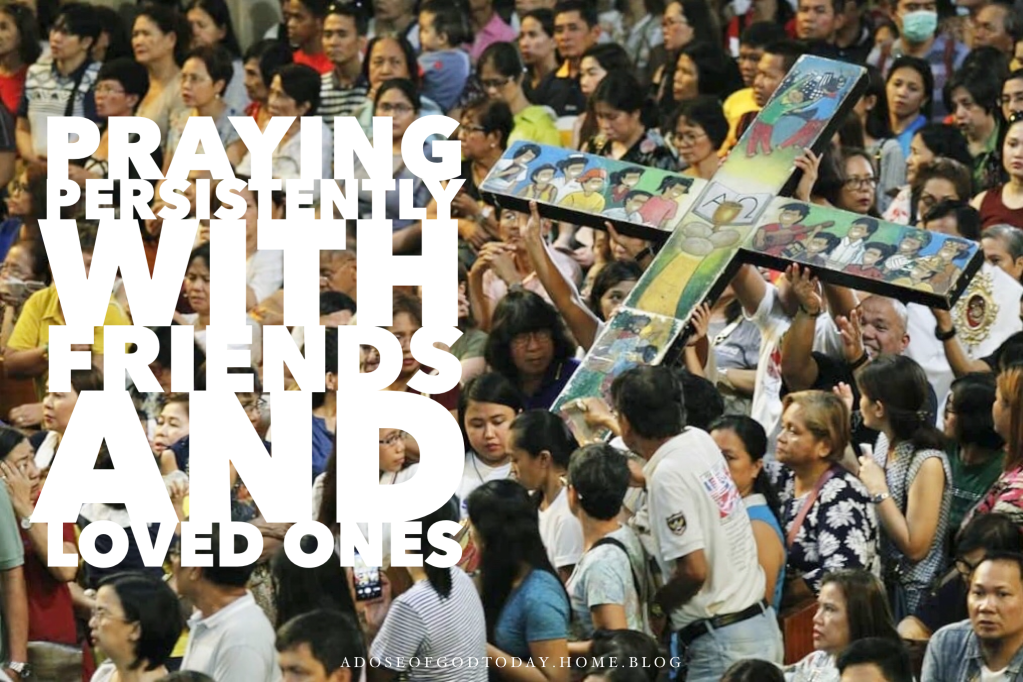
    Now, we see how could a man wants to manipulate God by becoming angry at God. This kind of attitude of Jonah might not be far also from our own experiences today. Unconsciously, we might be acting like Jonah too. Indeed, we believe that God is good, generous and kind, loving and merciful. Nevertheless, we might tend to believe that God should not be loving and merciful to those people whom we hate, whom we abhor, to people who have hurt us, to people whom we consider as useless and hopeless. We want a monopoly of God’s mercy and love limited to our friends, to our loved ones and to us, ourselves alone.

    This kind of attitude gives color in the way we pray. We tend to believe that our prayer is a way of changing the heart of God according to our own likes and desires. And so when what I prayed did not happen then I feel bad and become angry at God for not granting what I desired. We begin to distance ourselves from God. We stop going to Church because God seemed not to hear our prayers. We become bitter when we also see others whom we think are not deserving, are enjoying blessings.

    However, our Gospel today has something important to teach us. The request of the disciples was one of the most selfless and gracious request they made. One of them asked, “Lord, teach us to pray…” They wanted to pray like Jesus, to pray in His name and that is according to the mind, heart and will of Jesus.

    To pray like Jesus is to change our hearts and minds according to the will of God and not changing God’s heart according to our own desires. To pray like Jesus is being able to trust in God and to give our hearts to God that even though our desires are in conflict with God, then, we remain faithful and trustful in Him.

    And our best example of praying like Jesus aside from the disciples is our Mother Mary. It means that it is also possible for us to pray like Jesus and not like Jonah. May our Mother of Perpetual Help inspire, then, us to pray more like Jesus. Hinaut pa.

    Jom Baring, CSsR

  • Are you lost? Allow God to find you.

    Are you lost? Allow God to find you.

    September 15, 2019 – 24th Sunday in Ordinary Time

    A Reading from the Book of Exodus (32:7-11,13-14)

    The LORD said to Moses,
    “Go down at once to your people,
    whom you brought out of the land of Egypt,
    for they have become depraved.
    They have soon turned aside from the way I pointed out to them,
    making for themselves a molten calf and worshiping it,
    sacrificing to it and crying out,
    ‘This is your God, O Israel,
    who brought you out of the land of Egypt!’
    “I see how stiff-necked this people is, ” continued the LORD to Moses.
    Let me alone, then,
    that my wrath may blaze up against them to consume them.
    Then I will make of you a great nation.”

    But Moses implored the LORD, his God, saying,
    “Why, O LORD, should your wrath blaze up against your own people,
    whom you brought out of the land of Egypt
    with such great power and with so strong a hand?
    Remember your servants Abraham, Isaac, and Israel,
    and how you swore to them by your own self, saying,
    ‘I will make your descendants as numerous as the stars in the sky;
    and all this land that I promised,
    I will give your descendants as their perpetual heritage.’”
    So the LORD relented in the punishment
    he had threatened to inflict on his people.

    A reading from the First Letter of Paul to Timothy (1:12-17)

    Beloved:
    I am grateful to him who has strengthened me, Christ Jesus our Lord,
    because he considered me trustworthy
    in appointing me to the ministry.
    I was once a blasphemer and a persecutor and arrogant,
    but I have been mercifully treated
    because I acted out of ignorance in my unbelief.
    Indeed, the grace of our Lord has been abundant,
    along with the faith and love that are in Christ Jesus.
    This saying is trustworthy and deserves full acceptance:
    Christ Jesus came into the world to save sinners.
    Of these I am the foremost.
    But for that reason I was mercifully treated,
    so that in me, as the foremost,
    Christ Jesus might display all his patience as an example
    for those who would come to believe in him for everlasting life.
    To the king of ages, incorruptible, invisible, the only God,
    honor and glory forever and ever.  Amen.

    A reading from the Holy Gospel according to Luke (15:1-32)

    Tax collectors and sinners were all drawing near to listen to Jesus,
    but the Pharisees and scribes began to complain, saying,
    “This man welcomes sinners and eats with them.”
    So to them he addressed this parable.
    “What man among you having a hundred sheep and losing one of them
    would not leave the ninety-nine in the desert
    and go after the lost one until he finds it?
    And when he does find it,
    he sets it on his shoulders with great joy
    and, upon his arrival home,
    he calls together his friends and neighbors and says to them,
    ‘Rejoice with me because I have found my lost sheep.’
    I tell you, in just the same way
    there will be more joy in heaven over one sinner who repents
    than over ninety-nine righteous people
    who have no need of repentance.

    “Or what woman having ten coins and losing one
    would not light a lamp and sweep the house,
    searching carefully until she finds it?
    And when she does find it,
    she calls together her friends and neighbors
    and says to them,
    ‘Rejoice with me because I have found the coin that I lost.’
    In just the same way, I tell you,
    there will be rejoicing among the angels of God
    over one sinner who repents.”

    Homily

    A friend of mine once posted of his Facebook account his thoughts, he said, “I am so tired of searching for God.” From his post, I seemed to feel that God seemed not to be found. He was searching for God as he said he felt empty within, he felt that he could not find joy. And God seemed to have lost his way!

    How could that be possible? That was what I thought when he said that God seemed not to be found! It seems that we have this belief that it is us who are searching for God, it is us who has been looking for Him, yet, at the end, we surrender because we have never found God in our life. 

    The difficulty is when we are looking and searching for something or someone that has never been lost. It is very true with God. God has never lost his way. God stays with us and is always with us. Yet, a point in our life we claim that we were looking for him and did not find him.

    Yes, we naturally look and search for something or someone that we have lost. But how could we find something if it is not lost after all? In fact, our search for God is useless because we tend to search God outside instead of recognizing Him in our very life.

    Before I would proceed with my reflection, I would like to invite you first to listen to our Youth sharer today. Lovely Greganais an active member of our Redemptorist Youth Ministry who also volunteers as one of our members of the Youth Mission Team here in the Parish. So, let us welcome Lovely as she shares to us her experiences of God.

    Sharing of Lovely

    Since I was a little child, I & my siblings used to tease each other, throw things and make faces until the other one cries and be scolded by our mom over it. These scenarios are very common in most households today. My childhood was really awesome and memorable because from those experiences I become who I am today. Indeed, I am a product of Flores De Mayo, Sunday schools, Catechesis, being a Youth President, and now as a member of the Youth Mission Team.

    Yet, as I grew up too, the relationship that I & my older sister developed has become colder and farther. There seemed to be a barrier that kept us away from each other. I noticed that we tend to forget the pieces of those memorable past that made us who we are today. We have become busy to the point of not minding each other. We have even forgotten to stop and thank God for the many blessings.

    Thus, as years passed by, misunderstandings, feelings of being unloved, and fighting over small things were the reasons why I see the world as a burden and not as a blessing. I took for granted the gifts that God has given to me. These are the gifts of life, friends and most importantly the gift of family. 

    The bond that I & my sister built vanished gradually. I would describe it as a lamp that flickered in the dark and suddenly it turned off. Perhaps, I just saw the struggles that she encountered and not doing anything to help her. Maybe, I was just used to pretend that everything was perfectly fine even if it was not. But I realized, I have taken her for granted to the point of becoming indifferent towards my sister.

    Little did I know, my sister felt alone and helpless. There were days that Ate would just want to sleep and wish that she would never wake up. It was a nightmare for my family. I was devastated as a sister. I thought that I would lose her at any time. But, I just knew that it was a wake-up call from God, that I should reflect on things for me to learn & grow. I felt sorry for not being good enough as a sister, daughter, and a friend. I also felt sorry for growing indifferent towards her. 

    And by acknowledging my own indifference and hurtful attitude towards those whom I love, I realized that I am in need of mercy and forgiveness. This is where I find God most merciful to me. I realized too, that deep within me, I love my sister and have been longing for her. With this realization, it moved me to surrender to God all the burdens that we carry as a family. As I leaned on God, I found my strength.

    And being active in the Youth Ministry helped me a lot by making myself grounded in my faith and in touch with my own reality. This is how I discovered how Jesus’ love, acceptance, and forgiveness for me has freed me from every chain of anger, doubts, self-pity & brokenness. I am just filled with gratitude to God for the wonder he had done in our family and in my life. The trials and the failures I had were in fact opportunities for me to be found by God.

    Now I have understood that some mistakes take us to places that God had already prepared, not to hurt us but to teach us that His plans are greater than anything else. It’s never been too late to start again nor too late to let God reach us. He listens and waits 24/7.

    What we have just heard is a personal testimony of the power of God working in our troubled and wounded relationships. Indeed, those times of trials in the family make us realize and value more the presence of each one. And as Lovely shared to us, it is when we decide to lean on God that we also find our strength. Yes, it is when we allow God to touch us that we are being healed, and allowing God to search us that we are found.

    St. Paul recalls this story of his life. His past life of being a blasphemer, persecutor and arrogant made him so lost. It was a denial of God. Yet, God continued to search for Paul until they had an encounter. Paul’s encounter with Jesus turned Paul’s life completely because when Jesus found him, the Lord was so merciful to him. 

    That experience of mercy led Paul to gratitude. And that gratitude inspired him to give glory to God by becoming a minister and servant of the Gospel.

    Moreover, in the parable, Jesus also tells us of the shepherd who sought the lost until he found the lost sheep and a woman who lost her coin and searched for it until she found it.

    This image of God tells us of a God who searches for the lost. Thus, God never lost His way. In fact, it is us who will be lost. We are the sheep in the stories who are driven by our selfish desires. 

    Is it not that we tend to be unmindful and unconscious of many things in life except for our personal desires and wants, except with those that will give us comfort and pleasure? This has been the experience of Lovely when relationships are taken for granted.

    We might be full of ourselves, of what others can give us and of what is only beneficial to us without minding the needs of others. Like the sheep, we might also drift to the other side thinking that there is more security in addictions and vices, in depression and loneliness. So, we stray away from the comfort of our brothers and sisters, and from the very presence of God.

    These attitudes of ours are basically refusal of God’s invitation. And our reasons? We have other priorities. Thus, this reminds us of our passive, complacent and indifferent attitudes towards our relationships and the many invitations of God. 

    Nevertheless, God never tires to invite us again. God invites us to be with Him, to join with Him and enjoy His abiding presence in our sacraments, in our liturgy and in our daily prayers, and in our community.

    Jesus teaches us of a God who invites us and searches for us not just once but in every opportunity in our life.  And this is the truth; it is God who has been searching and inviting us. He has been looking for us and he patiently waits for us to allow him to find us. God takes the risk of being rejected. But though he has been rejected many times he never lost his confidence to invite us again and again.

    Thus, let us allow God to search for us and to allow him to find us. It is in this attitude that we will be able to listen to his many invitations and will inspire us to say YES to him. To say Yes and to affirm his invitation to recognize his presence in our life and with others. And when we are able to recognize him, then we will truly be joyful; our hearts will be filled with love of God, as St. Paul says to us. Hinaut pa.

    Jom Baring, CSsR  

  • It is when we learn to let go that we find life

    It is when we learn to let go that we find life

    September 8, 2019 – 23ndSunday in OT and Birthday of Mary

     A reading from the Book of Wisdom (9:13-18b)

    Who can know God’s counsel,
     or who can conceive what the LORD intends?
     For the deliberations of mortals are timid,
     and unsure are our plans.
     For the corruptible body burdens the soul
     and the earthen shelter weighs down the mind that has many concerns.
     And scarce do we guess the things on earth,
     and what is within our grasp we find with difficulty;
     but when things are in heaven, who can search them out?
     Or who ever knew your counsel, except you had given wisdom
     and sent your holy spirit from on high?
     And thus were the paths of those on earth made straight.

    A reading from the Letter of Paul to Philemon (9-10,12-17)

    I, Paul, an old man,
    and now also a prisoner for Christ Jesus,
    urge you on behalf of my child Onesimus,
    whose father I have become in my imprisonment;
    I am sending him, that is, my own heart, back to you.
    I should have liked to retain him for myself,
    so that he might serve me on your behalf
    in my imprisonment for the gospel,
    but I did not want to do anything without your consent,
    so that the good you do might not be forced but voluntary.
    Perhaps this is why he was away from you for a while,
    that you might have him back forever,
    no longer as a slave
    but more than a slave, a brother,
    beloved especially to me, but even more so to you,
    as a man and in the Lord.
    So if you regard me as a partner, welcome him as you would me.

    A reading from the Holy Gospel according to Luke (14:25-33)

    Great crowds were traveling with Jesus,
    and he turned and addressed them,
    “If anyone comes to me without hating his father and mother,
    wife and children, brothers and sisters,
    and even his own life,
    he cannot be my disciple.
    Whoever does not carry his own cross and come after me
    cannot be my disciple.
    Which of you wishing to construct a tower
    does not first sit down and calculate the cost
    to see if there is enough for its completion?
    Otherwise, after laying the foundation
    and finding himself unable to finish the work
    the onlookers should laugh at him and say,
    ‘This one began to build but did not have the resources to finish.’
    Or what king marching into battle would not first sit down
    and decide whether with ten thousand troops
    he can successfully oppose another king
    advancing upon him with twenty thousand troops?
    But if not, while he is still far away,
    he will send a delegation to ask for peace terms.
    In the same way,
    anyone of you who does not renounce all his possessions
    cannot be my disciple.”

    Homily

    All of these letting go are experiences that would tell us how a certain sacrifice could bring life and how a person could let go something in order to address a greater need. 

    Such experiences are the very ground where God reveals himself to us. These experiences are not remote from the stories we have heard in the bible. So, let us discover together how God invites us today.

    The Gospel seems to be quite harsh and lacking emotional affection towards our family. Jesus asks his disciples to “hate” our family and even our own life, only then that we can be true disciples. When we too will not be able to renounce our possession then we cannot be his disciples too.

    However, what Jesus really meant for this? Is hate here means to plant hatred towards our loved ones? Do we need to be destitute materially just for us to be able to follow him?

    What Jesus meant invites us towards the process of letting go. To be a true Christian, a disciple of the Lord, requires us availability and commitment. Each of us is asked to make the Lord as the priority in everything we do, no matter what our status is, whether you are married, a priest or a nun, or complicated, in a relationship, broken-hearted or single.

    This is what we find in the life of Paul who sacrificed his family, privileged status as a Pharisee and even his life to become a prisoner for Christ. He let go the comforts of his life because he found a greater treasure in Christ. Consequently, Paul was able to give life to many Christian churches. This was what he was sharing to his friend Philemon. He invited Philemon to exercise such spirit of letting go by treating his slave Onesimus, not anymore as a slave but as a friend and a brother.

    As it was difficult for Paul to let go of his comforts as a rich Jew, Philemon had surely found it difficult to let go of his slave and treat him instead as a brother. Philemon was invited not to be possessed by this, for him to be freer and also to give freedom to Onesimus. 

    This is what Jesus meant that anyone who does not renounce all his possessions cannot be his disciple. Philemon was invited to let go of his slave so that he will be able to give life to Onesimus.

    Moreover, the Book of Wisdom is a reminder to us how we could be easily driven by our desire to accumulate for ourselves. Human understanding tend to be selfish. Yet, we are called not to let our human tendencies to control us but also to seek the grace of God’s wisdom. We can only attain such wisdom when we too are more welcoming of God’s presence in our life, attuned to God’s revelations in our life.

    This is what we can learn from Mary, Our Mother of Perpetual Help whose birthday we celebrate today. In her life, she made many experiences of letting go. From the annunciation of the angel, Mary let go her plans for herself and the normal way of being a wife and a mother in order to give way to God’s desire. Most surely, Mary did not understand well everything that had to happen, yet, she let go of certainties in life and took the risk of trusting God’s wisdom at work through her. With that, her life has completely changed. She became an extra-ordinary mother. And as a mother, she also had to let go of her son from her comfort which led to the crucifixion of Jesus and his death. She had to let go of him so that Jesus can bring life to all.

    In the same way, we are invited by the Lord to let go of whatever that is possessing us now. It could our desire to be rich and famous, or our tendency to seek comfort and praise. It could also be our addictions and compulsive behaviors. This could also be our attachments to certain things or painful memories or even attachments to people. 

    It is in letting go of whatever that possessed us or from our attachments that we will surely become free, available and committed. In that way, God calls us to be able to give life. Is it not wonderful? It is, indeed! Hinaut pa.

    Jom Baring, CSsR

  • May Our Actions and Words Become Life-giving

    May Our Actions and Words Become Life-giving

    September 7, 2019 – Saturday 22nd Week in Ordinary Time

    A reading from the Holy Gospel according to Luke (6:1-5)

    While Jesus was going through a field of grain on a sabbath,
    his disciples were picking the heads of grain,
    rubbing them in their hands, and eating them.
    Some Pharisees said,
    “Why are you doing what is unlawful on the sabbath?”
    Jesus said to them in reply,
    “Have you not read what David did
    when he and those who were with him were hungry?
    How he went into the house of God, took the bread of offering,
    which only the priests could lawfully eat,
    ate of it, and shared it with his companions?”
    Then he said to them, “The Son of Man is lord of the sabbath.”

    Homily

    Some of the Pharisees reacted when they saw that the disciples of Jesus were plucking some grain and eating them. For them, they could not accept that kind of behavior especially when it was done on a Sabbath day. The Pharisees interpreted the law of the Sabbath in a way that a person cannot do anything. They were very strict in observing such law that they themselves formulated. 

    God’s intention was not to burden the people with the law but to make the Sabbath a restful and life-giving day for all. However, these scholars of the law expanded the law of the Sabbath. This was the reason why they would complain and feel disgusted every time Jesus condoned his disciples or even healed sick people on Sabbath day.

    This attitude of the Pharisees became condemning. They were more concerned of following the law rather than to be life-giving to those who were in need.

    Consequently, Jesus responded to them to make them realize that the Sabbath was not meant to burden people but to free people. Sabbath is a holy day because it is meant to celebrate the many wonders God has made. 

    Moreover, Jesus asserts his authority over the Sabbath for he himself is Lord and rules over the Sabbath. This was an invitation for the Pharisees to recognize Jesus as the life-giving Lord to which the Pharisees also failed.

    The Lord invites us today that our actions and words will also become life-giving. The Pharisees’ over-emphasis and fixation on observing the law hindered them from recognizing Jesus and thus to be life-giving to others. In that way, their attitude deprived people to experience God’s goodness and generosity. Let not our rigidity, inconsiderate attitudes and indifferent treatment towards people prevent us to become life-giving people. 

    Indeed, it is when we become generous people that we make our Sabbath, which we now celebrate on Sundays, sacred and life-giving. In this way, God’s presence is truly present in us. Hinaut pa.

    Jom Baring, CSsR

  • Jesus speaks to give life and freedom

    Jesus speaks to give life and freedom

    September 3, 2019 – Tuesday of the 22ndWeek in OT

    Memorial of Saint Gregory the Great, Pope and Doctor of the Church

    A reading from the Gospel of Luke (4:31-37)

    Jesus went down to Capernaum, a town of Galilee.
    He taught them on the sabbath,
    and they were astonished at his teaching
    because he spoke with authority.
    In the synagogue there was a man with the spirit of an unclean demon, 
    and he cried out in a loud voice,
    “What have you to do with us, Jesus of Nazareth?
    Have you come to destroy us?
    I know who you are–the Holy One of God!”
    Jesus rebuked him and said, “Be quiet! Come out of him!”
    Then the demon threw the man down in front of them
    and came out of him without doing him any harm.
    They were all amazed and said to one another,
    “What is there about his word?
    For with authority and power he commands the unclean spirits,
    and they come out.”
    And news of him spread everywhere in the surrounding region.

    Homily

    How often in a day do we speak of blessing for others? Or how often does our speech bring life to others? Or perhaps there are more cursing and hatred, complains and bitterness in our words.

    You know, the people in Capernaum were quite amazed at Jesus when we spoke and taught them. They were not amazed at his eloquence and fluency in the language but more astonished at his words that were spoken with authority.

    Well, what does it really mean? When I was younger, those people whom I considered as authorities would always have a weight when they would speak. Yet, I was always afraid of these authorities because they were the same people who would give punishments. It means that I associated authorities before as mere givers of punishments. And it was not a good association of them because I was always terrified by them.

    However, such concept of mine is totally different from what the people experienced with Jesus. Jesus spoke and taught them not like the Scribes and Pharisees who would always bragged about how good and righteous they were but burdening the people with many laws to observe and punishments of not following the law. He spoke to them not like the Roman authorities and soldiers who would demand that they should pay their taxes. 

    The words that Jesus spoke to them made them alive and free and not fearful and resentful. It means that the words of Jesus generates life and freedom, peace and reconciliation.

    This has been portrayed concretely when Jesus encountered an evil spirit. The evil spirit that burdened the man, made him suffer and subjected him to bitterness and hate, was powerless before Jesus. The words and the presence of Jesus brought light into the life of that man. Jesus healed the man and broke the oppressive influence of the evil spirit. 

    These powerful words of Jesus came from his very person. Because Jesus’ intention was honest, his words were of kindness, and his actions generous, that encounter became life-giving and freeing.

    Today, Jesus also calls us to find life and freedom in his words and presence in the scriptures and in this Eucharist. And hopefully, what we have found here will also be transmitted into our life that we ourselves will become life-giving and instruments of freedom.

    It would be good then to examine our words and our encounters with people today. Let it be the object of our discernment today. Are my words and presence life-giving or condemning? Am I giving freedom or condemnations? Are my words filled with hatred and anger or peace and kindness? 

    Then, if we find that our words and presence express more of condemnation, and judgments, of hate and bitterness, allow Jesus to transform us. Allow Jesus to cast the evil spirit in us so that we too will become free and at peace. Hinaut pa.

    Jom Baring, CSsR