Category: Ordinary Time

  • Do you fear authorities?

    Do you fear authorities?

    January 14, 2020 – Tuesday 1st Week in Ordinary Time

    Click here for the readings http://www.usccb.org/bible/readings/011420.cfm

    Homily

    During my elementary even up to my college days, I tended to fear authority figures. I followed rules and regulations because of fear of being punished by the authorities. In fact, I experienced being punished and shamed in front of others because I had been naughty. Those accumulated experiences of being punished and shamed created painful experiences and even traumatic for me. I have experienced this, both at home and at school.

    Thus, my relationship with authority figures was grounded on that fear. I saw them as punishers. Unconsciously, this was how I also related with God. I was afraid of God and afraid to commit sin because of fear of being punished and not because I love God. I realized that this attitude towards my relationship with authorities and with God does not do good to me. In fact, it only prevented me in expressing myself and being true to myself because I began to please authorities.

    This experience of mine brought me to the Gospel proclaimed to us today. Jesus appeared before the people and spoke with authority. This means that the words of Jesus contain weight. He commands and people listened and followed. What they felt and saw in Jesus was sincerity and honesty unlike the teachers of the law who merely mumbled the words of God but without life.

    Hence, from the very experience of the people they were able to differentiate the authority exercised by Jesus and the teachers of the law. It would be good then for us to look at this briefly and see how God invites us today.

    Jesus spoke with authority and the people felt that. Jesus even commanded an evil spirit to come out from a man, and so the man was freed. This tells us that the authority exercised by Jesus gives life and freedom, inspires and motivates the Spirit within us. This means that the authority of Jesus does not condemn but saves.

    However, the authority exercised by the teachers of the law condemns and incites fear to the people. They felt that the teachers of the law merely murmured the law for their own benefit but to the disadvantage of the common people. They had created many laws to dominate, manipulate and burden the people. Thus, the authority exercised by them prevented life and placed one person to slavery.

    This kind of manipulating and enslaving authority was portrayed through that man possessed by an evil spirit. It is loud, violent yet very fearful. The man was not himself but manipulated by someone else. Thus, in this kind of authority, it takes away the person to experience the grace of life and to be himself freely.

    Yet, with the compassionate authority of Jesus, the man was liberated and was given a chance to experience life.

    This is the invitation for us today. As we carry our duties and responsibilities every day, as parents, as elder siblings, as seniors to our colleagues at work, as teachers and mentors, as superiors  to your subordinates or even just as student leaders at school, we may ask ourselves, how do I exercise authority in my scope of influence? Do I give and inspire life, or do I dominate and manipulate others to incite fear and insecurity? 

    As Christians, we are invited by the Lord to follow him, and that is to exercise in our own capacity the authority given to us in order to bring life and freedom to others, to inspire and encourage others. Hinaut pa.

    Jom Baring, CSsR
  • Following the Lord closely

    Following the Lord closely

    January 13, 2020 – Monday First Week in Ordinary Time

    Click here for the readings http://www.usccb.org/bible/readings/011320.cfm

    Homily

    Christmas Season is over. Christmas songs have stopped playing. Christmas decorations were all kept and hidden. However, the spirit of Christmas lives on and this is what our liturgy is portraying us today as we also begin the first week of Ordinary Time.

    The Gospel of Mark tells us how the Emmanuel, the Word-made-flesh, who is Jesus walks and encounters people as he goes along. In those encounters of Jesus, he also calls and invites people to follow him.

    We might have wondered also if those men, Simon and Andrew as well as James and John followed Jesus immediately without any difficulty. Mark only described to us symbolically the change of ways in following Jesus. We have been told in other Gospel stories, that these men had previous encounters with Jesus and even with John the Baptist as they first knew the Baptizer.

    However, what Mark was trying to tell us here is the attitude of these men of being able to change their way of life. This is what Jesus preached, “Change your ways and believe in the Good News.”

    And so this was what these men did. They changed their ways by becoming fishers of men and women from being previously fishermen.

    They have abandoned their comfort zones in order to go beyond from themselves. They gave up their old attitudes that prevented them to go forward. These include accepting their sins and failures and accepting too that they were in need of God’s mercy.

    Their personal encounter with Jesus made all of these brighter for them. They had been given the courage as well as with the faith to believe in their capacities and potentials and to believe in God’s tremendous love for them.

    This is the invitation for us today also. The Christmas Season was an opportunity for us to encounter the Lord intimately in our life through our families and friends and through our Church. We went through advent to joyfully wait for his coming and to be more vigilant of God’s revelations. We have celebrated the Birth of Jesus to affirm that we are indeed loved beyond our expectation despite being unworthy. 

    Hopefully, our Christmas experience had really given us that opportunity of intimate encounter with Jesus. Our encounter with Jesus, just like the first disciples, allows us to be more attuned to Jesus’ voice to follow him wherever he may lead us. 

    Thus, allow Jesus to call you today, to motivate you, to inspire you, to give you courage and faith so that he may lead us too to change our old ways that only prevent us from going forward. Allow the Lord to challenge you and lead you to go out from your comfort zones that we may be able to go beyond from ourselves.

    In this way, we may discover more and more who Jesus is in our life and who we are before God. This is discipleship. This is following the Lord closely. In this journey, we may find more adventures and wonder to un-learn our selfish human ways in order to learn God’s ways. Hinaut pa. 

    Jom Baring, CSsR

  • By being grateful, we become welcoming of God’s invitation

    By being grateful, we become welcoming of God’s invitation

    December 13, 2019 – Friday 3rd Week of Advent / Memorial of St Lucy, Virgin and Martyr

    Click here for the readings http://www.usccb.org/bible/readings/121319.cfm

    Homily

    Gratefulness makes us see what surrounds us, both the good and the bad. Gratefulness allows us to be embracing and accepting of the things and people around us. It is when we are grateful too that we become joyful persons and will tend to see the goodness and uniqueness of others. And when we become joyful, we also become generous of ourselves towards the people around us, no matter who they are, whether they are our friends or strangers.

    However, if our heart is without gratefulness but rather bitter, hateful and vengeful because of our personal failures and failures of others towards us, then, we become close-minded, rejecting, and vicious in the way we relate with one another and even in the way we relate with God.

    An ungrateful heart makes us belittle ourselves and belittle others, jealous of the success of our friends, but having low self-esteem. With this in mind, let us see again and explore our Gospel today and discern on how God invites us.

    Let us see the attitude of the Chief Priests and Pharisees towards Jesus. These two groups of people were very critical towards Jesus because Jesus challenged their comfort, their belief and practices.

    So, what was Jesus really doing?

    Jesus was very unconventional because he ate and drank with sinners. He touched and mingled with the sick and the unclean people. Jesus preached a loving and forgiving God the Father. He was from Galilee, from an insignificant town called Nazareth. He was not a well-known intellectual and did not come from a rich and influential family. And all that Jesus did was a threat to the status quo.

    Thus, the Chief Priests of the Temple and the Pharisees were already contented with the comfort that they have, with the power and influence that they were enjoying. They were privileged people and the ordinary ones would almost worship them. They also preferred a strict and unforgiving God because it was through that belief that they could advance their self-interest. They used their position in the society to enrich themselves at the expense of the poor.

    That is why, they were against Jesus because he was changing their ways. Their hearts were filled with bitterness, hate, anger and the desire to have more; in other words, they were filled with themselves, worshipping their very selves. This is idolatry.

    These were the reasons why they could not accept Jesus or even recognize the presence of God in Jesus. As they rejected John the Baptist by accusing him of being possessed by a demon for being different and radical, and so they too rejected and despised Jesus, accusing him for being a glutton and drunkard because Jesus ate and drank with sinners and the poor.

    This is the response of an ungrateful heart. The Chief Priests and Pharisees did not recognize at all the works of God. Thus, by being ungrateful they also reject what comes from God.

    This will also happen to us when we remain ungrateful and when we refuse to recognize that everything is from God. When we become ungrateful persons, we also become self-entitled. We become demanding in our relationships. We become critical of those people around us and we tend to only see what is wrong in the other person. We will become stingy of our time and energy and ungenerous of our resources and presence to those who are asking for our help. And most of all, we become indifferent to people around us and indifferent to God.

    Thus, God calls each of us today to be more aware of the gifts, blessings and graces that we have received each day. It would be good then to bring back to our memories the many gifts that we have received as we prepare ourselves for the birth of Jesus.

    Hopefully, by starting from there, then our consciousness will be heightened and sharpened in recognizing the presence of God present in our life and in the lives of others. By being grateful, we may become welcoming of God’s invitation. Hinaut pa.

    Jom Baring, CSsR

  • Repent and Believe in the Gospel

    December 8, 2019 – 2nd Sunday of Advent

    Click here for the readings (http://www.usccb.org/bible/readings/120819.cfm)

    Homily shared by Fr. Mar Masangcay, CSsR (a Filipino Redemptorist Missionary based in South Korea)

    “Repent and Believe the Gospel”, when was the last time we heard those words? We usually hear those familiar words during Ash Wednesday, when we receive the ashes to mark the beginning of our Lenten observance. This call for repentance and faith is the first challenge Jesus posts us when He preached to us God’s kingdom. All His life has been dedicated to preach to us the Good News that God’s kingdom and Word is upon us. And the first response expected of us is “to repent and believe the Gospel”, i.e. repentance and faith.

    Once again, we hear the same call to repentance and faith as forewarned by John the Baptist in today’s gospel. “Repent for the Kingdom is at hand”. Same message and challenge is presented us: Since the Lord at hand is coming, Repent and Believe in Him then. 

    But what does repentance and faith means? What does it mean to repent and believe in the Gospel? What does it require? What do we have to do?

    To repent and believe, first, we should realize that “there is something wrong here” i.e. something is missing or lacking, or something out of sync or tune “yabag” happening in one’s life. If and when nothing wrong in one’s life, there is nothing to repent, change, and believe in. Second, we realize and admit that “I am the one who is wrong here”, perhaps the main source of it, and that no point of blaming others. Third, we admit that “I need to change and I need help” recognizing God’s mercy and the assistance of others. Fourth, we make a resolution that “I want and choose to be better than before”. And lastly, we commit to someone and something good and better in life, i.e. we declare “I believe in God”. 

    The challenge of repentance and faith requires then the realization that “There is something wrong”, the admission that “I am wrong”, the recognition that “I need help and need to change”, the resolution that “I want and choose to be better”, and the declaration that “I believe in God”. 

    It is like a special person is going to surprise you for a visit you in your house. You realize how messy your house is, and start to worry how to welcome your special guest. Then you admit that it is not only your house but moreso yourself is at mess. Then you try to do something and ask for help. In doing so, you resolve to make your house and yourself better because you now believe that your special guest look up to you and will make your life meaningful and better. 

    Repentance and faith always reminds me of Peter and Judas Iscariot. Both of them are apostles of Jesus, even the most beloved and trusted disciples (leader-treasurer), and have sinned against the Lord (denied-betrayed). What is the difference between them? Judas killed himself. He did not wait for the risen Lord. He did not give the Lord a chance to love and forgive him again. While Peter waited for the risen Lord. And thus gave the Lord a chance to love and forgive him again and anew. To repent and believe in the Gospel, then is our way of giving the Lord the chance to love and forgive us again and anew. It is all about giving God as well as yourself and others another chance in life. 

    The sacrament of reconciliation – popularly known as confession is our Catholic faith and church way of expressing our repentance and faith. During this Advent Season, we are encourage to go to confession as our way of repentance and faith to God so that the Lord have a chance to love and forgive us again and anew. So, go to confession these days.

    Last Sunday, on the first Sunday of Advent, we are challenged to “Stay Awake and Be Prepared for He is coming”, today we are challenged to “Repent for the Kingdom of God is at hand”. 

    As we once again prepare to the Lord’s coming into our lives, may we always “repent and believe in the Gospel” so that His kingdom of love and forgiveness have a chance to be with us always. 

  • We too are Bearers of the Good News

    We too are Bearers of the Good News

    November 30, 2019 – Feast of St. Andrew, Apostle

    A reading from the Letter of Paul to the Romans (10:9-18)

    Brothers and sisters:
    If you confess with your mouth that Jesus is Lord
    and believe in your heart that God raised him from the dead,
    you will be saved.
    For one believes with the heart and so is justified,
    and one confesses with the mouth and so is saved.
    The Scripture says,
    No one who believes in him will be put to shame.
    There is no distinction between Jew and Greek;
    the same Lord is Lord of all,
    enriching all who call upon him.
    For everyone who calls on the name of the Lord will be saved.

    But how can they call on him in whom they have not believed?
    And how can they believe in him of whom they have not heard?
    And how can they hear without someone to preach?
    And how can people preach unless they are sent?
    As it is written,
    How beautiful are the feet of those who bring the good news!
    But not everyone has heeded the good news;
    for Isaiah says, Lord, who has believed what was heard from us?
    Thus faith comes from what is heard,
    and what is heard comes through the word of Christ.
    But I ask, did they not hear?
    Certainly they did; for

    Their voice has gone forth to all the earth,
    and their words to the ends of the world.

    A reading from the Holy Gospel according to Matthew (4:18-22)

    As Jesus was walking by the Sea of Galilee, he saw two brothers,
    Simon who is called Peter, and his brother Andrew,
    casting a net into the sea; they were fishermen.
    He said to them,
    “Come after me, and I will make you fishers of men.”
    At once they left their nets and followed him.
    He walked along from there and saw two other brothers,
    James, the son of Zebedee, and his brother John.
    They were in a boat, with their father Zebedee, mending their nets.
    He called them, and immediately they left their boat and their father 
    and followed him.

    Homily

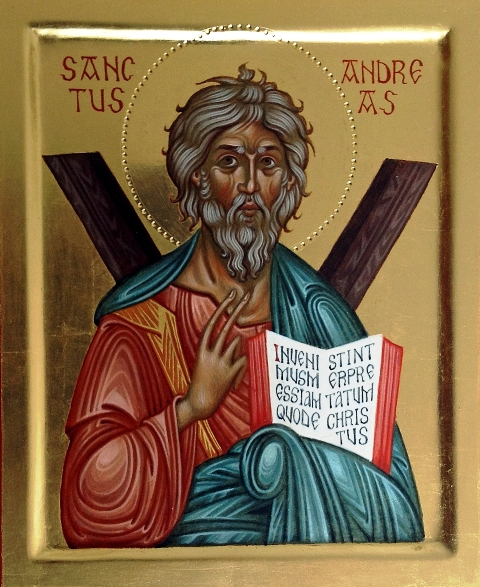
    We celebrate today the Feast of St. Andrew, one of the original 12 apostles. We know very little of him. According to our tradition, Andrew became the first bishop in the community of Constantinople until he was martyred through crucifixion on an X-shape cross. The gospels tell us also that he was the brother of Peter. They were from Bethsaida, a town near the Sea of Galilee. In John’s gospel, we were told that Andrew was a disciple of John the Baptist at first.

    In the same gospel, we found that Andrew had actually brought Peter to Jesus, telling his brother, “We have found the Messiah!” In the other gospels, it was Andrew who called the attention of Jesus about the boy with 5 loaves and 2 fish. Again, it was Andrew who told Jesus that there were some Greeks who wanted to see Jesus.

    From here, we can sense that Andrew was actually an apostle with a typical role. Unlike Peter, he was not able to witness the transfiguration of Jesus at Mt. Tabor. Andrew was not part of Jesus’ inner circle composed of Peter and the 2 brothers, James and John.

    He was in fact an ordinary guy, an ordinary apostle of Jesus. However, Andrew had a remarkable faith in Jesus.

    Remember, his brother Peter doubted and even denied Jesus three times. But for Andrew, he was the first one to realize that Jesus was truly the Messiah. In his conviction, he joyfully shared what he found to his brother. He himself became an evangelist, a preacher of the good news to his own brother. Moreover, he brought others to Jesus like the boy and those Greeks. He became a bridge between Jesus and other people. 

    This is what St. Paul has told us in the first reading. As there is a need and but also beauty in sharing one’s faith in Jesus to others. His letter to the Romans would help us ponder our own call to be a kind of apostle or bearer of the good news to others like St. Andrew. 

    We usually think that preaching is only proper to bishops, priests, and deacons. Indeed, public preaching of the gospel in liturgical occasions like what I am doing now is proper to me as a priest and not to you as lay persons. But it does not mean that you cannot preach the Gospel or share Jesus anymore to others. As Christians, we share the prophetic role of Jesus by virtue of our baptism. It means that all of us have both the responsibility and the privilege to be God’s messenger to others.

    The Gospel tells us how we are being called individually. To each of us, Jesus is saying, “COME, FOLLOW ME, AND I WILL MAKE YOU FISH FOR PEOPLE! I WILL MAKE YOU MY OWN APOSTLE!” This can surely be materialized when we preach with joy by our own example. 

    Thus, when we are happy with what we are doing and when we are honest in our relationships and dealings with others; and when we are sensitive to others and volunteer to help whenever someone needs a helping hand; when we become joyful givers to those who have less;  when we become more understanding and compassionate with those who are experiencing more difficulty in their life; and when people around us feel the deep expression of our faith as we pray in the church, in our homes or with others…then people will see these things and will recognize that we are Christians. Then like St. Andrew, we will be able to bring other people closer to Jesus, by becoming bearers of the Good News through our very life. Hinaut pa.

    Jom Baring, CSsR