Category: Ordinary Time

  • We are God’s family members

    We are God’s family members

    July 21, 2020 – Tuesday 16th Week in Ordinary Time

    Click here for the readings (http://www.usccb.org/bible/readings/072120.cfm)

    Homily

    How important really is your family? How much quality time and presence do you give to your family?

    Our experience of the home quarantine has given us time to be with our families. Many of my friends have expressed how they have spent quality time compared before. I am sure that each of us too have realized many things about the importance of our family relationship.

    This allows me to reflect today on family relationship. For most of us, our families are the source of our joy, security, identity, confidence and assurance. However, for some of us also, our family can be the source of our deepest pain, traumas and bitterness in life. Thus, we cannot deny that it is in the context of our families that we also first experience “being loved” and “being rejected.”

    Moreover, in the growth and development of our Christian faith it is also within the context of our families that we first experience God and we first imagine God. Thus, when I was growing up I was introduced to a God who was rather strict. God was someone that everybody should fear. I was told that this God punishes a naughty boy and rewards a good boy. As a young boy, I tried to be good to avoid God getting angry at me and punish me later on.  Unconsciously, I also became fearful to God.

    What motivated me then, to do good was out of fear from being punished rather than out of love.  I imagined God like an old man holding a stick who is ready to strike a boy who has been naughty. This image of God definitely haunted me. This was my very experience also at home from my parents who were ready to strike me with a stick whenever I become naughty and disobedient.

    However, later on when I became conscious of my faith-relationship with God, then, I realized that God’s true character is not the one that I first thought of. Experiences would actually tell me that God is kind and generous, loving and forgiving. This again is my experience of God with my family. I came to know and became confident that God loves, and in His kindness, God reveals his gift of presence to us in the most intimate way where we could feel Him. When we allow God to reveal himself to us, then God brings healing and reconciliation, freedom and peace.

    This is the assurance proclaimed to us in the Book of Prophet Micah. God is not someone who delights in the destruction of those whom God loves. God delights in mercy and showing kindness to His people. God shows compassion and faithfulness. Indeed, Prophet Micah wanted us to hold on this grace and to be confident with this grace.

    Moreover, talking about family also, this brings me of today’s Gospel. Jesus brought out a new idea of being a family where we too shall experience deeper God’s presence and invitations for us.
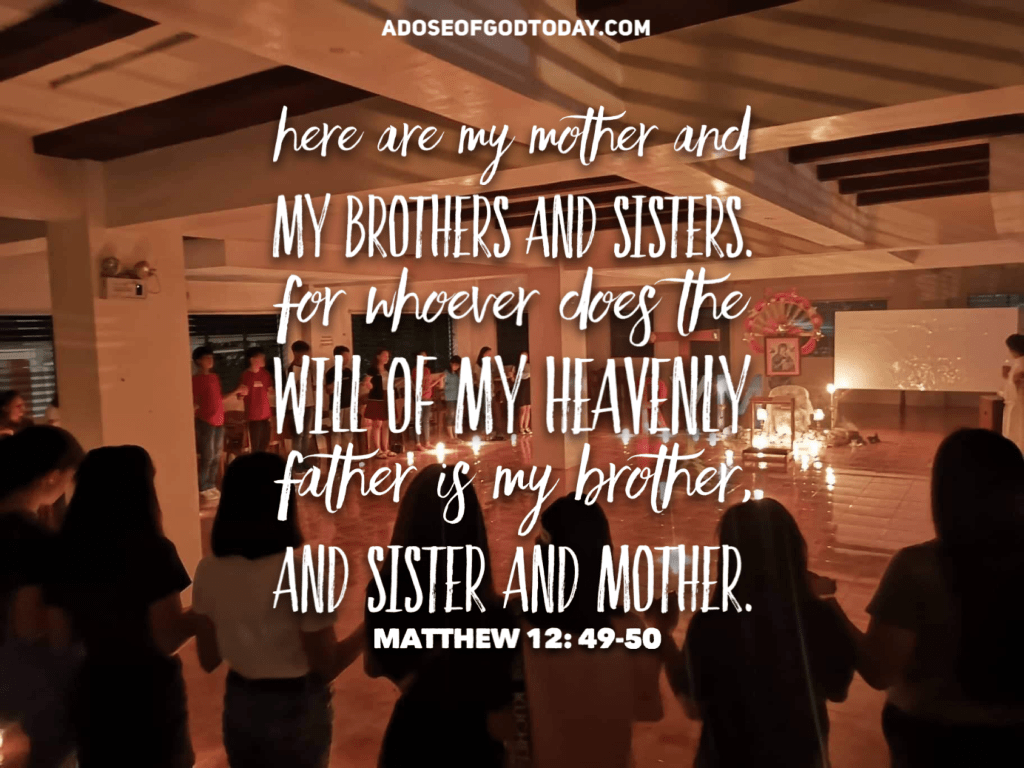
    Jesus asked, “Who is my mother? Who are my brothers and sisters?”  This scenario was a moment for Jesus to teach something very important to those followed him. The response of Jesus was a way of expanding the meaning of family relationship by pointing out the members of his family. These were those people listening to him, gathered around him to do the will of his Father. Of course, Jesus did not reject his immediate family but he expanded the essence of family relationship.

    Obviously, this family is beyond blood relationship. This is toward a deeper spiritual family relationship. This calls us to identify ourselves and others to be part of a bigger family of God.

    But how do we really belong to this family? Jesus told us that it is by doing the will of his Father. And the first step of doing the Father’s will is to LISTEN to the Son. Indeed, it is in listening that we also realize and become aware of God’s invitation for us.

    It is also clear that Jesus pointed out that his mother, brothers and sisters are those who were gathered around him and together listening to him. Certainly, there is wisdom in listening together, as a community or as family because the process of discernment becomes deeper, more realistic, clearer and empowering when we listen together and discern together on what God wants us to be and what God wants us to do.

    Advertisements

    This is what we are basically doing as we gather today in this Holy Eucharist. All of us present physically in this Church and also those of you who are joining us via livestream. As a family, we are called to discern and listen carefully to Jesus and at the same time to the voices of our brothers and sisters who are in pain and suffering in many ways.

    To sum up there are two invitations that I would like you to dwell today.

    First, be in touched with our personal God-experience. This will help us to have grounding in our faith-relationship with the Lord. Be confident with the assurance of Prophet Micah that God delights in our freedom not in our destruction.

    Second, allow ourselves to be part of God’s family by listening to Jesus through the scriptures and experiencing again his presence through the grace of the sacraments and through us and among us.

    Hopefully, this will make us more inclusive and welcoming as a family and discerning as we listen and respond to the voices of those who are in pain, who are oppressed and those who are condemned by others. Hinaut pa.

    Jom Baring, CSsR

  • How to recognize God’s signs

    How to recognize God’s signs

    Advertisements

    July 20, 2020 – Monday of the 16th Week in Ordinary Time

    Click here for the readings (http://www.usccb.org/bible/readings/072020.cfm)

    Homily

    As the pandemic developed and caused great difficulties all over the world, many have interpreted this event as a sign of the apocalyptic days or the end of the world. In fact, many tragic events in the past were also taken as signs of the end of the world. This caused panic and anxiety among those who really believed on this.

    Moreover, it has been our attitude to seek for signs especially when we are confused and filled with unanswered questions. We also ask God to give us signs when we are in the situation of making decisions. We also ask signs from God especially when we become doubtful of His presence and when we experience problems and trials in life. We believe that if God would give us a sign, then, that will make us confident in God.

    However, it has been our experience too, that when we do not receive any sign from God, we begin to doubt more or become angry with God for not listening to us. We may also think that life is so unfair because even a single sign of assurance is not given to us.

    Yet, we remind ourselves today of our tendency to expect impressive signs that will unfold before us. This is actually the problem that we have heard in our readings today. We are reminded of these two attitudes in us namely, our forgetfulness of God’s blessings and coldness towards God’s presence.

    The Book of Prophet Micah reminds us of this first tendency in us, of our short memory and inclination to forget God’s blessings. This is how Yahweh expressed the Divine plea to the people. God reminded the people how they were saved and brought out from Egypt and were released from slavery. Moreover, God sent instruments to guide the people like Moses, Aaron and Miriam. These events and people were signs of God’s blessings yet, the people have forgotten all of these. The people have become ungrateful to God because of their forgetfulness.

    Likewise, our Gospel today reminds us also of our tendency to become cold towards God’s presence. This has been portrayed the way people asked Jesus for a sign so that they will believe in him. The people expected Jesus to do a big and great sign before their eyes before they will recognize God. They thought of Jesus to be some kind of magician. This was the mistake of the people at that time because they asked sign from Jesus, when, in fact, Jesus himself was the greatest sign and miracle that ever happened.

    That is why, Jesus, as if scolding them of their ignorance and indifference, reminded them on how the Ninevites believed in Jonah’s sign and on how the Queen of Sheba believed also in the signs present with King Solomon. However, these people though Jesus was greater than Jonah and Solomon, did not recognize God in the person of Jesus.

    This happens also to us when we tend to be indifferent to what is ordinary. The Jews at that time were not able to recognize God’s tremendous presence in the ordinary life of Jesus. Because Jesus was too ordinary for them, and a mere son of a carpenter from Nazareth, the people refused to believe in Jesus and refused to recognize God in the person of Jesus.

    The Lord reveals himself to us in ordinary and many ways. This is what Jesus is inviting us today, that we may recognize daily God’s blessings and presence in us. But how?

    First, be appreciative and be always grateful even of small graces and blessings that you receive each day. Express in words and actions your gratitude. Be more generous to say sincerely “thank you” to people around you and to God. With this attitude we will always be reminded of the many blessings from God and avoid becoming forgetful.

    Second, be more discerning and listen better on how Jesus reveals himself in ordinary ways. This is also a call to be sensitive to God’s many revelations even in the most ordinary ways. Indeed, God reveals himself and his love for us every day and every moment of our life, in moments of defeat and moments victory, in moments of failures and moments of success, in moments of death and in moments of life. To discern and to listen, then, will make us less judgmental and to become more welcoming of God’s presence in our life.

    In these ways, we may always see and recognize God’s many ways of revealing His signs for us. Hinaut pa.

    Jom Baring, CSsR

  • God growing in us

    God growing in us

    Advertisements

    July 19, 2020 – 16th Sunday in Ordinary Time

    Click here for the readings (http://www.usccb.org/bible/readings/071920.cfm)

    Homily

    Who among us here have witnessed the actual growing of a seed, or any plant or of a person? We could have claimed that we have witnessed it just as parents looked closely as their child grows, or just as a farmer tends everyday his plants and animals. Yet, because growing is a process, it takes time and very slow. That is why, we don’t usually see with our own eyes how a seed begins to sprout and becomes a tree, or how a flower begins to grow and bloom or how a person develops physically and grows old. We only notice the gradual changes as time also goes by.

    However, thanks to our latest technology because a camera can capture this process of growing particularly of a plant or changes that happen in our nature. Through a photographic technique called “time-lapse” we can witness how a seed begins to sprout, take its roots and come out from the soil and become a full bloom plant. This always amazes me to see that.

    I want you to watch this short time-lapse of a growing seed in silence to bring yourself also into reflection and into calmness in the midst of noise, stress and anxiety that are around us today. (Click the link below)

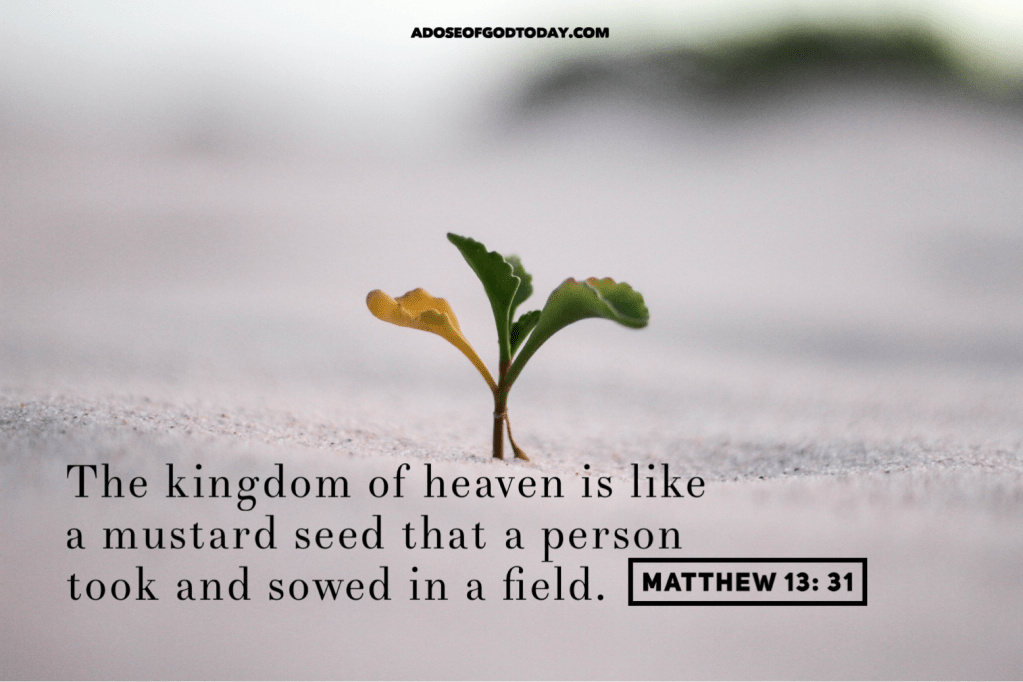
    With this amazement and wonder of the process of growing, this brings me into reflection for this Sunday’s Gospel. Jesus tells the people about the three parables of the Kingdom of Heaven. These are the parable of weeds among the wheat, the mustard seed and of the yeast.

    In all these three parables, what is common among them is the theme of growing. From here, I would like to invite you that we dwell deeper into these three parables and recognize how God invites us today and how God is growing in us.

    I would like to begin with the parables of the mustard seed and of the yeast. Indeed, these are invitations of God for letting us grow, to be mature and to develop.

    We understand GROWING or GROWTH to be dynamic. It involves changes, adaptations, shedding off of what was old and transforming into something new. Meaning, growing is a form of transformation.

    Both parables, tell us of the process of growth in a non-aggressive way because growth is gradual, silent and calm. Moreover, it is empowering and life-giving.

    This reminds us too of the wonder of creation. Creation is silent and relaxed, yet, destruction is noisy, distressful, aggressive and violent. In destruction, there is no growing because it suppresses and destroys. Surely, this is how we would find life distressful, filled with anxiety and worries, because when we do not grow or when we stop growing then, it leads us to destruction.

    And this is not what God wants us. God’s desire is that we develop into our full potential as what has God desired us to be. Thus, we are called to continue growing no matter how our hair have turned into white or our wrinkles have become more visible.

    Likewise, growing also leads us towards maturity. The first parable of the weeds among the wheat leads us into this invitation, MATURITY. Remember, the owner of the good seeds waited for the wheat to mature before weeding out the weeds, that were sowed by the enemy. To weed out the weeds when the wheat are still young, it will endanger the life of the young wheats. The owner has to wait when the wheat becomes mature and ready for harvesting.

    This means that only when we have grown and become mature that we also gain wisdom to recognize what is bad and good, what is unhealthy and healthy, what is from the evil one and what is from God.

    This tells us that the Kingdom of Heaven is already in us because God is with us. The seed has been planted on earth as Jesus was born for us. The Lord is already in our hearts as we are being baptized. Moreover, the Kingdom of Heaven is manifested in us when we also become mature in our faith and relationships with God and with others.

    How do we recognize that we have become mature? It is by being able to recognize the works of God and the works of the evil one, the works of kindness and the works of selfishness and to choose freely God.

    Now, these are the signs as well as the invitations for us to recognize the Kingdom of Heaven and to let God to grow in us.

    First, as the mustard seed grows and the flour reacts with the yeast, the kingdom of Heaven also begins in HUMILITY not in any form of aggression or arrogance. It is humble and simple. Thus, the kingdom of heaven can be very present in a family who makes the effort to pray together, in a couple who expresses their faithfulness despite their differences, in a person who shows true concern and generosity to another who is in need of help.

    Advertisements

    Second, the kingdom of heaven is empowering and life-giving.  The kingdom of heaven is present when our community empowers the weak. A community that discriminates, judges, condemns and indifferent never empowers but it oppresses the weak. However, when our community empowers, then it also gives life. Let us also remember that to be able to give life is to give more chances and opportunities for growth. To give life is to give hope. Therefore, our community is truly a kingdom of heaven when we uphold and protect every life to survive and to mature.

    As we recognize the Kingdom of Heaven in us today, let us also allow the Lord to grow in us, to bring changes and transformation in ourselves, in our attitudes and relationships and in the way we look at things in life. As we continually grow and become mature, we may also become individually, a person for others and also a community for others that gives life, that gives hope and allows chances and growth for the weak and the helpless. Hinaut pa.

    Jom Baring, CSsR

  • Be humble. Recognize your emptiness. Be Grateful.

    Be humble. Recognize your emptiness. Be Grateful.

    Advertisements

    July 14, 2020 – Tuesday 15th Week in Ordinary Time

    Click here for the readings (http://www.usccb.org/bible/readings/071420.cfm)

    Homily

    Jesus was very disappointed at the response of the people. Three places were mentioned to have been the places where Jesus did many wonderful things. These are Chorazin, Bethsaida and Capernaum. Miracles were performed as God’s sign of blessing and presence. However, Jesus found the heart of the people hardened and unrepentant. The people refused God’s offer of friendship.

    They did not want to be disturbed from what they were usually doing. They were just satisfied with the kind of life that they were leading. Thus, God’s invitation for them to change became a threat to what was comfortable, advantageous and beneficial for them.

    This is the reason why Jesus gave the uncompromising warning to these people because of their refusal of God’s offer of salvation, and that is, damnation. However, remember that it is not God’s desire for the people’s damnation. It was the people who chose to be damned and to reject God.

    There might be times where we will find ourselves in this kind of situation. We can easily take for granted the everyday miracles that are happening in our life. As a result, we could become ungrateful in the way we live our life, in the way we relate with others and even in the way we relate with God. And from these, there are three reasons that I see on why we would hold back and refuse God.

    First is the refusal to admit and recognize that there is something wrong in us, in the way we live our life, and in the way we relate with people around us. Unacceptance of our faults means distancing ourselves from our responsibility. This attitude will make us self-righteous and arrogant, making us blind of our own sins. Thus, when we refuse to admit our failures and sins, we point our fingers to others. We would find ways of covering up our sins by bringing up the sins of others or making reasons that we have become the way we are because of the faults of others.

    Second is the confidence of being self-satisfied. When we are filled with ourselves, filled with our selfish desires and wants, we also become self-satisfied. When this happens, we will not realize that we are also in need of God. This attitude comes from the tendency that tries to accumulate more for the self. The forms of accumulation is not just limited with our desire to enrich ourselves with material things but also, praises and recognitions from others, or even forms of compulsive behaviors and addictions. These forms of accumulation make ourselves busy and filled with many things, consequently, preventing God to occupy a space in our life. We would not dare to make a room for God because our heart is full, our mind is occupied and our day is busy.

    Third is being ungrateful. A self that refuses to admit sins and becomes self-satisfied also becomes ungrateful. When we become ungrateful, we easily take for granted the giver of gifts and the worker of miracles, and thus, the presence of God in our life. With this attitude, we also become self-entitled. We become demanding in our relationships. We become critical of those people around us and we tend to only see what is wrong in the other person. We will become stingy of our time and energy and ungenerous of our resources and presence to those who are asking for our help. And most of all, we become indifferent to people around us and indifferent to God, the source of all blessings and miracles. We will easily notice this in us because we will tend to become bitter, impatient and cranky.

    However, as the Lord continues to reveal himself in us, he desires that we become the person God wants us to be. That is why, the Lord never tires in calling us closer to Him, again and again. The Lord has blessed us and shown us many wonders to invite us. Thus, the invitation for us today is to be more aware of the many blessings and miracles God is doing for us today even in the midst of this pandemic.

    Advertisements

    Hopefully, by recognizing God’s blessings and miracles in our life, it will lead us to the three movements that will allow us to see and recognize the Lord in these difficult times.

    First. Humble ourselves by recognizing our failures and our need for mercy and forgiveness.

    Second. Recognize our emptiness and so of our need of God to fill our empty hearts. Never be afraid to be vulnerable and to show our weakness so that God can work miracle in us.

    And finally, be always grateful to the many good things that God has given us even small and simple things. This calls us to be more aware of God’s presence revealed even in ordinary ways and to be sensitive to the needs around us. Hinaut pa.

    Jom Baring, CSsR

  • When complacency and indifference grip us

    When complacency and indifference grip us

    Advertisements

    July 13, 2020 – Monday of the 15th Week in Ordinary Time

    Click here for the readings (http://www.usccb.org/bible/readings/071320.cfm)

    Homily

    In the first reading, Prophet Isaiah proclaimed to the people God’s message. It was addressed to the rulers of Sodom and to the people of Gomorrah. Isaiah particularly called their attention “to hear and to listen” because they pretended not to hear God at all. These people were identified as citizens of the “sin cities” in the biblical times.

    Moreover, as Isaiah served as God’s messenger to the people, God also expressed the divine dismay and disappointment over these people. God basically expressed how fed up He was with the practices of the people and sick of those facades portrayed by them. The sacrifices made by the people were found unworthy by God. God was not pleased. God even despised them.

    Why? Why would God close his eyes and not listen to their prayers?

    The reasons for these are found at the evil and unjust practices committed by them against the weak and the poor. Yahweh called the people to remove their evil deeds and to put an end on their wickedness. The people are called to seek justice and to do good. And how? It is by ending their selfish desires, stopping the abusers, caring the orphans and defending the widows. Meaning, the people are rather called to respond in concrete actions in the way God wants them to be and that is to be people for others.

    To become people for others is to take the side of those who are helpless, homeless, sick and poor. Only then that they also become true people of God.

    Hence, when our rituals, our prayers and other forms of devotion will stop to be just mere religious practices, then, these are all in vain. When we are too strict in our observance of our prayers, too sophisticated in performing our rituals but remain unmoved to the plight of the poor, unkind to those who need our help and indifferent to unjust practices around us, then, we are not different from the rulers of Sodom and people of Gomorrah.

    They had grown complacent and corrupt. They had become too attached to their comfort that they also tended to only focus on what was easy and beneficial for them. Their sacrifices and oblations were not for Yahweh. Those were merely shows to display how spectacular their rituals were.

    They found pleasure in them, but not God. They found contentment in their practices, but not God. They were extravagant for themselves but unkind to the homeless. They were sophisticated people but blind to the difficulties of the poor. They would not dare take sides of the oppressed because it would require more sacrifices from them. Thus, the rulers and the people would just keep the abusers among them because they too enjoyed their benefits. This is how Yahweh found displeasure in them and in their attitude.

    No matter how expressive we can be in our religious practices, we are not immune to the virus called INDIFFERENCE and COMPLACENCY. These are attitudes that may grip our hearts to become passive, unmoved, unkind, ungenerous to the needs of others.

    However, just as Isaiah was sent to the people to call them back to Yahweh, each of us today is reminded to beware of this tendency in us. This is what Jesus calls us in the Gospel of Matthew.

    He asked, “Do not think that I have come to bring peace upon the earth. I have come to bring not peace but the sword.”

    The peace that Jesus talks about here, is most likely the peace that we believe, the peace that is only about comfort and routine of life or ‘business-as-usual.’ This means that we go and proceed to what we usually do in life by doing what we want and by satisfying our needs and desires, from mere our complacency, unchallenged and unconfronted. Thus, this peace only knows about maintaining the status quo and the order that we are comfortable with and a kind of relationship that will not disturb and will not challenge us. Yet, this peace is shallow and remains self-centered. It simply focuses on our ego.

    However, Jesus is not bringing this kind of peace but sword that will pierce and disturb us. This includes piercing and disturbing our comfort, our current situation, our complacency, indifference and even routine.

    Hence, we may choose to be passive because, we do not want to be challenged, we do not want to go beyond and become life-giving. We do not want because it requires more effort from us, more time and more presence from us. As a result, we would not want to confront ourselves and others because it might cost us conflict and division, as Jesus said clearly in the Gospel. Because we do not want to sacrifice the contentment and the comfort that we apparently enjoy, so we distance ourselves from what God calls us to be.

    But, God does not want us to become a person like this because we will become prisoners of our own selfish desires. We will become abusive and corrupt yet the most insecure of all.

    Moreover, Jesus does not want us also to just go with the flow of life and remain passive. We might find ourselves to settle to what is only easy, comfortable and beneficial by doing the same things, thinking the same thoughts and imagining the same ideas to the point that we refuse to do more and give more.

    Advertisements

    The Lord wants us to find freedom. Jesus comes to disturb our seemingly peaceful lives. Jesus is not in favor for making ourselves stagnant. However, Jesus wants us to grow, to develop, to mature, to give life and to become the person He wants us to be.

    This means that our relationship with God becomes the first of all our other relationships. Yet, this will surely cause division in our other relationships because others may not understand us why we take the side of God and not them.

    Despite these challenges, we way find the courage to allow the Lord to disturb our complacency, indifference, passivity and routine so that we will be able to see things differently and wonderfully. We may become life-giving then as we express our faith and show to others the presence of God in us through our prayers, through our devotions and concrete actions of kindness and generosity. Hinaut pa.

    Jom Baring, CSsR