Category: Ordinary Time

  • Not Yours or Mine but HIS

    Not Yours or Mine but HIS

    Advertisements

    October 4, 2020 – 27th Sunday in Ordinary Time

    Click here for the readings (https://bible.usccb.org/bible/readings/100420.cfm)

    Homily

    For pasalubong, a madre once bought a box of munchkins from dunkin doughnut. While waiting for their flight, a family sat beside her at the pre-departure area. Giving in to her cravings for sweets, the sister took a munchkin from the box, and enjoyed eating it. Suddenly, from the same box the little boy also took and ate one. She did not mine at first, thinking the boy must be hungry. But then, the ate also took and ate one. This has upset the madre but she just ignored it and took one for herself. But then so did the nanay and tatay. This really irritated her that she glared at the family who was consuming the rest of the munchkins. But what really infuriated her was when the nanay took the last munchkin and offered it to her. Now indignant and so enraged, the sister stood up and changed her seat. But later on, when she opened her tote bag to get her purse, she saw, much to her embarrassment and shame that inside her bag was her own box of munchkins unopened. “Opps, hindi pala kanya yon.”

    Sometimes it is good to examine and ask ourselves: “What are the things that we claim as being rightly ours and yet are not truly ours?” This may not only be material possessions but could also be our status in society used to lord over others… titles used for personal advantages, prejudices and biases harbored towards others… or self-righteous behaviors that makes us feel morally better or more privilege or important than others. Sometimes, we are not different from that madre. We sometimes claim these privileges, which do not really belong to us, that we come to think and believe that they are only ours to own. Worse, we are sometimes greedy enough to claim that we are the rightful owners of the munchkins and it is only us to have and enjoy.

    Certainly Jesus would not tolerate and justify such behavior of distinctiveness, self-righteousness, greed and conceit. This is what Jesus criticizes here in our gospel today. 

    By telling us the parable of Ungrateful Tenants, he reminds us that God has already done His part for our salvation, and that we should also do our part. And our part is not to hoard, accumulate and own all the blessings He has given us but to produce its fruits and share it with others. Here, Jesus strongly condemned the Pharisees and scribes of his time and warns us of our tendency to be so pre-occupied with honor, recognition, privileges, titles, and social status – thinking and claiming that we are greater compared to others, and much worse, even resorting to greed, fraud, and murder, (pangdaraya, kaswapangan at pagpatay) in order to protect and maintain such claim.

    For Jesus, the Kingdom of God is wider than our human standards of social status and privileges. He reminds us today that we are not the rightful owners but mere tenants, sharers, benefactors or stewards of God’s graces. We cannot exclusively claim ownership and privilege for what we have, because everything we have is a gift from God.  For Him, God’s Kingdom is more like a big farm where all of us participates and shares in the production and fruits of the bounty, where each of us has something to contribute and benefit from, since no one is too poor who cannot share with others and no one is too rich who does not need others. 

    Our Eucharist today has a simple message: What you enjoy now are not only fruits of your labor but most of all, God’s gifts.  All of these are God’s blessings to you and for all of us. Accept the Gift, but don’t forget to acknowledge and thank the Giver. Be fruitful and share the fruits of God’s kingdom to others, for all these are not yours or mine, but His.

    Life on quarantine during these pandemic times do make us reflect and realize that our life is essentially on-loan, a God-given chance to live and create this life now. What we have now are just but borrowed time, talents and treasures to make life fruitful and bountiful for all. Somehow pandemic times is God’s way of pruning and forming us to be who we are and we should be – His stewards, mere tenants of His creation. Grant us, O Lord the humility to trust your Ways of creating anew our lives according to your Will. Amen.

    By  Fr. Aphelie Mario Masangcay, CSsR (a former Filipino Redemptorist Missionary for Filipino Migrants in South Korea who, due to immune compromised diabetic condition, stationed back home  in the Philippines for now).

  • Will you also reject God?

    Will you also reject God?

    Advertisements

    October 4, 2020 – 27th Sunday in Ordinary Time

    Click here for the readings (https://bible.usccb.org/bible/readings/100420.cfm)

    Homily

    Being rejected or to experience rejection is truly a terrible experience. When someone you love, a friend or family member rejects you for being who you are and for what you have done, is so painful. This experience creates emptiness in us and feelings of not being loved, not being wanted. This experience makes us worthless and useless, thus, traumatic. We experience this also in our workplaces when a co-worker and/or  your employer get angry at you and shows sour attitude towards you. Or when your work has been rejected or a proposal has not been approved because of their biases with you.

    In our community, there are many forms of rejection also that sometimes we are not aware of. We could just reject those whom we think are useless. We could easily not pay attention to those who do not belong in our circle of friends. We could just dismiss a person just because of appearance, education, family background or culture.

    These kinds of rejections are not alien to God. Our Gospel this Sunday tells us that God is also experiencing rejections from us. Yes, God has been rejected by us in many ways. Jesus describes this in the parable. The tenants of the vineyard rejected the emissaries of the landowner by killing them, and even his own son.

    This describes on how Israel repeadtedly rejected Yahweh by murdering the prophets sent for Israel’s conversion. However, the people’s response was of violence. The people rejected God’s messengers and killed them. It culminated in the life of Jesus, the Son of God. Indeed, Jesus, even though he is the Son of God had also been rejected. Only few recognized him as the Messiah. Many, especially the leaders of the Jewish people, failed to recognize and even refused to believe that he is indeed the Messiah. Hence, they killed him by nailing him on the cross, a shameful way of killing.

    God is still being rejected by us until today. We are doing it in many ways and even in creative ways. We reject God because we want our own ways. We reject him because we want to believe what we like to believe. We fall short on this when we think that we know better than God. That is why, we have the tendency to linger on GUILT, to always feel guilty of what we have done instead of feeling sorry of our sins and ask God’s forgiveness and accept God’s mercy.

    We reject God when we refuse to recognize his many appearances through the people we encounter. We reject God when we fail to recognize his presence in each of us. We reject God when we judge others. We reject God when we tend to believe that sinners such as alcoholics, drug addicts are less humans than us. Thus, we tend to believe that they are worthless and are good for nothing. We reject God when we continue to deprive others, when we continue to oppress and refuse to extend help to those who are in need. We reject God when we fail to see his face in each of us especially among us sinners, the poor and the oppressed.

    God hungers for you and me. He hungers for our attention and love. He hungers for our goodness and generosity that we are called to show to the needy; because in these ways we become a people of God who shows what is just, lovely, pure and gracious as what St. Paul told us in the second reading.

    God calls us today to recognize him, to feel his presence and to listen to what he is saying to us. I would like to invite you then to close your eyes… and remember those times when you failed to recognize God by rejecting the goodness of others, by judging the weaknesses of others, and by not accepting and embracing your own gifts, talents and also failures and weaknesses in life.

    Let us be sorry then, and ask God’s forgiveness so that we will be able to feel and recognize him in us and through others. In this way, we may able to receive the Body of Christ in our Eucharistic Celebration with joy in our hearts. Hinaut pa.

    Jom Baring, CSsR

  • Front-liners at home

    Front-liners at home

    Advertisements

    October 1 , 2020 – Thursday of the 26th Week in Ordinary Time (Memorial: St. Therese of the Child Jesus)

    Click here for the readings (https://bible.usccb.org/bible/readings/100120.cfm)

    Homily

    As the Corona Virus Pandemic continues to bring disorder in our way of life and as we continue to be limited in our movements especially with our religious practices essential to our faith, some parents and grandparents have expressed their worries as to the faith formation of the young generation. The Holy Eucharist and other public celebration of the Sacraments including catechetical gatherings intended for the younger generation, remain to be banned from the vast majority. Though many cities have been allowed to have the public religious gathering by 50% of the building/Church’s capacity, yet, minors and Senior Citizens are still discouraged to be present physically.

    This poses a concern as to how we continue the moral and spiritual formation of the young and the continual spiritual nourishment of the older ones. Consequently, the Church have found ways on how to reach out to those who are excluded particularly now through the use of social media. Yet, this might not be enough since not everyone can access it and the Church’s programs may not be appealing to the young.

    More than ever, the Church is in need of the “active participation” of parents, grandparents and young adults to be at the frontline in terms of moral and spiritual formation of the younger generation.

    Today’s Gospel reminds us of this mission we share from the 72 disciples sent ahead by Jesus to the cities where he intended to visit. They were Jesus’ front-liners at that time. Jesus sent them ahead to announce to them that God’s Kingdom is at hand. They were to prepare the hearts of the people who have been longing to see God and to experience good things from the Lord as what our Psalm proclaims today.

    Thus, the 72 disciples were told to bring peace to every household they visit. Even if there was the possibility of being rejected by those who were not ready, they were still to bring peace. As they were told to stay with those who welcomed them, the disciples were told to accept their hospitality and also to bring healing to those in pain, wounded, and sick.

    These were ways of nurturing those hearts who were longing to see God, to bring hope to those who were in despair and give hope to those who find life difficult and miserable.

    This is also the call to each of us now especially with you parents, grandparents and adults who live among and with the younger generation. Your presence is needed even more now to be those disciples of the Lord in your own context, that is, to be front-liners at home.

    You have this very important role to play to serve as front-liners, to prepare the hearts and mind of the younger ones, to nurture and develop their young faith and relationship with God.

    St. Therese of the Child Jesus, whose feast we celebrate today, reminds us of the mission we share with one another. St Therese is even called as the Patron of Mission even though she herself stayed most of her life inside the convent. Her little ways, her compassion and thoughtfulness to her sisters, her prayers and devotion were her ways of participating in God’s mission.

    Thus, for all of us too, we do our little and humble ways in participating in God’s mission. Parents, grandparents and adults, again, do your little ways in educating and nurturing the younger ones. Be welcoming to their different responses and be accepting to their ways of doing things and in relating with God. Affirm them and appreciate their efforts.

    But remember, to nurture and to develop one’s relationships with God is not done through “imposition” or by “force.” Never impose and never use force in nurturing the young ones. They learn by example. They admire through our sincere words and actions. They see and recognize God through us.

    In this way, we may be able to truly bring peace in our homes and bring healing into the hearts of our own family and friends. Hinaut pa.

    Jom Baring, CSsR

  • In our Capacity to receive and embrace

    In our Capacity to receive and embrace

    Advertisements

    September 28, 2020 – Monday of the 26th Week in Ordinary Time (Feast of San Lorenzo Ruiz)

    Click here for the readings (https://bible.usccb.org/bible/readings/092820.cfm)

    Homily

    Look at how the disciples behaved themselves. This passage of the Gospel of Luke tells us how the disciples argued among themselves on who was the greatest among them. They must have been boasting one another about their closeness with Jesus, their great qualities, their faithfulness, on who was the first to be called and who was the favored one among them. Their argument must have been fierce because it reached the ears of Jesus. Jesus heard not just their words but even realized the intention of their hearts.

    At this point, the disciples thought that Jesus’ kingdom will be like those of kings sitting on a golden throne in the palace with a great army, a political king. They believed that Jesus will inherit political power and vast riches and material wealth. Thus, obtaining a position and having a closer relationship with Jesus will give them the security and assurance of a higher and influential position when Jesus reigns.

    Consequently, the argument of the disciples was based on how they could benefit from their friendship with the Lord. As Jesus heard them, he too realized that this was in the heart of the disciples. Jesus had to teach them and to mold their hearts according to God’s desire.

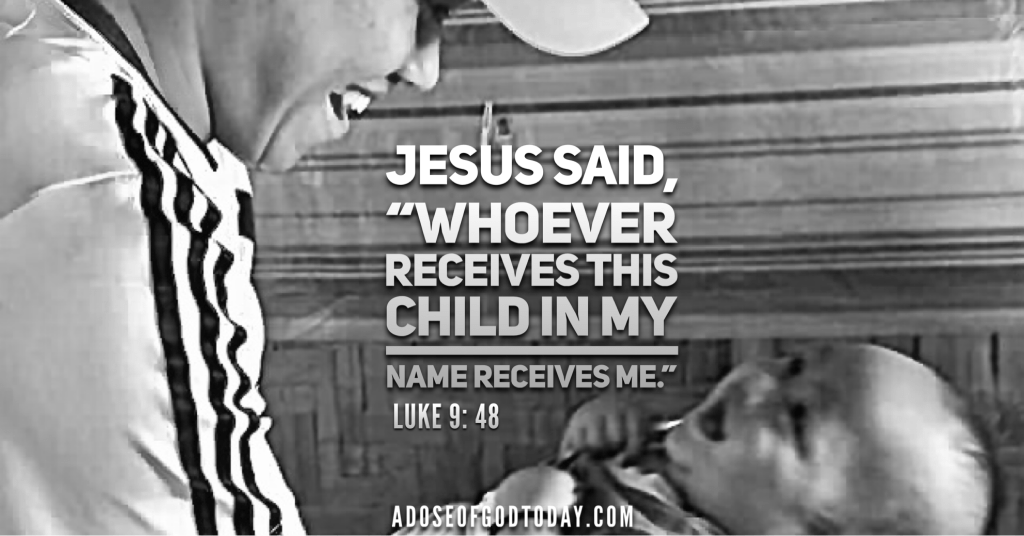
    That’s why Jesus taught the disciples an important lesson through a child. Jesus took and placed the child by his side and said, “Whoever receives this child in my name receives me, and whoever receives me receives the one who sent me. For the one who is least among all of you is the one who is the greatest.”

    Children, at the time of Jesus were considered not important because they were dependent, they have no rights and thus cannot be called as fully man at all. Jesus teaches that in the Kingdom of God, greatness is measured in the capacity to receive God. To receive God is best expressed in welcoming, in embracing and in receiving the least in our community.

    We are called to receive God in the person of those who are the least in our church and society. We are called to aspire to be great but neither in the way that we will be above others, nor to seek a higher position at the expense of others, but in the way of embracing others.

    This capacity to embrace others and embrace God fully was what San Lorenzo Ruiz showed to us. In offering his life, even to the point of death, San Lorenzo was always confident that Jesus was with him. He said, “If I have thousands of lives, all of them, I will offer to God.” This shows us that San Lorenzo had found himself, the kingdom.

    Thus, we shall surely see that when we make ourselves open to receive others, we too shall receive Jesus and Jesus will live in us. This is the reward, Jesus himself. The kingdom of God will be present in us because when we have Jesus, we will be at peace, secured and loved even if we are in the midst of trials and turmoil in life. Hinaut pa.

    Jom Baring, CSsR

  • Afterwards

    Afterwards

    Advertisements

    September 27, 2020 – 26th Sunday in Ordinary Time

    Click here for the readings (https://bible.usccb.org/bible/readings/092720.cfm)

    Homily

    Jesus told this parable of the two sons to make a point to his listeners that they may be able to see themselves in the story. The parable is a common situation at home that those who were listening could relate well. The father who asked his sons to be in the vineyard depicts an image of the everyday struggle of parents in motivating their children to follow them. And this kind of domestic situation was being used by Jesus to  make his message known and let people know God’s invitation.

    Thus, for us this Sunday, let us go deeper into this parable. Let us see the attitudes of the two sons and discover God’s invitation for us today.

    The father asked the first son to go and work in the vineyard. However, this son refused and said he will not. This son must be very busy with some other things in his life. He did not want any disturbance from his father. And so the father received an immediate “no” from his son. However, the Gospel told us that “afterwards,” the son changed his mind and went and worked in the vineyard.

    The word “afterwards” is very important here. Certainly, the son did not want to be disturbed. He did not want to be challenged by his father. He did not want to participate or to follow what his father said. At that time, what his father told him was insignificant for him. Yet, “afterwards,” he realized something and changed his mind. He changed his attitude and changed the direction of his life.

    This “afterwards” of the son was that process of realization on the importance of life. This son who initially refused his father had thought very well the implications of his actions. Not to go and work in the vineyard will not only not be his failure but will affect the entire family. This means that the “afterwards” of the first son became a moment for him to think not just for himself but also for people around him.

    This is what St Paul said in his letter to the Philippians, “do nothing out of selfishness or out of vainglory; rather, humbly regard others as more important than yourselves.” Certainly, this “afterwards” made the son to consider others and move from his own comforts in order to respond to a greater need. Thus, from changing his mind, this allowed him to change his perspective in life and his approach towards life. Moreover, this inspired him too to change his actions that led to transformation. Prophet Ezekiel tells us something about this, “since he has turned away from all the sins which he committed, he shall surely live.”

    This first son is the image of those sinners like the tax collectors and prostitutes at the time of Jesus who at their encounter with John the Baptist were touched and thought of their life. Indeed, the presence of Jesus made a great impact on their life and moved them to change and transform their life according to God’s desire for them.

    However, the second son in the story who was also asked by the father to go and work in the vineyard and said his big “Yes,” did something that must have surprised the father. This second son, though his words must have been a comfort and assurance to the father, revealed later on that he was only filled with pretensions. This son was only concerned in being affirmed. His words were empty. His words were merely a sugar-coating. Yet, his actions revealed different.

    This means that this son responded in words but he never listened and never believed. Afterall, what he was after was himself. He was merely concerned of his own interests. He did not consider others.

    Indeed, the second son is the image of the religious leaders and elders of the community at that time of Jesus. These were the people who memorized the scriptures, strict in observing rituals yet never changed their minds and attitudes towards others. They never believed in Jesus because believing in Jesus meant moving away from their privileges, moving away from their comforts, challenging the status quo and making themselves less important.

    The call of Jesus was too much for them, not good for their self-righteous image, bad for their business.  That’s why Jesus criticized their attitudes because they were only full of themselves, full of pretensions. When we become people like these, then, we are only depriving ourselves with true life, with freedom and depriving ourselves with the joy of being with God.

    God invites us today to identify ourselves not with the second son but with the first son who like him have said “NO” to the Lord many times. The mistakes, failures and sins we have committed in life were those moments of saying “no” to the Lord. Those were the moments of depriving ourselves with true life, with freedom and joy of being with God. Yet, time and again, God surprises us with His presence and appears before us through people and events to call us once again and to invite us to come closer to him.

    God only desires what is good and best for us. God desires that we enjoy a life where we are free and joyful. Hence, never deprive ourselves from these by becoming full of pretensions, full of selfishness. A person who is always pretentious, selfish, always seeking approval and affirmation, advancing his or her personal interest is a very sad and insecure person.

    Let us embrace our “afterwards,” those moments of realizations to dwell deeper on the importance of our life, of our relationships , of God, and on how our actions can affect others. By becoming less and less selfish and self-conscious then the more we become loving, life-giving and happy. Hinaut pa.

    Jom Baring, CSsR