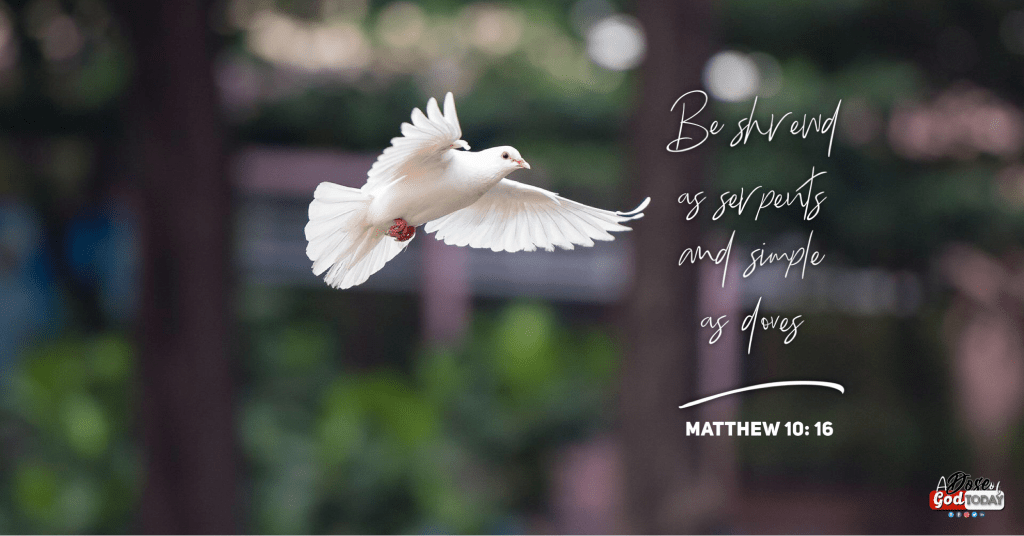
“Be shrewd as serpents and simple as doves.” This is what Jesus said to his disciples and now addressed also to us. What does Jesus really mean about this? In biblical understanding, the serpent is an image of Satan or of the devil. We remember, that it was the serpent that tempted the humanity to commit sin as told to us in the Book of Genesis. However, there are also other characters that the serpent possesses. The serpent is also believed to be wise, resourceful, flexible, adaptable, observant and cunning.
This means that a serpent adapts to its situation in order to survive. It finds ways as it observes its environment. It is in this way that Jesus invites us to be wise as the serpent, that is, to have the character in us that is wise, resourceful, has the quality to adjust to a given situation, observant and discerning. Like the serpent, Jesus invites us not to react immediately out of our emotions only, or to make decisions imprudently.
The dove is also understood to have the characters of being innocent, gentle, relax, peaceful, understanding and meek. The dove also represents the Spirit of God that brings comfort and peace, enlightenment and freedom. The dove reminds us of the gentle presence of God, never intimidating yet powerful, never imposing yet forceful.
It is in this way too that Jesus invites us to be as innocent and simple as the doves. Like the doves, we are called to keep calm and to always claim our peace so that we may be able to respond to life with wisdom. We are also called to be gentle and to be simple in order to bring encouragement and hope to others around who are already troubled and anxious. Kabay pa.
Exercising authority in our community gives us the opportunity and capacity to serve others. This is how we understand it in a Christian perspective. This means that when we have authority over other people, this does not give us the right to belittle or put people down just because we have power over them.
Thus, in any community, organization or even in our workplaces, when we are given authority, it is rather meant to give us the ability in empowering others and facilitating others to be more productive, growing and maturing.
The giving of authority is what we have also heard in today’s Gospel. Jesus gave authority to his Twelve disciples. This authority has two functions. First, to drive out unclean spirits that terrifies and imprisons people. Second, to cure every disease and every illness of the people to whom they were sent. Through the authority given by Jesus to the Twelve disciples, the Lord gave them the opportunity and capacity to serve others by setting people free and bringing healing to the sick.
The Gospel tells us now that authority is a gift. It is given to us as an opportunity and giving us the capacity to serve others and not to serve ourselves or to serve those who are only close to us. Thus, exercising authority is a form of a loving-service. And we will know that it is a loving-service when in exercising authority it sets people free, inspires freedom, brings healing and creates a space for growth.
However, when authority is also used as a means to serve oneself by manipulating and overpowering others, then, authority discourages and oppresses people just like unclean spirits or demons would do. Moreover, in this case, authority will also be the cause of divisions, wounds and toxicity in our community or organization just like a disease or illness would bring suffering to a person.
Hence, Jesus calls us today that as we exercise authority in our own context and life-situations whether at home, at work or in our communities and organizations, we may always be able to inspire freedom, to allow others to be free and be agents of healing and growth. Kabay pa.
As we grow older, we also develop fondness and attachments to few or many things, people, events and even memories of our past. This fondness and attachments could just because of our liking or comfort and pleasure. But to a deeper level, we have grown attached to it because it fills our emptiness, it satisfies our deep longing, and pampers our deepest desire.
However, when we are not conscious of these, such attachments that we have developed could make us stagnant, uncompromising, and indifferent to the point that our attachments to things, people, belief or memories become an obsession.
In fact, the younger generation today may have more chances to be more fixated and attached to things. Like for example, it is a common sight today of parents allowing their young children as early as 2 or 3 years old playing with smartphones, iPads or tablets to be entertained and to keep the child occupied. Perhaps because parents are multi-tasking and of the amount of workloads they have, that they cannot be always available to their small child. Thus, giving a smartphone to them would be the most convenient to do and to let these gadgets do the babysitting.
However, when this is not regulated and parents are not mindful enough of its effect to the child, the child may also grow a deeper attachment to gadgets that when a gadget is taken away, the child could throw an endless tantrum. That deeper attachment to a gadget of a child will be intensified when physical presence of parents is deprived in the formative years of the child. Consequently, gadgets fill up that emptiness in a child and satisfy the longing from a child to his or her parents.
Our attachments, whatever they may be – things, people or memories, that also become an obsession to us, could hamper the quality of our relationships with one another and of our freedom to be available for others and for God.
On this 13th Sunday of Ordinary Time, our readings invite us to look at ourselves, to look at our attachments and to examine the quality of our commitment in our relationships with others and with God. Thus, allow me now to go a bit deeper into our readings today and let us see how God invites us to be free and to be more available.
St. Paul in his letter to the Galatians acknowledges that Christ sets us free from the yoke of slavery. This yoke of slavery is our very attachments to things, to pleasure and to comfort that only satisfy oneself but indifferent to the needs of others. St. Paul further reminds us that this can be very dangerous because we will never be satisfied but rather will only go on biting and devouring one another. Though this sounds horrifying, but Paul wants to tell us that when selfishness fills our heart, then we also become corrupt and vicious in our relationship with one another. Accordingly, for St. Paul, this is not true freedom but slavery. Freedom, as St. Paul reminds us, is to be able to serve one another through love.
This is what Jesus is trying to teach to his disciples especially when James and John suggested to him to call fire from heaven and to consume a Samaritan Village. The reaction of James and John tells us of a fixation to power and authority. As disciples of the Lord, the two could have also grown entitled who wanted to assert their power and authority to people who did not belong to their group. Yet, Jesus reprimanded them because power and authority is not about being able to punish people or to become destructive and cruel to those who are against us. Power and authority is freedom to give life, to inspire life and motivate life in the community. Thus, when we ourselves become obsessed with power and authority, we also become entitled, demanding and abusive in our relationships. And this happens in our homes, workplaces, organizations and communities. Indeed, beware that we will not be consumed by this obsession.
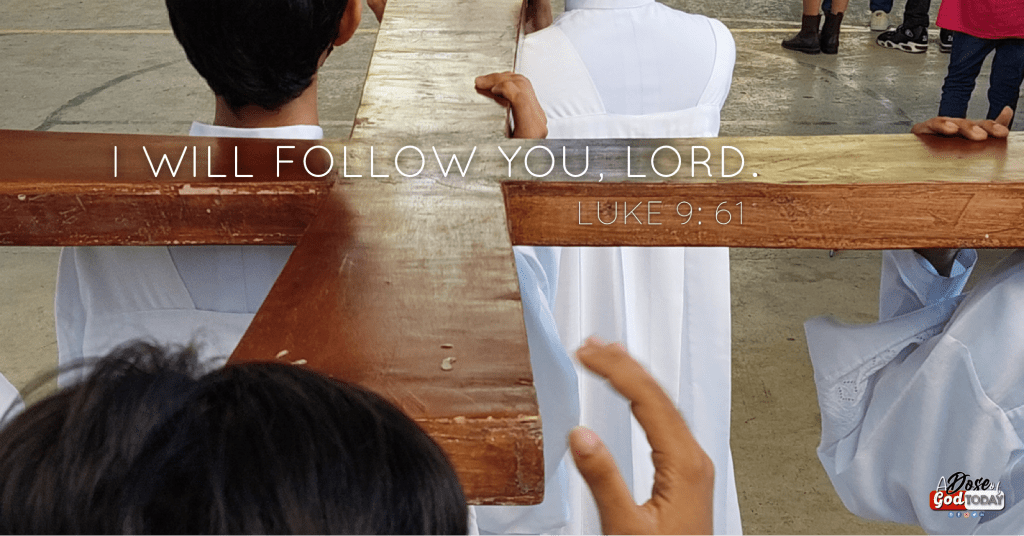
Moreover, Jesus points us another aspect of being free and that is in following him. Many expressed that they want to follow him, yet, because of their personal attachments to comfort, to people and other things in life, they cannot fully commit to the Lord. Jesus calls us that in order to follow him whether in religious life, in married life or in friendship is to fully commit ourselves. This calls us also to detach ourselves from whatever that prevents us to be more available in our commitment.
This is what Elisha shows us in the first reading from the First Book of Kings. Elisha who was called to follow Prophet Elijah gave up his attachments in life symbolized in slaughtering his oxen and giving it to people to eat. This was his form of giving up and detaching from what would prevent him from responding to the call of God through Elijah. Elisha made himself free so that he will be available for God and for the ministry he was called to do.
Now, there are at least three take aways that I want you to bring home today.
First, acknowledge our attachments, fixations and obsessions that prevent us from being free. This could be a thing, a person, a belief, an opinion or a particular unreconciled memory of our past. As we recognize them, may we come to realize and get hold to what really satisfies us, to what truly gives us life and freedom. Thus, may we always come to the point that it is Christ who sets us free, that it is God who fills our emptiness and longing in our heart, and who heals our broken hearts.
Second, slowly but consciously detach from those attachments, fixations and obsessions. It won’t be easy to stop an old habit already engrossed in our subconscious. Thus, we also need people to accompany us and to help us in order to remind and motivate us. In case we need a professional help, then, seek that help.
Third, humbly serve others by being physically and mentally present. St. Paul tells us that we are called for freedom, not to serve our ego, but to serve one another through love. Let this be a reminder to all us, to parents, grandparents, siblings, friends, collogues, ministers and religious that it is in a loving-service and not in controlling and manipulating others that we find true freedom and that we are able to give life. Kabay pa.
“How could I now tell my parents that I choose to settle down my life in marriage?” Quite a pressing concern might be for young mature couple nowadays. Somehow these words express the dilemma of young mature people are in – not only in making decision, but also of facing the implications of such decision. These words are not just about choosing one’s life-path & identity, but also of being responsible for & committed to one’s choice, either to be married, ordained, consecrated or singleton in life.
A wise man once said: “Life is about choices. Some we regret. Some we are proud of. Some will haunt us forever… And the message is: We are what we choose to be.” True indeed, we are product not of our circumstances & conditions but rather of the choices & decisions we make with those situations. We are what & who we are, not by circumstances but by CHOICE. One wise man would even say: “Your decision today is a statement of who you are & a declaration of who you choose to be.” Your identity & responsibility then is Your choice. And your choice is your identity & responsibility. Whatever, whoever, & however you are in life is by CHOICE… -with all its consequences.
The same can be & should be said about being Christian. To follow Jesus in life is BY Choice & not by circumstances. As he has pointed out in our gospel today, following Jesus demands our very own choice to be His disciples & to be responsible for our chosen life of discipleship for Him – however it might now be.
Consider that as we grow in our Christian life, God calls each one of us to a more radical discipleship – a more radical following of Christ. Eventually as we go through life, each one of us, as Christian has to make a life-commitment before the Lord. We have to make a free and voluntary life decision of what kind of Christian will you be, – whether as married, ordained, professed or single-blessed person. Such decision or option is our radical way of responding to His call to follow Him. Such as in marriage, a man leaves his mother, a woman leaves her home, they will travel on the road and the two became as one. All of us have to follow in Lord’s journey back to the Father in the way of life that he has called you to be – not by force or fear, nor by mere reactions to life-challenges, but by our free choice & commitment.
Like Elisha in our reading today, eventually we have to make a decision to leave everything behind and make a commitment to follow the Lord’s journey-pilgrimage to our Jerusalem. In a sense, Jesus calls us consequently to give up all our securities, to be faithful & loyal to the way of life God has called us to be, and to be free for God and His people.
Come to think of it. In the icon of OMPH, we see Mary, Our Mother tenderly holding her frightened Child Jesus close in her heart. This is an image of Mary as Theotokos (the God-bearer) who by her Choice, Fiat, Yes – has taken the choice & responsibility of taking care God’s presence in life. Through her Choice with all its consequences, Mary becomes the first tabernacle of God’s presence in our faith-life journey.
Same way with Mary, the Christian life we live is our (yours & mine) chosen & committed life, regardless of whatever & however the present state or outcome maybe. Regrettable, haunting, challenging, gratifying or glorifying may your life be, remember this is the life you choose & promise to be before God & others. This is the life you choose to be before God & others. And as per advice of St. Teresa of Calcuta who said: “God called us to be faithful, not to be successful,” the Christian life we chose & are choosing in following the Lord thus demands our faithfulness rather than our successes.
So, Remember then, that there was once a time in your life that you choose to be the kind of Christian you are now. Indeed, your decision is a statement of who you are and a declaration of who you choose to be. Move on and don’t look back. Howsoever the journey may have been so far, trust that He is leading and guiding you in your path. In whatever & however situation you might be, pray more for faithfulness & fidelity than success – that you remain steadfast in your commitment to Him, who journey with us always on the road of life now & forever. Amen.
The laws and decrees of the Lord are important and essential in the life of the people of God. In fact, the whole Bible talks about this importance that indeed, it is in following the precepts of the Lord that we shall find fullness of life. Hence, every law and decree of the Lord is expressive of the covenant with God that gives life to the people.
This is what the first reading tries to tell us in the Second Book of Kings. When the King was made aware of the covenant with God and the unfaithfulness done by his ancestors, he realized how far they have gone away from the Lord. This made the king to recognize those sins and to repent which was symbolized by tearing off his garment. From that repentance, the king led the people to renew once more the covenant they had with God by following ordinances, statutes and decrees of the Lord with all their hearts and souls.
This is an acknowledgement that no matter how affluent or comfortable we can be in life, but when we are far from the presence of God, then we find life empty and full of sadness. Life is being lived fully through the grace of God.
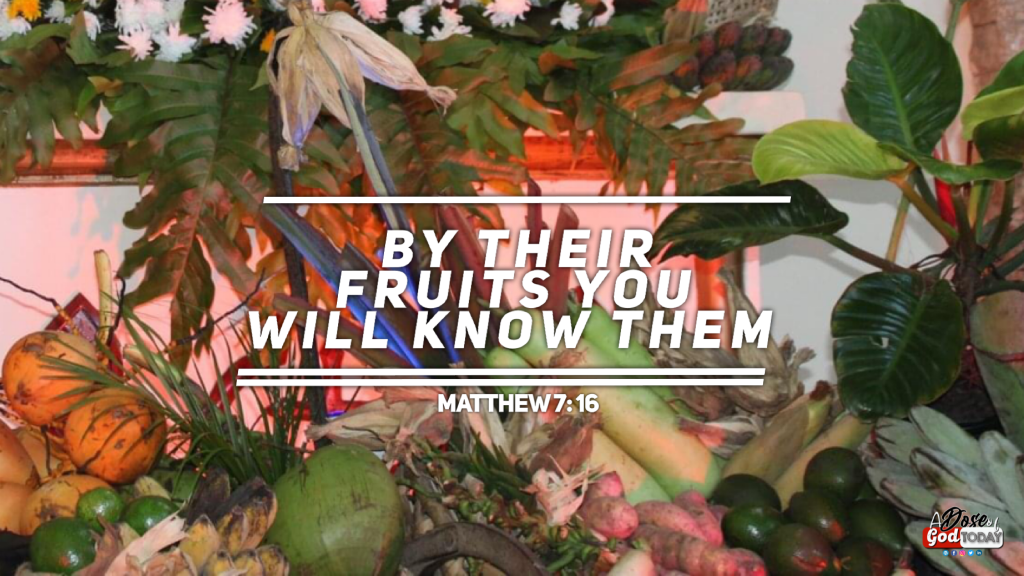
Meaning to say that the covenant with God with its laws and decrees are ways of achieving the fullness of life and being fruitful in life. And being fruitful in life means living in peace, in freedom, in inspiring and giving life for others.
This is what the Gospel reminds us today. Jesus calls us to be fruitful in life and at the same time to be careful of false prophets who seduce us with empty promises of fruitfulness.
The main intention of false prophets is to bring us away from the covenant with God, and to ultimately keep us away from the fullness of life and leading us instead into the corruption of life.
False prophets can appear to us as a real or virtual person who may persuade us to believe in false hopes, false alarms, fake news and disinformation especially with what is happening around us today. The intention of persuading us to believe has certainly contained hidden political or religious agenda. But beware of these and be discerning because these will only bring away from reality and from our community.
Moreover, such false prophets can also take the form of empty promises from various addictions. Gambling, alcohol, drugs, sex, shopping, gadgets, or even excessive internet usage may promise to fill our empty and broken hearts that long for attention and care, recognition and acceptance, affection and love. These forms of false prophets may also seduce us to believe that these addictions and unhealthy coping mechanisms can provide relief from the pain that we feel, from the pain of losing a loved one, from a heartbreak, from rejection, or from failure, shame and guilt. However, this is not true at all. Succumbing ourselves into these empty promises will only bring us deeper into ruin and corruption of our life and of life around us.
When we realize that this kind of person, media site, or attitude and perspective in life does not bring us closer to God but away from Him, away from our true selves and from other people, then, beware because that will only bring us to bad fruits being produced and to corruption of life.
Thus, as Jesus calls us to live life fully by following his desire for us, may our actions and words, our relationships and encounters with people may truly produce life-giving fruits of love, of understanding, and of peace and reconciliation in our communities. Kabay pa.





 A DOSE OF GOD TODAY