Category: Liturgical Year C

  • Seeking what matters most in our life

    Seeking what matters most in our life

    October 30, 2022 – 31st Sunday in Ordinary Time

    Click here for the readings (https://bible.usccb.org/bible/readings/103022.cfm)

    What do I seek in life? Love and acceptance? Understanding and friendship? Comfort and contentment? Health and wealth? In seeking what matters most in our life, we could experience discouragement, rejection, failure, pain or even shame. We know that not everything we can have in life. We also know that life can be sometimes too tough and overwhelming. There are those who may just enjoy life because of the privileges they have. There are also those who at the moment of their birth, pain and struggles seemed to be never ending.

    So, in seeking what really matters in our life, which may not necessarily be always material, others may resort to unhealthy and destructive ways especially when they too are not guided. Some may also be led and helped by others to come into right decisions and good discernment in life until they also discover God’s invitations for them and live a happy and holy life.

    On this 31st Sunday in Ordinary Time, this is something I want to share with you through an interesting biblical person, Zacchaeus, a Chief Tax Collector, hated and despised by many Jews of his time. He is quite interesting because his very life characterizes each person’s desire to seek what matters most in our life. So, allow me to journey with you today and let us discover together how God calls us.

    Zacchaeus, as described by Luke, was short in stature and a wealthy tax collector. His fellows Jews hated him for being a tax collector and someone who was affiliated with the Romans. Remember, at that time, Israel was under the a foreign invader, the Roman Empire who imposed tax on them.

    However, we could also ask, how Zacchaeus, a Jew, ended to the side of the Romans, working for them as a tax collector. We could actually imagine the life of Zacchaeus. Thus, being short in height, Zacchaeus as a young boy must have been a subject of bullying. Even until now, among our friends we actually make fun of people who are short or those people who do not belong to the standard of the majority like those who are too tall or too dark, etc.

    Because of the physical limitation of Zacchaeus, people looked down on him. It must have been so terrible for Zacchaeus to be bullied publicly and to be hurt emotionally. Zacchaeus must have felt the pain of rejection and disrespect towards him as a person. However, he was helpless against those playmates and other people who had bullied him.

    That emotional pain in him must have created a deep emptiness also within him. Thus, being bullied and rejected, Zacchaeus was in search of respect, of acceptance and of affirmation. But then, he could not gain those by just being who he was because people disrespected him for being who he was. Zacchaeus needed a way of getting his revenge. He won’t be able to get what he wanted if he would remain helpless and meek. He needed power and wealth to make those people who have bullied and rejected him to bow down to him.

    Zacchaeus grabbed the opportunity the Roman Empire could offer him. The Romans were feared, though hated by the Jews, but were forced to show their respect. People had to bow down to the powerful Romans. Thus, Zacchaeus made himself available in the service of the Romans. This was how Zacchaeus got his revenge against his fellow Jews. He became the chief tax collector and becoming one also meant becoming powerful and wealthy.

    Now, Zacchaeus was above those who have bullied him. Zacchaeus could now play the bully himself. As a chief tax collector, he could get his revenge by raising the tax against those people whom he also despised. Because of this, people would now please him, affirm him, and show their respect to him because he had power over them.

    Perhaps, Zacchaeus would love to see the faces of those who have abused him emotionally to beg for mercy. He could now demand what he needed and force the people to accept him and pay respect to him.

    However, Zacchaeus was never peaceful. He was always restless. At the beginning, this was not what he wanted but because of those pain of rejection and emotional wound, he turned out to be corrupt and a monster in the eyes of the people.

    Indeed, like Zacchaeus, to be bullied or to be rejected could create a deep emotional wound in us as well. Because of being helpless, we could not protect ourselves from people who hurt us emotionally such as bullying and rejection at school, in our neighborhood or even at home. As a result, we do not only begin to hate those people who were bullying and rejecting us, but we also hate ourselves  for being who we are. We hate ourselves because of the imperfection that people find in us.

    Thus, we also begin to think that if only we are not like this, then, people might accept us and love us. This consciousness begins to develop in us until we become a person whom we are not, just for the reason of being accepted, recognized, respected and loved by people around us. This is how we could be seeking what matters most in our life – that is, of being loved, being accepted, being welcomed for who we are.

    Now, back to Zacchaeus, in the very depth of his heart, Zacchaeus was seeking to be accepted by the community, which he never experienced. However, he heard about this man, named Jesus. Jesus was a miracle worker, a famous preacher who healed the sick, raised the dead and forgave sinners. St. Luke described to us how Zacchaeus became curious about Jesus. This curiosity actually showed the desire of a human heart to see and encounter God. Yet, we are also confronted by the fact that it is the Lord first who tenderly seeks for us.

    This is what the Book of Wisdom tells us. It says, “for you (Lord) love all things that you have made… you spare all things because they are yours, O Lord and Lover of souls… for your imperishable spirit is in all things.” Further, the author of the book tells us how the Lord will confront us of our sins and calls us back to his presence because God seeks for us and desires that we may have the fullness of life. indeed, God desires our salvation, our happiness and complete joy because God sees Himself in us, for we breathe God’s breath.

    This explains to us that, indeed, the longing in our heart for God and God’s longing for us is mutual. This is what we also find in Zacchaeus, the bullied who turned to be the bully.

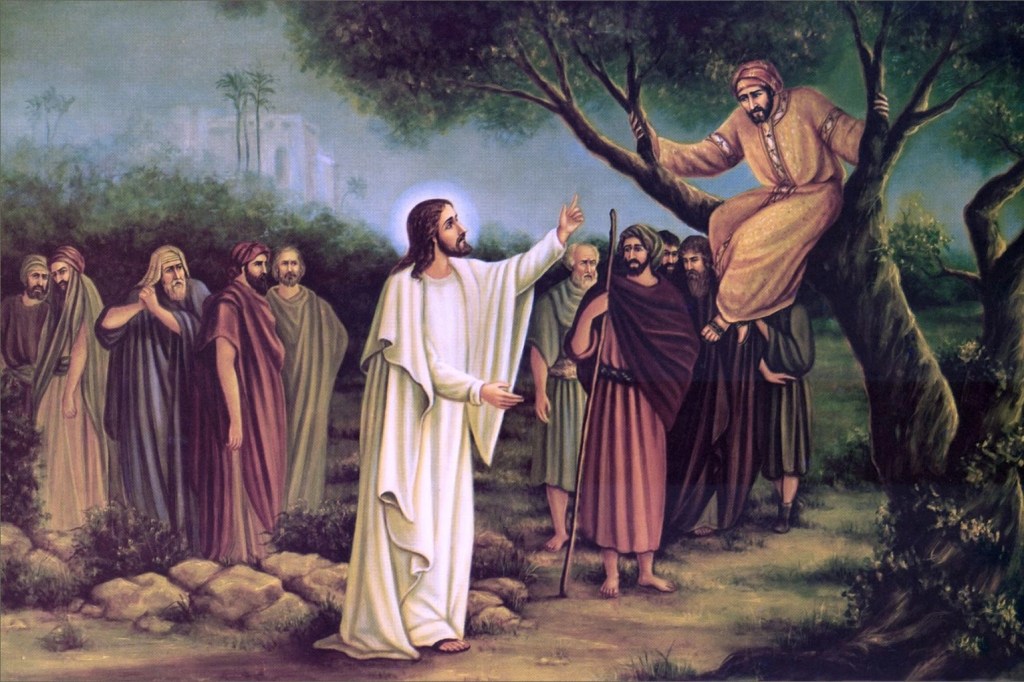
    And Luke, described to us the limitations Zacchaeus had, not just his physical limitation of being a short man but also because of his hardened heart, his emotional wounds, his corrupt practices as a tax collector and insecurities. These prevented him to see clearly Jesus, when the Lord was about to pass by. But, these limitations of Zacchaeus did not discourage him to seek further the Lord. There was certainly, a deep longing in his heart. So, Zacchaeus ran ahead and climbed the sycamore tree that he may see Jesus clearly. And truly, Zacchaeus saw the Lord. And Jesus saw him and called him.

    For the very first time in the life of Zacchaeus, he felt accepted and welcomed the way he was, thus, he felt being loved. Jesus addressed him with respect and with dignity without conditions and without pretensions. This encounter with Jesus, changed Zacchaeus completely because at last he was loved.

    This attitude reminds us of every human heart’s desire to encounter the Lord. We are made for God. God is imprinted in our hearts as we are created in God’s image and likeness. This is what the Book of Wisdom remind us. And so, let us be conscious on that. Let us be aware that we desire and seek God.

    Yet, in our desire for God, there will be things that will prevent us to see and encounter God. This is what we find in the story of Zacchaeus. Perhaps, our fear and shame of admitting that we have sinned prevent us in truly meeting the Lord. Fear causes us low self-esteem and to hide because we are afraid of being judged by others, and by the people around us. Shame also prevents us to hold God’s love in our hearts and his forgiveness because we feel that we are not worthy. Our emotional hurts from the past could also hold us back especially when they hardened our hearts to be welcoming of others like that of Zacchaeus.

    Our arrogance can also prevent us in meeting the Lord. Our indifference stops us from true conversion. Let us ask then, ourselves, what are those things, addictions, or attitudes that may hinder us from truly seeking God?

    Paul in his second letter to the Thessalonians, hoped, “that the name of the Lord Jesus may be glorified in us.” This means that through our very person, our thoughts, actions and works, the presence of our Lord may be revealed.

    This is what Zacchaeus challenges us also. Like him, each of us has actually the capacity to overcome anything that holds us back to see God clearly. We are called to run ahead and overcome those attitudes that prevent us from seeing clearly Jesus. Let us look for a sycamore tree where we can climb over our sins and fear. Look for a friend whom you can share you own problems and struggles. Seek the guidance and direction from people who can truly help you. Come to the sacraments with a heart that truly longs for the Lord, because only then, that we are able to overcome those that prevent us from being near the Lord.

    We too are reminded in the story that though our heart desires for God, but God desires more to see us, to be with us. Thus, the Lord is constantly looking and searching for us. Jesus was in fact searching for Zacchaeus, searching for a sinner, indeed, we are all the Zacchaeus in the Gospel that Jesus has been searching for. Jesus desires to be with us and that we will be reconciled to him and will be healed from our past hurts and pains. Let us allow then the Lord to search us, to find us and to heal us.

    Hopefully, our encounter with Jesus will bring us also into that joy of forgiveness and assurance of love from God that we are forgiven, accepted and respected. This may hopefully lead us too to repair the damage that we have caused to others and to make amendments for our sins like Zacchaeus who promised Jesus to give to the poor half of his possessions and repay four times over those he extorted. A sign of true repentance and conversion and of a heart that has found what really matters most. Kabay pa.

  • Tampo

    Tampo

    October 30, 2022 – 31st Sunday in Ordinary Time

    Click here for the readings (https://bible.usccb.org/bible/readings/103022.cfm)

    A man once approached an elderly priest and asked, “Father, how come it seems that God does not speak to His people anymore?  He used to speak so beautifully with such power and clarity to our prophets and apostles. But why is it that God seems no longer talk to us His people? Nagtatampo ba siya sa atin? Is he isolating Himself from us?”

    For a minute the priest was just in silence, shaking his head as though he was in pain. He replied in time, “My son, it is not that God no longer speaks to us His people. Hindi sya nagtatampo sa atin. He is not isolating Himself from us. It is just that… no one these days can stoop down low enough to listen to Him. No one… can stoop down…low enough… to listen to Him these days.

    At times, we also find ourselves like that man sharing the same question: “Why and how come God no longer speaks to us His people?” As we go through our lives doing our daily affairs, we do feel and experience at times the silence and absence of God. Nagtutulog ba ang Dios? Is God asleep? Nagtatampo ba ang Dios? Is God sulky? Is He isolating or distancing Himself from us?

    Zaccheus in our gospel today must have felt and experienced the same silence and absence of God in his life. While doing his usual work of collecting and counting money in the treasury, Zaccheus must have asked the same question about God no longer speaking to His people. He must have also wondered about the silence and absence of God in our lives.

    To the extent, that when he heard that Jesus is passing by, he decided to close his office, climbed up a tree, hoping to have a glimpse of Jesus, whom he must have heard of as godly person. Actually, he doesn’t want to be involved. He only wanted to “observe” Jesus and the crowd. So, while waiting for Jesus on the tree, perhaps he must be back then thinking about his favorite topic: his work, his money collections, his usual affairs & concerns.

    As he passed by the tree, Jesus saw Zaccheus and asked him to “come down and hurry for I must stay in your house today”. Somehow Zaccheus got more than what he bargained for. All he wanted was just a glimpse to observe Jesus. Now, he got an audience and a home visit from Jesus.  And, what is required of him is just to come down from the tree, invite Jesus in to his house, and take part in the life and mission of Jesus.

    So how come and why God is no longer speaking to us His people? Why do we at times felt and experience the absence and silence of God?

    Perhaps because, like Zaccheus, we become so concerned and comfortable about our day-to-day worldly affairs of being and striving to be always at the top of things and people. Like Zaccheus, perhaps we also don’t want to get involve and participate. We rather observe than serve the Lord and others. And like Zaccheus, we rather remain “at the top of all things” in our comfort zones, being labelled and stereotyped by others, – instead of being recognized as not only as Abraham’s descendant but more so as God’s children. So, why God no longer speaking? Perhaps it is because we are no longer stooping or kneeling down low enough to listen to Him.

    photo from https://aleteia.org/2016/10/29/going-out-on-a-limb-for-jesus-with-zacchaeus/

    The invitation of Jesus to Zaccheus: “To come down and hurry for I must stay in your house today” is a wake-up call also for us today: “to stoop down low enough to listen to Him”. For us then to experience the presence, voice, and lambing of God, instead of his absence, silence and tampo, we must learn to humbly listen to Him through His son Jesus Christ & be involve in His affairs.

    This is a reminder that in life at times, we become too-far, too-high, too-much, too-numb, too-away, too-distant from God that we cannot anymore see, hear, feel, and experience Him.  It is like our phones might be fully-charged but we have weak signal and out of coverage.

    However, rest assured, like Jesus, God is always reaching-out to us, wanting to be in contact with us whatever happens, “for the Son of Man has come to seek and to save what was lost”. All we have to do & required of us is to come down from our pedestals & comfort zones, invite Jesus into our lives and eventually participate in His ever-present life & mission in our lives. In other words, Stoop Down… Low Enough… to Listen to Him. 

    Perhaps we may ask ourselves: “when was the last time I stoop or knelling down low enough to listen to Him?”

    We learn last Sunday the most simple and very effective prayer of the tax collector: “O God, be merciful to me, a sinner” or simply the Jesus prayer: “Lord, have mercy”. May we also learn today from the prayer of prophet Samuel: “Speak, Lord, your servant is listening”.

    Before Our Father, may we find ourselves listening in humility & poverty, so that God can contact-trace & reach-out to us for the better of us always.

    So Be It. Kabay pa. Amen.

  • Towards a Humble recognition of our failures

    Towards a Humble recognition of our failures

    October 23, 2022 – 30th Sunday in Ordinary Time

    Click here for the readings (https://bible.usccb.org/bible/readings/102322.cfm)

    Have you ever been judged because of what you have done before? Or because of a mistake or failure or sin that you have committed that people around you believed that you are hopeless and beyond redemption? It is truly devastating to be judged by people around us especially when we are “put in a box,” that, as if there is nothing more in us except our sins and failures in life.

    Well, aside from being judged by others, each of us too can be the one who judge others because of their mistakes and failures in life. We could have played to be the righteous individuals who try scrutinize people searching for their faults and failures. We could be that mean person whose main intention is to bring other people down by shaming and gossiping their weaknesses in order to hide our own sins. This happens among our families, circle of friends, communities and our workplaces.

    This Sunday, I would like you to listen first to one of the members of the Redemptorist Youth Ministry. Miss Kirsten Dañas will share her reflections tonight. And so, let us discover together how the Lord invites us. Let, us welcome Miss Kirsten.

    Sharing of Miss Kirsten

    Three years ago, I met this person, she was new to us, she was quiet and so respectful. As time goes by, I can see how genuine she was, that’s why it was not hard for us to treat her like our younger sister. We became good friends, we share stories, we have each other’s company, we let her feel that she always belongs to us. There was this moment when we were talking to our colleagues that she was always bragging about “Loyalty or being faithful” when it comes to a relationship. And yes, there was no second thought on that, we are on the same line when it comes to that part. I can see how she was as a girlfriend to her partner. They were together for like three years, her partner was a good man, anything she asked was being given to her. She was very lucky to have such a wonderful man, a-one-call-away-partner anyone could ever asked.

    Months have passed, her partner got laid off from his job, I don’t know the whole reason behind it, but I saw in her eyes that she was also affected with that problem. Eventually, everything changed, I didn’t know why, but we noticed that she became closer with our co-worker whom she really didn’t like because of the past of this person whom she called “Babaero”.

    At first, I thought, she was just longing for a brotherly love because that person also gave her everything she needed. Until such time, I never would have imagined that brotherly love turned into Cheating. Yes, she was cheating with her boyfriend that time. We were so disappointed with her, she was the one bragging about loyalty yet she ate all the words she said. We distanced ourselves from her as if she didn’t exist, to the point that we judged her, talking beyond her back about what she did, and even called her a “Gold Digger”, because that only started when her boyfriend can no longer support her needs.

    I tried reaching out to her telling her to stop what she was doing. But, she chose to continue such actions. Though I was not expecting it, but this situation and her actions affected our working environment. Our workplace became toxic day by day until such a time that I felt I can no longer stand working there. I left that place without even talking to her or even saying good bye.

    Yet, years have passed, I met this man, the reason behind my friend’s unfaithfulness. He told me everything, that what they did was wrong. They were together for almost a year, yet they realized also to end their relationship for some reasons. A shocking truth struck me actually, when that man told me something about her. That friend of mine was a victim of abuse and greed from her own family most especially from her own parents and brothers. They wanted her to get in touch with anyone as long as they can benefit with the money that their daughter can provide them. How selfish her parents are!

    I was speechless that time. I realized, who am I to judge her that easily without knowing her story?  Knowing all the truth, I felt so sad, I wanted to hug her and I wanted to say sorry for the judgment I made against her. I really didn’t know that she was pressured by her own family. She should have been protected and cherished in the first place yet she was used and betrayed by her own family.

    I know that I can no longer take back all the things I did and said. But that circumstance made me realize a lot that indeed, it’s okay to feel down sometimes, it’s okay to feel sad, it’s okay to feel like giving up and it’s okay to have negative emotions. If ever we see someone who feels like this, let us embrace them, speak to them, listen first to their story, and allow them to open their heart. Most importantly, this calls me to be a non-judgmental person, to give my time and presence in order to accompany a friend. This will certainly bring significant and positive change in their lives.

    Now, being in this ministry for more than a decade brings me closer to Jesus and I realized how the Lord has changed me to become a better person by accepting that I am also a sinner in need of forgiveness, and that my failures and mistakes are rooms for me to learn and grow.

    She shared to us her experience that helped her to realize better about herself and her actions.

    The Gospel story that we have heard today conveys this message to us. To become self-righteous only blinds us. Thinking highly too much of ourselves will even prevent us from asking God to show his mercy upon us because we already think that we do not need God’s mercy. Therefore, the self-righteous attitude of the Pharisee is basically a denial of God, a rejection of God’s mercy because he felt that he did not need it. Moreover, this attitude only leads us to build invisible walls that separate us from others.

    Thus, we might still have that idea of condemning our brothers and sisters who are considered terrible sinners. We too might have that attitude of separating those people whom we consider as unclean for fear of being contaminated and be associated with them.

    On this Sunday, Jesus invites us to rather look closely at ourselves and to examine better our intentions, thoughts and actions so that it may also lead us to recognize our failures and sins. This was the attitude of the Tax Collector and the very reason why he could not look up to heaven. When he saw himself, he felt disgusted for the sins and failures he had done against God and his neighbors. He must have cheated and corrupted a lot of money. However, looking at himself, he realized his need of mercy and the need to be converted. That same realization will hopefully lead us to also join the tax collector in praying, “O God, be merciful to me, a sinner.”

    Such prayer and humility will surely reach the heart of God. In fact, the Book of Sirach in the first reading tells us that “the prayer of the lowly pierces the clouds; it does not rest till it reaches its goal.” God, our Just Judge, will come to our rescue and will show us his mercy when we also begin to honestly acknowledge our sins and failures. The God of Justice will listen to our petitions especially when the Lord also finds the poverty in our heart. This means that our heart is empty of any self-righteousness, of any self-satisfaction and self-justification.

    As the Lord defends us and shows us mercy, we are called to be more understanding to those who failed and sinned but not in the sense of condoning and tolerating such failures and sins. Thus, it is very important that as we exercise understanding, we also need to confront each other of our mistakes and failures. We are invited to be merciful rather than condemning.

    Therefore, to both the righteous and the sinners, God does not condemn but God rather desires our healing, reconciliation and fullness of life for all.

    This calls us, then, to see more in the person of our brothers and sisters, to stop our harsh judgments and condemnations, to stop our gossiping, image shaming, name-calling and bullying that only destroy the person of our brother or sister.

    I would like to invite you then, to embrace a family member, or a relative or a friend whom we know have sinned against us so that reconciliation will also begin in us. In this way then, we will hopefully become witnesses of God’s mercy and forgiveness. Kabay pa.

  • Jesus Prayer

    Jesus Prayer

    October 23, 2022 – 30th Sunday in Ordinary Time

    Click here for the readings (https://bible.usccb.org/bible/readings/102322.cfm)

    A story once told about two robbers were caught stealing. While trying to evade the chasing police and dogs, one of them said to the other: “Pray”. But the other snapped back in reply: “I don’t know how to pray”. Then, the first one persisted on: “Just pray any prayers you know, anyway, your God will listen”. The second wondered: “Any prayer will do?”. The first pushed: “Ya, any prayer”. So the second prayed the only prayer he knows, this way: “Bless us, O Lord, for these thy gifts, which we are about to receive from your goodness through Christ’s our Lord. Amen”.

    Here, they are. Chased by the dogs and police. About to be apprehended and punished for stealing. And the only prayer, one could think of is the formula-Prayer before Meal. Well, nice words, but surely not the right & appropriate prayer for that very moment.   

    Prayer is our Chat-talk with God – our exchange of words with God. Praying then is more than just mumbling words from subscribed formula or -prayer-format, because it is the opportunity for us to be who we are before God and to express our hearts’ desires to our Father. Better then for us, in praying before God – to say what we mean, and mean what we say, than just reciting formulas which we don’t really mean and thus does not say who we really are and what we really mean before God. Meaning, pray your heart’s desire before the Lord in you own words.

    Perhaps this is what Jesus is teaching us today about prayer. Through the parable of the Pharisee and the tax collector, Jesus teaches us that in prayer, God listens to us. God hears our cries and satisfies our heart’s desires. What is required of us, however, is our real selves humbly longing for Him – saying what we mean and meaning what we say to Him. Unlike the Pharisee, we should pray not for what we have done and what we have been doing, but pray instead in humility for what we need before God and for what God can do for us. Prayer is not our exhortations and exaltations of what we have done for God but our humble supplication before God’s presence for what He can do to us better & further in life.

    We also hear in our gospel today, the simple humble prayer of the tax collector: “O God, be merciful to me, a sinner”. This is the simple prayer-words that God as well as Jesus approves, for these words profoundly express who we humbly are before God, and what we mean, say, and desire from Him.

    Lord, Have Mercy on me a sinner”. Perhaps the simplest yet most effective prayer words in our Christian life are these words: “Lord, Have Mercy on us” “Ginoo, kaluy-I kami”, “Panginoon, Maawa ka sa Amin”. Junim, Jabirul Bepusoso.” These words, (traditionally also  known as “Jesus prayer”) are not only prayed by the tax-collector in our gospel today, but also in the Scripture, as cried out in prayer by the ten lepers, the blind Lazarus, and others. These people were all healed, forgiven, and redeemed for they have prayed to Jesus: “Lord, Have Mercy.”

    To pray then the Jesus prayer: “Lord, have mercy on me” means and says a lot. It reveals our very identity of who-I-am or who-we-are before God. First, it is a Cry for God’s Help, that is, it is our way of saying: “I need God’s help”. To ask for help today is considered as weakness and dependence. To pray then for God’s mercy is to rely not on our own but to depend on God’s strength and power. Second, it is a declaration of faith, i.e. our way of saying: “I believe in God’s will and I trust in God’s way”. In our world of distrust and unbelief, and toppled with individualism, to pray for God’s mercy is to believe and trust in an-other greater authority/power than ourselves. And lastly, to pray, “Lord, have mercy” is our humble obedience to God, i.e. it is our way of saying: Lord, I rest my case. I now listen to you. It’s now, not mine, but your will be done. Bahala na. Kabay pa. Siya Nawa.” This means that finally, after all has been said and done, prayer leads us into total respect and reverence to divine will & providence as well as peaceful silence before God’s presence.

    Remember then that God rejects the prayer of self-righteous persons, but listens to the prayer of sinners who are aware of their inner poverty. God hears the prayer of the humble who are aware of how poor they are before God for “the Lord hears the cry of the poor.”

    Perhaps we ask ourselves now, when was the last time we utter those words: “Lord, Have Mercy on Us” Panginoon, Maawa ka sa Amin; Ginoo, Kaluy-I kami; “Junim, chabirul bepusoso”? Did we say what we mean? Did we mean what we say? Are we saying those words, as a Cry for His Help in our lives, as declaration of our faith and trust in Him, and as our humble obedience to His plans and will for our lives? OR we said those words, like any prescribed formula-prayer inappropriately and without meaning it?

    Before God then, to pray the simple words of Jesus prayer, said with meaning and humility – is but enough and appropriate at all times.

    Whatsoever then happened, is happening and will happen at every moments of our lives, we own up our humble poverty before Him, and pray with full consent and intent the Jesus prayer: – “Lord, Have Mercy on Us sinners.” Amen.

  • UNDERSERVING yet Graced and Loved

    UNDERSERVING yet Graced and Loved

    October 17, 2022 – Monday of the 29th Week in Ordinary Time

    Click here for the readings (https://bible.usccb.org/bible/readings/101722.cfm)

    This is who we are – UNDERSERVING yet we are graced and loved by God who would do everything to liberate and empower us from whatever that is preventing us to live life to the full. This is how Paul captured such image of ours before God in his letter to the Ephesians, “you were dead in your transgressions and sins… but God who is rich in mercy, because of the great love he had for us… brought us to life with Christ (by grace you have been saved).”

    Let us become more conscious of this and claim such grace from the Lord. This act is indeed God’s initiative, out of that great love we are shown mercy and brought to life. We realize how each of us matters in God even though we are not deserving in anyway. Paul further tells us, “For by grace you have been saved through faith, and this is not from you; it is the gift of God; it is not from works, so no one may boast.”

    Yes, it is a sheer gift of God! A gift that offers us freedom and peace, reconciliation and the fullness of life with Christ.

    This is how we also understand the parable of Jesus in today’s Gospel from Luke. Jesus did not condemn people who are rich materially. The warning of Jesus is directed towards a heart that has become dependent on possessions to the point that greed consumes the person. Total dependence on material possessions or whatever possessions we may have or “things that possessed us,” lead our hearts to greed. Greed keeps us away from others and from God because it worships not the Lord but something and someone else. Greed corrupts the hearts and destroys our relationships.

    This makes any person to be distanced from the grace of God, away from the company of true friendship and love from the community because the person grows to be vicious and self-centered. This is what the Lord wants anyone to be free from. When we become dependent and totally occupied by something else rather than by our relationship with God and with one another, then, we become prisoners of our own human desires and selfish tendencies. This is the transgressions and sins that Paul tells us.

    Jesus invites us to invest and be rich in what matters to God. This means that as God has shown us mercy because of his great love for us, we are offered and given life with Christ. This is the fullness of life.

    Thus, what matters to God is for us to replicate what we have received, that is, to show mercy to our brothers and sisters, to express concretely our love for each other and to God and to become life-giving persons. The fullness of life is not being experienced alone but can only be experienced within the context of our community. Hence, it is by being able to give life, inspire life and heal life in our families, group of friends, workplaces, organizations and communities that we shall also truly experience the fullness of life with Christ. Kabay pa.