Category: LiturgIcal Year B

  • LESS is More than Enough

    LESS is More than Enough

    July 28, 2024 – 17th Sunday in Ordinary Time

    Click here for the readings (https://bible.usccb.org/bible/readings/072824.cfm)

    Our gospel today is surely something familiar and already known to us all. How could we miss one of the best stories of Jesus’ miracles ever told?  All four gospel evangelists (Matthew, Mark, Luke & John) have each own version of the story of this miracle. However one call this miracle-story – whether as “the multiplication of loaves & fishes”, or “the feeding of the multitude, these unique versions & diverse interpretations share the same plot.

    Basically it is about Jesus & His disciples with crowds of people gathered & now stranded in a far-distant mountain field, perhaps already during midday. Concerned about the people, Jesus ask his disciples for resources to tend & feed these multitude of people. With the less food-resources that they can collect & muster, Jesus instructed the disciples to organize people into small groups, took & blessed the less that they got, and have it broken & shared to the groups. People began to share what they got & have to each other, that in effect, had each other & one-another fed.

    And eventually made all filled & satisfied, and even able to garner twelve basketful of left-overs. Crisis-solved. Five thousand men (perhaps including or excluding women & children) were fed. A miracle happens. All are happy. Jesus saves the day.

    Perhaps there is more to the story than we may realize. Somehow the story have more lessons now to teach us than it has taught us before & always. Perhaps, we can learn here something about the Power of Less.

    What can Less do to All? What & how can the only Less we can have contribute for many (if not for all)? Ano at Paano ang magagawa ng kakaunti para sa karamihan at kalahatan? We may have something, but how it can help all? Like the man in our first reading, we also raised the practical question: “How can I set this (20 barley loaves & fresh grain) set up for a hundred people?” And somehow like the disciples, common sense tells us that “200 days’ wages worth of food is not enough for each of them to have a little.”

    And remember during pandemic times, we pondered: “What & how can my little inconveniences (like, wearing mask, face shield, quarantine, social distancing, or vaccine) can contribute in healing our infected & life-threating world?

    Somehow our condition and reality of LESS may bring us to these realizations. First, with less resources, we come to grip with our vulnerability. Suddenly, we come to experience how poor, fragile, limited, dependent & needy we are & we can  be. When we get what we want & have what we need – Fast, easy, accessible, instant & convenient life gives  us an illusion of power, independence & invulnerability in life. But when resources are scarce, & abilities are limited, we are humbled to realize our own poverty & neediness.

    With such humility, second, we begin to be thankful & to make the best of what we already have. We become “madiskarte sa buhay”. We learn to cope & live with what less resources we have. We get to know what is enough from what is too much. We know now what is essential & important things in life as well as what we can live & do without. In other words, with less, we become resilient as well as resourceful. Third, with less, we are moved to feel with & feel for one another. As we become conscious of our own poverty & our little resources, we come to empathize & sympathize with one another, and we try to help & contribute what little we have with others.

    Photo from https://goodtitevs.best/product_details/11663052.html

    In our gospel, Jesus did not only make a miracle of feeding the people. He also makes an example & witness of sharing the little we have with others. What meant to be a relief operation of feeding the people, now turned-out to be an agape, salu-salo, banquet because what they have received & got is also shared with others & one another. Less makes us kind & compassionate with one another. And yet still, fourth, less makes us rely on the help of others & trust in God’s mercy. In our poverty & humility, we come to realize that without God, we can do nothing. On our own we cannot live. We need God & each other to be & live in a much better & meaningful life.

    LESS can be powerful. Less can be more than enough. It can humbly render us poor, bring us to resiliency & resourcefulness, make us kind & compassionate to share with other, and above all, impels us rely & trust in God and one another. Though not much, LESS can make a BIG DIFFERENCE in life.

    Perhaps some of us are familiar with the 2007 comedy movie entitled: “Evan Almighty”. It is about a TV-anchorman turned politician Evan Baxter, not unlike Noah, inspired by God, built a big ARK to fulfill his promise campaign to change the world. The story-line evolved around how spectacular & comedic it is to literally build an ark in these modern times in order to change & save our world. Perhaps a primitive & crazy solution for our complicated world.

    At the end, Evan’s ARK may have saved his city (animals & people) from landslide & flooding. But he realized that what God meant for Evan to build an Ark is not literally a big physical structure of an ark, but as an acronym A.R.K., which means Acts of Random Kindness.

    ARK can change the world. Our little Acts of Random Kindness can make a Big difference. Less can change our world for the better.  With LESS, God can be & we can be.

    Take, Lord, the little resources we have. Bless & share these to others, as we are also needy of their help & of our Father’s mercy. Let these be our small contribution & acts of random kindness that we may have a share of our agape in God’s kingdom now & always.

    So Help us God, So may it Be. Amen.

  • INTERRUPTIONS

    INTERRUPTIONS

    July 21, 2024 – 16th Sunday in Ordinary Time

    Click here for the readings (https://bible.usccb.org/bible/readings/072124.cfm)

    A man went to see a friend who is a public high school teacher. However, as they chatted at the school canteen, they were continually interrupted by students who came for his friend’s advice or opinion on something or another. Eventually he asked his friend, “How do you manage to get any work done with so many interruptions?” His friend replied, “At first, I resented interruptions in my work. But one day, it suddenly dawned on me that interruptions are part of my teaching work. Educating students is not so much what I teach them inside the classroom but also how much time and attention I give them outside the classroom.”

    That teacher could have devoted his time on his lesson plans. He could have attended much of his time to his private life and not be involved with his student’s lives. But being caring and generous that he is, he made his work consists in being available to his students. No wonder he was greatly loved and respected by the students.

    We do experience interruptions in our life. Especially people who are in caring profession like teachers, priests, social workers, government and bank employees, doctors and nurses experience lots of disturbances at work. And usually these interruptions are particularly difficult especially when the request is not of our own choosing, when we don’t feel in the mood to help, and when it causes a lot of inconveniences. In such cases, a real sacrifice is involved. Most of the time, we have to forget ourselves and set aside our feeling and our plans.

    It is good for us to know that Jesus himself also had to cope with interruptions in his ministry. Jesus too had his plans upset and postponed because of other people’s needs. Our gospel today tells us how Jesus first has seen the need of his apostles for rest and recreation. After he had sent them on a mission to proclaim the good news, to heal the sick and to cast out demons, Jesus understood his apostles’ need for break & team-building to recharge their energy.

    They had been through a lot of experiences while on mission that they need the time to eat and to process their experiences with Jesus. With this, Jesus planned to take them off to a quiet place for a break because caregiver as they are, the apostles also needed caring; healer as they are they also needed healing. However, as we have heard, things didn’t work out as planned. The ordinary people followed them and interrupted their rest and recreation.

    And how did Jesus react? Not with annoyance but with compassion. Jesus was moved with pity for them. Inasmuch as he attended and took care of his apostles’ need for a break, out of compassion for them, Jesus also responded to the needs of other people.

    The key here is not on interruptions in life because there will always be interruptions in life. Life-interruptions are inevitable, & somehow God works through these interruptions. But important here is our attitudes toward these life-interruptions.

    Jesus teaches us today that in our work, our ministry, our service to others, what matters most is the SELFLESSNESS, our ability to go beyond our very selves for us to help and respond fully to the need of others.

    Meaning, we have to forget ourselves – lose & lessen ourselves once in awhile and set aside our feelings and plan for us to be compassionate – to feel with others, & allow God’s ways to happen. In ministry and care-giving to others, persons are more important than the work. In self-surrender & selflessness, God’s compassion, caring, healing, availability & presence do evolve.

    Yes, to take care of others and to love others is not an easy mission. But to care as Jesus did, when it does disturb & upset us, especially our plans – is the real test. Much as we do need the love and care of others, as Christians, remember we are also capable of caring and called to be take care of others, as Jesus, the Good Shepherd cares for his apostles and his flock.

    Through our selfless caring of others, we somehow feel with the sufferings of others as well as our own sufferings, and allow ourselves & others to be recharged & empowered, as we both received God’s healing & care through our Lord Jesus. Somehow as we care for others needs, we & others are also being taken cared of by God’s love & blessings in Jesus.

    Remember Jesus once said in Mt 16:25, “for whoever wants to save his own life will lose it, but whoever loses his life for my sake will find it.” In our selfless caring of others for Christ, we also find ourselves loved & cared for by God. Thus, we are also blessed as we are to selflessly be blessings to others.

    Third Sunday of July is particularly special for us Redemptorists all over the world because today is the Solemnity of the Holy Redeemer, the Titular feast of the Congregation of the Most Redeemer. As we Christians believe in Jesus as Resurrected Christ, we also give importance of our Lord as our Holy Redeemer, who continually disturbs, interrupts, intervenes & offers our lives God’s plentiful love & care ever since, until now & forever.

    May all be blessed as we are blessed to follow our Lord now & always.

    So May It Be. Amen.

  • R U JESUS?

    R U JESUS?

    July 15, 2024 – 15th Sunday in Ordinary Time

    Click here for the readings (https://bible.usccb.org/bible/readings/071424.cfm)

    There was once a school catechist who plans to teach the students about Jesus. So, she started like this, “Kids, I like to introduce you to someone you should know. He is a person who loves you most. Until now, he takes care of you sincerely. He is always present whenever you need him. He is the most kind and very good person whom you should know.” She have not finished yet piece yet, when a little girl raised her hands and said, “Mam, we already know him. He is Manong Joe, our neighbor the carpool driver. He is very good to us because he helps a lot of people. He even brings us to school everyday”.

    The catechist was speechless for the students know already Jesus through the faith and life of their simple neighbor and carpool driver who tries his best to witness and live out his Christian faith.

    Our readings today describes us the simple life of a prophet and missionary. Here in our first reading, Amos, who was just a mere shepherd became a prophet and was given a mission by God to preach His words to the Israelites. And in our gospel today, Jesus commissioned and sent out His disciples, who most of them were just mere fishermen, to preach the Good News to all people, to drive out demons and heal the sick.

    This would mean that for Him to make known to us His salvation, God chooses and sends ordinary simple people to become His prophets and missionaries of His salvation. Through the simple faith and lives of these ordinary people, God continues to make known to us His salvation and we also come to know Jesus Christ.

    Until now, Jesus continues His Mission of preaching the Good News of Salvation through us Christians, His disciples and believers. He intends that all of us Christians, not only priests or religious, but all of us baptized Christians become prophets and missionaries of God’s salvation. As children of God, we are also called, chosen and sent to be preachers and sharers of His salvation to others. By our baptism, every Christian, then is a missionary, a prophet of God’s salvation. We are also called to announce and preach Jesus Christ to others through our simple and humble witnessing of our Christian faith to our brothers and sisters.

    This reminds me of a story about a family who went for an excursion. Because they were such in a hurry to catch the bus in the terminal, they bumped into a beggar along the way. Having taken their seats, the boy then noticed the beggar on her knees picking up the spilled-off alms. He said, “I have to help the beggar”. But his mom opposed, “Don’t mind her. You might miss the trip. Besides, she should not be there at all.” But out of sympathy, the boy went down and helped the beggar. It was then he realized that she was a blind beggar, and so he apologized what had happened. On his way back to the bus, the blind beggar called out for him and said, “Thank you very much, boy. But may I know, are you Jesus?”

    Today, there are still a lot of our brothers and sisters who are still not familiar with & longing to meet Jesus. Like the blind beggar asking the question ‘are you Jesus?’, there are still people who have not and cannot recognize Jesus in our midst today. They long to know, to feel and to experience Jesus personally.

    And only through our Christian faith, through our discipleship and witnessing our faith in Jesus Christ to them, by our person, they will come to recognize and know Jesus in their own lives. Through us, His prophets and missionaries, Jesus continues to reveal the Salvation our Father has bestowed on us and on our brothers and sisters.

    We pray that like Manong Joe & that boy, in our simplicity we may grow in our faith in Jesus, for us to be worthy of being missionaries and prophets of God’s salvation to our brothers and sisters here & now always.

    So Be It. Amen

    With our simple faith in Jesus, let us now renew our faith, as we profess… I believe…

  • Reluctant Prophets

    Reluctant Prophets

    July 7, 2024 – 14th Sunday in Ordinary Time

    Click here for the readings (https://bible.usccb.org/bible/readings/070724.cfm)

    The gospel we have just heard and proclaimed to us is the Good News of our Salvation. However, there is something disturbing about our gospel today that may make us wonder and even suspect whether it is really Good News.

    Because as it is narrated to us, our gospel today basically tells us how Jesus was rejected in his own country. Yes, here we heard how Jesus was despised in his own country and by his own people. It describes to us that while he continued His Mission to preach the Good News for all & everybody, and as he preached the Good News particularly in own hometown, Jesus experienced humiliation.

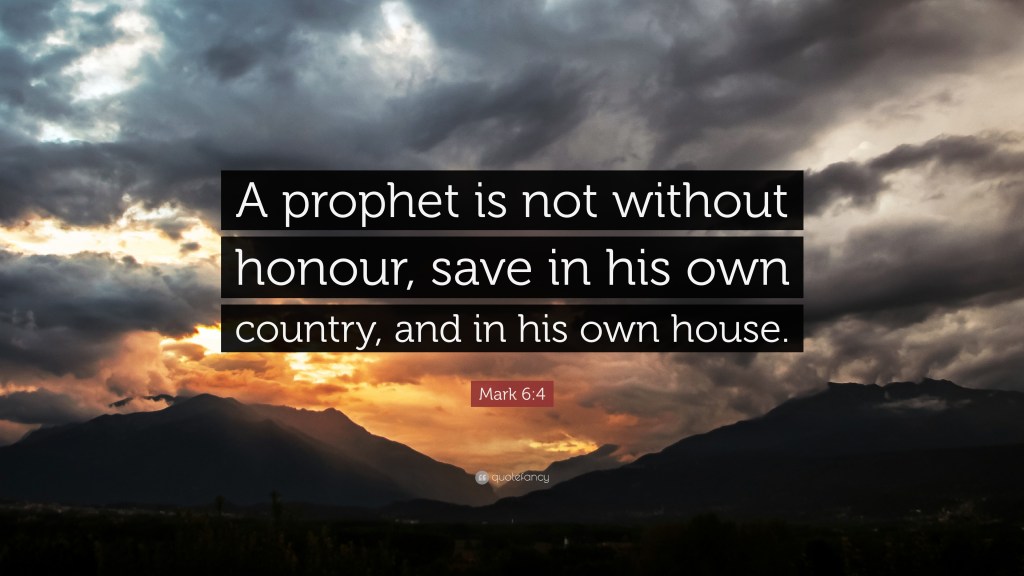
    He suffered persecutions and rejection in his own country and by his own people “sano” that, in effect, made it difficult for him to continue his work of salvation. Because of this experience, Jesus said: “Prophets are not without honor except in his native place and among his own kin and in his own house”. Good news has been preached and shared, miracles has been revealed and accomplished already, but were all rejected and wasted by his very Own people. Good new as it may be, our gospel today is certainly disturbing as well.

    Now, is it true that a prophet is not without honor except in his own home? Is a prophet honorable except in his own house and his own family? Experience tells us there is truth in this. Based not only on the experience of Jesus, but also on our experience, to share the Good News of Christ to our own household or community is a difficult assignment and mission.

    Tough and challenging indeed, to bring God’s message and do wonders and miracles in our own home. Why? Why is it hard to be a prophet in our own home? What makes it challenging to proclaim Christ and share the Good news within our own family where sometimes (or even always) parents complaining about their children, children blaming their parents, brother and sisters accusing each other? Or even within our community or church where we do tend to complain with & about one another?

    Somehow, we could identify in our gospel today two stumbling blocks that make it hard to be a prophet in our own home. First, our prejudices. Like the people who saw Jesus as only the carpenter’s son, it is also our tendency to prejudge others, as if we already know them, that make us blind to recognize prophets in our midst. We tend to downgrade, belittle others, and measure or to limit others by our own standard. “Ka-menos ba.”

    Comments like: He is only that, or he is just a ..” And because we judged, we boxed in, that person by our own standards, we want them to behave as we expect them to behave, no more no less. Comments like, “you are just my junior, don’t disobey (“Anak, lang tika, ayaw’g supak” or “Magulang baya ko ha.”)

    At the same time, we tend not only to belittle others but also we undervalue ourselves. “Unsaon ta man, pobre man, manghod lang man, dili man ko pari, wa man ko kaeswela. Ordinaryo man lang ko, dili man ko dato.” (What can I do, I’m just ordinary, poor, undereducated person.) There is much truth then to the saying: “over familiarity breeds contempt”.

    The second stumbling block to our being a prophet in our own turf is our lack of faith. In our gospel today, Jesus was not able to work miracles in his own country because of the people’s unbelief – their lack of faith. Usually it is slow for us to believe. If I may ask you: How many of you believe that you, yourself are called and sent to be today’s Christian prophet? Those who believe that you are a Christian prophet, please raise your hands.

    You might think “Me a prophet, no way. Maybe him, but not me”, or Father must be crazy, I am just a simple ordinary unworthy Catholic Christian. How can I be a prophet I cannot even confront my problematic son? How can I preach Good News to my irresponsible drunkard uncle? Or how many of you here believe that your son or daughter or your helper is also a prophet? You might think, how my son or daughter could be a prophet – they cannot even make their own room. My helper a prophet? she cannot even read her own letters. Yes, we tend to be slow to accept that we are God’s sons and daughters.

    https://quotefancy.com/quote/1318594/Mark-6-4-A-prophet-is-not-without-honour-save-in-his-own-country-and-in-his-own-house

    It is hard for us to believe that by virtue of our baptism – our baptismal consecration, every Catholic Christians share the dignity, identity, and responsibility, gifted to be Christ’s Prophets today.

    Remember, every Christian is baptized to be a prophet. Yes, tough & hard it is to be today’s prophet in our own home and community because of humiliations, persecutions, neglect and rejections that we may encounter caused by our prejudices and our lack of faith in Christ, others and in ourselves.

    Like the sano/townfolks of Jesus, we may have rejected and wasted the message and the miracles-offered because of our prejudices and lack of faith in the messenger.

    To proclaim the Good News is indeed threatening. But beyond and regardless of these difficulties and stumbling blocks, the message of salvation is remained humbly preached, shared, and fulfilled through the witnessing of ordinary people like us. As St. Paul would say as well: “I am content with weaknesses, insults, hardships, persecutions and constraints for the sake of Christ; for when I am weak, then I am strong.

    And the good news is, despite these difficulties and hardships, God continues to send prophets who will preach his salvation to others whatever it takes. And usually he calls and sends those who are weak, ordinary, young, mayokmok in our standards. And mayokmok we maybe, He sends us to be His prophets of Good News to our world today.

    Reluctant & hesitant prophets we may be in our own home, we still do our part in believing & proclaiming our faith that there is God’s prophet amongst us, for the Lord said: “Whether they heed or resist, they shall know that a prophet has been among them.

    Even we are slow to believe and as limited we may be, let us now renew and proclaim our faith…as we say….

  • In Sickness

    In Sickness

    June 30, 2024 – 13th Sunday in Ordinary Time

    Click here for the readings (https://bible.usccb.org/bible/readings/063024.cfm)

    “O, Kamusta na? How are You? Are You Ok?” Usually whenever we meet each other, we greet one another with these words. Through these words, we commonly express our concern for each other’s health and wellbeing. We acknowledge as well that human as we are, we are all prone to hurts, diseases, and sicknesses. Even the healthiest of us live with fear of accidents and diseases that can suddenly render us limited on the sidelines. Nobody likes to get sick. But nobody can claim that they have never been sick before. Easy for us to say “Bawal Magkasakit? (It is not allowed to get sick), but tayo ay nagkakasakit (we do get sick).

    Sickness cannot be denied. To get sick is part of our human nature. So, since we are subject to sickness, it is natural for us to ask about the health and wellbeing of others, especially those we have not seen for awhile.

    But what does it mean to be sick? Based on our experience, to be sick is more than just an experience of physical illness but a wide range of emotional, mental, psychological, and spiritual diseases and discomforts. Whenever we get sick, we become incapacitated. Normal for us to feel limited, dependent, depressed, irritable, helpless, and sometimes alienated or outcasted from God and others whenever we are sick. We know that it is not easy to get sick, especially when we are used to live our life independently and always in-control. Sickness is indeed a dreadful experience, as what was also described in our Gospel today.

    Our gospel today shows us as well that to be sick may be a horrible human experience but could also be opportunities for growth and a chance for life anew.

    First, sickness can be the opportunity to be converted. Jairus and the woman with hemorrhage came to Jesus. Coming to Jesus is an experience of conversion – a humble turning toward instead of turning away from Jesus. Whenever we get sick, we usually cease from our usual routine, go home and take a rest. It is in sickness that we break from our selfish ways and turn back towards God’s love and concern. Others would say that when we are sick, we desire and come to acknowledge God’s presence and appreciate God’s love in our lives. When we are healthy, we say, “Disco, Disco” but when sick, we say, “Dios ko, Dios ko”.

    Sickness can also be the opportunity to have faith and trust in God and others. Jairus begged to Jesus, “Please come lay your hands on her, that she may get well and live”. The woman aspired “If only I could touch his cloak, I shall be cured”. To be helpless and dependent of others are not normal for us. We rather be in-control and not needing others. But to be sick is humbling for you really need and have to trust on others. In sickness, we surrender ourselves and humbly ask for God’s mercy and rely on God’s providence, and the help of others.

    Sickness can also be the opportunity to be cleansed and be healed by God. In sickness, we witness God’s mercy, love, goodness, and miracles working in us. That through our faith and Jesus’ concern for us, God’s power and love are made known to all. In our weakness and sickness, God’s power and glory are revealed to you & to all.

    Sickness can be also opportunity to hear once again & anew our vocation and mission in life. When the woman was healed, Jesus calls her to “go in peace and be cured of your affliction” which means to be reconciled with herself and others who may have caused her afflictions. The girl is called to “arise” which mean to stand up from despair and have hope in life. Being healed from your sickness is a reminder that you are given another life – another new chance in life to make things right and better than before.

    And lastly sickness can be an opportunity to proclaim our faith. Just like the cured woman and girl, our healing from sickness makes us express and share our faith to others, and through our healing, others will see and witness God’s love revealed through us and come to believe more in Him.

    To be sick then can be the opportunity to be converted, to have faith and trust in God, to be cleansed and be healed, to renew life-commitments and mission, and to proclaim our faith for others to believe.

    Yes, no one wants to get sick. But whenever we get sick, take it less as disgrace but moreso as opportunity for God’s glory to be revealed in You. In other words, “A blessing in disguise”.

    So, Kamusta na? How are you coping?

    Perhaps God is healing us & through us, God is revealing something better for all of us in life.

    In our sickness, discomforts, & distress, let our prayer be like that of Jesus, saying: “Father, take this cup of suffering away from me. However, not my will, but Your will be Done.” Always & Forever.

    Siya Nawa. Hinaut pa unta. So be it. Amen.