Category: Liturgical Year A

  • God’s gift requires big responsibility

    God’s gift requires big responsibility

    December 22, 2019 – 4th Sunday of Advent

    Click here for the readings http://www.usccb.org/bible/readings/122219.cfm

    Homily by Fr. Mar Masangcay, CSsR, a Filipino Redemptorist based in South Korea.

    Aside from the sin of disobedience, what is other sin committed by Adam and Eve? Many of us would think that by eating the forbidden fruit, Adam and Eve have just committed the sin of disobedience to God. However, our first parents were also guilty of the sin of irresponsibility – for not taking responsibility for their action. When God asked about eating the fruit, Adam blamed Eve; and then, Eve blamed the serpent. Instead of claiming responsibility for their own actions, they blame each other and others, other than themselves; and because of this, sinfulness bound and begins to exist in their lives and our lives as well.

    This is very true with our experiences in life. Whenever we start not to take responsibility for our actions, try to run away from our responsibilities and start to blame others than ourselves, trouble, chaos and suffering is always present. But when we become responsible for ourselves and take full responsibility for one’s action, blessings, chances and mercies prevail.

    Today, we hear the annunciation of Jesus as experienced by Joseph. After Mary has taken the responsibility to be the mother of the son of God, Jesus, here now Joseph was invited to be the father of the child. Our gospel tells us how difficult it must be for Joseph to decide to accept the task of becoming a father to the child. Joseph was in a situation where Mary, his girlfriend is pregnant – “before they lived together, she was found with child.” But he knew that the child was not his. Why should he father a child whom is not of his blood? Would he let the child carry his name? Surely a dilemma for Joseph. It would be reasonable for him to deny and leave Mary and the child. But having heard God’s challenge and assurance, like Mary, Joseph accepted the responsibility, and as father to Jesus, he did his task in taking care and bringing up the word of God incarnated – becoming flesh – in our lives.

    The story of our Christian life started when God offers us a Present, a Gift of His only begotten son, Jesus. God’s priceless and most important gift to us is Jesus, the word of God made flesh. But Jesus is also our Responsibility. Accepting Him, as God’s gift requires big responsibility. Since God’s gift came as a child, Jesus needs human parents. Jesus needs a mother and father. Mary consented to be his mother and Joseph agreed to be his father. By taking responsibility for the child Jesus, they become parents to God’s gift, which eventually brings change and difference in their lives and our lives as well.

    Like, Joseph and Mary, we are also invited to take responsibility for Jesus in our lives. It is only by our acceptance of both the gift and responsibility of God’s gift to us; God’s redemption flourishes and continues to renew our lives. It is only by our being sponsors, benefactors, or poster parent to life and mission of Jesus in our lives, that God’s salvation continue to be present in our life today. Taking this responsibility entails us not only our sacrifice but moreso our total commitment.

    Which reminds me of about the hen and the pig. A hen and pig wish to please their caretaker. When the hen suggested that they will treat their caretaker a breakfast of “bacon and egg”, the pig argued: “Bacon and Egg” for you, might be a great sacrifice but for me, it’s a total commitment.

    We, Christian should then be committed to our responsibility and mission of making Jesus present and alive in our lives today.

    As Christmas draws near, may we become more responsible parent, sponsor, benefactor of Jesus, God’s son, in our lives now and forever. Amen.

  • To believe like Mary

    To believe like Mary

    December 20, 2019 – Friday of the 3rd Week of Advent

    Click here for the readings http://www.usccb.org/bible/readings/122019.cfm

    Homily

    What does it really mean to believe? 

    Our Gospel today reveals something to us as we are approaching the Birth of Jesus. Today’s Gospel brings into that memory where Mary believed despite the unbelievable circumstances in her life. 

    The Angel Gabriel greeted Mary, “Hail, full of grace! The Lord is with you!” Reflecting upon it, we find that the greeting is so deep. It is a statement from God that Mary is certainly favored and that God is delighted with Mary. Mary is, indeed, filled with GOD!

    In her simplicity and being an ordinary woman, she accepted God’s invitation extra-ordinarily because ‘she believed’. In her simplicity, Mary felt the trouble of being honored as favored by God. I am sure that Mary with her human emotions felt confused and afraid when the angel appeared before her. The revelation of the angel was difficult to understand, thus, she pondered in her heart the meaning of those.

    These troubles, confusion and fear led her to ask in all honesty, “how can it be?” It was neither a question of defiance nor of doubts but of concern on how she would go about it. The answer she got was God’s promise, that God is with her. 

    This promise from God inspired Mary and motivated her to give her consent, her big YES to God. Mary was called by God to be the Mother of Jesus, and Mary responded with joy and confidence. Her response is out of gratitude to God for being good to her and out of love and kindness for that was her experience with God. 

    Indeed, Mary’s whole life knew only love. There is no bitterness in the heart of Mary; no scars of fear or hate, only love. That is why, Mary would always choose to love which she always does. This love of Mary makes her affectionately close to us. Thus, we should neither fear nor hesitate to be close to her.

    The mission of Mary now was to be part of our story of salvation. Mary has a big role here, and that is, to be the Mother of the Redeemer of the World, who will bring peace and mercy. With Mary’s open heart, pure conscience, deep faith and love in God, she accepted the call from God and prompted her to declare, “Behold, I am God’s servant. Let it be done to me according to your word!” She owned this statement and kept it in her heart despite her confusions and anxieties. However, it was Mary’s leap of faith that made her confident before the Lord.

    Everything became possible with God because Mary believed. Remember, God cannot and will not work wonders with us unless we give our consent and believe.

    This is the invitation today for us, TO BELIEVE, because God reveals His presence in the events of our ordinary life. That day for Mary seemed to be just an ordinary day, but the revelation from the Angel just made the day anew.

    TO BELIEVE, then, is to be constantly aware of God’s many revelations in every single moment of our life. 

    TO BELIEVE is to trust in the Lord’s Words despite our troubles and questions, worries and anxieties. Mary pondered in her heart what had been revealed to her.

    TO BELIEVE in the Lord also means to be aware of the needs of others. Mary responded to God because her participation is vital for our salvation.

    TO BELIEVE is to listen to God’s invitation that through our life, God can make wonders, that through Mary’s simplicity, God brings forth creation.

    TO BELIEVE also means being pregnant with God’s presence. Yes, God invites us today that our life, our words and actions, and our relationships with one another will become pregnant with His loving and compassionate presence. 

    With those, let us also welcome Mary and journey with her in our life because it also means to receive Jesus in our lives for she will bring us closer to Jesus. Let us express then our deep gratitude to God because of this wonderful gift given to us through the person of Mary, Our Mother of Perpetual Help. Hinaut pa.

    Jom Baring, CSsR

  • Do you like surprises? Because God has a surprise for each of us

    Do you like surprises? Because God has a surprise for each of us

    December 19, 2019 – Thursday of the 3rd Week of Advent

    Click here for the readings http://www.usccb.org/bible/readings/121919.cfm

    Homily

    Do you like surprises? Or do you like to be surprised?

    When I was very young I really liked to be surprised because as a child, a surprise is a stimulus that creates excitement and happiness. Yet, as I was growing up I also gradually realized that I did not want any surprise anymore. I began to become calculating in what I say and in what I do. This has become the way I was brought up at home and at school. But more than this, I also grew up in an environment where a particular mistake or failure has a particular punishment.

    As a child, a punishment whether verbal or physical can be painful and shameful. Because of such experiences, I learned many lessons not to commit the same mistakes over and over again. As a result, I became very careful in what I say and with the things that I do. In fact, this helped me to become an organized person. Because of this too, I have become an obedient boy. I carefully followed orders as well as rules and regulations at school. Nevertheless, I became indignant to something that may come as a surprise or spontaneous. Thus, I refused to be surprised because I feel insecure and not prepared. I settled to what was only familiar to me, to what was routine and mechanical . Yet, I also tend to be complacent and rejecting to what was spontaneous and surprising.

    However, the readings that we have today shed light to my own experience and rather called me to what God desires for me and for all of us. So, let us go through once again the scriptures and discover how God is surprising us today.

    The Book of Judges tells us the story of the birth of Samson. Manoah and his wife, who was not named, were surprised by God. His wife was barren, therefore, she cannot conceived a child. However, in a surprising way, God blessed her with the visit of an angel. That angel announced to her the good news from the Lord. Being intuitive and receptive to God’s presence, she welcomed this surprise despite the physical limitations she had of being barren. 

    This tells us that there is something really good with the mother of Samson. Despite the pain of being shamed by people around her, just being barren, she never lost the attitude of being receptive and welcoming to God’s presence. She might have prayed a lot before this but for many years, her prayers remained unanswered. Heavens seemed to be too far from her and God’s ears seemed to be unavailable. Yet, she has never lost hope and thus, never lost her heart that longed for God’s surprise.

    However, in the announcement of the Birth of John to Zechariah, we have heard a different attitude from him. With the news proclaimed by Angel Gabriel, God’s surprise was just so damn good… that Zechariah couldn’t believe that in his old age with his old wife Elizabeth, they would be having a son. It was just so damn good that he refused to believe the great news from God.

    But we may wonder, how could Zechariah a priest of God become so numb and disbelieving of God’s surprise for him? 

    In the Biblical tradition, the revelation of God to Zechariah was the first since the last revelation in the Old Testament that ended in the Book of Malachi.  There was about 400 years of silence from heaven. There were no prophets and no revelations from Yahweh.

    From this, we could just presume that Zechariah had also become too apathetic to anything new and any surprise from God. He was just so used to his routine and to the many days that had become too ordinary for him. Yet, he had become indifferent to God’s surprise because his prayers to have a child seemed not been heard. 

    We too are not far from Zechariah. We might be tempted also to settle for what is routine, mechanical and ordinary because our prayers remained unanswered and our dreams remained unfulfilled. We might become lifeless in our prayers and relationship with one another because everything seemed to be just so ordinary. This may lead us to relate with God and with others in a lazy, complacent, automatic and uninterested way. 

    These attitudes, therefore, will prevent us from being more sensitive to God’s way of surprising us. Thus, in today’s Gospel, we are invited to encounter the Lord with an attitude of sensitivity and receptivity.

    God calls us to be sensitive to his surprises, which also means to be more aware of His presence in our life and in the life of others even in the midst of the ordinary, of the routine and of the usual. God comes to surprise us out of the blue because he loves to surprise us.

    God calls us also to be open and welcoming of His presence and of his surprise. God’s surprise will be worthless if we are not open to Him and refuse to be surprised by Him. An attitude that is receptive of God, makes us become childlike where in, we free ourselves from fear and anxieties, including judgments and biases. Thus, allow God to surprise us because, certainly, he has a surprise for each of us.

    Indeed, may God surprise us all the more in this joyful season that like that woman, the mother of Samson and Zechariah too, we shall praise the Lord with our lips and hearts because God is good and faithful to us. Hinaut pa.

    Jom Baring, CSsR

  • The Scandal of God

    The Scandal of God

    December 18, 2019 – Wednesday 3rd Week of Advent

    Click here for the readings http://www.usccb.org/bible/readings/121819.cfm

    Homily

    Have you ever experienced being betrayed? Betrayed by someone you love or someone who is so dear to you? 

     I am sure that many of us here would really be upset. Personally, I would feel angry and perhaps hate the person for betraying me. Betrayal or unfaithfulness is scandalous and disgraceful by the fact that it causes so much pain to the person being betrayed. This would happen within our relationships, within our families, relatives, friends, workmates. And because unfaithfulness causes us so much pain, it breaks our heart. Unfaithfulness destroys trust and confidence in a relationship.

    For us, our common attitude to painful experiences such us the unfaithfulness of a friend, or a partner or a relative is sometimes “hostile” either towards the person who betrayed us or towards ourselves. When we are hurt, we either inflict pain to others to take our own revenge or inflict pain on ourselves by lingering to depression, guilt, and self-pity.

    However, today’s Gospel presents to us a different attitude in a scenario that is intrigued with a scandalous betrayal and unfaithfulness.  Yes, the story that we have heard in the Gospel was scandalous. Mary and Joseph were already engaged but within that period of engagement Mary got pregnant. The people in their village knew that Joseph was not the father. Joseph himself was confident that Mary’s child in her womb was not his. Joseph knew that the Jewish law would find Mary guilty of adultery.  This is an act punishable by shame and death. Their law mandated Joseph to divorce her.

    In a small village like Nazareth, gossip seemed to be faster than lightning. Every person in their village knew that Mary was pregnant. Yes, Mary was judged by the people to be unfaithful to Joseph. And if we would imagine Joseph, surely, he too was hurt. He might have felt being betrayed. As a man, Joseph would have already imagined Mary as his wife. As a family, Joseph might have possibly dreamed of a simple and happy family. Unfortunately, these aspirations of Joseph seemed to be in darkness at that moment.

    But then, there was something in Joseph that particularly pleased God. Joseph was a good man. He was righteous and thoughtful. We expect Joseph to have been really hurt by this scandal yet what Joseph showed towards Mary was mercy rather than revenge, and love rather than hate in the midst of his anger, disappointment, confusion and fear. And so, Joseph considered to divorce Mary in secret and not to expose her for a public trial and public execution by stoning her to death. Joseph thought to protect Mary from further bullying and disgrace.

     Indeed, Joseph struggled with this decision. This crisis could have been the darkest in his life. But then, the story has not yet ended. This dark and difficult moment of Joseph became the way for God to reveal His plan. That is why, God revealed to Joseph in the night of dreaming and pondering. Through that revelation, Joseph’s view of Mary and her pregnancy and even of himself became larger and brighter. Joseph began to see the scandalous situation of Mary’s pregnancy through the eyes of faith rather than his fear and disappointment, through God’s love rather than his anger and hate.

    And from then on, Joseph saw and felt that what has been revealed to him was truly scandalous because God revealed Himself to him, because God has become man there in the womb of Mary just to be with us. It was scandalous because we thought that God is up there or out there in the heavens only, a place that no person can reach. But then Mary got pregnant. This is what blows our mind now, because through that unexpected pregnancy, God is telling us the He is intimately present with us. God is telling us that humanity can become pregnant with God.

    Mary’s faithfulness to Joseph was also questioned. She was accused of betrayal and infidelity. But after the revelation to Joseph, he understood that Mary’s pregnancy is a statement of God’s faithfulness and commitment to us. God commits himself to be our God. He commits himself to choose us as His people. This is God’s assurance to us now that he is present and he lives in the midst of our lives, in the midst of our pain, of our failures, of our disappointments, hurts and fears in order to bring to us His mercy, love and friendship.

    What God is telling us this Christmas is this – that He chooses life and not death because he chooses to be born like us. God is telling us that he never gives up on us because His name is Jesus – the God who saves us. God is telling us that we are not alone in our difficulties because He is Emmanuel, the God who is with us who gives joy and hope.

    As we are coming closer to celebrate the Lord’s birthday, I would like to invite you to look at the face of the person in front and behind you. Please look at her/him and generously give a warm smile and a simple “hi and hello.” Remember this, Jesus is born, human like us – as Christians we may always defend, protect, nurture and love every human life. Hinaut pa.

    Jom Baring, CSsR

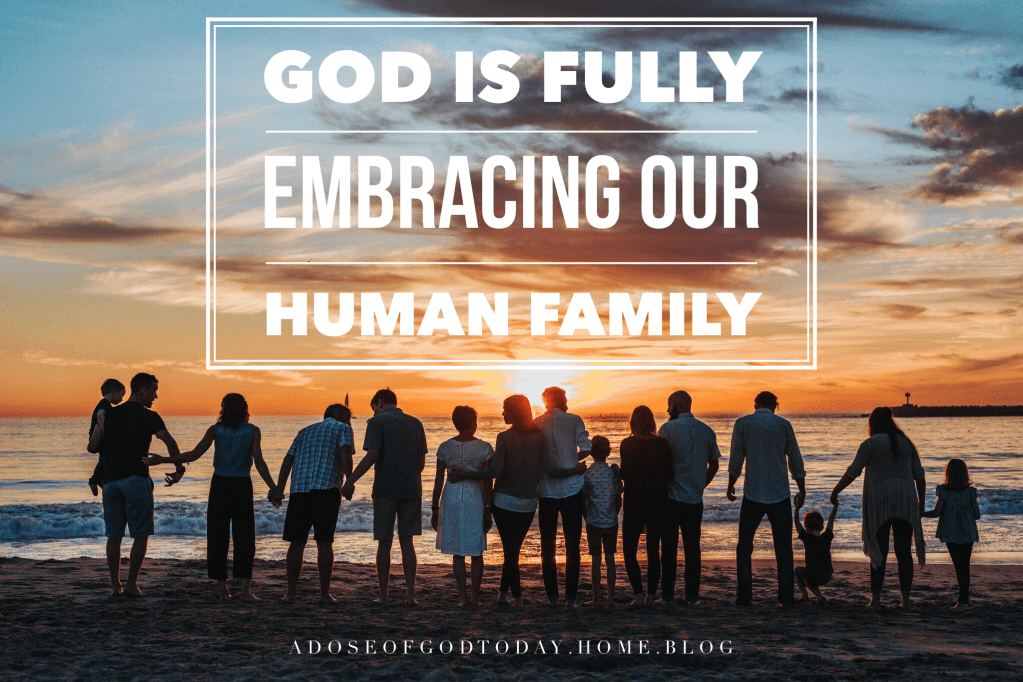
  • God fully embraces our human family

    God fully embraces our human family

    December 17, 2019 – Tuesday 3rd Week of Advent

    Click here for the readings http://www.usccb.org/bible/readings/121719.cfm

    Homily

    In one of my vacations at home during Christmas when I was still a student, I found my father meticulously writing names of people I did not recognize. I asked what was that for. I actually thought first that that could have been a list for the “utang” to be collected. J But I was wrong. My father told me that he was re-tracing our family tree. He was remembering and writing down the names of our relatives and of our great-grand fathers and mothers as far as he could remember and keep a record of our family history.

    I am not so fond of doing that. In fact, I am also quite indifferent towards looking and connecting with relatives. However, to my father, knowing and reconnecting with his past and even those people who have been part of who we are today as persons and family, is very important. My father told me funny stories about people whom he remembered as well as painful and shameful stories about some of those to whom we are related.

    This particular encounter I had with my father and with our family tree reminds me of the significance of the Gospel that we have today. We have this long list of ancestors of Jesus all the way from Abraham to him. There are 42 generations divided into three. 14 generations from Abraham to David, and then another 14 generations from David to the Babylonian Exile and another 14 generations from the Babylonian exile to Jesus.

    The numbers here are very important in the Biblical tradition. Fourteen is the equivalent of two “sevens.” Number 7 is believed to be a perfect number for the Hebrews. And having multiple number 7, is indeed, absolutely perfect!

    However, as these generations have been recorded by Matthew in his Gospel, we are also made aware that there were people whose lives were scandalous in the family tree of Jesus. 

    Yes, we have been presented of a family tree that is not so good. Jesus’ lineage is not perfect and not wholesome at all. There was King David who raped Bathsheba and then later ordered to murder her husband. There was Judah who sold his own brother Joseph for money. There was Rahab, who was a prostitute. There was King Ahaz who burned his own son alive as a human sacrifice. There was another King, Joash, who committed idolatry against Yahweh and murdered people in the Temple area. And there was the once revered King Solomon who later on turned to be unfaithful to God by turning to gods and goddesses of his many wives. 

    What is good news about this now, when in fact, Jesus did not come from a “good” family?

    With this kind of sin and imperfection, God is telling us something good about this. The family tree of Jesus is God’s statement to us that God indeed journeyed with us, in all our humanity, in all our sins and unfaithfulness. Jesus tells us that he fully embraces our humanity. God is not rejecting our imperfection but rather he allows our imperfection to be the very space for us to encounter him and to know him.

    This tells us now that despite our sinfulness and weaknesses, our human family is blessed beyond our expectation. God unfolds himself and his graces upon us through our weaknesses and sins so that we too will recognize him fully in our hearts.

    This Season of Advent is indeed a joyful season because it allows us to see once more not just our failures and sins but also to recognize how God unfolds his blessings and reveals his presence in our life.

    Hence, we are called today to be welcoming also of the lights and shadows of our past, to be grateful of the painful and joyful events in our history, to praise the generosity of God for journeying and accompanying us until today.

    May I invite you then, as we have looked into the family tree of Jesus, let us ask also the Lord to bring healing to our own family trees, to bring healing to any pain and shame that are haunting us until now and healing to broken relationships, and to bring freedom to our hearts and memories imprisoned by anger, hatred and indifference. 

    By allowing God to be more present in our individual lives and families, we may come to celebrate Christmas with gratitude and peace. Hinaut pa.

    Jom Baring, CSsR