Category: Liturgical Year A

  • Be Forgiven BY Being Forgiving for God

    Be Forgiven BY Being Forgiving for God

    Advertisements

    September 13, 2020 – 24th Sunday in Ordinary Time

    Click here for the readings (https://bible.usccb.org/bible/readings/091320.cfm)

    Homily

    “To err is human, to forgive is divine.” Easy for us to say these words at times to make excuses for our wrongdoings and to ask forgiveness for our mistakes. However, we also say same words of excuse to refuse forgiveness to those who have wronged and hurt us. “What can I do, I’m only human.” “Pasensya lang, tao lang po.” These words in fact describe not only our human frailty but also our difficulties of forgiving others. Perhaps asking forgiveness is much easier than giving forgiveness. But nevertheless to forgive is indeed difficult, especially whenever it is associated with “forgive and forget”.

    When his disciples asked Jesus how often should we forgive those who have sinned against us, they are just expressing our difficulties in practicing and upholding the value of forgiveness in our lives. Yes, like the disciples we see the value of forgiveness in our lives but we also know how frustrating forgiveness is and can be. In response to this, somehow Jesus in our gospel teaches and offers us something more about forgiveness.

    When he said “not seven times but seventy-seven,” Jesus is telling us to forgive indefinitely. Forgiving others then is not about numbers (counting faults, sins, mistakes and forgiveness) but all about sharing – GIVING your compassion and forgiveness (awa at patawad) without counting the cost or prize. Meaning, though human it is for us to err and to forgive is divine, nevertheless it is also human to forgive. Frail human as we are, we CAN also forgive and be forgiving of others. Difficult and frustrating it may be,  we can humanely and divinely give and share forgiveness with one another. 

    In our parable today about “the forgiven yet unforgiving servant,” Jesus is also teaching us that forgiveness is more than just “forgive and forget”. For Jesus, forgiveness is all about settling account, paying back, being patient, and regaining trust and respect. Meaning  to forgive is not about forgetting but all about evaluating, i.e. to put value and importance to the action-done, the experience-happened and the relationship-built. In other words,  Bigyang halaga at hinidi binabaliwala lamang. So, to forgive is then not about forgetting but rather about remembering – to put value on the whole experience of reconciliation from mistakes as part/member of ones life. It is a decision to give value, importance and responsibility to your action, experience and relationship.  And not to get out, get rid, and get away from our own mess, but to give God, each other and yourself another chance to grow and live life. For instance, the master forgave the servant because the master gives value and respect to the mercy-asked, promised-made and the relationship-renewed between him and the servant.  However the same forgiven servant was unforgiving because he did not value and respect his fellow servant. That is why to forgive is also  for both the aggrieved and aggressor to remember the wrongdoings-done, lessons-learned & restored trust from the mistake. Thus forgiving is about remembering for the sake of healing while forgetting the resentment. 

    Above all, our gospel today directs us to “Be forgiving as we are as we have been forgiven by God”. Let our reason then for forgiving others should be not ourselves (just to feel good) or be others (just to appease them) but be God, who forgives and loves us first and always. Forgive then not for our’s or other’s sake but for God’s sake, as Paul reminds us today that we live and die not for oneself but for God. Forgiveness is God’s grace we received and ought to be shared to others. Let our forgiveness be our offering of gratitude for God’s mercy and forgiveness – in thanksgiving for being ourselves forgiven.

    In the Lord’s prayer, Jesus taught us to ask our Father to “Forgive us AS (same way as) we forgive those who have sinned against us”. This is our cry to the Father to give us another chance in life as we try our best to give ourselves and other’s another chance also in life. Yes, forgiveness is divinely-granted but also humanly-shared for God, not to be forgotten but be remembered for its value in life.

    Pandemic times make us also conscious not only of the mess, struggles and challenges we are in, but also our own mistakes, shortcomings and wrong-doings in life. We realize that we also need not only God’s love, protection and guidance but also His forgiveness and mercy at this time as well. And we can fully enjoy all His graces by also being humanly and divinely enough forgiving and loving to those who have wronged, failed, and hurt us. In other words, we are mercifully forgiven by our being forgiving….. we are loved by our loving.

    Human as we are, yet are blessed and forgiven, may we be and ought to be for God’s sake forgiving to others especially to those who are needing of His compassion and mercy at this time.  So be it. Amen.

    By  Fr. Aphelie Mario Masangcay, CSsR (a former Filipino Redemptorist Missionary for Filipino Migrants in South Korea who, due to immune compromised diabetic condition, stationed back home  in the Philippines for now).

  • Be united in prayer because Christ is in the midst of us

    Be united in prayer because Christ is in the midst of us

    Advertisements

    September 6, 2020 –  23rd Sunday in Ordinary Time

    Click here for the readings (https://bible.usccb.org/bible/readings/090620.cfm)

    Homily

    Who wants to be corrected? Who wants to be criticized? Being with our friends, with our family or with a community, we cannot really avoid conflicts and tensions. However, a particular difficult situation can be more problematic when we become unwelcoming to corrections and to criticism.

    Jesus, in today’s Gospel offers us practical steps to overcome such situations in order to arrive in a mature way of attaining peace and reconciliation.

    Let us also bear in mind that because of the biases and discriminations that have been built up in us, we can become vicious when we are confronted by others because of our faults. That’s why, Jesus told us how to approach gently a person when we confront them of their faults or when we are being confronted. Yet, knowing that we can exercise forms of denial and refusal to admit our mistakes, then, Jesus affirms the need of the participation of the community. The Lord affirms this as he told us, “for where two or three are gathered together in my name, there am I in the midst of them.”

    Before I proceed deeper into the participation of the community, I would like to invite you that we look first and remind ourselves of our tendency to deny and refuse to be confronted and criticized of our sins and failures.

    Thus, I would like to share with you the two forms of denial that may become our attitude when confronted by others.

    First, when confronted, we might tend to overemphasize the faults of others yet; there will be no acknowledgement of our personal defects and sinfulness. This overemphasis of the faults of others is a mere cover up of one’s skeletons hidden in the closet. It is a way of taking revenge cruelly.

    Second, when confronted, we could display an air of self-righteousness and arrogance in our hearts; claiming that we are always right and good and never committed any mistake. As a result, we could become violent to our critics and would even seek to destroy them. This kind of attitude boasts oneself of his or her good image but hungry of recognition and praise from people around him or her.

    Moreover, there is actually wisdom and goodness in criticism in itself and by being confronted by others. This is how others, friends, family members and our community play a big role  in conversion and transformation.

    Nevertheless, we also remind ourselves also of these two kinds of criticism. There is a constructive criticism and destructive criticism.

    A constructive criticism seeks the good of my brother and sister. In this criticism, we do not seek to ridicule the person but to help the person to grow and learn from mistakes and failures. It gives both positive and negative feedbacks. This is done with honesty and sincerity. St Paul in his letter to the Romans reminded us too to express our love for one another. Indeed, in this way we express it concretely because this seeks the good of the others. We fulfill, then, the law, because it does no evil to our neighbor, but goodness and love.

    This is basically what Jesus offers us in the Gospel today.

    Jesus offers us to do it intimately and confront the person personally. If this will not work, then, Jesus suggests to bring a common friend to serve as a mediator. Yet, if the two will not work and the person continues to refuse, then we seek the judgment of the community or of the Church.

    On the other hand, what we avoid and what Jesus does not want to happen is when we choose the destructive criticism, which is hateful because it desires damage to my brother and sister. It is destructive because it puts down and humiliates the person and has no desire to help the person to grow and to learn. Destructive criticism is a mere accusation that is filled with bitterness and hate.

    Thus, this is done with evil intent. It is usually done when we talk behind the person in initiating, perpetrating and joining others to destroy the image of a person, like in gossiping.

    Advertisements

    Jesus does not want us to be that bitter and hateful accuser of our brothers and sisters but rather disciples of him who are humble enough to recognize our wrongdoings, and courageous enough to speak what is unjust and oppressive around us. Jesus desires that each of us becomes free by being able to recognize our sins so that transformation of hearts will be possible. It is in this way that we become a help to one another, so that as parents, leaders, mentors and authority figures, we will not be leading others blindly but with humility and willingness to be corrected, affirmed and challenged.

    This is where we can find the need of the participation of the community, and that is to be united in prayer. To be united in prayer is to become discerning both in our words and actions. To be united in prayer also practically suggests that we are in a community, and we are a community. When we become united in prayer, then, we allow the Lord to be present in us.

    Thus, to be able to truly confront the sins and failures present in our community, we are called also that we unite in prayer. This also include that we bring, in the spirit of prayer, our effort to confront and correct one another so that we will grow and become the persons God wants us to be.

    To be united in prayer is not just about asking God’s favor to grant our petitions. To be united in prayer then, is to pray in the name of Jesus and that is according to the mind, heart and will of the Lord.

    To be united in prayer also means to change our hearts and minds according to the will of God and not changing God’s mind and heart according to our own desires. As a community, this will help us to be able to trust in God and to give our hearts to God so that we can grow according to God’s desire for us. Hinaut pa.

    Jom Baring, CSsR

  • Together We Have and We Can.

    Together We Have and We Can.

    Advertisements

    September 6, 2020 – 23rd Sunday in Ordinary Time

    Click here for the readings (https://bible.usccb.org/bible/readings/090620.cfm)

    Homily

    How come Filipinos manage and remain to be resilient and strong in times of crisis and disasters? How come, Filipinos can easily bounce back and rebuild their lives despite worst life-conditions and terrible events in life? 

    During typhoon Ondoy back September 2009, I happened to be in Belgium finishing my master’s degrees and licentiate in Theology. The above-questions were raised by my professors, colleagues and classmates which even I myself cannot help but also wonder. In response to their questions, I narrated to them a testimony of Ondoy-survivor which was published in Philippine Daily Inquirer newspaper few days after the incident.

    During the typhoon, residents of an apartment seek refuge on the rooftop of their building. As they settle-in, while waiting for rescue and/or for the flood to subside, they started to pray the rosary together even if without their beads but by just using their fingers to count. After rosary, they pulled-out whatever provisions they were able to recover, and shared it with one another. As they had their fill, they began to share their stories – their experiences and backgrounds, hopes and dreams, fears and frustrations, as well as jokes and life-dramas.

    In others words, as answer to these questions, it is because we, Filipinos do and share things together especially during times of life-crisis and difficulties. We are not perfect people. We do have our own shortcomings and limitations. Nevertheless, we do have a common life. We usually live life together as family and community. And particularly, we usually pray, eat and share our stories together in good times and bad times.

    Somehow our Filipino togetherness, our common life as Filipino reflects the values Jesus upholds in our gospel today. For Jesus, Christian life must be lived and witnessed in the spirit of the following morals.

    First, together we pray. Christian life should have and share a common recognition and faith in God. Jesus said, “where two or three are gathered in my name, there am I in their midst.” God’s presence, love and mercy are assured and promised whenever we pray together in His name. Second, together we eat. Christian life should also have and share a common concerns and regards for others. Ours and the salvation of others is our responsibility. Not the judge or the savior, but we are all our brother’s keeper. They are in our watch and it is our responsibility to correct them when they are at fault, feed them when hungry, and take care of them when they need help. And lastly, together we share our life-stories. As Christians, we must also have and share common meanings, ideals and morals in life. Jesus said, “what we declare bound or loosed on earth shall be held bound or loosed in heaven”. Our life as community is the bearer of God’s salvation. God’s grace of redemption reveals itself and happens in and through our community, i.e. in partnership with our life together as community. What we value and give importance in life is sacred before God’s eyes. We also accept what God deems important to our lives which is Love.

    While we do have our shortcomings and still struggling, we cannot deny as Filipino we do possess these values and qualities as people. As reflected in our aspired values of maka-Dios, makatao at maka-Pilipino, we do have the basic orientation towards others (Dios, tao at Pilipino) as well as of doing, sharing and living life together in common. Thus, together we have and we can overcome life-worse crises.

    It was once said that we, human being as like angels, but angels with only one wing. For us to fly and rise, we need one another, we need each other. Together we do our part so that in partnership with God, we can be with Him always.

    Pandemic times has indeed rendered us physically & socially distance from one another and has deeply challenged our common life,  but it would not hinder us Filipinos together to share our Faith by our prayers, our Charity by our food-agape, & our values & meanings by our stories with one another, and with others. As the world struggles with the challenges of pandemic times, we take note of numbers of Filipinos on the frontlines, both here & abroad who raised to the occasion, been responsible and tirelessly sharing to the world all time, talents, and experiences of our common Filipino resiliency and strength by the witness of our faith, charity & stories especially during times of worse life-crises. May our life and faith as Filipino Catholic Christian people & communities be a constant gift and witness now and always to the world especially at this pandemic times. Amen

    By  Fr. Aphelie Mario Masangcay, CSsR (a former Filipino Redemptorist Missionary for Filipino Migrants in South Korea who, due to immune compromised diabetic condition, stationed back home  in the Philippines for now).

    Follow Me

    Get new content delivered directly to your inbox.

  • Making a sacrifice?

    Making a sacrifice?

    Advertisements

    August 30, 2020 – 22nd Sunday in Ordinary Time

    Click here for the readings (https://bible.usccb.org/bible/readings/083020.cfm)

    Homily

    Who wants a life without suffering, without sacrifices and difficulties? That would be nice, right? We could dream of a life that knows only comfort, that is easy, and that we’ll always feel good.

    There is actually nothing wrong in dreaming a life filled with comfort and without sacrifices and difficulties, to always feel blessed and good. This is a desire from us to feel secured. Nevertheless, the danger lies within a heart that denies sacrifice and suffering as part of our life, and as part of our Christian way of living.

    I remember a story being told to me when I was in college. There was a boy who went out into their garden and found a cocoon. It was so timely that he saw how the cocoon moved. The butterfly was about to come out from its cocoon. However, the butterfly was struggling. The boy felt pity for the butterfly. And so, the boy immediately, ran back to his room, got a pair of scissors. He wanted to help the butterfly and so, with scissors in his hand, he cut the cocoon carefully in order not to wound the butterfly. He was so successful that the butterfly was in her perfect shape and out of her cocoon.

    But then, something was wrong with the butterfly. She did not fly. She couldn’t fly because her wings were too weak. When the boy cut the cocoon, the butterfly lost the opportunity to make her wings strong. She was supposed to go through in that struggle, in that difficulty of coming out from her cocoon. Because of the easy way out, her wings were not made strong to enjoy the wind as she was supposed to fly.

    Advertisements

    In today’s Gospel, Jesus scolded Peter when he denied that Jesus should suffer and die. Even though, Peter confessed that Jesus is indeed the Christ sent by the Father, but then, Peter did not understand the commitment of being sent by the Father. Peter only knew of the victorious image of the Christ who will bring salvation and glory. Peter held on to his belief that in Jesus, there will be only blessings, power, and praises.

    This was the mistake of Peter. He couldn’t accept that Jesus will undergo suffering, persecution and death. He couldn’t accept of a vulnerable and weak God. This caused Peter to be scolded by Jesus and even called Satan because Peter only wanted an easy one, an easy life. Peter only considered what he wanted, not what God desired.

    This is also the consequence when we encounter Jesus. Before this passage of Peter being rebuked by Jesus, the Lord actually asked the disciples, “Who do you say that I am?” This question of Jesus was a question of commitment. And Peter responded this question with conviction. Peter said, “You are the Christ, the Son of the Living God.” Like Peter, if we confess that Jesus is the Christ, our Lord and Savior, then, this confession implies commitment and risk.

    After all, when we commit ourselves to somebody we love, risks and sacrifices are implied. That is why, in the Letter of Paul to the Roman, he reminds us to “offer our bodies as a living sacrifice, holy and pleasing to God.”

    This Sunday, we are reminded neither to fear nor deny the reality of making a sacrifice, of experiencing pain and difficulty in our life. Life is found when we go through the process of struggling. Never cut the cocoon or else there will be no life. When we experience pain, struggles, and difficulties never lose those opportunities because those are ways where we too shall find life, meaning and purpose.

    When we are called to make a sacrifice for others, never fear, because life is brought forth there. Take the example of parents and of mothers especially, giving birth is painful and excruciating, but the beauty of life is found when the baby finally comes out.

    Hence, do something concrete today (this week) that would best express your faith and knowledge of Jesus. Hopefully, by having this consciousness, this will further help us in knowing Jesus all the more because it is in knowing him that we also grow in our faith, in our commitment and relationship with God and with one another. Hinaut pa.

    Jom Baring, CSsR

  • Life Again OR Anew? Normal Life OR New Life?

    Life Again OR Anew? Normal Life OR New Life?

    Advertisements

    August 30, 2020 – 22nd Sunday in Ordinary Time

    Click here for the readings (https://bible.usccb.org/bible/readings/083020.cfm)

    Homily

    How are you coping lately with the New normal life pandemic times has put us up? Whether we like it or not, pandemic reality has changed, is changing, and will change our lives. For better for worse, our life ahead will never be normal back again. Rather than hoping to regain back the normal good old times, we cannot help but accept that we are now at the dawn of the New life ahead and cope with its demands.

    Challenging at this early stage is our grieving over our losses – be it relationships, work opportunities, privileges, lifestyle and above all our usual normal life back then. Many have resorted to anger and blame-game (blaming government, civic and church leaders, & even God and themselves) while others succumbed to bargaining (selling themselves short) and denial & depression – a great danger to mental health. That is why at the dawn of a new life before us now it is important for us nowadays to check and be aware of how we are grieving over our losses and coping with its demands, and above all discern our proper attitude and approach towards the dawn of  new normal life ahead.

    And perhaps we could ask the question: WWJS? “What Would Jesus Say” about our experience of New Normal? How should we approach and what should be our attitude to this New life with Him being offered before us now?

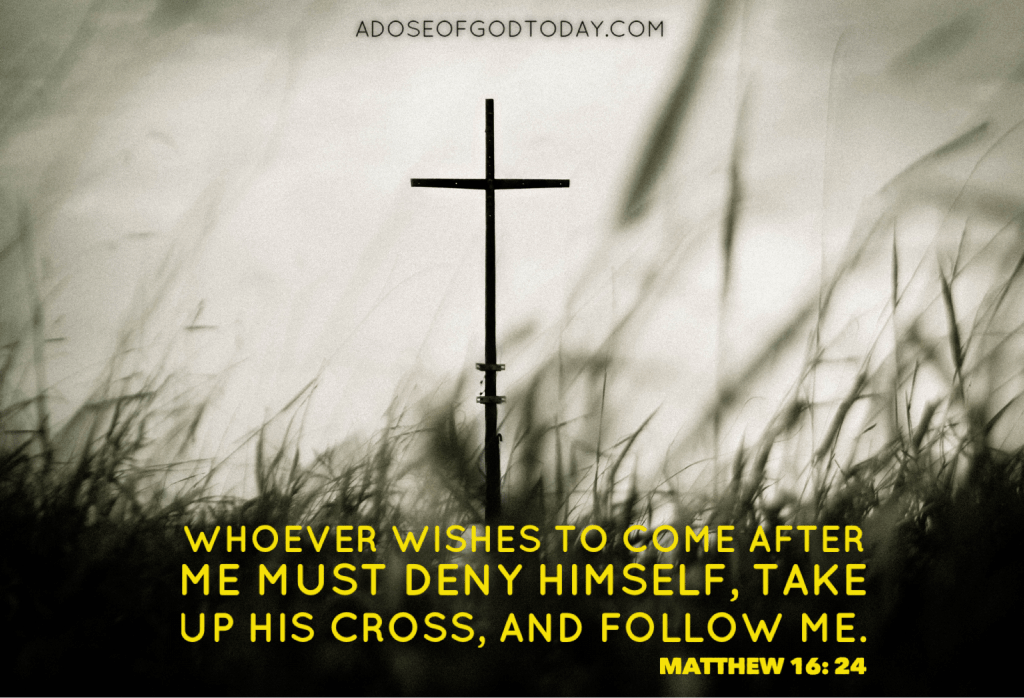
    We remember that for deciding and professing Jesus as his Christ, and as confirmed by Jesus, Peter gained a new identity, role and faith in life as the “Rock”. Because of his inspired new faith in Jesus as the Messiah, Peter plays now an important mission as the foundation stone in the New life Jesus is offering all. However, the same Peter in our gospel today is called by Jesus as stumbling block because he hinders Jesus from the coming suffering and persecution New life entails. For Jesus, the way to redemption is not through our normal way but through the suffering of the way of the cross that requires “deny oneself, take up your cross & follow me.” Meaning, newness also brings along death of our normal lives and loosening of our usual ways. Peter here becomes  an obstacle – a stumbling block to the New  because though he chooses the New but not at the cost of his usual old Normal but corrupted life and ways. Peter do believe in the promise of the New life with Christ but not at the expense of his usual but limited  normal life. Meaning, for listening and being inspired by God, Peter becomes the foundation stone to the promise of a New Life; but for clinging on to his usual Normal human ways, Peter becomes its stumbling block.  

    Thus amidst the New Life being offered us now during this pandemic times, as Jesus directs us through Peter, we may choose now whether to be a foundation stone OR a stumbling block to the New life with Christ. We may open and be inspired to welcome and adapt with the New ways OR we may remain with our usual limited normal life.

    And we also know that for the inspired New to come and grow in our lives now, we have to loose and give up our corrupted normal life. New wine requires new (not normal old) wineskin. New (not the usual) vine for new branches. New updated (not old outdated) system version for new programs. Updates are and should not be same but much better than the usual. And all these new lifestyle requires rebooting, reformatting, and reprogramming, i.e. in religious lingo, the way of the cross towards resurrection and the sorrowful mystery towards the glorious mystery. As Albert Einstein would say: “We cannot solve our problem with the same thinking we used when we created them”, we do need something new and above us (difficult it may be), and cannot remain with the same usual normal thinking, approach or attitude to deal and live with the new offer of life before us now. Same with Peter, we cannot BE Fishers of men by simply just doing our usual normal way of fishing fishes.

    Perhaps we ponder on these questions: “When given another chance now, would you do it Again OR Anew? Would you do it same as before OR better than before? Would you live now as usual as before OR as New as it can & will be?” And now we are given another Chance, so what’s it’s gonna be? Lord, as we, your followers cope with the challenges of our pandemic reality,  guide us to be a foundation stone, rather than a stumbling block to Your promise and offer of New Life with us now and always. Amen.  

    By  Fr. Aphelie Mario Masangcay, CSsR (a former Filipino Redemptorist Missionary for Filipino Migrants in South Korea who, due to immune compromised diabetic condition, stationed back home  in the Philippines for now).