Category: Homilies

  • God is Home with Us 

    God is Home with Us 

    December 24, 2025 – Vigil Mass of the Nativity of the Lord

    Click here for the readings (https://bible.usccb.org/bible/readings/122525-Vigil.cfm)

    Every Filipino knows that Christmas is not complete without family. Even those who live far away will try their best to come home. Some travel for hours, others for days. We brave traffic, long lines, delayed trips, and empty wallets, just to sit again at the same table. And when we finally arrive, there is always that familiar scene: food that overflows but for some it may seem never enough but somehow feeds everyone, relatives teasing each other, stories repeated every year, and laughter that makes the house feel alive again. Sometimes it is chaotic, sometimes noisy, sometimes even tiring but we still say, “Lahi ra gyud ang Pasko kung kumpleto atong pamilya.”

    Tonight, as we celebrate the Vigil Mass of the Nativity of the Lord, the Church tells us something very simple and very deep that Christmas is God coming home to us. Not as a guest who stays for a while, but as family who chooses to stay, who chooses to be with us.

    The first reading from Isaiah speaks of joy and restoration. The people had suffered exile, loss, and shame. They felt abandoned. But God speaks to them with tenderness. He tells them that they will no longer be called forsaken, no longer desolate. God delights in them. God rejoices over them like a bridegroom rejoices over his bride. This is not the language of a distant God. This is the language of love. God does not just fix things from afar. He commits Himself. He binds His joy to the joy of His people.

    The Psalm continues this promise. God speaks of a covenant that will last forever. His kindness will not be taken back. His faithfulness will remain. For a people who experienced broken promises from leaders, from systems, even from family, this assurance mattered deeply. God is saying, “I am not leaving. I am staying with you. I am here for you.”

    Moreover, in the second reading from the Acts of the Apostles, Paul retells the long story of God’s faithfulness. As God chose the people, God also raised leaders. God guided them patiently, even when they failed. And from this long history, God brings forth a Savior, Jesus. This reminds us that Christmas did not happen suddenly. It was prepared through generations of ordinary people. Some of those were faithful, some weak, some confused but all held by God’s mercy.

    This brings us to the Gospel of Matthew. Instead of beginning with angels and shepherds, Matthew starts with a long list of names which we have already heard on the Second Day of Misa de Aguinaldo. At first glance, it may sound boring. But if we listen carefully, this genealogy tells us something powerful. God chose to enter a family line that is imperfect. There are saints and sinners, kings and outsiders, faithful men and broken ones. This is not a clean story but a very human story.

    In this lineage we have Joseph, a man of silence and gentleness. He does not speak a single word in the Gospel. But his actions speak loudly. When he learns that Mary is pregnant, his world collapses. He is hurt, confused, and afraid. He plans to walk away quietly. But God meets him in a dream and asks him to do something difficult. He was called to trust, to stay, to take Mary into his home, and to name the child, Jesus.

    And Joseph obeys. He chooses love over pride. He chooses responsibility over comfort. He chooses faith over fear. And because of that choice, God enters the world not in a palace, but in a home with him and in with Mary.

    Here is the heart of Christmas: God does not save us from a distance. God enters our story and becomes part of our family. Thus, Emmanuel, the God-with-us, is not an idea. It is a reality lived in the middle of human weakness, confusion, and our ordinary life.

    This is why Christmas speaks so deeply to us Filipinos. We know what it means to hold families together despite poverty, distance, and wounds. We know what it means to forgive, to adjust, to endure, just so the family remains whole. And tonight, through the birth of Jesus our Lord, God tells us, “That is exactly how I love you.”

    But Christmas is not only meant to touch our hearts. It is meant to change how we live. It is meant to transform us.

    In our country today, many families are struggling. In fact, in the recent SWS Survey as of September 2025, the study found 50% of Filipino Families considered themselves poor.[1] In addition to that, there are also some tables are missing loved ones because of migration, sickness, conflict, or recent deaths. Many homes carry unspoken wounds like misunderstandings, resentment, and long silence. There are families divided by politics, money, and pride. There are also homes where joy has been replaced by survival.

    Into all of this, God still comes. Not to judge, but to heal us. Not to condemn, but to stay with us. But God also invites us to respond. We are not meant to stay passive.

    And Joseph teaches us that welcoming Jesus means making space, even when it is inconvenient. Isaiah reminds us that God delights in restoring what is broken. The genealogy reminds us that God works through imperfect families. And Jesus’ birth tells us that love becomes real when it chooses to commit and stay.

    So tonight, Christmas asks us one honest question, Is there room for God to be born in our family, not just in our decorations, but in our relationships?

    God comes home to us so that our homes may become places of mercy, patience, and hope. When we forgive, God is born. When we choose to stay instead of walk away, God is born. When we protect life, dignity, and truth, God is born. When we choose honesty and uphold what is just, God is born.

    Indeed, Christmas is God choosing to stay with us, so that we may learn to stay with one another.

    As we celebrate tonight , exchange our joyful Christmas greetings and gifts, and gather around our tables, may we remember that the greatest gift is already here. God is home with us.

    And so, I leave you one invitation. This Christmas, choose one relationship in your family where you will take the first step toward healing through forgiveness, listening, or simply by being present. Let that be your way of welcoming Christ into your home. Hinaut pa.


    [1] https://newsinfo.inquirer.net/2132072/half-of-filipinos-consider-themselves-poor-sws-survey-shows
  • When Silence Turns into Courage

    When Silence Turns into Courage

    December 24, 2025 – 9th Day of Misa de Aguinaldo

    Click here for the readings (https://bible.usccb.org/bible/readings/122425.cfm)

    As people, we are very familiar with silence. There is the silence we keep out of respect, the silence of endurance when life is hard, and sometimes, the silence we choose because speaking feels risky, dangerous. We have learned to endure silently during calamities and man-made disasters, economic hardships, injustice, and disappointments in our relationships. Many times, we tell ourselves, “Antos lang sa,” hoping that things will really get better in time for us. Yet, there is also a silence that weighs heavily. This silence comes from fear, frustration, or the feeling that our voice no longer matters.

    On this 9th and final day of the Misa de Aguinaldo, the Word of God speaks directly to that silence. It shows us that God does not want His people to remain voiceless forever. When God acts, silence is not meant to imprison us, but to prepare us for a braver and truer voice. I invite you now that we look closely at our readings and realize God’s wonderful invitations for us.

    In the First Reading from the Second Book of Samuel, King David was settled and secured. He had peace, power, and a comfortable home. Seeing this, he felt the desire to do something for God. He planned to build a house for the Lord. But God interrupted him. God reminded David that from the beginning, it was never about what David could do something for God, but about what God had already done for David. God took him from being a shepherd to becoming king. God protected him from his enemies. And now, God promises something deeper. The Lord said, “I will be a father to him.”

    This promise is not about buildings or a privileged status. It is about relationship and responsibility. God assured David of the Divine presence, but that presence also carries a mission for David. To belong to God is not only to be blessed, but to live in a way that reflects who God is.

    The Psalm echoes this same hope. The people proclaimed God’s steadfast love and faithfulness, not because their lives were easy, but because God remained faithful even when times were dark. In moments when leaders fail and systems collapsed, what kept the people standing was the conviction that God does not abandon His covenant. God remembers and God stays with us.

    This prepares us now for the Gospel, the Song of Zechariah, often called as the Benedictus. This song is not sung in comfort. It is rather sung after a long season of silence. Zechariah had been unable to speak because he doubted God’s word. Years of disappointment had closed his heart. Perhaps he believed that God’s promises no longer applied to him. That silence, however, became a space where God slowly worked wonderfully and powerfully.

    When Zechariah’s mouth was finally opened, what flowed out was not anger or self-defense, but praise and truth. He blessed the Lord, not because everything suddenly became perfect for him, but because he already saw clearly and recognized that God has visited His people, that God is fulfilling His promise, and that salvation is unfolding before his eyes.

    Indeed, Zechariah’s song is deeply prophetic. It speaks of God raising a mighty savior, of people being rescued from fear and terror, of hearts being turned back to God. But it also speaks of mission. Zechariah realized that his son, John, will go before the Lord to prepare His way, to give people knowledge of salvation, and to lead them out of darkness into light.

    This is where the Song of Zechariah becomes painfully relevant for us today.

    We live in a society, a nation wounded by massive corruption, dishonesty, and insincerity in public service. Many Filipinos have grown tired of broken promises. We have seen leaders speak beautiful words but live empty lives. We have watched truth being bent, justice delayed, and the poor always forgotten. In such a climate, it is tempting to withdraw, to just stay silent, and to say, “Wala na tayong magagawa,”– as if we can do nothing at all anymore.

    However, Zechariah’s song challenges this attitude of indifference. His praise is not passive. It is rather courageous because he speaks of light shining on those who dwell in darkness. He speaks of guiding feet into the path of peace. This is not poetry at all meant to entertain us.

    The Benedictus is a call to conscience.

    John the Baptist, whose mission Zechariah proclaimed, will grow up to become a prophet not by pleasing people and those in power and authority, but by telling the truth. John will speak against corruption, hypocrisy, and false religiosity. His integrity will disturb the comfortable and awaken the complacent. He will remind people that preparing the way of the Lord means changing how one lives, not just how one speaks.

    Today, the Church invites us also to see and situate ourselves in that very mission. We may not stand in public platforms or wear camel’s hair like John, but we are called to be prophetic in our own spaces. In our offices, schools, barangays, organizations, institutions and communities, we are called to let conscience speak. Integrity must become our language then. Honesty must be our habit. And truth must guide our choices, even when it costs us comfort or approval from others.

    Like Zechariah, many of us certainly, have experienced seasons of silence. We stayed silent to survive. We stayed silent to protect ourselves. Yet, Advent reminds us that silence is not the final word. God opens our mouths. And God restores our voices. Indeed, God calls ordinary people to speak light into dark places.

    This is the one theme that binds everything today that God frees our voice so that we may become witnesses of truth and hope.

    As we begin Christmas this evening, welcoming Christ means more than celebrating His birth. It means allowing Jesus’ light to shape our conscience. It means refusing to normalize corruption, dishonesty, and indifference in our hearts and communities. It means choosing integrity even when it is difficult.

    Zechariah taught us that when we finally trust God again, our voice becomes a blessing not only for ourselves, but for the whole community. John taught us too that preparing the way of the Lord requires courage, clarity, and faithfulness.

    So, may this final dawn of the Misa de Aguinaldo awaken in us a renewed conscience and a braver voice. And so, I leave you now the two concrete takeaways.

    First. Practice integrity deliberately. In one specific situation this Christmas season, choose honesty over convenience, even if no one is watching.

    Second. Speak truth with charity. When silence allows wrongdoing to continue, find a respectful but firm way to stand for what is right in your family, workplace, or community.

    May the God who turned Zechariah’s silence into prophecy also turn our silent endurance into courageous witness, so that our nation may slowly walk again in the path of peace. Hinaut pa.

  • Called by Name, Sent with a Mission

    Called by Name, Sent with a Mission

    December 23, 2025 – 8th Day of Misa de Aguinaldo

    Click here for the readings (https://bible.usccb.org/bible/readings/122325.cfm)

    Maayong Good Morning! In many Filipino families, the giving of a name is never simple. When a woman is pregnant, there are long conversations, sometimes even gentle arguments in giving a name to the baby. Some want to name the child after a grandparent, as a way of honoring family roots. In the case of my father, he chose to name me after his nickname.

    Well, others also choose the name of a saint, hoping the child will grow under that saint’s guidance. There are names inspired by faith, by gratitude, or by a story that touched the parents’ lives. And we believe that a name carries meaning. A name carries a story. A name also carries a hope.

    Today, on this 8th Day of Misa de Aguinaldo, the readings invite us to reflect not only on names, but on calling. They remind us that before we were named by our parents, we were already known by God. And more than being known, each of us is called for a purpose. And so, let us journey deeper into our readings today and realize God’s invitations for us.

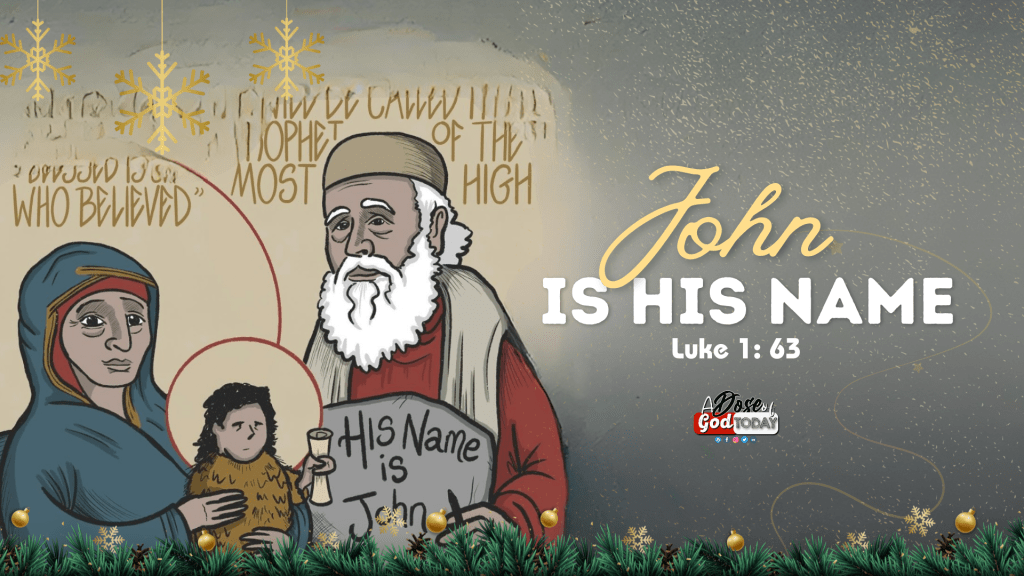
    In the Gospel, we have heard the story of the birth of John the Baptist. Elizabeth gave birth, and the neighbors rejoiced with her. On the eighth day, the child is to be named. According to their custom, they want to call him Zechariah, after his father. That was the normal way. That was what people expected. But Elizabeth spoke firmly, “He will be called John.” The people were confused because no one in the family had that name. So they turned to Zechariah.

    Here, something important happened. Zechariah, who had been silent for many months, wrote on the tablet, “John is his name.” At that moment, his mouth was opened. His tongue was freed. He began to speak, praising God. And so, silence ended as he began to praise God. Yet, fear and wonder filled everyone who witnessed this moment.

    To understand this better, we need to remember that Zechariah doubted God’s graciousness. He asked for proof. Because of that doubt, he lost his voice. His silence was not just physical. It was also spiritual because it because a time of waiting, listening, and learning to trust again.

    When Zechariah finally obeyed God’s word and named his son John, something was healed. His obedience opened his mouth. His trust restored his voice. This teaches us a powerful lesson that indeed, when we align ourselves with God’s will, even after doubt or failure, God gives us a new beginning.

    Hence, God’s graciousness was revealed in John. He is the one spoken of in the first reading from the prophet Malachi. John is the messenger who will prepare the way of the Lord, who will purify hearts and turn people back to God. John’s life will not be easy. He will live simply but will speak boldly and will call people to repentance. And his mission is clear and that is to point not to himself, but to the One who is coming.

    This is why the people ask in wonder, “What, then, will this child be?” They sensed that God’s hand is at work. They knew that this child has a purpose beyond ordinary expectations.

    Here, the Word of God gently turns toward us now. Like John, each of us has been called by name. We are not accidents. We are not forgotten. Our lives are not meaningless. God knows us deeply, even more than our parents do. And like Zechariah, we sometimes struggle to trust that calling.

    Indeed, many of us today are perhaps carrying silent doubts. We doubt our worth. We doubt our ability to change. We doubt that God can still use us after our mistakes. Some of us have lost our voice. Not literally, but spiritually. We stop speaking about what is right. We stop standing for truth. We stop working for justice. We stop expressing faith because we are tired, afraid, or disappointed.

    However, the story of Zechariah today gives us hope. Silence does not have to be the end. Waiting also does not mean abandonment. God uses even our silent seasons to shape us. When the time is right, God can open our mouths again, not to complain, but to praise. Not to defend ourselves, but to proclaim His goodness and graciousness.

    The psalm today echoes this message, “Teach me your ways, O Lord.” It is the prayer of someone who knows that life is a journey. Hence, we do not always see clearly and so we need guidance. We need humility. God leads the humble in what is right. He teaches those who are willing to listen.

    As Christmas approaches in two days, John the Baptist stands before us as a reminder of our role that we are not the Savior. But we are called to prepare the way. In our homes, workplaces, schools, and communities, we can help make hearts ready for Christ. Not through loud words, but through honest lives. Not through perfection, but through our sincerity.

    Like the parents who choose a name with hope for their child’s future, God has placed hope in each of us first. Our names, our lives, our stories matter to God. And even when we have doubted, like Zechariah, God patiently waits for us to trust again.

    So, remember this, we are called by God not just by name, but for a mission. When we listen and obey, our lives become a voice that points others to Christ. I leave you now your two takeaways.

    First. Live your name and calling with intention. Ask yourself: How can my words and actions today help prepare a place for Christ in the lives of others?

    Second. Use your voice for good. Speak words that heal, encourage, and tell the truth, especially in situations where silence allows harm or indifference to grow.

    As we continue our Misa de Aguinaldo, may John the Baptist remind us that even before Christ arrives in Bethlehem, God is already at work, calling us by name and sending us with purpose. Ok lang? Sana All.

  • The Gift We Return to God

    The Gift We Return to God

    December 22, 2025 – Seventh Day of Misa de Aguinaldo

    Click here for the readings (https://bible.usccb.org/bible/readings/122225.cfm)

    Every Filipino knows the joy of giving gifts. When Christmas comes, even if money is tight, we try our best to prepare something like food on the table, a small present wrapped with care, an envelope with a cash, or even just our presence. We say, “Importante ang paghinumdum.” Indeed, what matters is that we remembered and we are being remembered.

    In our culture, we realize that giving is never just about the price of the gift. It is about the heart behind it. It is about gratitude, relationship, and love.

    Today, on the 7th Day of Misa de Aguinaldo, the readings invite us to look deeper into this familiar act of giving. They ask us two important questions. First, when God gives us a gift, how do we respond? Second, do we simply receive, or do we also learn how to return the gift to Him?

    In the first reading, we have the story of Hannah. For a long time, she carried a deep pain. She could not bear a child, and again in her culture, that was a heavy burden. But Hannah did not harden her heart. She brought her longing to God. And God heard her cry. God gave her a son, Samuel.

    Now here is the surprising part. When Samuel was still very young, Hannah brought him to the temple and said, “For this child I prayed, and the Lord has granted me my request. Therefore, I give him back to the Lord.” Imagine that moment. A mother finally receives the gift she waited for, and instead of holding on tightly, she offers him back to God. This is not easy. This is not ordinary giving. This is a heart that truly understands where the gift came from.

    Through the gift of Samuel to Hannah, she realized how faithful God is to her. Through this gift, she also realized the other gift she received, through her friendship with Prophet Eli. The presence of Eli to Hannah was a reminder that there was hope. That friendship, made Hannah to be comforted when she was humiliated. Eli was Hannah’s prayer warrior. This made Hannah to be ever grateful to God.

    Hannah taught us something important. Gratitude is not only saying “thank you.” Gratitude is trusting God enough to offer back what we treasure most. Hannah did not lose her son. Instead, she placed him in God’s hands. And because of that, Samuel’s life became a blessing not only for her, but for the whole people of Israel.

    This is capture through Hannah’s song in the responsorial psalm. Her words were full of praise, not because her life became perfect, but because she experienced who God truly is. She proclaimed that God raises the poor, lifts the lowly, and gives hope to the weak. Hannah realized that God is a God who reverses situations, who sees the forgotten, and who gives dignity to those being pushed aside.

    Moreover, the Gospel of Luke brought us into the heart of another woman, Mary. Though that joyful heart, Mary sang. This is Mary’s Magnificat. Like Hannah, Mary is a woman who received a gift she did not earn and did not fully understand. Yet, God chose her, a simple young woman from Nazareth, to carry His Son. And Mary responds not with fear or pride, but with praise, “My soul magnifies the Lord.”

    Mary’s Magnificat tells us who God is and what God does. God looks upon the lowliness of His servant. God scatters the proud, lifts up the humble, fills the hungry with good things. Mary recognizes that her life has become a place where God’s wonders are revealed. She does not claim the glory for herself. She points everything back to God. That is why she says, “All generations will call me blessed.” Not because she is great on her own, but because God has done great things in her.

    Here, we see the heart of today’s message. God’s gifts are never meant to end with us. They are meant to flow through us. Hannah received a son and returned him to God’s service. Mary received Christ and offered her whole life so that God’s salvation could reach the world. Both women show us the same truth that when God gives, He invites us to become part of His work.

    This speaks deeply to us as Filipinos during Christmas. We receive many gifts, not only material ones, but gifts of life, family, work, education, second chances, healing, and hope after many trials. We have survived storms, sickness, loss, and hardship. Here in Marawi, you have lived out the horror of terrorism during the siege and the bombing. The fact that we are here today is already a gift. The question is: What do we do with what we have received?

    Sometimes we hold on too tightly. We say, “This is mine. I earned this. I deserve this.” However, today’s Misa de Aguinaldo gently reminds us that everything we have is first a gift from God. And the greatest joy comes not from keeping, but from offering. Yet, not as a mere obligation but through a heart filled with gratitude.

    This is how Mary shows us the way. She did not know all the answers. She did not have a detailed plan. But she trusted that God could do wonders through her simple yes. Because of that, God entered human history and salvation became close to us.

    As Christmas draws nearer, the Church invites us to reflect not only on what we will receive, but on what we are willing to give back. Not just gifts under the tree, but gifts of time, forgiveness, attention, and compassion. In a world tired of noise, anger, and division, these are powerful offerings.

    Today, let us remember this that God’s greatest gifts are meant to be returned through a grateful and generous life. Like Hannah and Mary, may we learn to say, “Lord, everything I have comes from You. Use it for Your greater purpose.”

    I leave you now with two simple takeaways.

    First, offer one concrete gift of yourself this Christmas season. It may be your time to listen, your skills to serve, or your presence to someone who feels forgotten. Choose one act and do it with love.

    Second, learn to recognize God’s blessings in your ordinary life. Each day even when it is not Christmas, name one gift you have received and ask yourself how it can become a blessing for others.

    May Mary, the woman who carried God’s greatest gift, teach us how to receive with humility and give with joy. Hinaut pa.

  • Making Room for God

    Making Room for God

    December 21, 2025 – Fourth Sunday of Advent, Sixth Day of Misa de Aguinaldo

    Click here for the readings (https://bible.usccb.org/bible/readings/122125.cfm)

    A few days before Christmas, a family started to rearrange their house. Old things were taken out and furniture were moved. Some members of the family complained, some get tired, but everyone knew why those things had to be done. A visitor was coming. A loved one will arrive soon from abroad. And because that person mattered, the house must make space. Well, it was not perfect, but it was prepared with love. And this simple act of making room helps us understand what this Misa de Aguinaldo on this Fourth Sunday of Advent, is really asking of us.

    All the readings we have today lead us to one clear invitation and that is… God chooses to come close to us, and we are called to make room for Him. So let us explore our readings and realize how the Lord invites us today.

    In the first reading from Isaiah, the people were anxious and uncertain about their future. They were surrounded by fear and threats from their neighboring nations. In that situation, God spoke of a child who will be born, one who will be called Emmanuel, the “God-with-us.” This is not just a promise for later. It is a reminder that God does not wait for calm days before coming. The Lord enters our history when people are afraid, confused, and unsure. Indeed, God chooses closeness and chooses to be present.

    This speaks deeply to us as Filipinos. Many of us live with daily worries. We worry about work, about money, and about sickness. Parents worry about the future of their children and children worry about their aging and sick parents. Our communities also worry about peace. From our worries, our prayers are being formed. And so, sometimes our prayer is not long or beautiful. It is simply as saying, “Lord, be with us.” And today, God answers that prayer. The Lord comes, not from a distance, but into our very situation.

    The Responsorial psalm which is the same as yesterday, continues this message but adds a gentle challenge. It asks us again, “Who can stand in the presence of the Lord?” It is those with clean hands and pure hearts. Thus, to make room for God is not only about words or rituals. It is about the way we live. It is about honesty in our work, faithfulness in our relationships, humility in our success, and compassion for those who are struggling. Advent reminds us that welcoming God also means allowing Him to change us, to transform our hearts into his likeness.

    Saint Paul, in his letter to the Romans, brings us deeper into this mystery. He speaks of Jesus as truly human, born into our history, and at the same time the Son of God who brings grace and peace. Grace always comes first. Before we do anything for God, He already comes to us. But Paul also speaks of the obedience of faith. Faith is not only believing certain truths. It is trusting God enough to follow Him, even when the path is not clear.

    This obedience of faith becomes very concrete in the Gospel through Saint Joseph. Joseph was an ordinary man with ordinary plans. Yet, when he discovered that Mary was pregnant, his world was shaken. He felt pain, confusion, and fear. Like many of us, he tried to solve the problem quietly. But when God spoke to him, Joseph listened. He took Mary into his home. He accepted the child and allowed his plans to change. And so his life was also transformed.

    Joseph taught us something very important today that making room for God often means allowing God to disturb our comfort. Joseph did not understand everything, but he trusted and he acted. His obedience created space for the Savior to enter the world.

    This is where the Gospel touches our own lives. We may attend all the Misa de Aguinaldo completing the 9 days, sing the carols, and prepare the food for our Noche Buena as well as Christmas Parties, but the deeper question remains: Is there room for God in our hearts? Is there space for Him in our decisions, our habits, our priorities?

    For some, making room for God may mean letting go of a long-held anger and hatred. For others, it may mean choosing honesty when no one is watching. For families, it may mean listening to one another again, sitting together, healing what has been broken. For the young, it may mean choosing what is right over what is easy. For leaders and workers, it may mean serving with integrity and compassion.

    As Christmas draws near, God does not ask for a perfect home or a perfect heart. The Lord asks for an open one. Like Joseph, we are invited to trust. Like the psalm reminds us, we are invited to live with sincerity. Like Paul teaches, we are invited to obey in faith. And like Isaiah promises, we are reminded that God truly desires to be with us.

    And so, as we continue this Misa de Aguinaldo and move closer to Christmas, let us remember two simple invitations for today.

    First, each day, make one small space for God by choosing honesty, forgiveness, or kindness where it is most difficult.

    Second, like Joseph, learn to trust God enough to let Him change your plans, believing that His way will always lead to life. Hinaut pa.