Category: Homilies

  • LDR – Long-Distance Relationships

    LDR – Long-Distance Relationships

    May 21, 2023 – Solemnity of the Ascension of the Lord

    Click here for the readings (https://bible.usccb.org/bible/readings/052123-Ascension.cfm)

    For those who are into (LDR) Long-Distance relationships, especially with migrants who have lived and worked abroad away from our families and loved ones, separation and homesickness have been a constant struggle in their daily lives. Experiences of separation and homesickness are indeed never been easy to deal and content with in our journey through life. Difficult it may be, but we also know that our day to day wrestling with separation and homesickness could also provide us opportunities for growth in meaning and values in life. Because at times, in our separation and homesickness, we may become more in touch and conscious of who are most important people in our own life, and what, why and how are they valuable in one’s life. Separation and homesickness could be a chance for us to discover, claim and commit once again to what is important and essential in our own lives.

    At times in life, like “one cannot see the forest for the trees” we need then to detach, separate and be distant from our attachments in order to see and discover once again for ourselves the values, principles and meanings that are most dear to us now and in effect inspire us to move on forward with life. As Henri Nouwen would say: “What is most close, most intimate, most present often cannot be experienced directly but only with a certain distance.” In other words, separation and homesickness can move us to be more appreciative, responsible and hopeful in life. Thus, “Absence makes the heart grows fonder”. Ang mawalay nakakabusog rin ng puso. Ang mabulag makatambok pud og kasingkasing. This can be the upside of life-separation and homesickness.

    However, the downside of separation and homesickness is “Out of sight, out of mind”. Ang mawalay nakakawala ng landas at nakakasira ng ulo rin. Ang mabulag makasaag ug makabuang pud. If you don’t see, you don’t mind, and you even don’t care. Separation and homesickness can also render us directionless, meaningless and hopeless in life.

    Crucial then in our experience of separation and homesickness is the once-again & always search, giving importance and making a promise to our values, meanings and missions in life.

    Today, we celebrate the 2nd Glorious Mystery, the Ascension of the Lord. Tradition has it that forty days after the risen Lord appearances before his disciples, the Lord has ascended back to Our Father, leaving behind and separated away from us His disciples. This would mean that separation and homesickness share in our life as well as in our faith, as part of our life-story and our salvation history as well. Like the experience of the two disciples in Emmaus where the Lord appeared to them and then disappeared when they recognized Him, Salvation also requires the Lord’s resurrection and departure (His coming and going into our own lives) – that part and parcel of our faith and life story is the paradox of homecoming and separation, of the hellos and goodbyes. And during moments of departure and distance, separation and homesickness – though with a downside of pain, anguish & of losing direction, could also be the upside and opportunity to discover and claim once again what is importance and valuable in our life as well as what is our mission in life now, that is, our life-values and life-missions.

    Our readings remind us that in the Lord’s ascension, the Lord empowered and gave his disciples the task and mission to be His witnesses in the world, saying “Go, therefore, and make disciples of all nations, baptizing and teaching them” with the assurance “I am with you always forever.” This explains why the Lord’s ascension is more than just about the Lord’s departure, separation and disappearances but more so about once again and anew finding, claiming, committing and fulfilling our life-missions.

    We pray then, that like the two disciples of Emmaus, may our usual departure and distance from our loved ones and the usual Lord’s departure and distance from us, move and inspire us to go on discovering and upholding our values, principles, and meanings in life, as well as fondly reclaim and actively fulfill our hopes and missions in life. Amen. 

  • Grow Up In Love

    Grow Up In Love

    May 14, 2023 – Sixth Sunday of Easter

    Click here for the readings (https://bible.usccb.org/bible/readings/051423.cfm)

    “They said if you love someone, you set them free. If they come back again, till the end, you are meant to be.”

    Does it ring a bell? Sounds familiar? That is a line from a popular song sung by Barbara Streisand and Barry Manilow called “Some good things never last.” Such line tells us more about love. It is also telling us about growing up in life.

    Because we all know, big part of life is GROWING UP. We ourselves grow up – hopefully. And we help others to grow up as well. And we have surely seen how we and others have grown up all these years. Growing up is about really helping oneself and others to help us and them grow up in maturity.

    And the commandment of Jesus to love one another has a lot of things to do with growing up. Same as helping others grow is love, to love also means to help oneself and others to grow up in life. Loving would entail giving oneself and each other a chance to GROW, i.e. to allow each other to stand in one’s feet, and be responsible for one’s own and other’s growth.

    Loving yourself means not only pampering yourself but letting go of your securities and giving yourself a chance to grow. Loving others would also mean trusting others enough to be on their own so that they can make a stand for their lives. That’s why, in loving others, set fee – let go, let be & let grow.

    This is very true in a Parent – Child relationship. Because and out of their love for their children, a parent must learn how to stand back, (not to abandon or reject them) but in order to help and give the children a chance – an opportunity to stand on their own and be responsible for their own life-growth. Just like, a child cannot stand in his own two feet and walk, if & when the parent does not allow the child to stand up and walk.

    Experiences of standing back, letting go, saying goodbye, setting free have never been an easy part of growing up as well as loving others. Imagine how hard it was for you and your parent when you had your first step, your first day in school, your first jeepney ride on your own, your first camping, your first date, your first boyfriend/girlfriend, your first job, your wedding day, as well as your first child. But we all know that we must be given a chance and to go through those experiences in order for us to grow up and learn how to live life and love life, because we know deep inside that loving is not about falling in love but growing up in love. We love not because we fall in love, but because we grow in love.

    This is what Jesus is trying to teach us in our gospel today. As his paalam, panamilit, last farewell, mi ultimo adios to his apostles, Jesus is trying to tell them that because of his love for them, he should leave them behind, not to forsake them, but to give them a chance to grow in His love – to practice the love he has taught them and to experience for themselves the Father’s love he had preached them. In other words, as he goes back to the Father, Jesus has given them then & us now the opportunity to grow in our faith, and to witness and share that faith to others, just like what happened to the apostles in our first reading. Out of love and in order for us to grow in that love, Jesus – as parent, guide, leader, good shepherd, true vine Himself has to step back, let go, say goodbye, set us free to love God for ourselves and help others love God for themselves.

    It is just like Jesus is saying his farewell panamilit to us now, “Guys, I have already taught you, guided you what to do. I have already done my part. Now is your time to do your part. Just carry out what I have told and taught you: Love God with all your heart and love one another as yourself, same as I have loved you. By the way, don’t worry. I will never abandon you. I will be always with you in the Holy Spirit.”

    Allowing the risen Lord to be part of our daily lives has always been an invitation and challenge of Easter for us. It is both a call and a dare to leave behind to our comfort zones and say goodbye to our usual normal ways, to detach and set ourselves from our attachments, and to engage into an exodus with the Lord towards growth in faith and life – in other words, to grow up in love.

    We pray then that as we grow to become responsible disciples for the Lord, may we also grow up responsibly in our faith and life, and in love for Him and others.

    So. May it be. Amen. 

  • HELLO, LOVE, STAY

    HELLO, LOVE, STAY

    A Reflection by Rizza Mae O. Malalay – Youth Mission Volunteer

    “People said, there are places where we stay longer. There are also places that are mere stopovers. Just like Hong Kong. So you have to make the most out of your time. Because, no one stays here forever” (Sabi nila may mga lugar na pangmatagalan. May mga lugar na dinadaanan lang. Parang Hong Kong. Kaya bawat oras dapat sulitin mo kasi walang nagtatagal dito.) This is the opening line from the trailer of the movie Hello, Love, Goodbye released last 2019.

    Some people in the social media used its audio in their reels/videos, showcasing the placeS they had been and the things they have done. It makes me kind of nostalgic which leads me in this two lingering questions. First, how will you know whether it is forever or only a stopover? Second, how can you get the most out of your time?

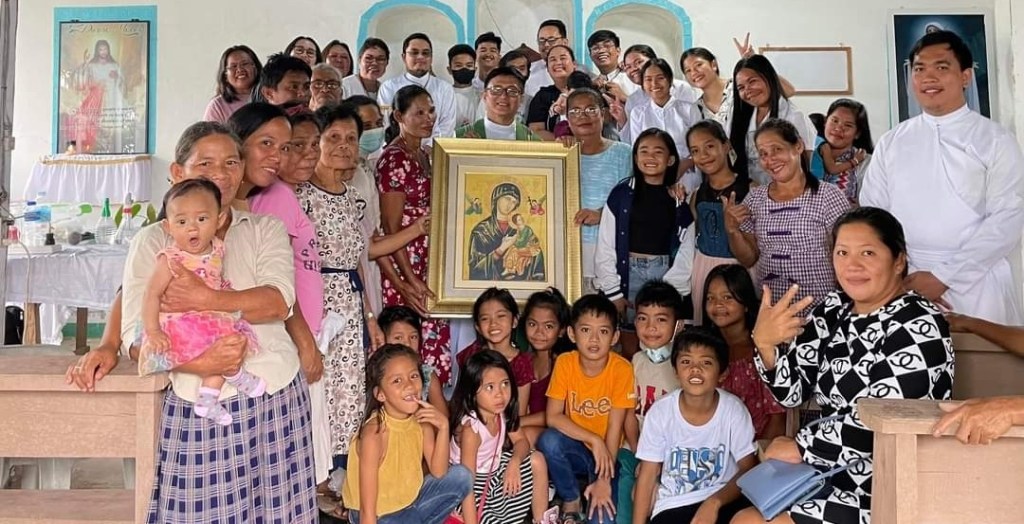
    I was recently part of the Davao Redemptorist Mission Team in their Icon Mission in Maco, Davao de Oro. The Our Mother of Perpetual Help Church in Maco is a Diocesan Shrine. Though it is the Diocesan Shrine, yet, not all chapels know and understand the icon’s background and its elements. They also do not practice novena in their chapels.

    In one of our activities, we introduced the house blessings and the enthronement of the Icon of Our Mother of Perpetual Help in their altars. And during those times, there was this Nanay who lived not too far away just an hour and a half of hiking. People in that area would say that it is too far.

    Anyway, Nanay invited us to their home for the house blessing and the enthronement of the icon, which our team gladly accepted. We went there with Nanay’s niece and her granddaughters. When we arrived, Nanay Landa and her husband Tatay Ernesto were delighted. Nanay asked Tatay to catch us some chickens for us to eat and for us to bring. They lived in a small hut in the middle of the coconut trees, no water supply nor electricity. Nanay shared that a lot of bikers would visit them for two things, first, because of the the trail and second, the beautiful overlooking  view of the Davao Gulf, the Municipality of Maco and the City of Tagum.

    During our lunch, stories and laughter were shared. We took a nap as well and rested for a while. We spent about 4 hours there and when we bid our goodbyes. Nanay cannot contain how grateful she was that even though their home was far, we took the time and effort to visit them. She was on the verge of tears when I waved goodbye.

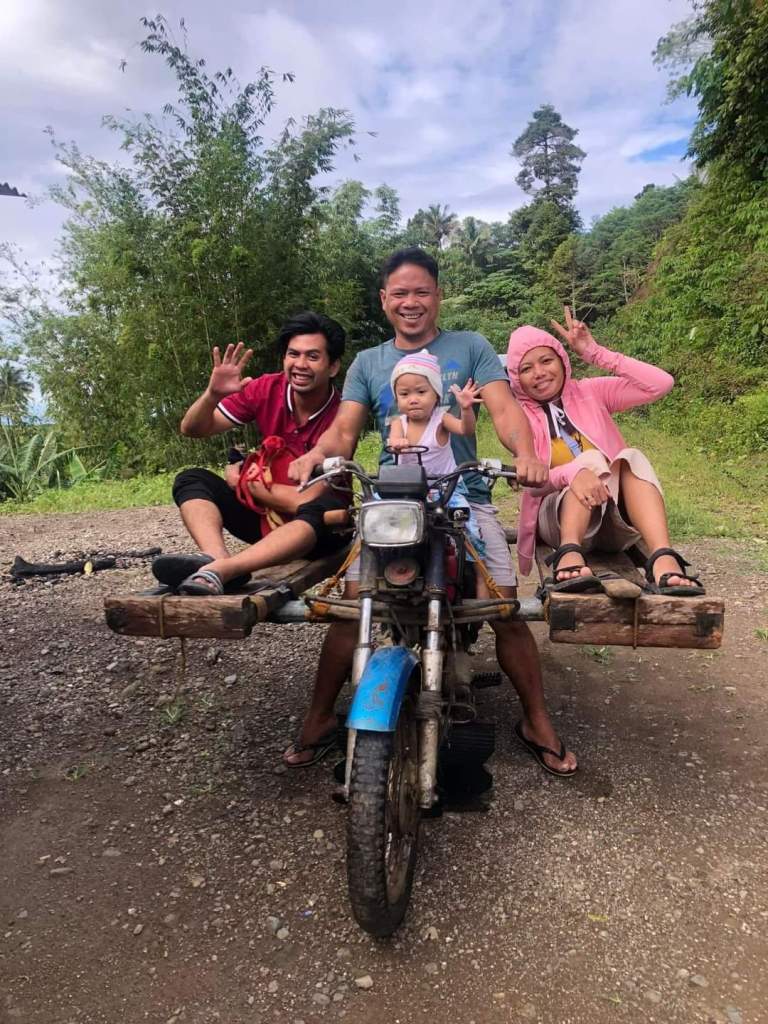
    In another mission area I also experienced riding “skylab motorcycle,” a two-wheeled motor with planks on both sides which can carry four persons. Riding on the skylab motor was never easy at first, not to mention that you need a balance on the other side. I got nervous since the road was bumpy. I also found it hard to choose which side to sit. If I will go the right, I was scared that snakes might jump from nowhere or insects from the leaves of the trees will crawl on me or I can collect twigs for firewoods or worst a branch from a tree might stab me accidentally 😅. On the left side is simply a cliff. So, I chose the former. We were praying and laughing at the same time but what really caught my attention was the toddler who was with us. Her father was the driver, and she was sitting on the tank of the skylab motor. While we were praying and laughing, the toddler was just chilling there and looked at us as if questioning us why we were so noisy. It was so fun that we rode skylab for the 2nd and 3rd times. After those experiences, riding the skylab motor became so easy for me then.

    Those encounters brought me to these realizations:      

    • To Jesus Through Mary. This is one of our modules. That their love for Mary brings them closer to Jesus. I was also moved when one time while doing the house blessing and enthronement of the Icon, a woman who was pregnant bursted in tears while we were reading the prayer and while holding the icon in her hands. I may not know what she was going through but I know that God touched her on that day through Mary. May my love for Mary inspire me to be self-giving, a love that will inspire me not only to remain in the state of loving but also in serving.
    • To Trust and Have Faith in God. It was just like riding the skylab. God is my driver and my balance is my principles in life. If the road becomes bumpy and I’m scared and not secured at all, and the only way for me to save myself is to jump, then I will definitely get into an accident. I am reminded now to be like the toddler, who knows her father well and to trust him above all. I am challenged to know Christ more in order for me to trust and have faith in Him more that whatever comes my way, I will always be and feel safe in His presence.

    Going back to my first question, I am reminded now with one of the lines shared with us by Ate Portia in one of her sessions, “We may be in this world but we are not of this world“. Change is constant and living in this world is not forever, no matter how much I love the place, I am just a passerby. Time will come I will become a memory, so I need to make most of my time in this world, and how can I possibly do it? Just by simply living in a purposeful and meaningful life. Doing what gives me a purpose and doing what gives life its meaning.

    I pray that the love of God will stay with me forever and that I will be able to radiate this love and joy in me with others.

  • Bahala Na

    Bahala Na

    May 7, 2023 – Fifth Sunday of Easter

    Click here for the readings (https://bible.usccb.org/bible/readings/050723.cfm)

    For us, Easter people to fully appreciate the meaning and benefit from the fruits of the mystery of the Lord’s resurrection, we must reflect and try to discover how the Lord has resurrected and can be resurrected in our daily ordinary lives now. Somehow someway during this Easter Season we ponder on the question: Sa unsang pamaagi nabanhaw ug mabanhaw ang Ginoong Dios sa akong kinabuhi karon? In what ways the risen Lord has & may be truly resurrected in our very lives at this very moment?

    As we have recently experienced during the pandemic times, we cannot deny that there are moments in our life that we experience crises and distress. Yes, we do have moments in life when everything seems to fall apart, gets very dark and uncertain, when we are down and at lost, when things get bad, when trouble, sickness, suffering and death strike, when we are left behind and find ourselves on our own, when things have no meaning and doesn’t make sense anymore. These are critical moments in our lives, where usually moments when we have nothing else but faith, have no one else but God, and can do nothing anything anymore but just to trust in God.

    We, Filipinos usually express this faith through the words: “Bahala na”. Usually in moments of crises in life, we articulate our faith in God and in Jesus by saying “bahala na.” Others have criticized such Filipino faith as our fatalistic or defeatist mentality. But for us Filipino, praying and saying, “Bahala na” is more than an expression of resignation to fate or “kapalaran” but articulations of our deep trust and faith in God in times of crisis in life. Because for us, “bahala na” means more than just “come what may” (o pawala nalang), but it is our way of saying, that when after we have already done our part, but things are not complete or finish yet, now “Bathala na” “sumadios nawa”, “gipaka-dios ko na”, “gitugyan ko na sa Ginoo”. “I now entrust to Him.” All now is in God’s.

    This has the same meaning with the word “Amen” “Kabay pa”. “Hinaut pa Unta”. So be it.” This is our expression of deep trust in God, saying, “after all I have done… with God, all will be well. So be it. Siya Nawa. Amen. Bahala na”.

    Here in our gospel today, we hear Jesus saying to his apostles, “do not let your hearts be troubled. You have faith in God, have faith also in me.” These are the farewell words – the ‘mi ultimo adius’ of Jesus to his apostles said during his despidida party – the Last Supper. After he had warned them of the crisis that lies ahead for Him and his disciples, Jesus have also felt the heartbrokenness his apostles must have felt of the coming loss and crisis. Here, at their crisis moment, Jesus consoles and directs his friends to trust in God and in Him – an invitation to: “Bahala na.” He said to them & to us now: “Don’t let your heart’s be troubled. Believe in God. Believe in me.”

    This is Jesus’ way of saying: “Don’t worry, Me & Our Father got this. Have faith in us. Entrust this to Us”. “Ayaw na kabalaka. Kami sa akong Amahan ang bahala. Salig lang kanamo. Isalig, ipasa-Ginoo, ipasa-bahala, ipasa-Dios na kanamo”.

    The same words of consolations and directions are being preached to us today. Jesus feels for us. He feels and knows the heartbreak we feel, and the difficulties we are in – in our every moment of our life-crises. He also invites us to always trust always in God and in Him. When he said “I am the Way, the Truth and Life”, he is also leading us that it is God and Him, not ourselves who will bring and deliver us to our salvation and eternal life. And only when we always follow and persevere in the Lord’s way, which is the way of the suffering and cross, as well as keep on trusting in God – “bahala na” not only during crisis moments of life, we eventually share and enjoy our life and salvation at Home with God, Our Father and Jesus.

    In other words, the Lord has and can be truly resurrected in our daily ordinary lives now, if and when we learn how to trust and have faith in Him, who is our Way, Truth and Life. Thus, by saying Bahala na, Amen to His Way, Truth and Life, and allowing His Way, Truth and Life in our ordinary lives, He has indeed risen and can be truly risen.

    In every moment of our ordinary lives then, as we do our part, we pray that we must always have faith and trust in God and in Jesus. For we know, without the way there is no going, without the truth there is no knowing, without the life there is no growing. Thus, we seek the way that we may go, the truth that we may know, and the life that we may grow eternally, only to discover and realize that Our Way, our Truth and Our Life is the Risen Lord himself in daily ordinary lives now.

    In other words, and simply said, our prayer is  Bahala na. Amen.

  • THE GATE OF THE SHEEP

    THE GATE OF THE SHEEP

    April 30, 2023 – Fourth Sunday of Easter

    Click here for the readings (https://bible.usccb.org/bible/readings/043023.cfm)

    Parents are the first shepherds of children at home. As shepherds, they take care of their children, and make sure that home is welcoming and nurturing. Parents secure that the basic needs of human intimacy and love, of physical, mental and spiritual aspects of children are provided. Parents lead children by example through their words and deeds.

    However, what if our parents are irresponsible? When a father turns out to be alcoholic, abusive and immature or a mother turns out to be distant, self-obsessed and cruel in her words, then, it will not be surprising if children will also turn out to be like them, lost and unproductive, broken and resentful.

    This can also be true in a wider picture. When our leaders, whether in our Church or State, will turn out to be unreliable, corrupt, abusive and self-absorbed, then, our community will surely be in a mess. That is why, there is really a need to learn and to practice what Jesus calls us to be.

    Each of us, certainly, has the responsibility of taking care of others. As we celebrate the 4th Sunday of Easter, we also celebrate this as Good Shepherd Sunday. And so, let us take a deeper look on how God invites us today.

    The image of God as a shepherd is a recurring theme in the bible. In fact, the Psalm today captures very well this image, “The Lord is my Shepherd; there is nothing I shall want.”  Jesus used this image to portray himself as the Good Shepherd who is willing to give his life for the sake of his sheep, who makes sure that the flock is taken cared and well provided. The Good Shepherd cares, protects and provides for the sheep as he himself proclaimed, “I am the gate the gate for the sheep.”

    In Biblical times, sheep were very important to the lives of the people because sheep provide both food and clothing. Since the sheep needed grass, the shepherd would always look for green pastures. Because of this, the shepherd and his sheep were always on a journey in search for green pastures and water. The shepherd will provide shelter and protection for his sheep – 24/7. Consequently, the shepherd would develop a close relationship with his sheep to the point of becoming familiar to each of them, giving them names and calling them by name. The sheep in return would also become familiar with their shepherd. They would recognize his voice and follow him wherever he may lead them. In a way, trust and confidence is built up in this kind of relationship.

    From this point, I would like to highlight the two relationships where we are invited to reflect and to grow and mature. First is the relationship of the Shepherd to the sheep. Second is the relationship between the sheep with their shepherd.

    As persons who exercise responsibility over others God invites us to learn from the relationship the shepherd has with his sheep. The shepherd takes time to know his sheep; he spends quality time with them. The shepherd develops a rapport with his sheep allowing himself to be in the midst of his sheep. He is neither distant nor indifferent, but close and involved to every sheep. The shepherd responds to the needs of his sheep.

    Thus, Jesus invites us that like him we too shall develop a consciousness of serving, of taking care of others, of becoming instruments of God’s care and compassion to His people. As parents, as leaders in our community, organization or in your field of work, or as priests and religious, we are called to learn from the Good shepherd.

    And remember, this is power which is an ability to influence, to create and transform. This power is ought to be expressed through love, so that, power transforms into service and giving of oneself. Jesus, our Good Shepherd, tells us that being a person with power as an authority figure or leader is not about controlling others or manipulating others, but rather, having the capacity to serve and love without pretension, without manipulation and that does not count the cost.

    The second relationship that I am emphasizing is between the sheep with their shepherd. Today, we might not like the idea of being called as sheep. Sheep are known to be stupid and submissive animals. Yet, we, human beings are cultured, intelligent, and sophisticated because of our reason. But then, do these qualities in us really make us totally different from the attitudes of the sheep?

    Is it not that we also tend to be unmindful and unconscious of many things in life except for our personal desires and wants, except with those that will give us comfort and pleasure? Yes, we might tend to be more focused of the green pastures that we have at this moment but careless of what surrounds us.

    We might be full of ourselves, of what others can give us and of what is only beneficial to us without minding the needs of others, meaning, egocentric. Like the sheep, we might not be conscious also of the vicious and greedy wolf in our midst and saying nothing about it. We might find ourselves dumb and stupid for not recognizing, not speaking out, and not standing up against to what is unjust and evil in our community. Like the sheep, we might also wander to the other side thinking that there is more security in vices, in depression and loneliness. So, we stray away from the comfort of our brothers and sisters.

    Thus, we too need a Shepherd who will lead us, who will show us the way, to inspire us and to motivate us. We are called, then, to also develop a close relationship with our shepherd, to put our trust and confidence to our shepherd, whoever he/she may be – our parents, leaders in the community, the pastors in our parish, or teachers and mentors.

    Indeed, we are called to trust and to grow in faith and confidence in Jesus, who is our Good Shepherd who laid down his life for us. Jesus is in our midst, hopefully, we too shall spend more time with him in prayer so that we become familiar of his voice and attuned to his ways. In this way, we may be able to follow him with joy and confidence. Kabay pa.