Category: Homilies

  • Inclusive Grace

    Inclusive Grace

    September 29, 2024 – 26th Sunday in Ordinary Time

    Click here for the readings (https://bible.usccb.org/bible/readings/092924.cfm)

    This Sunday we celebrate the National Seafarers & Migrant Sunday. This is not only to recognize the contribution of the OFW & Migrant families to the betterment of our quality of life here at home but also their struggles of living life afar from their loved ones in long-distance relationship, and their steadfast Christian faith to live & share Jesus to others at home & abroad.

    My father & elder brother are Seafarers. I have also lived as Migrant student & missionary abroad. I know & have experienced how to live life in distance & away from my families, friends & loved ones.

    For us who have live & work abroad & also who have been raised in a long-distance relationship family, living & giving witness to our Christian faith is particularly challenging. Much that we have to adjust & manage with the unusual circumstances & culture we are in – afar from our comfort zones & support groups in a totally in a different foreign culture & lifestyles, OFW families have also to contend with faith & church life.

    Here at home, we have to do with going to Sunday Eucharist with less & absence of loved ones. And more challenging, when we find ourselves alone abroad in a non-Christian countries. And even much more challenging, when we are in a mostly Christian nation, but we cannot fully relate because they tend to think that they are the only Christians around & their version of Christianity is & should be only observed by all. In other words, we may find ourselves with exclusive, non-welcoming & critical Catholic church abroad.

    Sometimes it is good to examine and ask ourselves: “What are the things that we claim as being rightly ours and yet are not truly ours?” This may not only be material possessions but could also be our status in society we use to lord over others,.. titles we use for personal advantages, … our prejudices and biases we harbored towards others,… or our self-righteous behaviors & beliefs that makes us feel morally better, privilege or important than others. We sometimes claim these privileges – which do not really belong to us, though we come to think and believe that they are only ours to have. Worse, we sometimes claim that we are the rightful owners of Christian life & faith that we impose on others should practice & observed.

    Here in our first reading, we heard Joshua complaining to Moses for letting two elders who were absent during the meeting, receive the spirit of prophecy. Joshua was thinking that only those elders who attended the meeting are the rightful recipients of the spirit of prophecy.

    A similar story here is depicted in our gospel today. John reported to Jesus: “Master, we saw a man who is not one of us casting our devils in your name; and because he was not one of us we tried to stop him.” Meaning, John and other disciples tried to exclude a non-member from exercising the ministry of healing and exorcism in the name of Jesus. Just like Joshua, the apostles believed that they are exclusively the privilege persons to invoke the name of the Lord.

    But as we all know; Jesus did not stop the estranged but effective exorcist. Like Moses, Jesus was not concerned about how the exorcist got the spirit of exorcism but was simply glad he had it. Clearly, Jesus perceived the situation differently. He said, “If anyone who is not against us is for us”. In other words, the Kingdom of God is beyond and wider than our human standards. Salvation is non-exclusive.

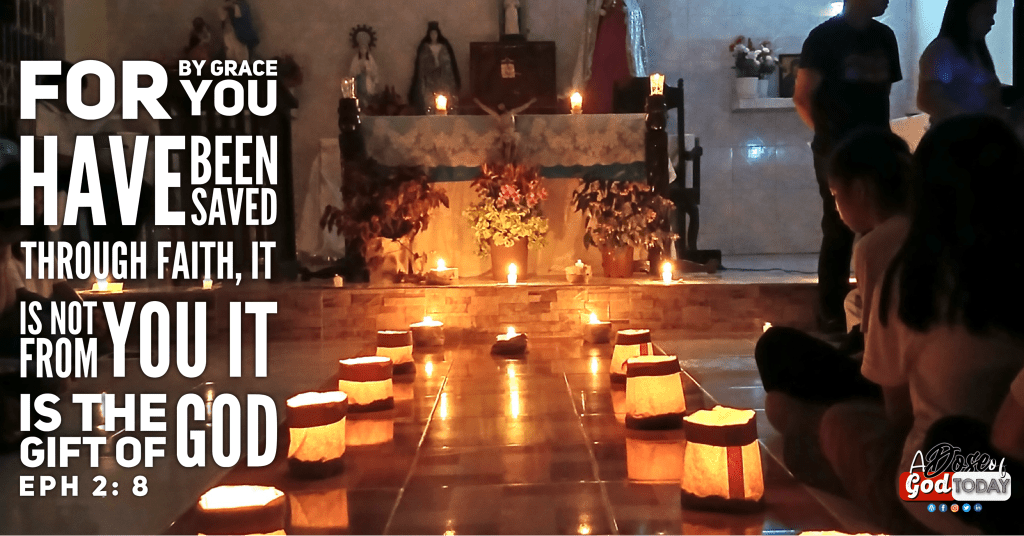
    It is God’s gift for all, not only for privileged few. Consequently, God’s blessings for us are Sharewares – meant to be shared, and not to be kept selfishly & owned exclusively. He challenged us instead to be open-minded to others, to “Let God’s spirit blows where it will” since God rewards those who show even the smallest courtesies to those who teach and share in Jesus’ name.

    On the contrary, he warned the disciples then & us now against our tendency to be selective, downgrading, arrogant, jealous, and intolerant of one another – as if we have the monopoly of the gift of God’s graces & spirit, and the exclusive rightful owner of what we have, or exclusive person to invoke Jesus name. Instead of selfishly thinking for ourselves & of ourselves, he challenged us to be what we claim to be: Christians. That is, If we claim to be Christians – a follower of Christ let us also be Christians in our attitude and behavior in our discipleship and relationship with one another & others.

    Since we call ourselves as Christians, we must also be Christ-like: tolerant open-minded, creative, non-exclusive at the same time determined and non-compromising in our faith in God’s salvation for all humanity through Jesus’ name. In other words, it is not for us to forbid and impose limitations on God’s capacity & ways. It is not for us to program God’s own Plans & Ways for all which are far way better than our human standards and ways. Jesus offers us then inclusive grace than exclusive privileges.

    Somehow our readings today are wake-up calls for us to realize not only our self-centered ways and attitudes in life demand our conversion & transformation.  Somehow we are challenge to do away our exclusive global-thinking that we don’t mind the locals, and to resist our mere mainstream mentality that we suspect alternatives.  

    Most of all, that even we are alone on our own abroad, and incomplete family here at home, w e challenge to cooperate and share with one another God’s non-exclusive all-embracing intervention, protection, salvation, healing, and blessings that we do pray & really need at these challenging life, especially in a long-distance relationships.

    May Our Father & His Will be always upon Us, Lord. Whatever & however our gifts, talents, limits & blessings we have now may be, allow us to contribute & cooperate with Your plans of saving us now and always. Amen.

  • With open & welcoming heart

    With open & welcoming heart

    September 22, 2024 – 25th Sunday in Ordinary Time

    Click here for the readings (https://bible.usccb.org/bible/readings/092224.cfm)

    In a village badly hit by drought, a woman decided to fetch water from the well. But before doing this, she had to find clean & available container to use. Unfortunately, almost every container she has, were already filled, and used for other things – like oil, vinegar, gas, soy sauce and others. Until eventually, she found an Empty container, which she readily cleaned and brought with her to the well. There, using her now clean container, she was able to quench her thirst, wash herself and bring some water for her family to use and drink.

    A simple story but with a strong message, and that is: Thirst quenched, body refreshed and water is enjoyed because an empty and open container is available.

    This is also true in our life and faith. Common sense tells us that only an open and welcoming hand can receive and share gifts. If hands are close, filled or occupied, one cannot receive or accept more. If hands are open, empty, and available, one can accept, receive, or share gifts because there are still lots of space or room available to welcome & receive.

    While they were on the way to Jerusalem, Jesus in our gospel today warned his disciples of his coming passion and death. However, they were not listening. They were so immersed with their quarrel as to who is the greatest among them. Instead of being concern of Jesus, they were more concerned and pre-occupied with their power, influence, and wealth. In a sense, their hearts and minds are already full & occupied of themselves that made them unavailable, unwelcoming and close to others. That is why when Jesus asked them about their discussion, they were embarrassed and remained silent. Jesus then uses this occasion to reprimand them and correct them as to what constitutes true greatness in God’s eyes.

    True greatness, he says, does not come from having power and influence over people but consists in humble service. He tells his ambitious disciples that everyone is important, and that true greatness comes from being open, welcoming and available to all people even down to the little children. Jesus here also instructs us of what kind of followers He wants us to be. He wants us to be his great disciples by our humble service to our brothers and sisters – open, welcoming & available sharers of God’s graces to all.

    But, is it not true that we are rather like the ambitious disci arguing on the road about which of them was the greatest? At times, we are full of selfish ambition; always putting ourselves first, wanting the best of everything. Like some of our local & church leaders, ut is easy for us to think of what we have as completely ours, no thanks to anyone else. We fail to remember that we are just mere stewards of many gifts which God entrusts us with, and mere containers which He intends to be used in His service.

    To be a disciple, then, means being open, welcoming, available, and responsive to what God may ask of us at any given moment for the needs of other & all. Remember, only an open, available, welcoming hand, container and heart is capable of receiving, giving and sharing God’s blessings.

    We can, thus only receive, give, & share if & when we are open, available, welcome & empty enough to receive the little ones, Jesus, and the One who sent Him into our very lives now and always. Be reminded, Jesus said: “Whoever receives one child such as this in my name, receives me; and whoever receives me, receives not me but the One who sent me.”

    Lord, decrease my selfishness & my me-first attitude & as well as, increase my concern & compassion for others. Most especially during trying times, open my eyes, move my heart, and prepare my hands to serve those around me who are in need for us to share Your healing graces for us now & forever. Amen.

  • EPHPHATA

    EPHPHATA

    September 8, 2024 – 23rd Sunday in Ordinary Time

    Click here for the readings (https://bible.usccb.org/bible/readings/090824.cfm)

    In proclaiming us the Good News of God’s Salvation, Jesus performed lots of healing miracles. Our gospel today is one of the greatest healing miracles ever told about Jesus. Here, Jesus cured a Gentile who has both hearing and speech impediments. And somehow hearing those miracle stories sometime makes us wonder how does it feel to be healed by Jesus? In a sense, if that deaf & dumb Gentile is with us now, how he would tell us today his story? And what would be his message for us today? Does he have something to say to us today about him being healed by Jesus?

    I happen to came across once an account of Jesus’ healing ministry, which is worth reflecting on. It is called: “the healing of a deaf and mute man as may have been told…by himself”. It goes like this….

    My name is James. I was once completely deaf. I was deprived of so much that others have taken for granted, i.e. the gift of hearing. I could not hear the shouts of children at play, the singing of the birds, the sound of the wind in the trees… I could not hear words of comfort, encouragement, or advice. Most people find it tiresome to communicate with me. This made me usually feel terribly isolated. Worse, because also of my speech impediment, I could not express myself – the more I felt deprived and isolated. Usually insensitive people just laughed at my stammering.

    Also because I could not communicate and contribute anything to the community, I also felt useless and discriminated. People don’t like to communicate and touch me because I am disable and different. And when you are handicap and different, people are afraid of you. Worse, I sometimes believe that my disabilities were God’s punishment. I was full of self-pity. I longed for compassion. I was convinced that no one understood and felt sorry for me.

    That was until the day I learned about Jesus. Even though he was a Jew and I was a Gentile that did not stop me from seeking his help. And what an experience! The first thing he did was to take me aside rrom the crowd and gave me his undivided attention. This made me feel important. He did not speak to me as it would have been a waste of words. Instead he touched me. It was a tender, patient and loving touch. He made me feel what I could not hear. He put his fingers into my ears. Then spitting his finger with some of his ‘laway’, he touched my tongue with his finger. Next he looked up to the heaven to show me that what will happen is God’s saving help. Then he said to me, Ephphatha “Be opened” And suddenly my ears were opened and my speech became normal. I was cured. He then told me not broadcast what he had done for me. But I was unable to keep quiet. There was so much bottled up inside me that made me talked too much – non stop. I could not pass anyone in the street without saying “hello”. I couldn’t remain silent in the presence of someone in pain if I felt a word would help. I couldn’t bear to see an injustice done without denouncing it.

    But soon I realized that I talked to much, and was not listening, which is also hurting others. So I try to really listen to others, which meant that I had to stop talking. I listened to the sound of nature, to music, to laughter and crying. With this I discovered that everybody has certain disabilities that prevent them from making full use of their gift of speech – shyness, insensitivity, apathy… Impediments that prevent them from hearing well – prejudice, inattention, refusal to listen.

    Why am I telling you all this? It is to save you from the fate of those who have ears but cannot hear, and tongues but cannot speak. What I discovered from my experience is this: The greatest tragedy is not to be born deaf or dumb, but to have ears and yet fail to hear; and to have tongues and yet fail to speak. That is why Jesus words were: Be Opened…. Open my ear to hear His words. Open my tongues to proclaim my faith.

    Hearing and speech are indeed great means of communication. But without heart that is able to feel compassion, we will never be able to use these gifts well. It is only with the heart that we can listen rightly, and it is only with the heart that we can speak rightly. Jesus, who touched my ears and my tongue, also touched my heart. It was when he opened my heart above all that made me new. For me, that was the real miracle. He opened my heart so that I can love him and love one another. So, be opened in ears, in tongues and in above all, in heart.

    From this testimony, we learn that whatever then is our disabilities & impediments in life now & beyond, Jesus do will for our healing & well-being in life. But all these happen according to His own will, ways & purposes than ours, and usually happen not in public & hullabaloo, but privately & in silence as well. And above all, our healing & well-being are meant to make us to be more OPEN & receptive to God’s offer of better life & love with Him.

    Heal us, O Lord, from our self-centeredness that make us sick & isolated from your love & grace. Open our closed ears, mouths & hearts that we may fully be opened to enjoy our life with You and our Father now & always.

    So May It Be. Hinaut pa unta. Amen.

  • Conscience over reputations

    Conscience over reputations

    September 1, 2024 – 22nd Sunday in Ordinary Time

    Click here for the readings (https://bible.usccb.org/bible/readings/090124.cfm)

    What is more important: Conscience OR Reputations?

    The famous comic actor Charlie Chaplin once said: “Worry more about your conscience than your reputation, because your conscience is what you are, your reputation is what others think of you. And what others think of you is their problem.”

    These words of wisdom are lesson Charlie Chaplin must have learned in life, and not out of joke or humor. Somehow this is his way of telling and teaching us that whatever happens in life, we must take care of our own conscience rather than our reputation. Thus, we must give importance to what and who we are, rather than what others think and say about us.

    If you really come to think of us, in our world today we may say much is given value to our reputations than our conscience. Nowadays somehow much has been promoted in life about building our reputation rather than forming our own consciences. Many, if not most of us, define ourselves by what others think and say about us, rather than what and who we really are; and we do tend to judge others by what others think and say about them than what and who they really are.

    People have been and can fall victims of thinking more about what will people say about them, rather than what they think is right and just for themselves. In other words, people do tend to be more pre-occupied with building and protecting their reputations, rather than forming and honoring their consciences. And rightly so, as Charlie Chaplin suggests, this mentality should not be the right thinking and approach in life. It should rather be conscience first, instead of reputation over conscience.

    Our gospel today is also all about reputation and conscience. As Jesus warms his disciples then about hypocrisy and hypocrites, Jesus teaches also us now that the tendency to over-emphasize reputations over our conscience is Hypocrisy. For Jesus, hypocrites are people who do things for the sake of image & show – that is for what others will say and think of them.

    They are more concern in cleaning their hands and cups but not their hearts; more sensitive with what comes from the outside but not what come out from within. (Icing than the cake, make-up than the face, clothing than the body, packaging than the content, wrappings than the gift). Not honoring then your conscience and what and who you are, but being more concern with your reputation and what will people say and think of you is Hypocrisy. And Jesus is warning us never to fall into hypocrisy and not to be hypocrites.

    Here Jesus is also teaching us to detect hypocrisy and hypocrites in us and in others by our over-concern for reputation over and above our conscience. Whenever we give importance and become conscious more of what will people think and say about us, we fall into hypocrisy and becoming hypocrites.

    Whenever we find ourselves more concern about building and protecting our reputation, we fall into hypocrisy and becoming hypocrites ourselves. And whenever we find ourselves compromising our conscience for the sake of public approval and recognition, we fall into hypocrisy and becoming hypocrites ourselves.

    Although we might be easily fall into this mentality, we do have the capacity to detect and discern hypocrisy in us. At times we do come up to conclusions about ourselves and others like: Magpakatoo ka Brother, (Be True, My brother). Maganda nga pero pangit ang ugali (Pretty but bad personality). Mabuti ang kalagayan pero masama naman ang kalooban. (Well-off but bad person). Mayaman pero walang hiya at modo (Intelligent but disrespectful and shameless).

    Yes, we do have the instinct to read people who are hypocrites, and hypocrisy in us. So, beware of hypocrisy and of hypocrites in us and in others.

    To avoid hypocrisy in us, we must learn how to grow in righteousness. Righteousness is having right relations with God, others & oneself. It is all about forming, following, and honoring our conscience – what and who we really are. We should thus be more concern about cleaning our hearts and what is coming within us, and be true to who and what we really are. For what is conscience?

    As Thomas Merton says: “Conscience is the light by which we interpret God’s will for us in life.” Meaning, our conscience is the very working OS (operation system) for us to access, know, and communicate with God’s will for us – thus our access or signal to God. Our concern then should be strengthening and growing our consciences.

    Again as Charlie Chaplin would say: “Worry more about your conscience than your reputation, because your conscience is what you are, your reputation is what others think of you. And what others think of you is their problem.” In other words, Make your conscience as your primary concern in life… The rest is other’s problem. Remember then that God loves us not by our reputations but by our conscience.

    Help us O Lord to pay much attention to God’s still and small voice speaking within our hearts, and thus we can righteously live life in a way that will keep our consciences free and clear before God, now and always.

    So May It Be. Amen.

  • Decision to Believe

    Decision to Believe

    August 25, 2024 – 21st Sunday in Ordinary Time

    Click here for the readings (https://bible.usccb.org/bible/readings/082524.cfm)

    During the revolution in Nicaragua, it was once said that a group of Catholics seeks refuge inside a big cathedral. While praying inside as the war between rebels and army escalates,  gun-toting rebels came inside and barked at them, “Those who believed in Jesus Christ, stay and stand up for your faith. Those who don’t believe in Jesus Christ, you may now go free.” Hearing this, more than two-third of the refugees went out in a hurry and left the church, while the rest stayed behind trembling. The rebels then, closed the cathedral’s door and said, “Brothers and sisters, please continue to pray. We all need your prayers. But we rather pray with true believers than with hypocrites.”

    In his book Conversations with God, Neale Donald Walsch said: “Your decision today is a statement of who you are & a testimony of who you choose to be.” True indeed, whatever decisions we make in life reflect our very own identity as well as life-choices. Whatever circumstances we are in – whether free or limited, we do have a choice in life. What makes it difficult for us nowadays is not the lack, but rather because of the many choices & options we have. And even not to choose may also been a good choice. However, not making a choice in life now & in our life-hereafter makes our life miserable & meaningless. Thus, whatever your choice & what you decide mirrors your own identity & attitude towards life.

    In today’s reading, we hear Joshua, the successor of Moses challenging the Israelites once and for all, to make a choice. Although the Israelites were the chosen people and had experienced the mighty works of Yahweh, still some of them had worshipped idols and other gods.

    They were very influenced by the religious practices of their ancestors and of the natives who worshipped idols. Before the people, Joshua proclaimed his faith in Yahweh that he and his house decide that they would serve only the Lord. Seeing this, the people also accepted Yahweh as their Lord and God.

    In the gospel, we also hear Jesus challenging his disciples to make a choice. Many followed Jesus, some out of curiosity, some for healing and for other favors, and some out of conviction that he was the Messiah. But when Jesus began to teach them about participating in his very life and mission, by accepting his word and partaking in his body and blood as food and drink, many could not accept it.

    Many disciples withdrew and no longer followed him. They deserted him and stopped following him. That is the time Jesus asked his twelve apostles, “Will you also go away?” He asked them whether they too would leave him. He did not want to force anyone to accept him.

    He has already shown the way. Now they had to make a decision, a choice. And Peter proclaimed his and their choice: “Lord, to whom shall we go? You have the message of eternal life. We now believe and know that you are the Holy One of God.”

    Joshua, Peter & the apostles made their choice. Dear friends in Christ: “what about us?” “How about us?”

    In today’s readings, we are also challenged to make a decision. We are asked to make a choice, whether do you believe in Jesus, as the words of eternal life or not. “Are you for Jesus or against Jesus?” We know that although most of Filipinos are Catholics, some have left the Church. Some become cold or lukewarm with their faith in God and His Church. We know some of our relatives or friends have stopped going to mass, leave the church and/or joined this group or that sect.

    If Jesus now asks you: “How about you? Do you want to go away too?” What will your answer be? Will it be a definite, convincing “Yes or No”.  Or will it be a hesitant “Yes or No”?

    During Eucharist, as we recite the Apostle’s creed, we say: “I believe. I believe in God the Father Almighty. I believe in Jesus Christ, the only son of our Lord.” But do we really believe in God? Do we really believe and accept Jesus Christ as our Savior or do we desert Him like others do? Simple put, do we say what we mean & mean what we say? Are we believers in faith, or just in name?

    Our faith then is not a matter of saying words or formula out of convention, convenience, or obligation, but a matter of professing, proclaiming our own free and voluntary decision or choice to follow Christ. Remember: Your decision today is a statement of who you are and a testament of who you choose to be. Ours then is our decision to believe in our Lord Jesus Christ.

    Like the Apostles, Lord, we do say: “Asa pa man diay: to whom shall we go? You have the words of eternal life. We have come to believe and are convinced that you are the Holy One of God.” May we never be separated from you. Amen.

    Please stand, let us now proclaim our choice, our decision…