Category: Homilies

  • What makes our heart unbelieving and hardened?

    What makes our heart unbelieving and hardened?

    April 26, 2025 – Saturday in the Octave of Easter

    Click here for the readings (https://bible.usccb.org/bible/readings/042625.cfm)

    When a terrifying and agonizing event happen in our life, it overwhelms our heart and mind. Such a horrible experience brings us into a state of shock, confusion and disbelief. Persons who are recently in a traumatizing experience may manifest anxiety and fear and other spontaneous strong emotional outbursts. There may be flashbacks of that terrifying event and thus make the person to withdraw and isolate from others.

    To protect oneself, a possible coping is to shut down that memory of the past. Hence, it makes the heart unbelieving and hardened towards others.

    Such human experience was the very state that the disciples of Jesus went through. They were in a state of shock and disbelief after the horrible event that happened to Jesus. And so, they retreated and hid themselves because of fear. They locked themselves in a room to protect themselves. Yet, when Jesus fulfilled his promise to be with them through the gift of his resurrection, their hearts remained closed.

    Indeed, they could not believe it. They could not even accept what has been reported by Mary Magdalene. They would not even accept the testimony of the two disciples who went to Emmaus and reported that the Lord appeared to them.

    The disciples must have been filled with guilt. They were ashamed for fleeing and hiding when Jesus was arrested, tortured, and killed. Peter denied Jesus who earlier said he won’t. The very experience and those days were just disheartening. They too must have felt that there was no more hope for them. Their courage was gone. Their spirits dampened. These were devastating, and so, they became unbelieving and their hearts hardened.

    The terrible death of Jesus, killed in the most shameful and painful way, was beyond their expectation. Yet, it happened. The Lord told them he would suffer and die. He also told them he would be raised on the third day. Despite this, they were all unprepared.

    And when Jesus was raised and appeared to other disciples, their minds and hearts were closed because they were too afraid. They stayed in their grief and sorrow, nursing their fear and shame.

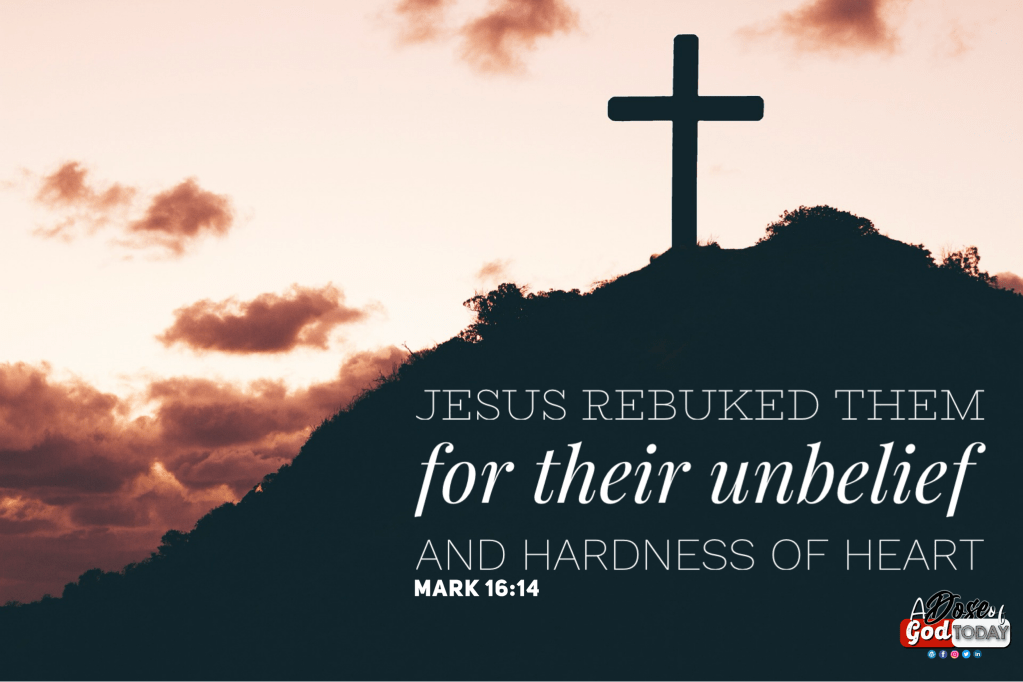
    However, the Lord appeared to them all and confronted them. As the Gospel of Mark told us, “Jesus appeared to them and rebuked them for their unbelief and hardness of heart.” Yes, the Lord confronted and challenged them by rebuking them. It was the Lord’s way of making them wake up and move forward. They have been staying in that disposition and attitude that was already unhealthy and unhelpful for them and for others.

    We too could find ourselves having such kind of disposition and attitude. When we stay too long in our grief, we nurture our own emotional wounds. Feeding our fears with anxiety further escalates the issue. Such dispositions of the heart and mind make us more submerged into fear and anxiety, leading into sin and darkness.

    We remind ourselves, it is okay to grieve. It is okay to be afraid after a painful experience. It is okay to feel down and discouraged after a failure. It is okay to feel lonely and alone. It is okay to be sad and not feeling okay.

    However, when we are already staying too much in these human emotions and even reinforcing these emotions with our unhealthy coping and nursing them. Then, that is not okay. It is not alright. These attitudes would lead us farther from others. We would move even farther from our true selves and the grace of God.

    Today, the Risen Jesus, through the gift of His Resurrection, we are called to confront ourselves, to confront our friends and one another when we are going in those unhealthy and life-sucking state of life. Let us allow the grace of the resurrection to give us hope, courage and a new way of looking at things and looking at our life.

    We move forward and move on, knowing that the grace of God is with us, and that the presence of Jesus assures us that there is life, and that there is hope, always. Hinaut pa.
  • FINDING SOMETHING

    FINDING SOMETHING

    April 25, 2025 – Friday in the Octave of Easter

    Click here for the readings (https://bible.usccb.org/bible/readings/042525.cfm)

    When we face overwhelming realities in life like failures, disappointments, hatred, pain, trauma or broken relationships, we might find ourselves escaping, hiding, or retreating. We try to escape from our realities and develop a way of forgetting. Some would develop unhealthy coping or attitudes that lead towards more difficulties.

    Indeed, these are some of our possible reactions when we face these realities in life. This may happen to us because we don’t know what to do and where to go. This was also the situation of the disciples of Jesus. Their hearts were filled with pain, disappointment, frustrations and doubts.

    The arrest of Jesus, his suffering and his death were so shameful and terrifying that they also hid themselves for fear of the Jews.

    Their immediate response was to go back their old self, to retreat and not to confront anymore what they were going through. Because they believed that they were failures, they succumbed to the temptation to go back to their old ways and that was to fish. Having a painful and horrible experience, they retreated. They were giving up. They were losing hope.

    However, all night they caught nothing. The “night” in the Gospel is very symbolic because it reveals to us that the disciples were in darkness and they couldn’t find light. They were hopeless. They wanted to give up. But, at dawn a stranger appeared on the shore and said, “cast the net over the right side of the boat and you will find something.” And they did, they trusted that stranger and to their surprise, when they pulled the net they could barely pull it back because there were plenty of fish. Indeed, they found something.

    Then, the “beloved disciple” recognized that it was the Lord Jesus. This tells us that once we have become intimate with Jesus, our heart will always desire for Jesus.

    This inspired Peter to respond immediately and to come near to Jesus. Again, this was symbolically done. Peter let go again of his boat, that is, his old self. He jumped confidently into the sea of his past failures and frustrations because he knew that Jesus was waiting for him.

    In this way, Jesus calls us to we find something even in the midst of pain, failures and difficulties. Hence, the Risen Lord invites us today.

    First, when we meet failures and difficulties, do not go back to the old unhealthy ways and old habits, which could only be our emotional reactions. Rather, pray and ask the Spirit of the Lord to give us courage and patience to confront what we are going through.

    Second, as we face them, never think that you can do everything alone. The journey is lighter when we are with somebody whom we can trust, whom we can share our story. Find and build lasting friendship, build a deeper family relationship, invest in your relationships. When we are told to cast our net, to change the course of our boat and to change our life – go for it and trust the Lord because it might be in that direction that we will find the abundance of love and life.

    Third, be always aware of God’s presence. Just like the beloved disciple let us always be intimate with Jesus. It is when we become more familiar with Jesus that we also become aware of his presence in everyone. Hinaut pa.

  • The Power of Self-Giving and the Power of Loving

    The Power of Self-Giving and the Power of Loving

    April 17, 2025 – Mass of the Lord’s Last Supper and Washing of Feet

    Click here for the readings (https://bible.usccb.org/bible/readings/041725-Supper.cfm)

    What power do we have us humans? How is power manifested in our relationships? What power do we actually have and called to develop?

    Power is an ability to influence, to create and transform. It can be either positive or negative. When power is expressed as a positive force via affirmation, then, power builds respect. When it is expressed through love, then, power transforms into service and giving of oneself. However, when power is expressed as a negative force, it leads to coercion, manipulation, abuse, violence and even to death

    Each of us is a bundle of energy, of power. We possess power as long as we live with others because power can only exist and be exercised in the context of our community. Hence, power is entirely about relationship because power is an exercise of influence. This can be realized only in the context of community.

    We remind ourselves that it is also in the context of our relationships that we discover who we are, our talents and capacities, strengths and potentials, as well as our weaknesses and limitations. It is in the community that we also understand ourselves the “I am.” I am – is the uniqueness of the person whatever his or her status in life. Our person regardless of our social standing, sexual orientation, age, educational attainment or role in the family or community, is called by the Lord to share in God’s fullness of life, living in a community. Our person also is gifted with THINKING, FEELING, and ACTING. These are forms of power which can be expressed positively or negatively within our community

    Our thinking, feeling and acting can, indeed, influence others. Through thinking we create ideas, we make plans and decisions. Through feeling or emotions, our thinking and acting are influenced. Our feeling may dictate our thinking and in the process also affect our actions. Through our actions we initiate movements that may directly and indirectly affect our environment, which include the people around us.

    Thus, when we become anxious of ourselves and less aware of who we are, there is a tendency of insecurity. Insecurity leads us to compensations. This means that what is lacking in us, we try to compensate in other forms. For example, a child who is abused physically or verbally at home, may tend to be a bully at school to exercise dominance. Or a person who is deprived of things, like food, toys, and clothes at home may tend to become a hoarder later on. The person will try to collect and possess more, to feel some sense of security. While trying to satisfy himself/herself, the person may in turn deprive others too.

    These are expressions of power that are also being unfolded as we begin the Paschal Triduum of Christ beginning tonight and will culminate in the Resurrection of Christ.

    Yet, for now, what I want to focus more is on how power in its positive and negative forms give influence to people and transform us. It is good then, that we become aware on how the power of Satan suppresses life and how the Power of God gives life.

    Let us look first at the power of Satan and on how it controls and brings death. The Gospel of John clearly tells us that the devil had already induced Judas, to hand Jesus over. In the same Gospel, it was also described that as soon as Judas took the morsel, Satan entered him (John 13:27).

    The intentions of the heart and actions of Judas were already leaning towards the evil spirit. Thus, it was easy for Satan to get hold of Judas and bring him deeper into darkness and sin. This was how the devil influenced the mind, decisions and actions of Judas.

    Judas must have thought that his desires and longings will be fulfilled through these actions and decisions of him. Yet, he was wrong. He was controlled and manipulated. He was not himself anymore. Judas was in total darkness. Satan was controlling him, perhaps, even without fully realizing that the evil spirit was already manipulating him farther away from the grace and light of Jesus and closer to darkness and death. This led him to his pitiful death. This is how the power of Satan controls us and brings us farther away from the grace of God.

    However, let us also not forget how Jesus turned upside down this terrible event. Even though that happened to Judas, but Jesus turned that night of betrayal and pain through the power of love and mercy.

    This was described to us as Jesus assumed the humble position of washing the feet of his disciples. It was power expressed through service and humility. Jesus tells us that being a person with power as an authority figure or leader is not about controlling others or manipulating others.

    As Jesus washed the feet of his disciples, he gives a model of a life-giving way of expressing power. This is through service and love, ANG PAG-ALAGAD UG PAGHIGUGMA. This tells us too that the power of being a Christian is our the capacity to serve and love without pretention, without manipulation and that does not count the cost. Christian Discipleship is indeed a form of power, a life-giving power.

    This call and invitation to exercise power as a Christian Disciple today applies to all, regardless of our age, gender and sexual orientation, social status, educational attainment or state in life. We shall witness this at how our community is represented by men and women from various sectors at the Washing of the Feet.

    Indeed, to be a disciple of Christ is to give life just as Jesus gives his life for us. And this is the true expression of power which is sacramentally given to us through the shared meal on that Last Supper of Jesus. This is what we powerfully remember today.

    It cannot be denied that at the Last Supper of Jesus, his Body and Blood were given also to a disciple, a friend and a companion who betrayed him on that night. Yes, even Judas was in that meal. He too received the body and blood of Jesus even though he was not in the “state of grace.” Jesus gave and offered his body and blood for Judas and for us who are also potential Judases[1] today. This is the power of forgiveness, the power of unconditional love, the power self-giving. This is the power of God.

    As we enter into the Paschal Triduum, let us also allow the power of serving, of loving, of caring and of compassion to be the very power we express in our relationships, in our roles and leadership, and in our life through our thinking, feeling and acting. Let the power of God transform any forms of control, manipulation, and abuse into life and into love. Hinaut pa.


    [1] In the words of Bishop Pablo David, DD, Bishop of Kalookan.

    ***This homily was first preached on April 6, 2023.

  • How much do we value our relationships?

    How much do we value our relationships?

    April 16, 2025 – Wednesday of the Holy Week

    Click here for the readings (https://bible.usccb.org/bible/readings/041625.cfm)

    How much do you value your loved ones? How much do you value your friends? How much do we value our relationships? When we value so much these people in our lives, their importance are shown in the way we spend much of our quality time and presence. When we also truly value people who are close to us, the more we become less and less self-centered. What becomes natural to us then is the way we give ourselves for those whom we value so much. These can be expressed in concrete ways like sharing our material resources, making ourselves available for them, giving an effort to understand and listen to them.

    This is how we grow and mature as persons capable of loving and giving life especially when what we experience is a mutual sharing of life and love.

    However, the value that we give to each other can also be spoiled. When we ourselves turned to be “life-sucking” or persons who suck and consume the life of others – then, we surely spoil and degrade the value of our relationships. This makes us attention-seekers, guilt-trippers and energy-consuming creatures to our family members and friends. This also means that we do not actually give value to people but we are only concerned on what we can personally gain and benefit from others.

    This is how Judas turned to be one, as he betrayed his friend and master. Judas sold Jesus. He even dared to ask the chief priests of the temple, “What are you willing to give ME if I hand him over to you?” And for 30 pieces of silver, Judas was most willing to hand over and betray Jesus. The value was not that much but Judas valued Jesus so little. He was willing as long as he could benefit something immediately.

    Well, why would Judas do that to the person who only showed kindness and generosity to him and to the people? Judas though, was chosen to be one of the close friends of Jesus and disciples had these two attitudes that motivated him to betray the Lord and to sell him for thirty pieces of silver.

    First, Judas never believed that Jesus is the Lord and the Messiah. He never believed in the Son of God who was sent into the world to redeem the world and save the people from their sins and evil ways. Judas never believed in Jesus but only thought that Jesus was a mere teacher. Thus, Judas never called Jesus as Lord but only Rabbi, which means teacher.

    Second, Judas did not have a close, personal and intimate relationship with Jesus. Because Judas never believed in Jesus as Lord, it also followed that Judas had never developed that close relationship with the Lord. Judas actually failed to build true friendship and closeness with Jesus. Hence, he could not recognize God in Jesus.

    These attitudes of Judas may also be present in us. When we do not believe or refuse to believe in Jesus as our Savior and Lord, who has come to love and forgive us, then, we too shall have the difficulty of not being able to build a personal relationship with God. Failure to recognize God in our life leads us to a distanced relationship with God.

    This is also true with our human relationships. Failure to believe in the person, to a friend, to your beloved, to your husband, or wife or child will lead us to a distanced relationship. This failure in knowing the person and building personal and intimate relationship with the person will lead us to easily discard the person. It will be easy for us to hurt them, to cause them pain, to cheat on them, to betray them, to leave and abandon them – because after all, we are never committed in that relationship. And because we don’t value that relationship.

    Thus, we are called rather now to know better the person that we are in relationship with, our friends, our beloved and all those people around us. It is in knowing them that we come to recognize their importance and believe in them. And again, this shall also move us to truly value our relationships by committing ourselves in those relationships by developing a close and intimate relationship with others and with God. This is manifested in the way we give life for the sake of others. Kabay pa.

  • Let God BE GOD now

    Let God BE GOD now

    April 13, 2025 – Palm Sunday of the Lord’s Passion

    Click here for the readings (https://bible.usccb.org/bible/readings/041325.cfm)

    For us Filipinos, there are three occasions in the year that we come home, get together, and spend quality time with our family: Christmas, All Souls’ Day, and Holy Week. These are the moments when and where us Filipinos BE with each other – that is where and when we experience, encounter, and meet each other again as family and community which usually lead to renewal, deepening and strengthening of bonding and relationships among family. While during Christmas, we are with our family and friends, and during All Souls’ day, with our family and relatives remembering our beloved dead members of the family, Holy Week is particularly our time and space with God.

    Today, Palm Sunday marks the beginning of our Holy Week this year of Faith & Hope. These days in this week of this year of faith is our time and space to BE with our God. This week is our God-time and God-space. Particularly this week is more than just our chance to be with God but more so God’s chance to be with us. Meaning, this week is not only our time and space with God but more so GOD’s time and space with us. It is more like God must be first and foremost Be with us rather than We must be with God. The center or focus of this week then is not ourselves but God. This week is not about us and ourselves but about HIM and His being with Us now. This is our chance then to experience, encounter and meet God in His own terms and not on our own terms. The best attitude then is to let Him set the agenda, activities, schedules, and venue of this week. Meaning, to let Him takes the steering wheel – let Him drive your life this week. Let God BE God, not be a god as we want or need Him to be, but as HE chooses to be with us now at this very juncture of our faith & life.

    To do this and make the best of this week, allow me to suggest some appropriate approaches & attitudes.

    First, REMEMBER. As I have said, this is not about us but about Him. So, once again be reminded, that is to put into mind – God’s story with Us which is the Jesus story. We are to remember (to make it member or part of ourselves) what God did, does and is doing to us through the life and mission of Jesus Christ. So, time and space to Recall, Remind, Remember God’s story with us through Jesus, rather our story with God.

    Then, REFLECT. This is an invitation to mirror back or reflect back God’s story with & along our faith-story with God now. In other words, Manalamin. To look and see our faith-life experiences from the point of view of God’s story and less from our own perspective. Meaning, Be moved. Be Disturbed. Be influenced. Be shaken. Be Challenged. Be transformed by God’s story, presence, words, movements, plans, agenda and will for us, you and I now.

    And above all, eventually RESPOND to what, when, how, when and where God is calling, inviting, and leading us now in whatever faith-life commitment we choose to be. Meaning, whether you are ordained, married, professed, or baptized Christian, be a BETTER version of Christian as you choose and committed to be.

    Today we begin Holy Week. Remember, Reflect, and Respond to what God did, does and is doing in You and Us now by being with God, not in our own terms but in His own terms.

    For us to let God be God to us now & anew, perhaps concretely, in view of coming elections, during this week we also remember, reflect & respond on what we have gone thru & is going on in our faith-life pilgrimage now as a nation of Filipino Catholics & so be guided by His will & be in tuned with God’s ways for us in choosing wisely & voting conscientiously our national leaders.

    May we, you and I have a blessed meaningful and inspired week ahead.

    So Be it. Amen.