September 7, 2019 – Saturday 22nd Week in Ordinary Time
A reading from the Holy Gospel according to Luke (6:1-5)
While Jesus was going through a field of grain on a sabbath, his disciples were picking the heads of grain, rubbing them in their hands, and eating them. Some Pharisees said, “Why are you doing what is unlawful on the sabbath?” Jesus said to them in reply, “Have you not read what David did when he and those who were with him were hungry? How he went into the house of God, took the bread of offering, which only the priests could lawfully eat, ate of it, and shared it with his companions?” Then he said to them, “The Son of Man is lord of the sabbath.”
Homily
Some of the Pharisees reacted when they saw that the disciples of Jesus were plucking some grain and eating them. For them, they could not accept that kind of behavior especially when it was done on a Sabbath day. The Pharisees interpreted the law of the Sabbath in a way that a person cannot do anything. They were very strict in observing such law that they themselves formulated.
God’s intention was not to burden the people with the law but to make the Sabbath a restful and life-giving day for all. However, these scholars of the law expanded the law of the Sabbath. This was the reason why they would complain and feel disgusted every time Jesus condoned his disciples or even healed sick people on Sabbath day.
This attitude of the Pharisees became condemning. They were more concerned of following the law rather than to be life-giving to those who were in need.
Consequently, Jesus responded to them to make them realize that the Sabbath was not meant to burden people but to free people. Sabbath is a holy day because it is meant to celebrate the many wonders God has made.
Moreover, Jesus asserts his authority over the Sabbath for he himself is Lord and rules over the Sabbath. This was an invitation for the Pharisees to recognize Jesus as the life-giving Lord to which the Pharisees also failed.
The Lord invites us today that our actions and words will also become life-giving. The Pharisees’ over-emphasis and fixation on observing the law hindered them from recognizing Jesus and thus to be life-giving to others. In that way, their attitude deprived people to experience God’s goodness and generosity. Let not our rigidity, inconsiderate attitudes and indifferent treatment towards people prevent us to become life-giving people.
Indeed, it is when we become generous people that we make our Sabbath, which we now celebrate on Sundays, sacred and life-giving. In this way, God’s presence is truly present in us. Hinaut pa.
Memorial of Saint Gregory the Great, Pope and Doctor of the Church
A reading from the Gospel of Luke (4:31-37)
Jesus went down to Capernaum, a town of Galilee. He taught them on the sabbath, and they were astonished at his teaching because he spoke with authority. In the synagogue there was a man with the spirit of an unclean demon, and he cried out in a loud voice, “What have you to do with us, Jesus of Nazareth? Have you come to destroy us? I know who you are–the Holy One of God!” Jesus rebuked him and said, “Be quiet! Come out of him!” Then the demon threw the man down in front of them and came out of him without doing him any harm. They were all amazed and said to one another, “What is there about his word? For with authority and power he commands the unclean spirits, and they come out.” And news of him spread everywhere in the surrounding region.
Homily
How often in a day do we speak of blessing for others? Or how often does our speech bring life to others? Or perhaps there are more cursing and hatred, complains and bitterness in our words.
You know, the people in Capernaum were quite amazed at Jesus when we spoke and taught them. They were not amazed at his eloquence and fluency in the language but more astonished at his words that were spoken with authority.
Well, what does it really mean? When I was younger, those people whom I considered as authorities would always have a weight when they would speak. Yet, I was always afraid of these authorities because they were the same people who would give punishments. It means that I associated authorities before as mere givers of punishments. And it was not a good association of them because I was always terrified by them.
However, such concept of mine is totally different from what the people experienced with Jesus. Jesus spoke and taught them not like the Scribes and Pharisees who would always bragged about how good and righteous they were but burdening the people with many laws to observe and punishments of not following the law. He spoke to them not like the Roman authorities and soldiers who would demand that they should pay their taxes.
The words that Jesus spoke to them made them alive and free and not fearful and resentful. It means that the words of Jesus generates life and freedom, peace and reconciliation.
This has been portrayed concretely when Jesus encountered an evil spirit. The evil spirit that burdened the man, made him suffer and subjected him to bitterness and hate, was powerless before Jesus. The words and the presence of Jesus brought light into the life of that man. Jesus healed the man and broke the oppressive influence of the evil spirit.
These powerful words of Jesus came from his very person. Because Jesus’ intention was honest, his words were of kindness, and his actions generous, that encounter became life-giving and freeing.
Today, Jesus also calls us to find life and freedom in his words and presence in the scriptures and in this Eucharist. And hopefully, what we have found here will also be transmitted into our life that we ourselves will become life-giving and instruments of freedom.
It would be good then to examine our words and our encounters with people today. Let it be the object of our discernment today. Are my words and presence life-giving or condemning? Am I giving freedom or condemnations? Are my words filled with hatred and anger or peace and kindness?
Then, if we find that our words and presence express more of condemnation, and judgments, of hate and bitterness, allow Jesus to transform us. Allow Jesus to cast the evil spirit in us so that we too will become free and at peace. Hinaut pa.
A reading from the Gospel according to Mark (6:17-29)
Herod was the one who had John the Baptist arrested and bound in prison on account of Herodias, the wife of his brother Philip, whom he had married. John had said to Herod, “It is not lawful for you to have your brother’s wife.” Herodias harbored a grudge against him and wanted to kill him but was unable to do so. Herod feared John, knowing him to be a righteous and holy man, and kept him in custody. When he heard him speak he was very much perplexed, yet he liked to listen to him. She had an opportunity one day when Herod, on his birthday, gave a banquet for his courtiers, his military officers, and the leading men of Galilee. Herodias’ own daughter came in and performed a dance that delighted Herod and his guests. The king said to the girl, “Ask of me whatever you wish and I will grant it to you.” He even swore many things to her, “I will grant you whatever you ask of me, even to half of my kingdom.” She went out and said to her mother, “What shall I ask for?” She replied, “The head of John the Baptist.” The girl hurried back to the king’s presence and made her request, “I want you to give me at once on a platter the head of John the Baptist.” The king was deeply distressed, but because of his oaths and the guests he did not wish to break his word to her. So he promptly dispatched an executioner with orders to bring back his head. He went off and beheaded him in the prison. He brought in the head on a platter and gave it to the girl. The girl in turn gave it to her mother. When his disciples heard about it, they came and took his body and laid it in a tomb.
Homily
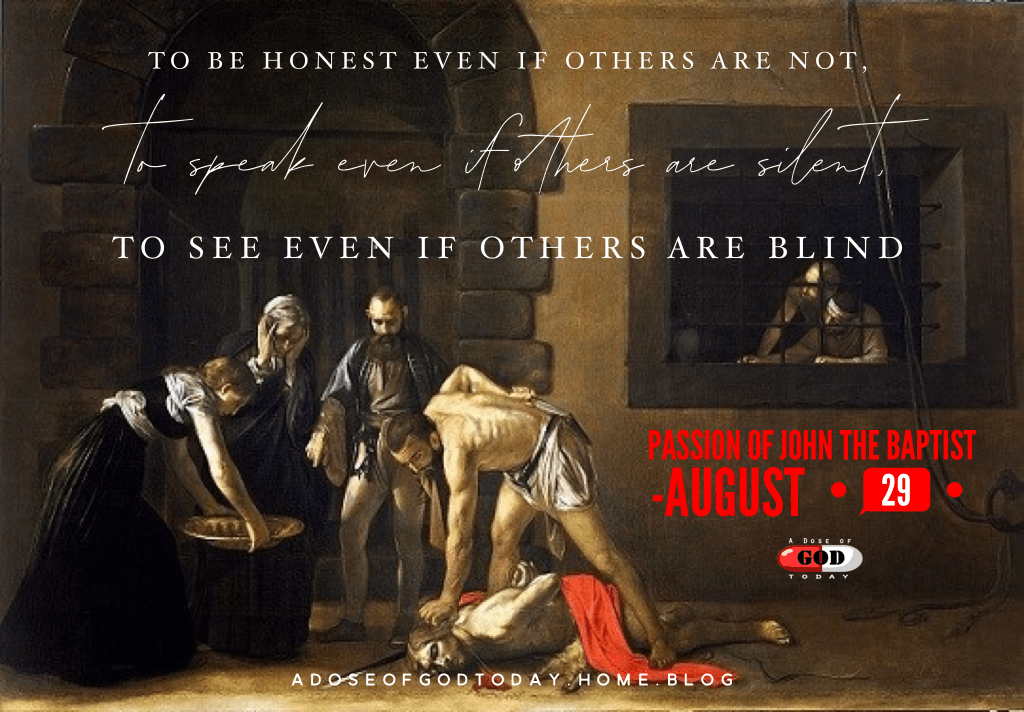
The Gospel told us about this story on how John was beheaded. Thus, today, the Church remembers the passion of St. John the Baptist.
It was through the daughter of Herodias who danced before King Herod that the head of the prophet was requested. King Herod and Herodias, the wife of his brother, had an adulterous relationship. Even though everybody knew about this but no one would like to speak about it. The scandal and immorality of Herod and Herodias was as bright as the sun, but every one was afraid to look at it or even speak about it.
It was only John the Baptist who spoke about it and reminded King Herod for breaking God’s law. John spoke against it even though the rest chose to remain silent. He chose to look at it and confront it even though many pretended not to see it. John being a chosen prophet of God, had been really true to his identity. John was a real troublemaker and a “disturbance to Israel” because he disturbed the conscience of Herod and the conscience of the people.
Consequently, being a prophet, by speaking out the truth and disturbing the conscience of the people, he was silenced by those who hated him. In the end, he was beheaded.
Like most of the people at that time of John the Baptist, many times we find ourselves choosing to remain silent and not to speak out about the truth. We too find ourselves to pretend not to see the scandal and feel indifferent about it.
There are reasons of course why we do this. To be an honest person is difficult. A friend once shared to me. His conscience has been disturbed because of the corrupt practices in their office. Yet, he found it difficult to confront the people doing such corruption because almost everyone does it and their senior officers seemed to tolerate such practice. In speaking out, he thought, he might lose his job. So he remained silent about it and choose to be indifferent.
Hence, we chose not to stand or to speak up because we are afraid that we might lose our job, our career, our position and influence, our name or our life. We are afraid because we might lose the comforts and the peace that we seemed to be enjoying. Moreover, we also choose to remain silent because we ourselves are guilty. It is indeed a risky thing to do and we dare not to take the risk.
However, having such attitude is not what God wants us to be. God calls us to be honest even if others are not, to speak even if others would remain silent, to see even if others would tend not to see.
Thus, through the inspiration of John the Baptist, we may find courage when it becomes difficult for us to live faithfully our Christian life. Hinaut pa.
August 28, 2019 – Memorial of St. Augustine, bishop and doctor of the Church
A reading from the Gospel of Matthew (23:27-32)
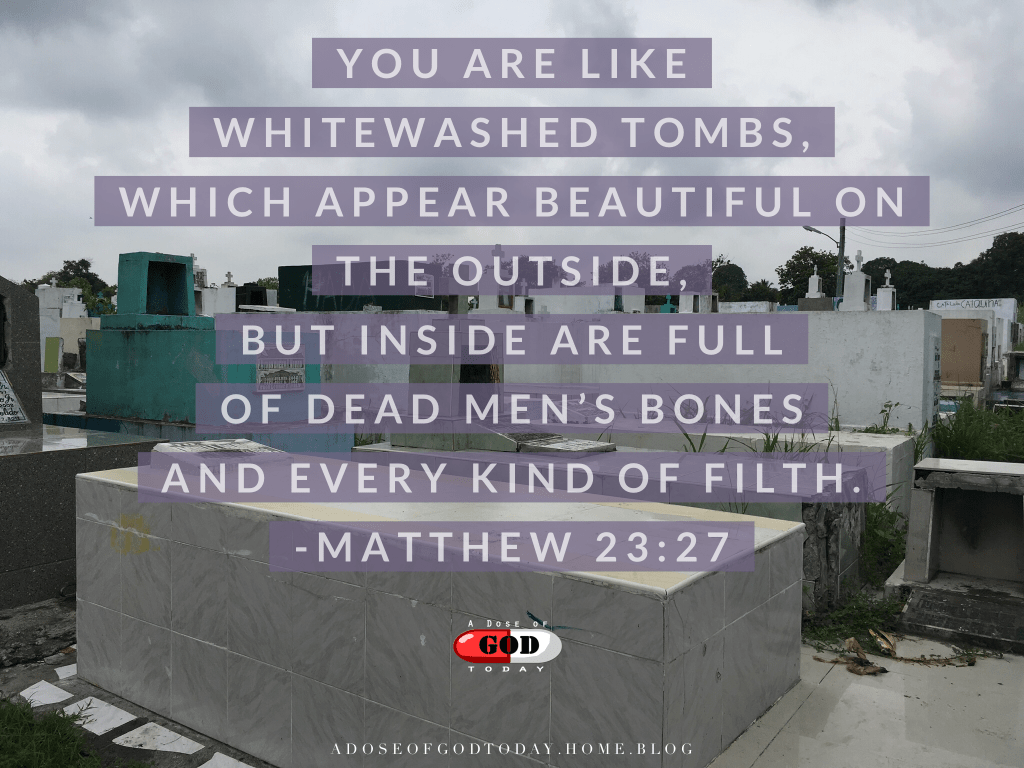
Jesus said, “Woe to you, scribes and Pharisees, you hypocrites. You are like whitewashed tombs, which appear beautiful on the outside, but inside are full of dead men’s bones and every kind of filth. Even so, on the outside you appear righteous, but inside you are filled with hypocrisy and evildoing.
“Woe to you, scribes and Pharisees, you hypocrites. You build the tombs of the prophets and adorn the memorials of the righteous, and you say, ‘If we had lived in the days of our ancestors, we would not have joined them in shedding the prophets’ blood.’ Thus you bear witness against yourselves that you are the children of those who murdered the prophets; now fill up what your ancestors measured out!”
Homily
In today’s Gospel and as it was in the past few days, Jesus pointed out the danger of self-righteousness that leads to bitterness, discontentment and insecurity. There is a need to recognize our faults and sinfulness rather than undermining them by finding the fault of others in order to cover our own.
Jesus addressed the teachers of the law and the Pharisees who seemed to be so righteous, yet, sickly and sinful inside. Jesus compared them to “whitewashed tombs, which appear beautiful on the outside, but inside are full of dead men’s bones and every kind of dirt.” Jesus called them hypocrites.
Jesus demands consistency in our words and actions, in the way we relate with others and with God. Consequently, there is a need for us to recognize our own “tombs,” which also means recognizing our own sinfulness and failures. When we choose to blind ourselves from own sinfulness and failures, then, there is a danger of making ourselves distant from God, from others and from our own reality.
It would be good then, to be reminded of the forms of denials.
First, we will tend to overemphasize the faults of others yet; there will be no acknowledgement of our personal defects and sinfulness. This overemphasis of the faults of others is a mere cover up of one’s skeletons hidden in the closet.
Second, there will be an air of self-righteousness and arrogance in our hearts; claiming that we are always right and good and the rest are stupid. When we ourselves are being criticized then we become violent to our critics and would even seek to destroy them. This kind of attitude boasts oneself of his or her good image but hungry of recognition and praise from people around him or her.
Jesus does not want us to become bitter, hateful and pretentious persons but rather disciples of him who are humble enough to recognize our wrongdoings, and courageous enough to speak our own unjust and oppressive attitudes. Jesus desires that each of us becomes free by being able to recognize our sins so that transformation of hearts will be possible. It is in this way that we become of help to one another, so that as parents, leaders, mentors and authority figures, we will be leading others with honesty and sincerity. Moreover, that we may become persons who are not after recognition and praise from others, but persons who express deep gratitude to God.
And in a special way, we remember a great saint today, St. Augustine, who became a pillar in our Church doctrines. He himself struggled with his own pretentions. However, when he had the courage to face his sinful self, then, he also found God most merciful to him. His generosity, his wisdom and his commitment to be of service of others and of the whole Church sprung forth from that conversion of Augustine.
And so for today I would like to invite you to see ourselves closer and ask, what are my inconsistencies, my bitter and hypocrite-attitudes? We will only be able to answer this when we also stop pretending and will humble ourselves before God to accept our imperfections. Hopefully, when we are able to identify our attitudes that are inconsistent with our faith then that will move us to be converted back to Christ, to be closer to him. Hinaut pa.
Thus says the LORD: I know their works and their thoughts, and I come to gather nations of every language; they shall come and see my glory. I will set a sign among them; from them I will send fugitives to the nations: to Tarshish, Put and Lud, Mosoch, Tubal and Javan, to the distant coastlands that have never heard of my fame, or seen my glory; and they shall proclaim my glory among the nations. They shall bring all your brothers and sisters from all the nations as an offering to the LORD, on horses and in chariots, in carts, upon mules and dromedaries, to Jerusalem, my holy mountain, says the LORD, just as the Israelites bring their offering to the house of the LORD in clean vessels. Some of these I will take as priests and Levites, says the LORD.
A Reading from the Letter to the Hebrews (12:5-7,11-13)
Brothers and sisters, You have forgotten the exhortation addressed to you as children: “My son, do not disdain the discipline of the Lord or lose heart when reproved by him; for whom the Lord loves, he disciplines; he scourges every son he acknowledges.” Endure your trials as “discipline”; God treats you as sons. For what “son” is there whom his father does not discipline? At the time, all discipline seems a cause not for joy but for pain, yet later it brings the peaceful fruit of righteousness to those who are trained by it.
So strengthen your drooping hands and your weak knees. Make straight paths for your feet, that what is lame may not be disjointed but healed.
From the Holy Gospel according to Luke (13:22-30)
Jesus passed through towns and villages, teaching as he went and making his way to Jerusalem. Someone asked him, “Lord, will only a few people be saved?” He answered them, “Strive to enter through the narrow gate, for many, I tell you, will attempt to enter but will not be strong enough. After the master of the house has arisen and locked the door, then will you stand outside knocking and saying, ‘Lord, open the door for us.’ He will say to you in reply, ‘I do not know where you are from. And you will say, ‘We ate and drank in your company and you taught in our streets.’ Then he will say to you, ‘I do not know where you are from. Depart from me, all you evildoers!’ And there will be wailing and grinding of teeth when you see Abraham, Isaac, and Jacob and all the prophets in the kingdom of God and you yourselves cast out. And people will come from the east and the west and from the north and the south and will recline at table in the kingdom of God. For behold, some are last who will be first, and some are first who will be last.”
Homily
It is common to see in the airports the x-ray and metal detector machines that each passenger must go through. Each passenger will pass these, and the nearer you are at the gate, you have to pass through the machines and by this time in a more thorough and stricter manner. Metals in the body are removed, these include, mobile phones, watches, belts and even shoes. When there will be undesirable objects like scissors, lighters or any pointed objects and even breakable items like bottles which exceed to the allowed size, are all to be surrendered. A passenger has to let go of them or take the hassle again of going back to the check-in counter.
Thus, I realized too that the more I bring unnecessary things in my flight the more it becomes troublesome for me. Besides, if I bring undesirable items too then, I am asked to let go of those things that are not allowed in the flight just for me to be allowed to board on my flight.
This realization brought me into today’s readings. So, I invite you that we see again and discover how God unfolds his invitations for us today.
“Lord, will only a few people be saved?”someone asked Jesus. We could wonder why that man asked about that. Well, the path that Jesus was taking seemed too difficult for this man. This was the reason why he asked the Lord about this. Jesus’ way was totally different from the trend at that time. People believed in a God who was so far away, too powerful and almighty. Yet, Jesus presented a God who is so close with the people. The people believed in an untouchable God who burdens them with so many laws to follow. Yet, Jesus introduced to them a God who heals the broken-hearted, who favored the poor and the despised. Their world taught them that they should be above others, to be rich, famous and powerful. But then, Jesus remained humble and poor, simple and unassuming, weak and powerless.
The Lord desires that everyone will be saved, and will experience healing and peace, reconciliation and freedom. This is what we have heard from the first reading in the Book of Isaiah. It was an affirmation of God’s desire to gather every one whether Jews or Gentiles, sinner or saints, rich or poor. People from all nations will come to worship the Lord.
However, as it was at the time of Jesus, we continue to prevent the Lord from making us closer to him. Our tendency to advance our selfish desires and interests at the expense of others, stops us in allowing the Lord to work in us. Selfishness and arrogance continue to hold us back from God.
Yet, God’s salvation is offered to us freely, but not imposed on us. And so it means that salvation also requires our participation. This makes the door of salvation “narrow” because of the commitment that it entails as we live our life.
To understand this better, the Letter to the Hebrews tells us on how we could enter that narrow gate. It is simply through “discipline.” The author wants to tell us that the trials and sufferings that we endure in this life are opportunities for us to be disciplined by God. And this is where we can participate with God.
When we encounter problems and difficulties, and disappointments, particularly in your marriage, with your families, with your friends, with your studies, or work or business – do not retreat or become aggressive. Retreating or being aggrieve will do us no good. These trials are opportunities for us to build our personality, to be responsible, to grow with confidence, to be committed, to be honest, and to gain more wisdom.
But remember, in this kind of discipline, God never desires us to suffer or to be in pain. Pain and suffering are just part of this world where we are now. Yet, God, in His wisdom, uses these human experiences of pain, suffering, disappointments and fears as ways to discipline us. These are doors for us to welcome God in our life so that He may be able to bring blessings upon us, to give us His peace and freedom. Certainly, God desires that we turn to Him and become closer to Him.
Indeed, trials in life are ways for us to strip ourselves from our arrogance, to let go of our selfish desires, and to turn away from our sinful ways. These are the unnecessary baggage that will prevent us from entering the narrow gate. Yet, if we come as we are, without any pretentions and selfishness, then, we shall see that the narrow gate of Jesus is wider than us.
Thus, God’s way of disciplining us is not about punishing us and giving more pain to us, but to correct us, to mold and to form us according to His desire for us. As we become conscious of this, we will discover the wonder of the process of working with God to mold us.
Today, let us also show and express our desire for the salvation of all, the giving of peace and freedom to all as desired by Jesus. As we participate with God let us listen attentively to His voice in the scriptures, in our sacraments, in our culture, in our current events and with those who are suffering in many ways in our community. Hopefully, this will lead us to respond to God’s invitation in becoming his instruments of salvation for our brothers and sisters and of the rest of God’s creation. Hinaut pa.



 A DOSE OF GOD TODAY