When I was younger, I used to play, eat and even sleep at my playmates’ house or them in our house. I grew up in this environment being assured that I was welcomed. I also witnessed how the adults at that time would do the same where they also felt welcomed. Indeed, that culture made me realize how a community becomes more compassionate and generous as every house and every person welcomes others.
This brings me to what our readings this Sunday is reminding us, that is, the call of hospitality or the invitation to be welcoming.
Our first reading tells us of the story of Prophet Elisha who was welcomed by a rich woman but childless and whose husband was old. Elisha, though a stranger, was welcomed into their home. In their culture at that time, a childless couple would surely suffer shame for having no child. Elisha who was very aware of this feeling of the couple particularly of the woman, prophesied something that would made them truly happy. Elisha promised the couple that by the following year she will certainly have a child.
Thus, though it seemed that it was only Elisha who was welcomed by them but in fact, Elisha on his part also welcomed the desire and the longing of this couple.
This tells us now that welcoming others into our homes or into our lives, brings grace. Making ourselves open for others allows the grace of God to also work in our lives. This is what Paul wrote in his letter to the Romans.
Paul reminds us that baptism is a way of welcoming God into our lives. Moreover, it is also God’s way of welcoming us into God’s divine presence. That is why, Paul told us that as we were baptized we also join in the death of Christ. But how? Christ died for our sins. And in baptism, our sin dies because we are being forgiven. Through that forgiveness then we also rise into a new person just as Christ rose from the dead.
The grace of baptism lies here because as we welcome God into our life and God welcoming us, this becomes a “mutual welcoming.” When welcoming becomes mutual then true relationship begins to form and develop. Consequently, God is our Father, and we are God’s children.
This is the same also when we take the risk in welcoming others into our life. True friendship only develops and strengthens when there is a mutual welcoming of each other. This mutual welcoming involves sharing of stories, sharing of pains, sharing of joys as well as sharing of hopes and dreams.
Recently, a dear friend visited me after months of lockdowns. Since our movements now have been eased for a bit, compared to the situation during the Enhanced Community Quarantine, we had an opportunity to catch up with each other personally even for a short period of time. Such simple encounter was indeed a form of mutual welcoming.
However, we also know that in welcoming others we may get hurt. This happens when there is no mutual welcoming in our relationship. A relationship that is colored with manipulation or abuse or betrayal or pretensions is such a toxic relationship. This kind of relationship gives us pain and trauma which could lead us to sadness and misery in life.
Advertisements
This happened to a friend who welcomed a person in her life. Yet, unknowingly she was not welcomed at all in the life of that person whom she loved. She was just used and abused for the sake of personal pleasure of the other.
But then, the Gospel of Matthew tells us and assures us the kind of relationship Jesus is offering to us. Jesus offers us a relationship that gives and promotes life and joy. Although the Gospel sounds a bit harsh for it suggests to hate our parents, but it actually means to place our relationship with God as the first or the beginning.
Making God as the first priority in our every relationship gives us a good foundation to our other human relationships. The more we become in touched with our relationships with the Lord, the more we also become in touched with our human relationships.
Consequently, Jesus calls us today to be welcoming, to allow ourselves to open up even though that would mean that we become vulnerable. Jesus said, “Whoever welcomes you, welcomes me, and whoever welcomes me, welcomes him who sent me.” Meaning, welcoming others with the intention of loving is welcoming God.
Making ourselves vulnerable to welcome others is a way of losing our life, yet, in welcoming others, we also realize the beauty of loving and finding our life. Therefore, today, Jesus calls us to be welcoming as we are being welcomed, to be loving as we are also being loved.
Today also, let us seek forgiveness and reconciliation with those whom we have hurt because of our selfishness, dishonesty and indifference. May we truly welcome others in our life too in the way of loving truly and not as a form of manipulating or using others for our own advantage and pleasure. Hinaut pa.
June 27, 2020 – Feast of Our Mother of Perpetual Help
Readings: Isaiah 7:10-17; Revelation 12:1-6,10; John 19:25-27
Homily
As the Corona Virus 2019 stole the spotlight, the medical experts warned us of the signs and symptoms of the virus. Accordingly, the virus can cause a range of symptoms to a person from mild illness to pneumonia. Its most common symptoms, they said, are fever, tiredness and dry cough. Others may also show aches and pains, nasal congestion, runny nose or sore throat.
We are made aware of it and thus, when we begin to have these signs and symptoms then we are advised to seek medical help. It is, definitely, important to be aware of these because through this first step then, we can save lives, not just our life but also of those who are dear to us.
Moreover, looking at it from a distance, this pandemic is in itself a sign that no matter how much we have achieved in life, or no matter how much power and wealth we have accumulated, we are vulnerable. This pandemic also is a sign that tells us how competent or ignorant, sincere or corrupt, and organized or messy our leaders can be. This pandemic also is a sign given to us how individuals and communities have reached out to those in need.
With all these signs and symptoms that the Corona Virus Pandemic has brought to us, this allows me to dwell deeper into the feast we celebrate today, the Feast of Mary, Our Mother of Perpetual Help.
Our first reading is very interesting because it tells us about signs. Usually, we would ask signs from God, but, in this story of Ahaz, King of Judah, it was the Lord who asked a man to ask for a sign. Ahaz’s story seemed to be very good because he did not ask a sign from God. He refused to ask a sign. However, his refusal to ask a sign from God was actually a refusal to believe in God.
What really happened? Ahaz sold himself to another god, to the King of Assyria. He sold himself because he thought that this foreign power, Assyria will only be the one who can grant immediate protection and salvation for him and his kingdom. Instead of asking wisdom from the Lord on how to lead his people, Ahaz went to the Assyrians and pleased them. The kingdom of Judah at that time was under the threat of two other kingdoms, Syria and Israel. Instead of trusting the Lord to protect and save him, he went to another god, to whom he thought was his savior.
However, history tells us that as Assyria defeated the enemies of Ahaz, he became a puppet of the King of Assyria. Not only that, the Assyrians imposed heavy taxes to the people and blasphemed the Temple of the Lord by introducing the Assyrian gods.
This is the reason why it was the Lord himself who offered Ahaz to ask for a sign so that he may believe that God will bring salvation. Yet, even though Ahaz refused, God still promised a sign of salvation. This sign is through a virgin who will conceive a son. This son will be called Emmanuel, meaning, God is with us.
This is the sign that even in the midst of our own disbelief, doubts and even refusal to believe, God remains with us. God remains our God and continues to be for us and with us. This is a sign of God’s faithfulness in us despite our unfaithfulness. This is a sign of God’s generosity despite our ingratitude. And this is what we celebrate today on this feast of Our Mother of Perpetual Help. The Virgin who is carrying the son, the Emmanuel in her arms, is the great sign that God showed to us.
There again on the cross, as the Gospel of John tells us, the son showed us his greatest sign of love and faithfulness. The son has come to be with us and on the cross he stretched out his hand for the sake of all. The son, indeed, comes to help us perpetually.
Jesus is in fact the true perpetual help. Mary is instrumental because through her, God’s sign has been brought to us. She allowed herself to be God’s instrument of help and compassion, to be the mother of the Perpetual Help.
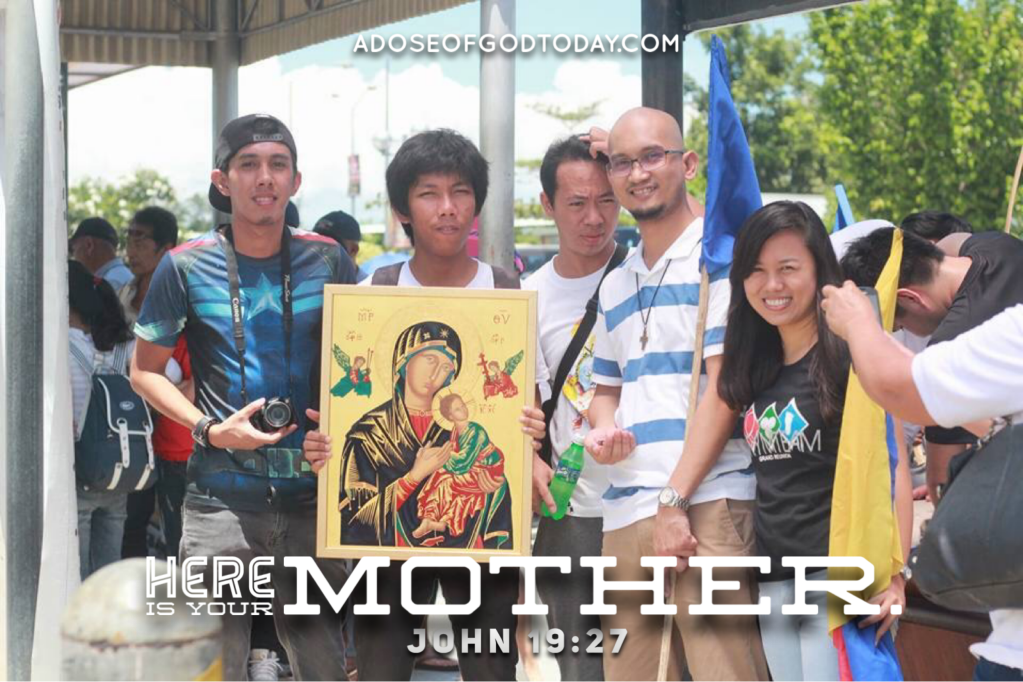
Even when Jesus was about to die, he assured us to have a mother, that we will not be orphaned and alone. Mary’s presence became the sign of God’s presence among us by becoming our mother.
This is the reason why we, the Church, would always seek guidance and inspiration from Mary because we feel the identity of being a child to her. The intercession of Mary as a mother, becomes a bridge of faith. It is to lead us to her risen Son, Jesus Christ.
Thus, this feast that we celebrate does not actually point to Mary. This feast points to the greatest sign, the perpetual help, and who is Jesus himself.
What is it to you and to me now, to us, who are devoted to Our Mother of Perpetual Help? How shall we express our act of thanksgiving for all the graces and blessings received?
This feast invites us that each of us and that our community becomes a sign of God’s help and love, compassion and faithfulness. This means that we let our devotion transform our life. It means that our devotion should not only remain a mere devotional practice but must also flow into our actions and words, into our decisions and choices in life.
Our devotion, then, is call to mission. It is mission because we are sent to become signs and symptoms of God’s goodness. I invite you then this time, to discern for yourself on how you could be a sign and symptom of God’s help and compassion to people around you.
How many of us who find it hard to observe the “no touching” advice from our medical experts? Because of the increase of the infection we are all advised to refrain from touching people or things. Touch only when it is necessary. The virus can also be passed through our touch, through our hands.
Because we have been so used to touch, in expressing our affection we touch, when we give comfort to a friend or a person we love we touch, even when we greet a friend or even a stranger we also touch. Even in our religious practices we also touch. When we pray and ask the intercession of the saints we touch their sacred statues or even kiss the holy images of our Lord. However, with this pandemic we are all advised not to do it.
Moreover, we are being confined at home. Our movements are limited and our desire to meet our friends and loved ones is sometimes prohibited or at least limited. For the past months, we long for a human touch and long for human encounter. Thus, we could also understand the frustration that we feel because of this abrupt change in our behavior.
With all of these, we also realize the importance of human touch and of human encounter. It is important because there is a healing power in human touch. A human touch can comfort a bruised and fearful heart. It could take away the painful part of your body. It could give you confidence and assurance of support, love and trust.
On this 9th and last day of our Novena in honor to Our Mother of Perpetual Help, whose feast we shall celebrate tomorrow, I invite you now to listen to a personal story from a front liner herself, a nurse by profession who in the midst of our frustrations she herself went into something more frustrating too. She was confronted with fear yet at the same time of her call of duty to be at the service of those who are sick.
Thus, with her, we also bring ourselves into reflection today with our theme, “Our Mother of Perpetual Help: Source of Help to Front liners Battling Covid-19, to those infected by the virus and to those who have died because of the virus.”
“I am SHIELA MAE PANTILLO, a DIALYSIS NURSE, for almost 7 years and still counting. Now a days we are often called FRONTLINERS, and this FRONTLINER will share a piece of my journey during this pandemic.
I’ll start by asking: Does anyone of you tried of wearing a PPE or a Protective Personal Equipment? Or have you seen one? Or do you have any idea, what it feels like inside in it? Because for me, definitely I DO! And I tell all of you that it’s not fun to try one.
A PPE is composed of an overall kind of suit, covering your whole body, that makes you sweat and feel uncomfortable inside in it. This also comes with the N95 face mask that fits your respiratory entrance and exit, which is your NOSE and MOUTH. This could sometimes lead medical practitioner to feel DIFFICULTY OF BREATHING, when used for quite some time. Last but not the least is the face shield and gloves and that make a basic PPE complete or should I say the OUTFIT OF THE DAY!
Wearing such things make me feel that I am an ASTRONAUT, going outside the world fighting for aliens, “kidding aside.” However, behind my PPE and inside my heart are the worst feelings kept within. FEAR, ANXIETY, WORRIES are there that can even lead a person to DEPRESSION. I am always anxious because as I face the patients, I never know what will happen and that one day I will become infected and might end up losing my life too.
I will give one situation. This was during my shift at 3pm to 11pm. This was a very toxic day. We have 3 patients on deck admitted for dialysis. I was the team leader that time. Every one of them has a specific treatment to be done.
With my team, we also have an ICU patient who needed a dialysis immediately. The patient needed blood transfusion and Dobutamine drips needed to be provided for Blood pressure to increase. However, there was some problem with another patient because dialysis machines kept on alarming due to catheter access problem. One could just imagine the pressure that it gave me as the team leader at that time.
Suddenly, in the middle of this mess, I received a phone call from my Head Nurse. He asked me if I remember a particular patient during the past week. As my head nursed described to me the patient, I slowly remembered the patient and realized I was the one who ministered to the patient. Upon realizing this, my heart began to beat faster. I felt my Adrenaline Hormones bursting into my brain telling me that there might be something wrong with that patient.
Then, my head nurse added that the patient will be transferred to a government hospital for further investigation. They had seen signs and symptoms of the virus COVID-19. At the moment everything started to move slowly, as if slow motion really. As I remembered, I can’t hear anything!!! I only heard the Cardiac Monitor having ASYSTOLE for quite sometime or called FLAT LINE that sounded like tooooooooooot!!!!!!
Everything went blurred for the first time in my life. I began to absorb all the negative feelings which made my heart heavier. Again FEAR, ANXIETY, PARANOIA occupied my brain cells. It took me a couple of minute to go back to reality. I realized that I was unconsciously just saying YES to my Head Nurse though I didn’t understand what he was saying. I was overwhelmed of what would happen next.
The first person who came into my head was my Senior Citizen Mother. I asked, how will I supposed to tell her my situation? I was so scared to go home thinking that I should be the health care provider, but now I might be the carrier of the virus and might infect my own mother.
As I reached home and cleaned up myself. I told my mother if she can go to my brother and live with him at Buhangin and to stay there for some days. I didn’t want to tell her the reason for asking her to do that. I didn’t want her to be worried for me. But, then she REFUSED.
I tried to make things clearer for her, just to make her say yes and to transfer. But again she said NO. So I told her the TRUTH, that she needed to get away from me because I’ll do a personal isolation to myself for several days just to make sure that I’m not a carrier of the virus. However, still my mother said NO.
What do you expect from a mother who is also worried for her daughter? This made me more irritated and frustrated. Without noticing it, my voice become loud as if I was already shouting at my mom, hoping she could at least understand my frustration. But what struck me most was what she said and did.
My mom sat down and held the rosary, and told me, “My child we will pray and continue to pray. Our Mother of Perpetual Help always listens and never leaves your side. Have you forgotten that you were once far away from us for 4 years as an OFW but never she abandoned you. She keeps you safe until this day.”
At that moment, I felt a pail of cold water splashed over me, removing worries, anxiety and paranoia. I told myself, why on earth should I be worried when in the first place she chooses me to serve her people? GOD gives me this gift, being a skillful nurse to help the sick. This made me to burst into tears as I prayed, “I offer everything to you LORD. Through you Our Mother of Perpetual Help, you helped me to lift all my burdens in life. With you, I feel that no matter what happens you will never abandon me. Amen. Amen!”
This has been my prayer as I counted the days of my self-isolation. With my mom, we continued to pray the rosary and ask the intercession of Mary. Al last we got the result of the patient and it was NEGATIVE. Those fear and anxiety were over. It was the ANSWERED PRAYER we are all waiting for. As you people can see me right now and until the days ahead, I promise to always be here standing and serving as a NURSE, as a FRONTLINER and will continue to HELP and SAVE LIVES as what OUR MOTHER OF PERPETUAL HELP inspires me to be. Amen.”
Advertisements
In the sharing of Sheila, we heard a struggle of a front liner that she has to go through. It was evident how fear and anxiety could affect us so much. Sometimes, more than the virus, fear and anxiety paralyze us. Moreover, what we find comforting is the support and the love of a mother, who perhaps could not also really understand the real situation why they had to be separated. In times like this, it is indeed the touch of a person who loves us that brings calmness in us, that brings peace and assurance in our hearts.
This has been shown also in that simple action of praying the rosary and calling the intercession of Mary, Our Mother of Perpetual Help who never ceases to touch us to comfort us and to bring healing in our hearts.
Moreover, we can also wonder how those who were infected have been coping with this terrible disease. Again, more than the virus, the depression, the loneliness, the desperation and helplessness, their fear and anxiety would have definitely disturbed them too. I have friends who asked for prayers for those who were infected by the virus. I have also some friends who themselves got infected and so were isolated from their loved ones. Those whom they loved, their parents or their children were prevented to visit them. Thus, this created so much stress and longing to them. Yet, they cannot help it because of the danger of infecting those whom they love.
These frustrations and longing to be touched or to have a human encounter is innate in us. Thus, not being able to touch and be touched by the people whom we love would give us emptiness.
This is also what we have heard in today’s Gospel. A leper who was discriminated and socially isolated because of their illness came to Jesus. He asked for healing. What he was asking was totally against the culture and belief at that time for he came near to Jesus. The community despised them and they were always driven out of the city. They should and never be near with anyone.
With this situation, he must have longed for that encounter with another human being who understands and shows compassion. In his desire to have a human encounter, through Jesus, he too encountered God.
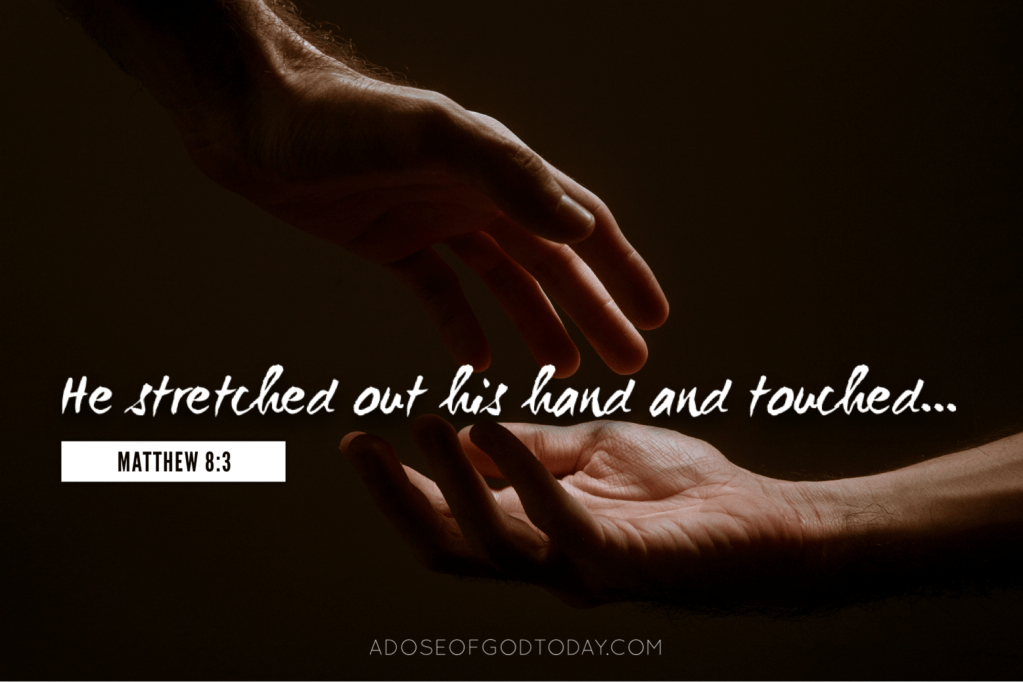
As this leper encountered Jesus, there was more in this encounter. Jesus actually healed others even by just saying words. Even at a distance, Jesus can heal a sick person. However, in this situation, Jesus knew the longing of this leper. As the leper longed for human encounter, for acceptance, he also longed to be touched, to be loved. Indeed, against the culture and belief at that time, Jesus stretched out his hand and touched him.
The touch of Jesus made this leper clean and healed. Jesus’ touch assured him that God has not left him and that God loves him. That touch of God, reminds the leper and those who are not that our touch can be a form of loving that expresses healing, confidence and affection.
This is the invitation for us today. Though physically it is difficult these days to touch others, but at least make an effort to let those who need love and understanding be touched by your presence. Though we may not be able to caress the back of a friend for comfort, let those who are grieving and confused, those who are in pain and lost to be touched by the assurance of your friendship. Let those who are hungry and suffering in dire poverty be touched also by your generosity.
Indeed, there are many ways where we can touch other lives and become life-giving in our own profession and status in life. Thus, do not be afraid to touch others with the intention to give life and to be life for others. In this way, we are truly children of Mary, Our Mother of Perpetual Help, who continues to touch us today. Hinaut pa. Viva Maria! Viva Hesus!
Jerusalem fell, trampled upon and destroyed. A powerful nation invaded the Kingdom, trampled the holy objects for the Sanctuary of Yahweh, officials and the people were exiled to Babylon.
Was this God’s desire that Jerusalem will be destroyed? That the Temple will be blasphemed? That that people will be slaughtered and many exiled to a foreign land as prisoners?
No. Of course not. This was not God’s desire. In fact, at the very beginning of the foundation of the kingdom of Israel the Lord guided the people to abide in the covenant and in the words of the Lord. Yahweh sent prophets to become heralds and to remind the people and leaders to live according to God’s desire. Thus, through the covenant and the commandments of God the people shall find the fullness of life.
However, history tells us how the people and their leaders turned their back against God when they have become rich and powerful. They forgot that God gave them those blessings. Jehoiachin, the king of Jerusalem just like his predecessors turned against God also. History described Jehoiachin as a godless tyrant. He completely abandoned the covenant and trampled the commandments of God in the way he lived his life as a man and as a king.
Advertisements
Jehoiachin was portrayed to have an incestuous relationship with his mother, even daughter-in-law and with his step-mother. He was into a habit of murdering his men for pleasure and later just to violate their wives and grab their properties.
Thus, instead of strengthening his army, instead of caring and providing better opportunities for his people, and asking the guidance from the Lord to lead the kingdom, he was rather busy pleasuring himself at the expense of his own people. As a result, when an enemy attacked them, he was completely overwhelmed because he was not prepared.
Although God was all along with his people, yet, the people left the Lord out of their lives. Hence, what happened in Jerusalem was not merely a punishment but a result of complacency, corruption and unfaithfulness.
All kinds of threats and dangers will always be in our lives. Big and small. Surprising and overwhelming. Just like this Corona Virus Pandemic. It is a big threat, a surprising and an overwhelming one that many countries now find it difficult to defeat.
In our individual lives too there are threats and dangers. And what we are invited to do is to invest into something that will somehow prepare us or at least to have a good ground in case the worst will hit.
This is what Jesus told us in the Gospel today. “Everyone who listens to these words of mine and acts on them will be like a wise man who built his house on rock. The rain fell, the floods came, and the winds blew and buffeted the house. But it did not collapse; it had been set solidly on rock.”
Jesus speaks of having a good foundation like building a house on rock rather than on sand. What does it mean? Building a house on rock means making myself founded on Jesus. Jesus is the rock, the very foundation of our person and of our faith. Jesus will also be our foundation once we are also ready to accept him and allow him to transform our life.
How do we do it?
It is by listening to his words, living his words and holding on to his promises that we become solid. By listening to God’s words and wisdom then, the more we also become aware of God’s desire for us. This will always assure us because God’s desire for us is always good and will always give life to us.
However, if we decide to build our life on mere human understanding, mere human desires and wants, then, we are like building our house on sand. To settle on these weak foundations, means putting trust on our human inclinations to sin. We know that we are weak and we can easily be driven by our selfish desires and wants. This is the story of Jehoiachin who distanced himself from the Lord and submerged himself into what he only wanted that affected the lives of many.
The Lord invites us today to claim Him as the very foundation of our whole life. The Lord will be our best investment in life who shall deliver and protect us even when the worst will hit us. This also means that Jesus wants us to make him part of our every decision and action. We are being assured by Jesus that when the storms of failures, losses, death, illness, pain, injury, worries and doubts in life will come, then, we have Jesus to hold on and to lean on and his words which will guide us. Thus, if we have Jesus in our life, we will certainly be fine. Hinaut pa.
Have you been in a point in your life when everything seemed to be so devastating?
Though you recognized that there are blessings but then, life for you appeared to be so unfair. Because of the difficult circumstances in our life, these could lead us to believe that we are in total misery. Perhaps because of the many failures you had in life that it becomes difficult to see any hope. Possibly because of the misfortunes that happened with your relationships, with your job or business that you also seemed to believe that God has completely forgotten about you. The unfavorable turn of events in your family or your other relationships could have led you this moment to believe that you have been deprived of happiness.
Such experiences and belief may lead us to become cold towards God’s graciousness in us. As a result, we may become dismissive of God’s invitations and graces intended for our growth and participation in God’s plan for us and for our community.
This has been the case of this man, Zechariah. In fact, there were many interesting events surrounding the life of this priest of the temple. The Gospel told us that Zechariah became mute, he could not speak after the angel revealed to him that God’s graciousness was upon him. Zechariah did not believe and dismissed God’s grace that he and his wife will have a son.
What led Zechariah to become like this was the failures and shame he experienced in his life, as a man, as a husband, and as a priest of the temple. We knew that Zechariah and Elizabeth had no son until they were very old. With those many years of being childless they endured the shame of having no child.
Their culture and faith believed that a childless couple was cursed and punished by God for the sins they committed or committed by their ancestors. Yet, Zechariah knew that he and his wife did not deserve such curse and punishment. Zechariah must have prayed a lot to God to give them a child. Yet, for those many years of praying, heaven seemed to be so silent. God was seemed to be so far away from him.
Interestingly, God had not revealed anything to His chosen people for the past 400 years. God’s last revelation through a prophet was in the Book of Malachi. And for that long period of waiting, Zechariah also must have become too tired from waiting.
This looked natural to a person who believed that God had already forgotten him. Zechariah, therefore, performed his duties in the temple mechanically. His heart too had grown tired and indifferent. This was the reason why he couldn’t believe the words of the angel. Instead of listening and welcoming God’s grace, he rather argued and rejected it as nonsense.
That’s why Zechariah was deprived of his voice and hearing. It was God’s way of telling Zechariah that he ought to be more conscious of God’s presence and of God’s graciousness expressed in many ways.
Indeed, the birth of John was the greatest sign for Zechariah and Elizabeth that indeed God did not forget them. The birth of this child led Zechariah to affirm that God is gracious. In fact, the name John means God is gracious.
In that graciousness of God, he made John as the very instrument to bring people back to God, and to lead people closer to God. This had been the experience of Zechariah. God never left him. It was Zechariah who gradually distanced himself from the Lord. Thus, through the birth of John, this son was bringing back his father back to God. John was the herald, the announcer who guided people to the Lord.
This is what we have heard in the first reading. In the prophecy of the Book of Isaiah, this person shall be a light of the nations because he will teach, lead and gather the people to see God. The birth of this person is not by accident but planned well by God.
Isaiah described God calling his herald even before his birth. This herald has been named and appointed by God to lead his people. This is God’s promise to be first fulfilled through the participation of humanity, through us.
The birth of John then, is God’s manifestation that He is indeed gracious and faithful despite our unbelief and doubts. God continues to reveal himself to us even though we refuse to believe or when we become indifferent.
This was the role of John and that was to bring people again to believe that God has never abandoned us. God remembers us and with us. This made John a great and important prophet because he reminded the people about God, made people recognize God and brought them close to God. Yet, because of this role of John, he paid it with his life. He was martyred, beheaded actually, because of this cause to make people recognize God.
Advertisements
On this 7th day also of our Novena-Mass in honor of Mary, Our Mother of Perpetual Help, we remember in a special way those who are greatly suffering and stricken by wars and conflicts caused by issues of racism and imperialism. Many of our brothers and sisters have been displaced, died and in dire state because of war and conflicts.
Hopefully, through our devotion to Mary and through the invitation of God on this Solemnity of John the Baptist, each of us also will become instruments of God’s graciousness. In the way we live our life, perform our duties and express our faith, we may be able to lead people back and close to God and to discover a life filled with peace and love with God and with each other.
Thus, even if our situation is far from those who are victims of wars and conflicts, at least in our own sphere of influence we shall also do our part to become an instrument of peace and people who lead others to the Lord.
Meaning, you as parents, you are in the best position to lead your children to God. You are there to prepare the way of the Lord in the hearts of your children. Teachers, educators and persons who are in authority, you too are in the position to influence your students, mentees and subjects to discover God in your authority. As friends or co-workers, we too are in the position to let those people around us to realize that God is in us. Through us, people around us may discover and be led closer to the Lord.
This, indeed, will be our best way of expressing our devotion to Mary and gratitude to God for He is gracious to us. Hinaut pa. Viva Maria! Viva Hesus!





 A DOSE OF GOD TODAY