Once I receive a Christmas card that say: “A child is born in our midst”. Well, that’s okay because that is the core message of Christmas. But what made me suspect then was that card was sent from the sisters’ convent. Imagine the sisters’ sending me a message that a child is born in their midst”. Me batang ipinanganak sa kanila. Hmmm???
Christmas reminds us that God has blessed us with a Child. Yes, God comes into our lives as a Child – not as fully grown man or as superman or as god, but as a poor child on a manger. For a child to live and grow in life, God’s child needs also a human parent and family like any other child. Jesus Christ, God’s son has to be taken, accepted, adopted and above all chosen by human parents and family. He grew up then in, with & through his family who adopted and chosen Him to be their own. And in a Family Jesus was born, loved, lived and has grown as a Person. Not in a Monastery or Convent.
Yes, God’s son has a family, a foster parents and family who chose Him to be their own. And He is now our own as well. Jesus is part of our family. He is our adopted and chosen brother, kapatid, igsoon, (우리 형이에요)
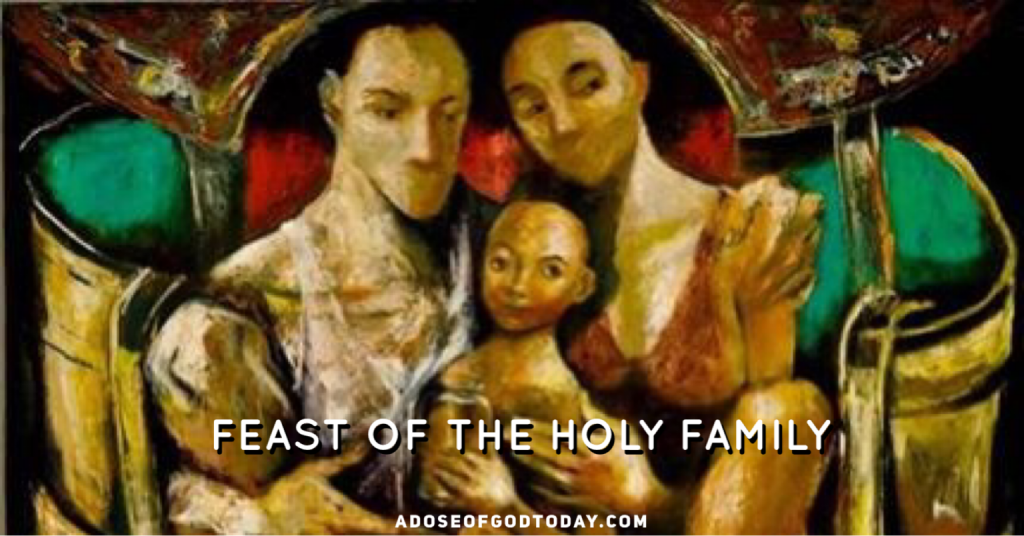
Today we honor the Holy Family, the very first family who welcomes and willingly accepts the Immanuel “the God with us” into our lives. Mary and Joseph are the very first parents who adopted and chosen the child of God Jesus to be their very own as member of their family. Our gospel today gives us a description on how Mary and Joseph do their best to parent the child Jesus into their own lives as they observe their own local cultural and religious traditions, while conscious of the mysterious unique experience of adopting and choosing God’s blessing into their lives. Yes, Jesus with Mary & Joseph they become a normal human family However, Jesus with Mary & Joseph they also become a HOLY family – now member of God’s family.
Honoring the Holy Family on Christmas season posts the on-going ever-present challenge for us, like Mary and Joseph, to adopt and parent Jesus, God’s child by choice into our lives now and always. Since God’s gift of grace comes to us as a Child – not as fully grown man or as superman or as god, but as a poor child on a manger, somebody has to take care of the Child & be responsible for the child to grow & mature into our very lives, so that His grace & blessing be revealed, given & share to all.
Taking care & responsibility for Jesus by willingly accepting, adopting & choosing Him into our lives to be our own, part of our own lives as family and community, we come to know also that we also are and becoming God’s adopted and chosen children and people, part of His Holy Family. Sa ating pag-angkin kay Hesus na ating kapamilya, tayo ay naging at maging ka-anak/kapamilya rin ng Dios at kamag-anak ng anak ng Dios. As we consider Jesus as our chosen brother, as our family member, we are and also become God’s children and Jesus family, part of the God’s Holy Family.
With the Holy Family of Jesus, Mary & Jospeh, may this Christmas season, and the coming New Year remind us always that even in times of darkness, crisis, quarantine or pandemic, God comes into our lives always & comes to us as a Child, who can bring us hope, promise & better life, as we willingly choose to adopt, take care & parent Him now as part of our human & holy family.
Have a Blessed Christmas & new Year to us all. Amen.
On December 20, a policeman shot dead in broad-daylight a mother and her son. The mother was shot twice. The first was shot while she was embracing her to keep him from the policeman. The second was made when she already fell on the ground.
It was merciless. It was not just heartbreaking, but it was evil. The police officer without any emotion of fear and doubts, shot them dead in the presence of her daughter and of people.
This is an image of our world in darkness. Indeed, the world is not just darkened by the recent natural calamities, of typhoons and floods that affected millions of our brothers and sisters. The world is not just darkened by this long and tiring health and economic restrictions brought by our fear of covid-19 pandemic.
Our world and the hearts of others are also gloomed by anger, by hatred, by violence, by indifference, by evil. The world is also gloomed by the desire to have power, to gain control and manipulations, to be above others. the world is also gloomed by our dishonest and selfish leaders, by our unjust practices, by our hate speech, by our fanaticism, by our support of the corrupt, by our blind obedience of the violent.
Yet, this is the very world and the very hearts as well that God chose and continues to choose again to be born.
The world may be darkened by our tragic experiences this year and gloomed by our individual and collective sins; the world may be darkened by our painful and sorrowful experiences and gloomed by indifference and violence perpetrated by many of us, directly and indirectly, God still choose to bring the light, to give us the grace and to grant us his salvation.
Tonight, this is what God wants to remind us. In the first reading the prophet proclaims the coming of the light because those of walked in darkness will see a great light and those who dwelt in the land of gloom, a light will shine. Paul in his letter to Titus tells us, “God reveals his grace of salvation to all peoples.” God’s promise is fulfilled because God is granting us his salvation.
And in the prophecy of Isaiah, God will cast away the darkness and land of gloom. But what is this darkness and land of gloom?
It is our sin and guilt. It is our pain and sorrow. It is our difficult and overwhelming situation whatever they may be. Just look around. Darkness is around us. We may not be aware of it because we have become so used to it. However, God has come to us to bring light and salvation. Indeed, light is hope. It is God’s forgiveness. It is mercy. It is freedom. It is the fullness of life.
God, indeed, will destroy the yoke on our shoulders that burdened us. This is the yoke of slavery from sin and evil. God destroys them not by violence but through the gentleness of God’s own yoke of friendship, of companionship. Remember, Jesus has offered us to take his yoke.
God will also smash the rod of the taskmaster. This is the rod of our selfish desires. These shall be smashed by the Lord not through anger and hatred but through God’s gift of peace and mercy.
Isaiah tells us that a child is born to us, a son is given us. He is Wonder-Counselor, God-Hero, Father-Forever, Prince of Peace. The birth of this child tells us the situation of the world and of our hearts.
The child was born at midnight and it was dark. He was laid in a manger because there was NO ROOM in the inn. No one offered them a comfortable and respectable place where Mary could deliver her baby. Joseph could not even find a regular bed but found a manger. No one offered a place for the baby to rest.
And do we think that this was such a happy situation to witness? Do we not feel the indifference of the people around them? Do we not feel those cold hearts who did not care that a pregnant woman was about to deliver her first baby? Do we not feel these at all? Something must be wrong with us!
Those cold hearts and indifferent people who did not care at all, they remained in darkness and did not recognize that God was among them, that God was there. Their hearts must be so dark that even though it was God who has come near to them, yet, they could not offer him a room. This is an expression of the unwelcoming attitude of the darkness in us.
However, despite this rejection and indifference, God finds a way to let us know that He is with us. This light found its way in a “manger.” God was born and was laid in a manger – poor, humble and unadorned. Light, certainly, finds a way to illumine the world and our hearts. God, indeed, finds a way to give Himself to an unwelcoming world and unwelcoming heart.
And to whom did he proclaim his birth? TO THE SHEPHERDS! To the stateless, insignificant, nameless, unimportant, abandoned, unrecognized and poor shepherds of Bethlehem.
They were the first ones to receive the gift of light, the humble and the underprivileged. This is God’s statement that God is for the abandoned and for the forgotten, whose life have been darkened by those who were indifferent.
Though, Jesus was born about two thousand years ago, yet, he is reborn in us when we allow our dark guilt and sin to be accepted, confronted and forgiven; when we allow our painful and traumatic experiences become ways for us to discover hope and freedom; when we recognize that we need the Lord and his gift of salvation; when we stop being indifferent and begin to care and to show genuine concern; and when we are able to recognize that we are all brothers and sisters in need of love and mercy.
Christmas happens every day because God comes to visit us every day. Let his light dispel the darkness in us now. Let his peace dispel our fear now. Let his light cast away our selfishness and evil desires now. Let his peace cast away our anger and hatred now. Hinaut pa.
Our traumatic experiences, unexpected and painful events that have happened in our life could be our heavy reasons to retreat into sadness and desperation. Sometimes, we could not help it because what has occurred to us was just too much to bear, and too overwhelming. Such experience can be likened to darkness where every gleam of the light of joy and comfort was deprived from us.
However, there are many of us also who despite those painful, traumatic and heartbreaking experiences in their life, they persisted to hope again and too see something beyond the darkness that had befallen into their life.
For us to have a better understanding on this and a better realization on the wonder of seeing beyond darkness and hoping beyond pain and sadness, let us rediscover God’s invitation for us today and see how the three gifts of presence, of light and of life were slowly being unboxed in today’s readings.
In the Second Book of Samuel, the prophet proclaimed the gift of presence to be given to David. David who thought that he should build a house for God, was promised by the Lord to be given a house that will last forever. This is the covenant so dear to the people because God will be a father.
Besides, the Psalm also expressed a similar hope. Because of the suffering endured by the people of this time, they longed to that promise of God who shall show an everlasting kindness. What kept them hopeful was their confidence in God’s faithfulness because God is our Father. This confidence in God as Father, is the gift of the presence of God being unboxed slowly throughout the history of Israel.
In the Gospel of Luke, what has been proclaimed to us today is the Song of Zechariah. Remember, before he was able to sing this, Zechariah was muted by God. Because of his unbelief to God’s gift to him, Zechariah was silenced. He did not listen and believe in God’s revelation.
Remember again, Zechariah’s unbelieving response was a bitter reaction to God. Zechariah must have believed that God had forgotten him and abandoned him. The shame that he endured for being childless for many years must have brought him to hopelessness. He forgot that God was faithful. Yet, despite this reaction of Zechariah towards the gift of God, John was given to him and to his wife. The birth of John, was a gift of light. The dark shame and guilt of Zechariah was removed because of this gift of light. John was a light to him and to people who came to be baptized by John. John also led people to see the true light. John as the prophet of the Most High, himself unboxed the gift of light for people to see and be illuminated. He unboxed that gift through his preaching of the coming of the Messiah, the Lamb of God who was in their midst.
This is how Zechariah recalled the covenant of God and the fulfillment of the promise of a mighty Savior. In his song, he also recounted how his eyes have seen clearly that promise being unfolded through the birth of his son. John will go before the Lord to prepare his way, to give knowledge of salvation by the forgiveness of sins. The song of Zechariah itself is the unboxing of the gift of life.
The Song of Zechariah proclaims to us the abundance of life coming into us now and that we too, each of us, is unboxing this gift of life.
With all of these, how do we unbox the gifts given to us by the Lord?
We unbox the gift of presence of God by becoming confident in God’s presence. Both the Second Book of Samuel and the Psalm tell us that God is our Father. Take confidence in this. It is because that God is a Father to us, God will always be for us. We may have not so nice experiences with our earthly fathers, but God as our Father, will never hurt and will never leave us.
We unbox the gift of light when we also accept and confront our own blindness and our own darkness. Like Zechariah, he was confronted by the Angel of his unbelief. Let us also confront ourselves and challenge ourselves not to succumb to what is dark and to what is evil. Only then, also that we will be able to confront the darkness and the evil around us when we are confident that we have unboxed the gift of light, who is Jesus.
We also unbox the gift of life when we learn to embrace the beauty and the wonder of every form of life. God is about to be born like us, and God chooses to be born because God is life and God is for life. When we learn to show respect to all life, cherish all life and protect all life, then we unbox this gift and be gifted with eternal life.
The gifts of presence, of light and life is Jesus himself. Remember that. Hinaut pa.
Who was the person who taught you to pray? Who was that important person in your life who brought you to the church and to develop your personal relationship with God? I am sure that we have our own share of stories and memories of those persons who were significant in the formation of our faith. They may be our grandparents or parents, siblings or relatives or others because of their friends. Others also only began going to the church and learned how to pray and became closer to God because they were following their girlfriend or boyfriend in the Church.
Well, I want you to remember that person and please, thank the person. If the person is sitting near you, say thank you. If the person is not around with you anymore, then, in remembrance of that person, say thank you also as you imagine the face of that person.
I want you now to listen a story of real struggle that happened very recently who despite the pain and overwhelming confusion, she is able to realize the gift of persons in her life during these trying times. Let us listen to Mildred Taño Tocao (Ate Neneng) short story.
The bitterness and the difficulty of losing your beloved in life, is truly painful to accept. My husband had been ill for many months yet, he kept his illness to himself. He never asked for help perhaps because he did not want to be troubled.
I was only able to bring him to the hospital when he had the difficulty in breathings. When I brought him to the hospital, I had many fears since I easily get scared. I am scared of seeing dead people. I am scared of patients who are gravely ill. However, at that time, I was able to overcome to those fears because I wanted my husband to be healed and to live.
Yet, when he was brought to the Intensive Care Unit (ICU), I was prevented to be with him. I went home but I isolated myself from my children and grandchildren since I was exposed to the hospital. I was very confused and very anxious. I was all alone in the room. I was paranoid and would easily get scared every time I would hear my phone ringing. I was scared that the hospital might give me some sad news. Yet, the time really came when I was informed that my husband died alone, away from us.
The pain in my heart was overwhelming. I lost my husband. I have never even seen him just for once before he was buried. What I can do was to cry. Moreover, because of the mandatory 14 days quarantine imposed on me, I could not embrace my two grandchildren. I can only hear their cried looking for me. I was grieving and deeply sorrowful.
However, despite all these, “God is gracious and fills us with gifts.”
“I am still thankful to you Lord for the gift of life and for the gift of presence of my husband, Tata. You have awakened my husband to praise and thank you. Although, he rarely went to Church, but my husband slowly came back to you and realized the importance of going to the Church. There were even times when it would be him waking me up early and reminding me to go to Church and pray. It is still painful to think that he is no longer with us. What I can do now is to remember him and cherish our memories with him especially as we are about to celebrate Christmas and New Year.”
Despite all these painful events in our life, I am really grateful to the Lord because God has given us many gifts. Our children and our grandchildren are the most wonderful gifts we have received. Now, they are the source my strength and of my inspiration in the midst of this painful event of losing my beloved husband.
Ate Neneng and the whole family had been a subject of discrimination and because of the surrounding fear during this pandemic, they too were deprived to see and bury their beloved dead. However, the painful experience of Ate Neneng and of the whole family leads us to this wonder to see beyond darkness and to hope beyond pain and sadness.
What helped Ate Neneng to see beyond are the very presence of those people who love her and whom she loves. Her children and grandchildren, as she shared, became the very source of comfort and strength to her in these very difficult times. In this way, God reveals His graciousness and gifts to us with those people who are near to us, particularly our family. This is what Ate Neneng also realized as she struggled to discover hope and find light in this heartbreaking point of her life.
To consciously remember and recognize the people in our life and in the story of our faith, we too are being reminded of God’s action within our history. God called messengers or heralds to lead us and gather us into the presence of God. With this, let us also discover how God worked in our history and reveal His graciousness to us through the Sacred Scriptures.
In the prophecy from the Book of Malachi, we have heard of God’s herald who shall lead and gather the people to see God. He is like a refiner’s fire who will teach and correct the wrong of the people. The herald leads the people to repentance to fully welcome the Lord. And the very life of this person is the message of God to make the people prepare themselves for God’s coming. This is God’s promise that is to be first fulfilled through the participation of humanity, through us.
The person of this herald is truly a gift because his presence means bringing us into preparation. This is how God’s graciousness is also revealed because what God desires is our salvation and our freedom. The role of the herald becomes our link with God.
The author of the Psalm expressed the desire to be taught by the Lord and to be led to the truth. This is the role of the herald in the first reading and the herald in the Gospel of Luke who teaches, leads and gathers the people to recognize God’s graciousness.
What is more interesting about the herald was how he was conceived in his mother’s womb. In the Gospel of Luke, which tells us of the birth of John, the herald of God was surrounded by a story of surprise and of God’s graciousness. The Lord continued the revelation of this plan through the old childless couple, Zechariah and Elizabeth.
Indeed, to the surprise of this old couple an angel announced that they will have a son. Elizabeth welcomed the message from God, but her husband, because it was too much to believe, could not accept God’s gift. That is why, Zechariah was silenced by God. He only recovered his voice when his son was born. It was when he gave the name John to his son that the Lord opened his mouth again because the Lord is gracious.
The name John literally means, God is Gracious. The birth of John the Baptist is a testimony of God’s graciousness not just to the old couple, Zechariah and Elizabeth but to the whole humanity. The couple is an image of the people who longed to be taught and to be led to God. As John was a gift to his parents, John also points to God’s graciousness who is about to come in its fullness. Zechariah also realized that his son is God’s message to him. With the birth of his son John, Zechariah was filled with God’s gift which made him to speak again because of so much joy and gratitude to the Lord.
Yes, Zechariah spoke and regained his voice because of so much joy in his heart, because of so much gratitude in his spirit. The birth of John is a divine manifestation that God is gracious and faithful despite our unbelief and doubts. God continues to reveal himself to us even though we may refuse to believe.
This was the role of John and that was to bring people again to believe that God has never abandoned us. God remembers and He is here with us. This made John a great and important prophet because he made people recognize God and brought them closer to God. He was a refiner’s fire because he challenged the people’s way of life and called them to get out from their comfort zones of power, influence, abuse, sin and corruption. Yet, because of this role of John, it caused John’s life. He was martyred, beheaded actually, because of this cause to make people recognize that God is gracious.
This is the invitation for us today – to be a herald of God. Each of us was led and taught by significant people in our life. Now, it is our time to be one, to become God’s herald today, to become like John the Baptist who will also lead others to God, who will point to others how God is so gracious to us.
How do we become a herald today?
You as parents, you are in the best position to lead your children to God. You are there to prepare the way of the Lord in the hearts of your children – not through indifference and irresponsibility but through your love and understanding, through your loving presence and affection.
Teachers, educators and persons who are in authority, you too are in the position to influence your students, mentees and subjects to discover God through your authority – not through dominance and control but through your loving care and gentleness.
As friends, co-workers, and classmates we too are in the position to let those people around us to realize that God is in us – not through manipulation and deceit but through our kindness and generosity. Through us, people around us may discover and be led closer to God. Hinaut pa.
How grateful am I today? Gratitude makes us recognize the many things that surround us in a manner of being appreciative and positive. Gratitude allows us to be embracing and accepting of the things and people around us. It is when we are grateful too that we become joyful persons because we see the goodness and uniqueness of others.
The joy that comes from being grateful leads us to be more aware of God’s tremendous generosity to us despite our weaknesses and sins. When we become joyful, we also become generous towards the people around us, no matter who they are, whether they are friends or strangers.
Such character in us that is being nurtured because of gratitude, calls us now on this Seventh Day of our Misa de Aguinaldo to be more conscious of God’s gift to us and to grow in gratitude. For us to recognize the gifts in us, let us see first how gifts of the Lord were also being revealed in today’s readings.
In the First Book of Samuel, we heard the story of Hannah. Hannah had been into humiliation and shame because of being infertile. She could not bear a son which gave her so much anguish. Being the second wife of Elkanah, Hannah was always humiliated by Peninnah, the first wife. Yet, through the prophet Eli, Hannah’s prayers were answered. She bore a son, Samuel.
Through the gift of Samuel to Hannah, she realized how faithful God is to her. Through this gift, she also realized the other gift she received, through her friendship with Prophet Eli. The presence of Eli to Hannah was a reminder that there was hope. That friendship, made Hannah to be comforted when she was humiliated. Eli was Hannah’s prayer warrior. This made Hannah to be ever grateful to God. Because of her gratitude to God’s blessing and saving her from humiliation, she dedicated her son to God. In fact, because of this offering, Hannah had been blessed also to have 5 more children after Samuel. Hannah’s story is a testament that when we become generous, God’s blesses us more.
The Responsorial Psalm, which was also taken from the same Book of Samuel, expressed the experiences of the people and particularly of Hannah in the first reading. God comes to rescue his people who were oppressed, humiliated and broken. The response, “My heart exults in the Lord my savior,” expressed that deep gratitude to God who is not indifferent to the suffering of the people. A heart that exults God is joyful and grateful. Thus, to praise and truly worship God is to have a heart filled with joy and gratitude.
To both, we are reminded of God who comes to bless us in order to save us, to liberate us and to empower us. This character of God has been the experience of Mary. Her song famously called as the Magnificat expressed also that deep gratitude to the Lord.
God is indeed great for he has done many great things to the lowly ones. This recalls and recognizes the action of God where the powerful, the arrogant and the corrupt are brought to shame while the lowly, the poor and the hungry are raised and satisfied. This song depicts how God favored and blessed those who call him God and those who remain faithful. Mary’s song is certainly a song of gratitude to God.
Everything that we have heard in the readings tell us that when a person grows to be grateful, the person also becomes more aware of the presence of God, the giver of blessings and gifts. This reminds us too that everything is a gift.
God calls us today to be more grateful of the gifts and blessings that we have received each day, no matter how small that would be. But if we have received so much, be more thankful and be more generous too. Remember, a grateful person is a person who goes forward, because when we are grateful we also become contented of the present, whatever there is. We also become reconciled with the past, whatever that was. And we become hopeful and positive of the future, whatever there will be.
In a concrete way, let us begin today in recognizing every gift we have received from God, not just our material things, but also the gift of persons of our friends and family, of faith and community. As we recognize them, let our hearts be filled with gratitude to the Lord and gratitude to people around us. Let that gratitude express the joy in us, to dispel our anxieties and fears, our guilt and shame, our indifference and sin. Hinaut pa.







 A DOSE OF GOD TODAY