I AM who am is God’s name given to Moses. This name reveals to us that God remains present, sees and listens to the present situation of the people. Indeed, God’s name and presence expressed God’s concern. Moses was told by the Lord, “I am concerned about you and about the way you are being treated in Egypt.”
This tells us that God is neither indifferent nor too far from us to care about us nor too high to reach. In fact, it is God who continually reaches us and desires for our liberation and salvation. This is how God shows his faithfulness in the covenant that God created with us. God never forgets. God remembers us all the time.
This is the care and affection that we have heard from the Gospel today. Jesus offers us his friendship that gives support and company. Jesus expressed this in two points.
First, “Come to me, all you who labor and are burdened and I will give you rest.” This tells us of God’s initiative and willingness to suffer on our behalf. Thus, dying on the cross to spare us from eternal damnation.
Second, “Take my yoke upon you and learn from me.” This tells us of Jesus’ desire to accompany us, to be our friend to whom we can share our burdens and struggles. In this friendship, we shall find comfort and rest.
These are also the invitations for us today – to come and welcome the Lord’s presence always and to accept his offer of friendship. As we learn Jesus’ way of loving, we may also learn to become a friend to people around us who shall also offer our presence and affection, understanding and love. Hinaut pa.
Surely we are all now familiar of the painting called “Hapag ng Pag-asa” painted by Joey Velasco. Surely you have seen it. How could you have missed it? Like the Last Supper painting, Hapag is a painting of Jesus having meal (breaking bread) with street-children, instead of his disciples. As it grew into popularity, Joey Velasco made a documentary-video “Kanbas ng Lipunan” to revisit those street-children on the painting, listen to their stories & their reaction about the painting.
One of them, “Emong”, as he saw himself on the painting, somehow said: “while nangangariton on a very hot day, We saw Jesus walking along our dirty & noisy street. Seems tired, alone weary & hungry. So, niyaya namin sya kumain. We invited Him to eat into our corner. Shared our pagpag (left-overs) with Him as He also shared us His little bread. Then we talked & shared about our stories, journey & struggles. Then, menasahe namin sya. We also laid down to rest & sleep for a while. That day was our salu-salu & we have Jesus with us.”
Easy for us to see the painting of Jesus having salu-salo with street-children AS the Lord lovingly reaching out to us poor & needy people. Emong’s take on the painting however provides a much wider perspective. It is not only God reaching out to us, but it also we, like the poor street-children is reaching out & responding to God, who needs also our acceptance, welcome, care & hospitality. The street-kid Emong reminds us that God’s blessings & grace of salvation work with our response & participation. God has everything to offer us always for our salvation & He do need our child-like response & participation. Great indeed to be helped by the Lord. But it is much greater when we help the Lord in His work of salvation. There is Pag-asa/HOPE whenever God & people/the Lord & us collaborate with one another.
And In our Gospel today, Jesus particularly praises innocence & challenges us to have an innocent childlike attitude & view about life now & here after. Why? Because, common sense tells us that mature people tends to deduce, judge & conclude positions, while innocents tend to induce, imagine & propose possibilities. Mature people tend to critically denounce, while innocents tend to pronounce & proclaim with wander. Even in our mature & old age, we should never lose & forget our ability to be childlike – open to live & view life not only from our own perspective, but also wandering about God’s better work, will & plans for us.
Like Moses before the burning bush, we can only experience God’s presence in our midst, if & we start again & anew to be curious & wondering about what is going on & happening with us now along with what God is doing & offering us now. Somehow we do need at time to be palaboy, wandering aimlessly in like Moses & Emong, so that we may see, respond & contribute in the mission of Jesus Christ.
The Lord Jesus is always reaching out to us. He has a message to tell us. He has God’s grace to offer us now. All we need now is like Emong, the streetchildren, & Moses, to reach-out, share & do our part – taking care, responding & helping our Lord Jesus to do his mighty works & renew the face of the earth.
Lord, like the little ones, make us see what you see in us, what you are offering us, what we can offer & help you to do you will, especially during these pandemic times. Amen.
Being rejected is a terrible experience. When someone you love, a friend or family member rejects you for being who you are and for what you have done, is painful. This experience creates emptiness in us and feelings of not being loved and not being accepted. This makes us feel worthless and useless, thus, traumatic. This can also be experienced in workplaces when a co-worker and/or your employer gets angry at you and shows sour attitude towards you. Or when your work has been rejected or a proposal has not been approved because of their biases with you.
In our community, there are many forms of rejection also that sometimes we are not aware of. We could just reject those whom we think are useless. We could easily not pay attention to those who do not belong in our circle of friends. We could just dismiss a person just because of appearance, education, family background or culture.
Moreover, there is another form of rejection also that can be traced in the Bible. This is the rejection experienced by people who spoke in behalf of God, who preached and taught what God wanted for the community. Prophets are usually rejected by people because their words and presence disturb the peace and comfort of the rich and the powerful.
This is what our first reading from the Book of Amos told us. Amos was rejected by Amaziah, the priest of Bethel because Amos was prophesying the destruction of the Northern Kingdom of Israel. Amos prophesied this by also pointing out the reasons behind. The Northern Kingdom who enjoyed prosperity and abundance also turned out to be oppressive to the poor and the weak in their society. Thus, Amos spoke of the injustice committed by the rich and the powerful against the poor.
Consequently, Amos irked the Amaziah who enjoyed influence and wealth from this kind of life. That is why, Amaziah wanted Amos to go back to Judah, the Southern Kingdom and do his prophesying there while earning income. For Amaziah, being a priest of the temple and being a prophet was just about earning something and enjoying privileges.
However, being a true priest or a prophet is not about earning something or enjoying the comfort of wealth and influence. A prophet is God’s voice that penetrates the heart of every man and woman, that penetrates and disturbs the heart of the community that has become indifferent and complacent, unjust and oppressive.
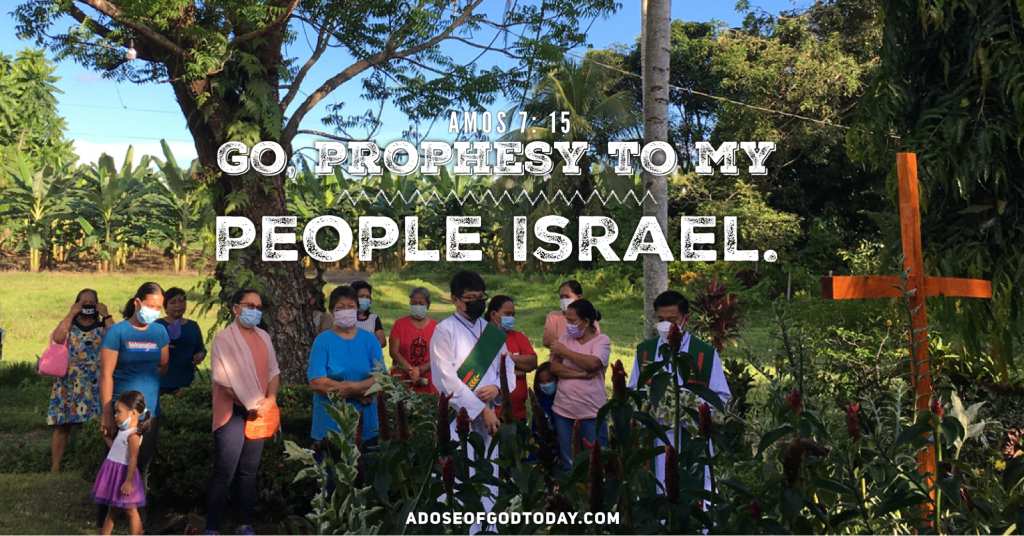
That is why, Amos who was a shepherd was called by the Lord to speak on God’s behalf and deliver God’s message. He was commanded to “Go, prophesy to my people, Israel.” Though he did not come from a family of priests or from a lineage of prophets, yet, God chose him. Being God’s prophet after all is not about what we have attained or achieved and not about an excellent family background.
This is what the Gospel of Mark also revealed to us. Jesus sent out the twelve Apostles, two by two, whom he chose. These men where not from any family background that one would expect. Yet, Jesus saw something beyond the ordinary life of these men. This was how God worked wonders in them. And thus, Jesus gave them authority to free people burdened and oppressed by the unclean or evil spirit and to cure the sick. This means that they have been given the gift to heal and free people.
However, they have “to take nothing” for the journey. This calls every Apostle to fully trust in God’s providence expressed through the generosity of the people around them. To take nothing for the journey will allow them to be free from any unnecessary burden whether physical, material, psychological or spiritual.
Yet, as they proclaim peace and grant blessing to many homes, it is expected that not all will accept. Rejection is part of life of a preacher and of a prophet who proclaims what God wants to be proclaimed. People won’t easily accept God’s invitation and God’s presence.
And the reason? God demands change or transformation of our heart and of our whole life.
Change can be thought by many of us as a mere “disturbance” to what we have already become comfortable and familiar. But then, the danger of complacency and indifference could grip our hearts to the point that we become unmoved in from of the suffering of those around us.
This reminds us of the life of Fr. Rudy Romano, CSsR, a Redemptorist Missionary who spoke about the crimes of injustices committed against the poor in Cebu. His voice and presence became a “disturbance” to the powerful, the rich and the privileged. Like Amos and many prophets in the Holy Scripture, he too was rejected and martyred. He was even told by his own father to only focus on his sacramental duties as a priest. But, Fr. Rudy responded to his Dad’s letter, that he won’t be a worthy priest anymore if he would follow his father’s advice.
Fr. Rudy chose to stand with the oppressed and committed himself to speak what God wants him to speak and to live the life of a prophet as God called him to be.
In consequence, Fr. Rudy was abducted on this day, July 11, in 1985 in Cebu City. For the past 36 years, his body was never been found. Such is the fate of a prophet yet relentless in his words and eternal is his spirit.
The confidence and the faith that Fr. Rudy showed must have been what St. Paul spoke about in his letter to the Ephesians. Paul proclaimed that God the Father blessed us with every spiritual blessing and this was made possible because of His Son, Jesus Christ our Lord.
These spiritual blessings must have grown in the heart of Fr. Rudy. These spiritual blessings which St. Paul proclaimed are the grace of being chosen by God, the grace to be holy and without blemish, the grace of being an adopted child of God, the gift of redemption and freedom, the gift of forgiveness of sins and the grace to share in the mystery of God.
For us today, each of us, regardless of our background or profession or achievements and failures in life is called to be God’s prophet in the bigger picture of our society and even within our small sphere of influence like our homes, schools, workplaces or organizations.
As a prophet shall arose in our midst, hopefully, we too shall welcome now and learn to discern the words and the presence of the prophet among us whoever he or she may be. May the prophet’s voice and life disturb our complacency and indifference.
Let our conscience then, be guided also by our faith in God, be inspired by love and be moved by our hope to bring change and transformation into our life and in our community that will bring healing and freedom. Hinaut pa.
Jesus sends his disciples to announce the Good News of God’s Kingdom and cast out demons and heal the sick. With a great deal of trust and courage they obey Jesus and venture into the unknown. They take nothing and go two by two in their mission. The disciple is never alone as the Lord chooses another to accompany him. Because of their “yes” the Lord’s message spreads and the world begins to change.
Evaluating the dismal results, a parish evangelization team realizes that focusing on mission logistics leads to the message becoming buried. Getting engrossed with the means leads to neglect of the Good News!
Fidelity to the core of our baptism allows God to carry out His mission through us. We don’t have to worry about material needs. The almighty opens the hearts of believers to provide for His preachers. The important thing is to obey the Lord and proclaim the Good News. We preach His Cross and find consolation and joy in our trials.
We accomplish God’s work as community and always with reference to His will to preach the Kingdom of God. In His name, we cast out demons and heal the sick!
Heavenly Father, we do not rely on human resources in our ministry. You will always provide for whatever it takes to be Your humble and faithful disciples. We trust You in word and deed as one Body of Christ, united in spirit and in truth. We receive communion with fervor and allow You to make us channels of Your healing love so that others may find hope, freedom and life in the Kingdom You prepare for all of us.
Brothers and sisters, we witness to the joy of the Gospel in word and in deed. Amen.
Days before the departure for our Parish Mission in Balabagan, Lanao del Sur, I made sure that all I need were in my ‘bags’. I doubled checked my things to be sure that I have not forgotten anything. My bags were full and heavy as I loaded them into our mission vehicle. When I arrived in the area, I realized that I brought a lot of useless things.
At home and at school, I was trained to be prepared and self-sufficient. Hence, it became natural to me to make myself ready, prepared for anything to happen, and independent.
Yet, Jesus reminded his Apostles to bring what was only most essential as they were sent to cure the illnesses of the people, to bring life and forgiveness, to bring blessing and peace to many homes.
I find this quite harsh and truly difficult. However, there is wisdom behind the words of Jesus. Our desire to be prepared, to be independent and self-sufficient would sometimes come from our deep anxiety of what would come next.
But what if a circumstance would not allow us to have any preparation? What if an event would surprisingly come and we have nothing to bring but go ahead with nothing? Surely, this will make us insecure and helpless.
This reminds me of Joseph who was stripped of anything he had. He was sold as a slave to the Egyptians by his own brothers. He was seduced by the wife of his master and then, imprisoned unjustly. He was forgotten in the prison for 13 years.
Nonetheless, Joseph remained faithful and trustful to God despite those terrible and horrible events in the life. Joseph remained calm and discerning as a person. As Joseph had nothing with him in his journey to Egypt as a slave, Joseph also did not hold any grudges and bitterness in his heart. He did not let his anger, resentment and hatred to burden and overpower him and prevent him from discovering and doing what God prepared for him. This is how Joseph found himself to be the savior of his own family and of many peoples when famine hit the world. God prepared him for this so that in Joseph, forgiveness shall be granted and life shall be given.
Jesus invites us today also, as he urged also his disciples in the Gospel, to take what is most essential in life by having a childlike trust in the providence of God. We are called to get rid of our unnecessary baggage behind whether physical, emotional, psychological or spiritual so that we will be able to welcome the goodness of God through other people.
This is the reason why Jesus told the Apostles not bring anything so that they too will be able to welcome the generosity of God through the generosity of the people. Joseph was also grateful for those people who helped him and especially to the Pharaoh who gave him freedom and responsibility to bring life to many peoples.
Let us allow ourselves then, to be helped by others. In return, let us also allow ourselves to be of help to those who are in need so that through us, God’s generosity will overflow. In this way, we shall be able to bring healing, life, forgiveness and peace into our homes and communities. Hinaut pa.






 A DOSE OF GOD TODAY