Category: Homilies

  • Enough

    Enough

    August 1, 2021 – 18th Sunday in Ordinary Time

    Click here for the readings (https://bible.usccb.org/bible/readings/080121.cfm)

    It could happen that once in a while some wayward beggars would come to us & ask for some “bahaw” or left-over food to eat. Once I gave some enough food for a day to a beggar. As he received the food, he asked: “Walay kape ug saging man lang?” (How about some coffee & fruits for extra?). Though this irritated me, it also made me think: “If I’m going to give, why not give all – the full package deal with all the extras? Why only give enough for the day? Why not for the whole week?

    But as we all know, human as we are, we are not easily contented. Hard for us to be fully satisfied. We want more. We need more than we already have. Like that wayward beggar, we want some extra: extra rice, sauce, toppings, privileges, discount, bonus, payment and others, but effortless & easily, if possible, quickly. So, when is the limited resources that I have now, enough for me? When is the less that I have, enough for me to share with others who are in need? So, when is enough is enough?

    Somehow at the very heart of our readings today is the question about ENOUGH.

    In Exodus, we hear that after escaping slavery from Egypt, the people of Israel found themselves free but hungry in the desert. They needed food for the journey & they grumbly complained about their predicament. To the point of blaming Moses &  even preferring to be slave again in Egypt but nourished, rather than free but starving in the wilderness. Yahweh heard their cries & addressed their needs. God rained down bread from heaven for them, and they only have to gather enough bread for their daily portion.  Great! But they also asked: “What’s this?”. And perhaps may also have asked: “only this, fine flakes?” It might be from heaven, but why only biscuits/flakes? Why not pizza or burger? No extra drinks? And why gather only enough for the day? Why not save & reserve for tomorrow?

    In the same way in our gospel today, after they were fed and have their fill at the multiplication of loaves, the people followed Jesus because they want more. They never had enough. They need more extra from Jesus. In their mind, they would think: “Since you, Jesus have already fed us, what more can You offer us? What shall we do to have what You can give us? Do we need to work for food?

    Over and beyond our human need for survival & God’s saving act is the question of our Faith and Trust in God. The manna from heaven and the miracle of feeding thousands of people is not about the Gift, but about our faith in the Giver. What matter most then is not having enough or more than enough Food and blessings to receive, but more so about us believing & trusting in God’s way of taking care of us. It is all about having enough faith & trust in God’s work of giving us life to its fullness.   

    Through the manna from heaven, Yahweh gave the people enough manna provision for the day – not  pizza for the whole week, because as Yahweh said, “I will test them, to see whether they follow my instructions or not”. The graces before us now then is a test in our faith with God rather than rescue operation to satisfy our immediate & urgent needs. In the same way, there is more to the miracle of Jesus than just the feeding of the multitude. It is a challenge for the people-then & us-now, as Jesus said: to “BELIEVE in the one God sent”. In the same way as God sent manna from Heaven, God sent us His son, Jesus not just to satisfy our cravings, our needs & hunger for more, but more so to offer us fullness & meaningful life. Here, Jesus clearly proclaiming to us now: “I am the bread of life; whoever comes to me will never hunger, and whoever believes in me will never thirst.”

    Simply put: In life , Jesus is Enough for Us. He is all that we need in life, nothing more, nothing less. Only required of us now is to accept Him, as God-sent  bread of Life, and believe His life & witness as God’s work of salvation, is enough and more than enough for us, and for all.

    This is what St. Alphonsus de Liguori, the founder of the Redemptorists whom we also honor today believes. For St. Alphonsus, “With Him, there is fullness of redemption” – with Jesus, we got & have abundance grace & blessing. In other words, Jesus is enough & more than enough for us. And Jesus & all his offer of graces are given for all and not only for the few. All has a share in God’s blessing of Redemption – and this is what St. Alphonsus and we Redemptorists, & all of us Christian, believe & proclaim to all people in the world, most especially to the poor, neglected & most abandoned: Jesus, the bread of Life is enough for us & for all.

    When Jesus taught us to pray “Give us each day our daily bread”, he doesn’t want us just to express our needs, since the Father knows already what we need. But he wants us to express our faith in God that we believe and abide with whatever the Father wills for us. Thus, when all is said and done, it was not the manna that sustained the Israelites in the desert, it was not the bread and fishes in the Jesus’ time, it was not our daily bread that sustains us today. What sustained them and us today is our faith and trust in God.

    No matter how difficult life may be, for those who trust in God, and live a day at a time, rest assured, God’s blessing of manna from heaven falls everyday with Jesus always with us. Lord, our bread of life, Your Love & your grace is Enough for us. Continue to nourish & give us life especially now during these trying times of pandemic. Amen.

  • SMALL ACTS OF KINDNESS MATTER

    SMALL ACTS OF KINDNESS MATTER

    July 25, 2021 – 17th Sunday in Ordinary Time

    Click here for the readings (https://bible.usccb.org/bible/readings/072521.cfm)

    The total population of the world is now at 7.9 billion and The State of Food Security and Nutrition in the World estimated that there are about 811 million people in the world who went hungry in 2020.[1] Out of that number, the 418 million hungry people are found in Asia. The report also projected that around 660 million will still suffer hunger in 2030 because of the lasting effects of Covid-19 Pandemic on global food security. Moreover, there are about 9 million people die of hunger and hunger-related diseases.[2] And in every 10 seconds, a child dies because of hunger. This is the cause of the 3.1 million deaths of children around the globe every year.

    Here in the Philippines, the recent SWS survey revealed that there are about 4.2 million Filipino families suffering from hunger.[3] And Mindanao has the highest rate of incidence of hunger with 1.2 million families.

    With these statistics available to us, there is a need that we become aware of the suffering that our brothers and sisters are enduring because of hunger. We cannot be blind and indifferent to this need. In fact, our readings this Sunday would actually help us to be more conscious of such hunger and of other forms of hunger around us.

    The first reading from the Second Book of Kings proclaimed to us how a nameless man from Baal-Shalishah brought food to Prophet Elisha. People were starving and they needed food. This was the reason that the man offered his food to the hungry men of God. However, Elisha’s servant knew that that food was not enough for them all. This was the reason why the servant objected Elisha when he demanded that the food must be distributed. But then, there was something Prophet Elisha saw that the servant did not recognize at that moment. Prophet Elisha believed that no matter how little they have, that will be enough for God to work wonders. Certainly, when the food was generously given to the people, they were surprised because there were left overs. The little food that they have shall be multiplied by the Lord. This was what the Prophet believed.

    The confidence in God’s providence and complete trust in God’s power to sustain and provide for His people, manifested also in the Gospel this Sunday. The Gospel of John told us that Jesus was aware of the needs of the people. The Lord was not just conscious of the spiritual hunger of the people but also their physical hunger. This awareness in Jesus moved him to ask Phillip, “Where can we buy enough food for them to eat?”

    Jesus did not just see the hunger of the people. Jesus also felt their hunger. This urged Jesus to do something. However, Jesus needed the participation of people around him. Phillip, just like the servant of Prophet Elisha, could not think of anything since they did not have enough money to buy food for all. Just like the servant of the Prophet, Phillip seemed to be too calculated in his response to the words of Jesus and thus of his response to the needs of the people. Yet, this prevented him only to fully participate in Jesus’ saving action at that moment.

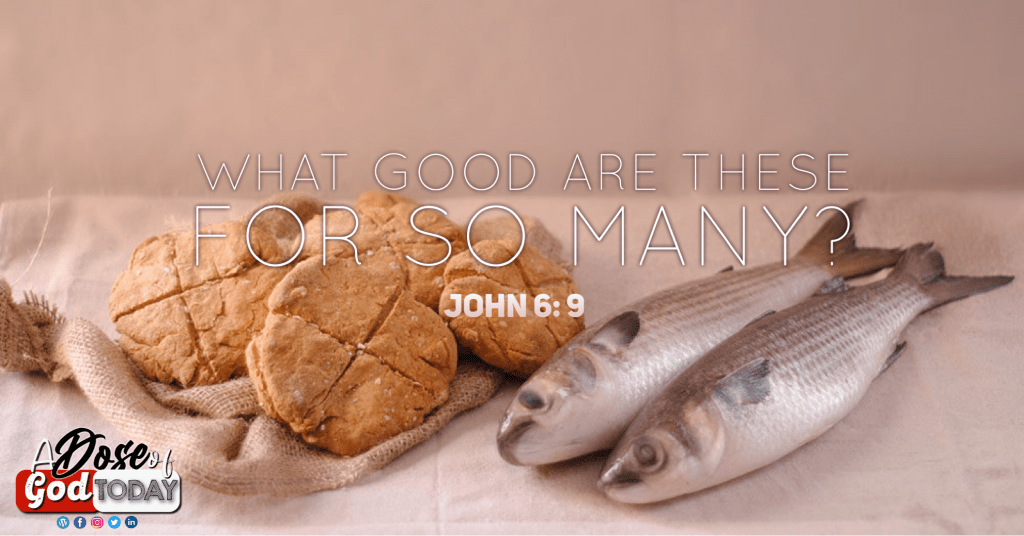
    It was Andrew who brought to Jesus a boy who had five barley loaves and two fish. The appearance of the boy in the story was actually very symbolic. He was nameless and faceless and was just a boy with small food. Yet, that nameless and faceless boy must have volunteered and gave generously his food to Jesus.

    With the boy’s willingness and generosity, his small share became the perfect offering that Jesus needed so that the people will be fed. It was through that boy who had five loaves and two fish that Jesus did something and made everyone to wonder.

    The first reading and the Gospel seemed to have a common ground. There was the small share from a man  who came from Baal-Shalishah and the loaves and fish from the boy. The little things that they had were transformed into many. The small share that they gave became abundant.

    This is where we find God’s invitation for us today as we have also become aware of the pressing hunger in our communities. We are invited by Jesus to offer sincerely the little that we have. We might be thinking that the world’s problem on hunger is too big for us to respond and our share will only be insignificant. Then, having such pessimistic view and calculated in our generosity will only prevent us from participating in God’s saving action, like the servant of Elisha and Phillip. But let us remember, the twenty barley loaves and fresh grain of the man were insignificant to a hundred men and even the five loaves and two fish of that nameless boy were nothing compared to the five thousand men. However, the man did not keep away his food and the boy did not run away to hide what he had, rather, both of them offered generously what they had no matter how small or insignificant those were. Indeed, this tells us that small acts of kindness matter in the presence of the Lord.

    The action of the man as well of the nameless boy were symbols of our vulnerabilities and weaknesses, of our anxieties and fears of having not enough but at the same time the power behind a generous action. To give away the little that we have, makes us insecure, yet, it is actually through the little that we possess that the Lord works wonderfully. When we give something and then we feel vulnerable because that was all we have, no matter how small, is actually the fruit of our generosity. Remember, true generous people will always feel helpless because what they give to others is not something that is only an excess of their possession.

    Thus, the Lord invites us today to be generous with what we have, no matter how small or inadequate in our eyes. Remember, the Lord needs our participation, our small contribution so that he too can work wonders through us and through our small things. With us, Lord will be able to continue to feed the various hungers around us. These many hungers involve hunger for food, for shelter, for a home and family, for friendship, for acceptance, for love and intimacy, or for a deeper relationship with God.

    Let us take time today to be that nameless man and nameless boy who generously offered the little things they had, to make a generous action towards people around us, no matter how small would that be as long as it is given in generosity and kindness, the Lord shall make wonders with us and through us. Hinaut pa.


    [1] https://data.unicef.org/resources/sofi-2021/

    [2] https://www.theworldcounts.com/challenges/people-and-poverty/hunger-and-obesity/how-many-people-die-from-hunger-each-year/story

    [3] https://www.rappler.com/nation/millions-filipino-families-stay-hungry-sws-survey-may-2021

  • WHEN GRUMBLING BECOMES A PATTERN

    WHEN GRUMBLING BECOMES A PATTERN

    July 21, 2021 – Wednesday 16th Week in Ordinary Time

    Click here for the readings (https://bible.usccb.org/bible/readings/072121.cfm)

    How difficult and annoying it will be to listen to a person who grumbles every now and then. It will truly be. It sucks out every positive energy and even inner joy to both, to the one who grumbles a lot and to the person who is forced to listen to a person’s endless grumbles.

    Moses and Aaron must have felt this as they listened to the many grumbles and complaints of the people. The people already complained to God because of their poverty and slavery in Egypt. When they were brought out of Egypt and were chased by Egyptians armies, they grumbled to Moses for taking them out of Egypt. When they were finally free and were in the desert, they started to complain to Moses and Aaron because there was no food. They said to Moses and Aaron that it was much better to die in Egypt but full than dying in the desert because of hunger.

    Certainly, the people must have complained also of the situation they were in. They must have grumbled for having no water, of the hot weather during the day, of the cold wind in the night, of the blisters on their feet, of the diseases they encountered on the road, of the insects and wild animals in the desert, of their neighbors and companions in that exodus.

    Indeed, there seemed to be a pattern of grumbles of the Israelites. They must have been blaming God because of the discomforts and difficulties they experienced. Yet, they completely forgot how God showed the divine power to bring a powerful nation to its knees in order to save them. God showed the might of divine justice to show to the oppressors the wrong they did to the poor. God made wonders for the people and faithfully journeyed with them as he has promised. But then, the hearts of the people were just filled with grumbles.

    We could have become like this too. When grumbling becomes our pattern, we could easily grumble of the food on our table, of the gift given to us, of the traffic caused by a motorist, of the long queue in a supermarket, of the smell of the person next to us, of the slow internet connection, of the delay of delivery of our online purchase, of the outfit of our friend, of the mistakes of our sibling or child, of the work of our colleague, of the actions of your spouse, of our recurring illness, etc. We could have endless grumblings.

    Our grumbles, like the Israelites, are not just because of what surrounds us or of our environment where we are at the moment. If the Israelites were not in the desert, they would still find something to complain about. This means, no matter how comfortable we are in life, a person can still find reasons to grumble.

    Our grumbles are rooted in our heart that has turned ungrateful. No matter how educated we are, or no matter how much money we have in the bank or influence we have in our organization or community, our heart can still be sick of grumbling because of our ingratitude and unawareness of God’s grace and tremendous presence in us.

    When this happens to us, we are truly plagued by this sickness of the heart that consumes us and brings us away from the grace of God.

    Yet, God does not want this to happen to us. God desires the ultimate fulfillment of our heart. This is the reason why God sent manna and quail for the Israelites. This act of grace from God was not meant to condone the people’s grumbling but to remind them of God’s graciousness. Later Moses kept two jars of those manna that remained fresh and free of spoil. This reminds the Israelites that God provides and God sustains us.

    This is the invitation for us today – to remind ourselves, to remember and be constantly aware of God’s graciousness and loving presence. Gratitude in our heart grows when we also learn to remember, to store God’s story with us and the many wonderful things God has done for us, in the memory of our heart.

    The Eucharist that we celebrate is an act of remembrance of Christ’s memory. As a community of faith, we make Christ ever alive in us. This means that the Eucharist is not a mere remembering of the distant past, but making Christ alive and present in this very moment, in the here and now.

    This is how we are also called to make alive our memory of God’s gracious actions in us through our actions and words that express gratitude. Let our hearts be filled with gratitude then, to free our heart from the spoil and disease of complaints and grumbles. Hinaut pa.

  • A LOVING AND REDEEMING PRESENCE

    A LOVING AND REDEEMING PRESENCE

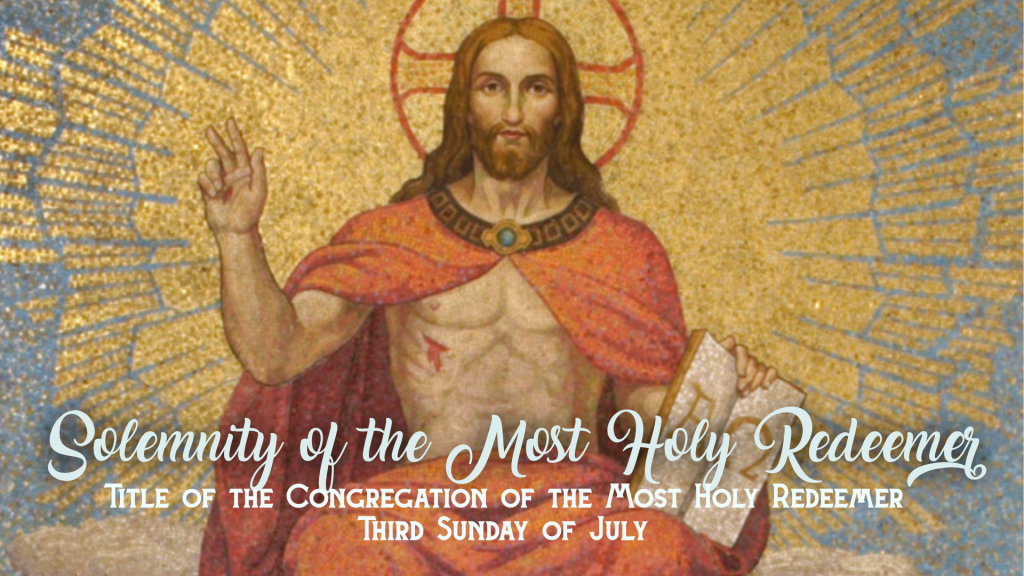
    July 18, 2021 – Solemnity of the Most Holy Redeemer

    Is 55:2b-6; Is 12:2-6; Rm 5:12-21; Jn 3:13-18,21

    How was your God-experience when you were a child?

    Certainly, each of us has our own experiences of God. Our God experiences and even image of God during our childhood would somehow paint the picture of God’s image as we grow older. Our early thoughts and ideas about God would somehow color also on how we relate with Him. Moreover, these thoughts and ideas were greatly influenced by our human experiences. How we were being brought up by our parents and adults around us will surely have an influence.

    In fact, this has been the personal experience of St. Alphonsus Ma. De Liguori, our holy founder of the Redemptorist Missionaries. As it was the culture and popular belief at that time, the young Alphonsus was introduced to a God who immediately would punish the sinner. God was believed to be too far and too high and remote. Yet, God was terrifying because God can put a person into eternal misery and damnation.

    St. Alphonsus Ma. de Liguori, Founder of the Redemptorists.

    This was in the consciousness of the young Alphonsus. Such belief in this kind of God was even reinforced because of his upbringing at home. His father who was a naval officer and a captain was a strict disciplinarian. One would just expect that Alphonsus must have been terrified by his father. If Alphonsus would commit any mistake, surely, Alphonsus would receive beatings or insults from his father.

    No wonder, Alphonsus became a scrupulous person who was overly concerned that something he thought or did might have been a sin. In modern language, Alphonsus could have suffered OCD or Obsessive Compulsive Disorder. Alphonsus was always terrified that he might have done something wrong, that he might have sinned and will be damned to the point that his guilt would haunt him.

    However, later on, slowly Alphonsus realized God’s true character. Experiences would actually tell him that God is kind and generous, loving and forgiving. Alphonsus felt this as he allowed himself to be at the service of the poor and the sick. This realization of Alphonsus was the very reason of the name of our congregation, the Congregation of the Most Holy Redeemer.

    Christ and his loving and redeeming presence and action brings out God’s true character. God does not condemn. God does not desire our death and eternal misery. God rather desires life that is free and filled with joy for us.

    This is the very message that Alphonsus preached, wrote and sang about that Jesus redeems us and liberates us from sin and death and to whatever that makes us miserable and lifeless. And this is God’s initiative because it is God’s desire.

    Our first reading and Psalm proclaimed about this. The first reading told us how Yahweh made an everlasting covenant with His chosen people. God makes the initiative to relate to us in love. Our Psalm reminds us about the faithfulness of God that we should rather not fear God but trust Him because God is our strength.

    This revelation tells us that God does not threaten us with God’s power to punish and bring us to eternal death. God rather related with us in the most personal and intimate way. This is what we affirm as we celebrate the Solemnity of the Most Holy Redeemer.

    The scriptures tell us that the God who created the world is a God who hears the cry of the poor and the entire creation. This God is neither apart nor alien to us but a God who is near and close to us. Our God is not “somewhere out there” but rather “here with us” who tirelessly journeys and lives with us from the beginning.

    Thus, despite our sinfulness, stupidity, and unfaithfulness, God never surrenders on us. St. Paul proclaimed in his letter to the Romans, “where sin increased, grace abounded all the more.”

    This is how the Gospel reminds us too that God “so loved” the world that he gave his only Son. In our pains and struggles in life, God stays with us. With Jesus, God walks and speaks to us. God even laughs with us and cries with us and to the point of suffering and dying for us.

    See, though God is almighty and all-powerful but God never threatened us with His power of control and dominance. God builds intimate friendship with us, showing care and compassion, offering healing and salvation.

    Hence, this feast of the Holy Redeemer is all about that relationship with a God who desires to be with us and to share life with Him.

    This is how we are invited to grow today – that we too will also live in friendship with others, by showing concern and love, offering healing and peace.

    We have to be watchful then, when we gain power over others and will tend to exercise control and dominance over them. With this tendency, we will be inclined to abuse the weak and that instead of building bridges, we build walls, instead of developing friendship, we promote fear. As a result, we will become indifferent to the struggles of others and intolerant to the mistakes of those who are around us. This is not what God wants us to be.

    God wants us to make friends, to show our affection and concern in the way Jesus makes us his friends so that we too shall learn to become individuals and a community with a loving and redeeming presence. Hinaut pa.

  • UPGRADING INTERRUPTIONS

    UPGRADING INTERRUPTIONS

    July 18, 2021 – 16th Sunday in Ordinary Time

    Click here for the readings (https://bible.usccb.org/bible/readings/071821.cfm)

    A lady once went to visit a friend who is a public high school teacher. As they chatted at the school canteen, however, they were continually interrupted by students who came for his friend’s advice  or opinion on something. Eventually she asked her friend, “How do you manage to get any work done with these interruptions?” Her friend replied, “At first, I resented interruptions in my work. But one day, it suddenly dawned on me that interruptions are part of my teaching work. Educating students is not so much what I teach them inside the classroom, but moreso about how much time and attention I spent them outside the classroom.”

    That teacher could have devoted her time on her lesson plans. She could have attended much of her time to her private life and not be involved with her student’s lives. But being caring and generous that she is, she made her work consists of being available to her students’ needs. No wonder she was greatly loved and respected by the students.

    We do experience interruptions in our life. Especially people who are in caring profession like teachers, priests, social workers, government and bank employees, frontliners, doctors and nurses experience lots of disturbances at work. And usually these interruptions are particularly difficult especially when the request is not of our own choosing, when we don’t feel in the mood to help, when we are forced to respond and when it causes a lot of inconveniences. In such cases, a real sacrifice is involved. Most of the time, we have to forget ourselves and set aside our feelings and present plans to address the pressing needs of others than ourselves.

    Good for us to know that Jesus himself, like us, also had to cope and contend with disturbances & interruptions in his ministry. Jesus too had his plans upset and postponed because of other people’s needs.

    In our gospel today Jesus saw the need of his apostles for rest and recreation. After sending them on a mission to proclaim the good news, to heal the sick and to cast out demons, Jesus understood his apostles’ need to recharge their energy. They had been through a lot while on mission that they need the time to eat, enjoy, & process their experiences with Jesus & the people. With this, Jesus planned to take them off to a quiet place for a break because frontliner caregiver as they are, the apostles also needed caring.

    However, as we have heard, things didn’t work out as planned. The ordinary people sabotaged their rest and recreation. And how did Jesus react? Not with annoyance but with compassion. Jesus was moved with pity for them. Inasmuch as he attended and took care of his apostles’ need for a break, out of compassion for them, Jesus also responded to the pressing needs of other people.

    Nobody likes interruptions. We know how annoying & limiting interruptions are. However, there will always be interruptions in life. They are inevitable – cannot be avoided. Be as it may. Somehow our readings today may also teach us some lessons about our experiences of interruptions in life.

    First, interruptions can be God’s way of taking care of us. The Lord said in our first reading: “I myself…take care, gather, bring back, appoint..” Meaning, What God does Himself to us are His hands-on interventions in our lives that will definitely disturbs us. As Paul said, Jesus is God’s intervention in our lives, who totally can disturbs, change & renew our lives. Jesus is God’s cure to save & help us to live our lives for the better.

    Second, interruptions can be our way of taking care of ourselves. As interruptions happen, we are moved to give more attention & value to what is important and we really need. The disciples needed to rest, recreation & recharge, and the people needs God’s healing, care, inspiration & meaning through Jesus’ words & ministry. In crisis-disturbance, we are to adjust, adapt & cope with our bare necessities. We evaluate – we put value on what we have & longs for the better than the usual.

    Third, interruptions can be our way of taking care of one another. As it caused us to be conscious of our needs, life-interruptions make us also feel the needs of others & moves our hearts to compassion to help. It challenges us to do whatever we can to contribute & fulfill our mission in life for them & for us.  Life-interruptions moves us to sympathize & empathize with one another.

    Simply put, whatever, whenever & however it happens to us then, now & in the future, these interruptions can be the chance for our intervening, disturbing & interrupting God to take care of us, & can be our opportunity to take care & be a better versions of ourselves & of one another. Interruptions call us to faith, self-care, compassion & personal mission.

    If we really come to think of it, our present experiences of Covid pandemic is & has been indeed a great interruption to our lives. Needless to say, the disturbance, crises, & challenges, Covid pandemic has done and cost in our lives nowadays. However, somehow like a major medical operation or dialysis procedure, perhaps this pandemic is God’s intervention to save from our own sickness & destruction. The interruptions we are going through might be God’s way of saving, curing & healing us from usual our toxic & abusive-lifestyle that make us sick & has brought cancerous diseases & infectious viruses to our nature, environment, physical bodies & personal lives. As we cope with the challenges of the pandemic times, we come also to see & value more the need for us to reimagine our lives, be more clear with our priorities & steadfast with our values, purpose & principles in life.  And above all, we come to realize that we need each other, we feel for one another, & we contribute what we can for a much better life ahead.

    Somehow the pandemic, virus, quarantine, immunization we are going through are God’s evasive, interrupted, inconvenient procedure for our upgrade, from corrupted & infected system to a better version of our humanity & our world. With the Lord and our compassion for one another, somehow what we are going through nowadays is God’s way of care-giving & care-taking us now & always.

    Lord, Interrupt & disturb us, once in a while (if not always), … that we may realize how sick we are,…. how we need You & one another,…. how we can help & take care of one another and…. how God is working & intervening to protect & save our lives & world now especially during these trying pandemic times. Amen.