
April 3, 2026 – Good Friday of the Lord’s Passion
Click here for the readings (https://bible.usccb.org/bible/readings/040326.cfm)
Today, we stand before the Cross. And we do so not as strangers to suffering, but as people who know what it means to carry fear, uncertainty, and quiet struggles. In our community, there are moments when we feel unsafe to freely express our faith, moments when we feel small, even vulnerable. And in these experiences, we ask, “Where do we find strength? Where do we find hope?”
Good Friday answers us not with many words, but with a Person, Jesus on the Cross.
I remember my time in Balabagan, in a small chapel in Brgy. Purakan dedicated to Our Mother of Perpetual Help. The community there was small, around ten Christian families. Simple people, quiet in their faith, yet deeply rooted.
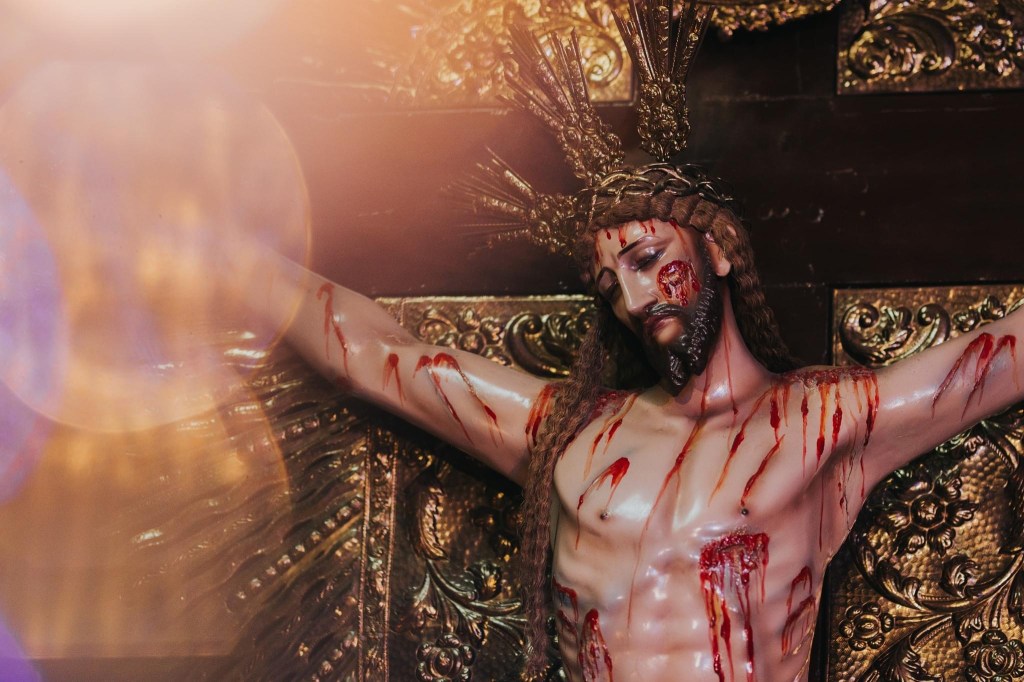
One night, a group of drunk men forcibly entered the chapel. What they did was painful beyond words. They desecrated the sacred place. They defiled it. They brought in trash. They destroyed sacred images. And most painfully, they brought down the large crucifix in the sanctuary and struck it again and again until the image of Christ was completely destroyed.
The community grieved over it. They were hurt and shaken. But something remarkable also happened. Instead of giving in to fear, they chose to stand. Instead of turning away, they gathered, prayed, and remained. And in that broken cross, stripped of its image, they began to see something deeper.
Because what happened to that cross was not new. Jesus Himself was scourged, insulted, mocked, beaten, crucified, and killed. The cross has always been a place of violence and rejection. And yet, it is also the place where God revealed His greatest love.
Even when the image was destroyed, the meaning of the cross remained and even became clearer. The cross is not just about destruction. The cross is about life.
This is what we hear from Prophet Isaiah. The Suffering Servant was rejected, wounded, and humiliated. Yet through his suffering, healing came. “By his wounds, we are healed.” This means that what seemed like defeat became the source of salvation.
The Letter to the Hebrews reminds us that Jesus understands our suffering. He is not distant. He knows fear, pain, and anguish. And because of this, we can approach Him with confidence because the Lord walks with us in our struggles.
And in the Passion according to John, we see that Jesus was not powerless. Even in suffering, He remained faithful. He chose to love until the end. The cross was not simply imposed on Him, it was rather, embraced out of love.
And this brings us to a deeper challenge. Often, we think of the cross only as our problems. We say, “My struggles are my cross.” “My difficulties are my cross.” And while these are also real, the Gospel invites us to go deeper.
This brings us into the realization that the cross is not only something we carry. It is something we live today. There are three invitations now that we find in the cross of Christ.
First, the cross is love. To carry the cross is to love even when it is difficult, to forgive when it hurts, to remain when it is easier to leave, and to give without expecting in return. This is the love of Christ.
Second, the cross is truth. Jesus stood for the truth even when it led Him to death. Many during His time chose silence, fear, or compromise. Even today, we face the same temptation. Carrying the cross means standing for what is right, even when it is risky, even when we feel alone.
Third, the cross is self-giving. Jesus gave His life so that others may live. To carry the cross is to share ourselves, our time, our strength, and our presence for the good of others.
Friends, what happened in that chapel in Purakan was painful. But it was also a witness. Because even when the cross was destroyed, the faith of the people was not. Even when the image was broken, the meaning of the cross became stronger.
And that is our hope because God’s love cannot be destroyed. Faith also cannot be silenced. And life will always rise from suffering.
So today, as we venerate the cross, let us not see it only as a symbol of pain. Let us see it as the victory of love over hatred.
The victory of truth over lies. The victory of life over death.
Thus, the cross may be wounded, broken, even rejected. But it will always remain the sign of God who gives life. And in that cross, we find the courage not only to endure but to love, to stand, and to live. Hinaut pa.


 A DOSE OF GOD TODAY