Category: Saints

  • God’s coming received with great opposition

    God’s coming received with great opposition

    December 14, 2019 – Saturday 2nd Week of Advent / Memorial of St John of the Cross, priest and doctor of the Church

    Click here for the readings http://www.usccb.org/bible/readings/121419.cfm

    Homily

    Have you been opposed by others just because you are different? Have you been rejected by people around you just because you do not adhere to the status quo, to what they do and to what they liked to believe?

    The Gospel today tells us that the arrival of Jesus was not received warmly by people around him particularly of those in the leadership, of those in the high position. Despite the call of the prophets from the ancient times from Isaiah, Elijah and up to the person of John the Baptist, God’s coming was received with great opposition. As the prophets called the people to turn away from sin and selfishness, the prophets also received violent condemnation from the powerful. This was what happened to John the Baptist who confronted King Herod for his immoral union with his brother’s wife. As a result, John was silenced by beheading him. In the words of Jesus, he said, “they treated him as they pleased.”
    Indeed, the Lord revealed himself, yet the people refused to recognize him because their hearts were filled with malice and full of themselves. These people who continually rejected and opposed Jesus had become so comfortable with their life but trapped by their own selfishness.

    The Pharisees, scribes, lawyers and priests of the temple were so comfortable with their way of life that they did not want a change and did not want to be challenged. They were afraid of losing what they were enjoying. Herod and his mistress were also contented with their immoral life and did not want to be confronted. Thus, these people did not want God to change their life. What they seek was the preservation of that kind of life they were living. However, this was not what God wanted. Jesus wanted them to be free, that is why, he had to confront them.

    In this Season of Advent, we are reminded to also examine ourselves if we have become too comfortable with what we have been doing, with what we have been thinking and with what we are living for. The problem is not the comfort in itself, the concern is our attitude or way of life in choosing to be indifferent and unmoved with what is happening around us and with God’s self-revelations in our life. This also include our attitudes of not wanting to change, to be challenged, to be criticized and to be corrected.

    Hence, this calls us to confront ourselves with those attitudes that do not lead us closer to others and closer to God. Jesus invites us today to be more welcoming of his presence by also letting go of those comforts that prevent us from coming closer to him, and attitudes that prevent God to enter into our life.

    As we prepare ourselves to celebrate the birth of Jesus, may our hearts and our whole life be more ready and more welcoming of God’s coming. Hinaut pa.

    Jom Baring, CSsR

  • By being grateful, we become welcoming of God’s invitation

    By being grateful, we become welcoming of God’s invitation

    December 13, 2019 – Friday 3rd Week of Advent / Memorial of St Lucy, Virgin and Martyr

    Click here for the readings http://www.usccb.org/bible/readings/121319.cfm

    Homily

    Gratefulness makes us see what surrounds us, both the good and the bad. Gratefulness allows us to be embracing and accepting of the things and people around us. It is when we are grateful too that we become joyful persons and will tend to see the goodness and uniqueness of others. And when we become joyful, we also become generous of ourselves towards the people around us, no matter who they are, whether they are our friends or strangers.

    However, if our heart is without gratefulness but rather bitter, hateful and vengeful because of our personal failures and failures of others towards us, then, we become close-minded, rejecting, and vicious in the way we relate with one another and even in the way we relate with God.

    An ungrateful heart makes us belittle ourselves and belittle others, jealous of the success of our friends, but having low self-esteem. With this in mind, let us see again and explore our Gospel today and discern on how God invites us.

    Let us see the attitude of the Chief Priests and Pharisees towards Jesus. These two groups of people were very critical towards Jesus because Jesus challenged their comfort, their belief and practices.

    So, what was Jesus really doing?

    Jesus was very unconventional because he ate and drank with sinners. He touched and mingled with the sick and the unclean people. Jesus preached a loving and forgiving God the Father. He was from Galilee, from an insignificant town called Nazareth. He was not a well-known intellectual and did not come from a rich and influential family. And all that Jesus did was a threat to the status quo.

    Thus, the Chief Priests of the Temple and the Pharisees were already contented with the comfort that they have, with the power and influence that they were enjoying. They were privileged people and the ordinary ones would almost worship them. They also preferred a strict and unforgiving God because it was through that belief that they could advance their self-interest. They used their position in the society to enrich themselves at the expense of the poor.

    That is why, they were against Jesus because he was changing their ways. Their hearts were filled with bitterness, hate, anger and the desire to have more; in other words, they were filled with themselves, worshipping their very selves. This is idolatry.

    These were the reasons why they could not accept Jesus or even recognize the presence of God in Jesus. As they rejected John the Baptist by accusing him of being possessed by a demon for being different and radical, and so they too rejected and despised Jesus, accusing him for being a glutton and drunkard because Jesus ate and drank with sinners and the poor.

    This is the response of an ungrateful heart. The Chief Priests and Pharisees did not recognize at all the works of God. Thus, by being ungrateful they also reject what comes from God.

    This will also happen to us when we remain ungrateful and when we refuse to recognize that everything is from God. When we become ungrateful persons, we also become self-entitled. We become demanding in our relationships. We become critical of those people around us and we tend to only see what is wrong in the other person. We will become stingy of our time and energy and ungenerous of our resources and presence to those who are asking for our help. And most of all, we become indifferent to people around us and indifferent to God.

    Thus, God calls each of us today to be more aware of the gifts, blessings and graces that we have received each day. It would be good then to bring back to our memories the many gifts that we have received as we prepare ourselves for the birth of Jesus.

    Hopefully, by starting from there, then our consciousness will be heightened and sharpened in recognizing the presence of God present in our life and in the lives of others. By being grateful, we may become welcoming of God’s invitation. Hinaut pa.

    Jom Baring, CSsR

  • Surprise!

    December 12, 2019 – Our Lady of Guadalupe

    Click here for the readings http://www.usccb.org/bible/readings/121219.cfm

    Homily

    The Season of Advent is characterized by an element of surprise. This means that God’s coming is a big surprise for us. We do not expect that God who is almighty and all-powerful will come to visit us and to humble Himself in order to reveal himself to us.

    This is what our Gospel tells to us today. Elizabeth was surprised by the visit of her cousin Mary. But more than that, Elizabeth and the baby in her womb were more surprised of what Mary carried in her womb. They were surprised because God had visited them. This prompted baby John to leap with joy because God has come through Mary.

    The feast of Our Lady of Guadalupe is also a manifestation on how God has visited us in history. Moreover, this visit of God through Mary to San Juan Diego is an expression of God’s loving concern for his oppressed people particularly in Latin America. God’s visit then, is a revelation that God is on the side of the poor and the oppressed, of the weak and powerless.

    On this Season of Advent and on this feast of Our Lady of Guadalupe, we are invited to allow God to surprise us. Thus, never lose the sense of being surprised. This means that we are challenged to put down our judgments and biases, indifferences and suspicions, thus, to be less and less guarded, that may prevent God from surprising us – and that may stop us too from welcoming God.

    God surprises all the more when we begin to embrace our own failures and sins, and when we begin to accept that we are vulnerable and weak. And when God comes to surprise us, may it lead us to leap with joy. And hopefully, that experience will also move us to also surprise others with our own kindness and generosity. Hinaut pa.

    Jom Baring, CSsR

  • We too are Bearers of the Good News

    We too are Bearers of the Good News

    November 30, 2019 – Feast of St. Andrew, Apostle

    A reading from the Letter of Paul to the Romans (10:9-18)

    Brothers and sisters:
    If you confess with your mouth that Jesus is Lord
    and believe in your heart that God raised him from the dead,
    you will be saved.
    For one believes with the heart and so is justified,
    and one confesses with the mouth and so is saved.
    The Scripture says,
    No one who believes in him will be put to shame.
    There is no distinction between Jew and Greek;
    the same Lord is Lord of all,
    enriching all who call upon him.
    For everyone who calls on the name of the Lord will be saved.

    But how can they call on him in whom they have not believed?
    And how can they believe in him of whom they have not heard?
    And how can they hear without someone to preach?
    And how can people preach unless they are sent?
    As it is written,
    How beautiful are the feet of those who bring the good news!
    But not everyone has heeded the good news;
    for Isaiah says, Lord, who has believed what was heard from us?
    Thus faith comes from what is heard,
    and what is heard comes through the word of Christ.
    But I ask, did they not hear?
    Certainly they did; for

    Their voice has gone forth to all the earth,
    and their words to the ends of the world.

    A reading from the Holy Gospel according to Matthew (4:18-22)

    As Jesus was walking by the Sea of Galilee, he saw two brothers,
    Simon who is called Peter, and his brother Andrew,
    casting a net into the sea; they were fishermen.
    He said to them,
    “Come after me, and I will make you fishers of men.”
    At once they left their nets and followed him.
    He walked along from there and saw two other brothers,
    James, the son of Zebedee, and his brother John.
    They were in a boat, with their father Zebedee, mending their nets.
    He called them, and immediately they left their boat and their father 
    and followed him.

    Homily

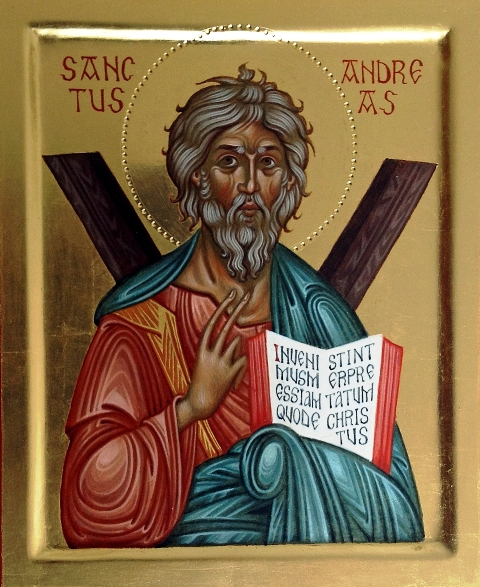
    We celebrate today the Feast of St. Andrew, one of the original 12 apostles. We know very little of him. According to our tradition, Andrew became the first bishop in the community of Constantinople until he was martyred through crucifixion on an X-shape cross. The gospels tell us also that he was the brother of Peter. They were from Bethsaida, a town near the Sea of Galilee. In John’s gospel, we were told that Andrew was a disciple of John the Baptist at first.

    In the same gospel, we found that Andrew had actually brought Peter to Jesus, telling his brother, “We have found the Messiah!” In the other gospels, it was Andrew who called the attention of Jesus about the boy with 5 loaves and 2 fish. Again, it was Andrew who told Jesus that there were some Greeks who wanted to see Jesus.

    From here, we can sense that Andrew was actually an apostle with a typical role. Unlike Peter, he was not able to witness the transfiguration of Jesus at Mt. Tabor. Andrew was not part of Jesus’ inner circle composed of Peter and the 2 brothers, James and John.

    He was in fact an ordinary guy, an ordinary apostle of Jesus. However, Andrew had a remarkable faith in Jesus.

    Remember, his brother Peter doubted and even denied Jesus three times. But for Andrew, he was the first one to realize that Jesus was truly the Messiah. In his conviction, he joyfully shared what he found to his brother. He himself became an evangelist, a preacher of the good news to his own brother. Moreover, he brought others to Jesus like the boy and those Greeks. He became a bridge between Jesus and other people. 

    This is what St. Paul has told us in the first reading. As there is a need and but also beauty in sharing one’s faith in Jesus to others. His letter to the Romans would help us ponder our own call to be a kind of apostle or bearer of the good news to others like St. Andrew. 

    We usually think that preaching is only proper to bishops, priests, and deacons. Indeed, public preaching of the gospel in liturgical occasions like what I am doing now is proper to me as a priest and not to you as lay persons. But it does not mean that you cannot preach the Gospel or share Jesus anymore to others. As Christians, we share the prophetic role of Jesus by virtue of our baptism. It means that all of us have both the responsibility and the privilege to be God’s messenger to others.

    The Gospel tells us how we are being called individually. To each of us, Jesus is saying, “COME, FOLLOW ME, AND I WILL MAKE YOU FISH FOR PEOPLE! I WILL MAKE YOU MY OWN APOSTLE!” This can surely be materialized when we preach with joy by our own example. 

    Thus, when we are happy with what we are doing and when we are honest in our relationships and dealings with others; and when we are sensitive to others and volunteer to help whenever someone needs a helping hand; when we become joyful givers to those who have less;  when we become more understanding and compassionate with those who are experiencing more difficulty in their life; and when people around us feel the deep expression of our faith as we pray in the church, in our homes or with others…then people will see these things and will recognize that we are Christians. Then like St. Andrew, we will be able to bring other people closer to Jesus, by becoming bearers of the Good News through our very life. Hinaut pa.

    Jom Baring, CSsR

  • What I truly offer to God is wonderfully blessed by God

    What I truly offer to God is wonderfully blessed by God

    November 21, 2019 – Feast of the Presentation of the Blessed Virgin Mary

    Today, we celebrate the feast of the Presentation of Mary to the Temple. This feast is not found in the bible but in a scripture called the Protoevangelium of James. So, it means that this feast actually, has no historical basis. However, why do we celebrate it? Why is it important for the Church?

    Even though this is not an historical event, but this feast itself is spiritually and theologically important for the Church. In that scripture, the Protoevangelium of James, it was described that the parents of Mary, who were Saints Joachim and Anne offered their daughter, Mary, to God in the Temple at the age of 3 years old.

    The action of Joachim and Anne was an expression of their gratefulness to the Lord. This old couple offered back to God the very gift that they have received from God.

    It was in this way that Mary had been consecrated to God for the purpose that God transforms the life of Mary. Hence, this feast of Mary tells us how God consecrates a life that is fully offered to Him. This tells us too, how God can make a simple offering to become so wonderful and beautiful.

    This feast prepares us for the Immaculate Conception of Mary and of the great mystery that we will celebrate on Christmas day, the birth of Jesus. Thus, through the act of sacrifice of the Joachim and Anne and the act of faith of Mary’s “yes” to the Lord; God in return blessed not just Joachim and Anne and Mary, but, each of us, through the birth of Jesus.

    This is the message for us today. We are called to offer back to God all that we have.

    As husband and wife, offer back to God your marriage life, making God the very center of your marriage.

    As a family, offer to God your very relationships including your joys even your sacrifices and pains.

    As a professional, offer to God your work, your passion, your talents and even your insecurities and failures.

    As a young person, offer to God your dreams and hopes and even your fears and anxieties of the future.

    As an old person, offer to God your good old days, the days that you have spent on this earth with your loved ones including the good and bad experiences and even your illness and  uncertainties in life.

    In offering to God what we have, it also calls us to be confident in God, to trust him fully. God promises us that when we are able to offer what we have to Him; He will surely bless them and transform them beyond our expectation. God will certainly bring forth life, healing, reconciliation and wonderful and beautiful things through us and among us. Hinaut pa.

    Jom Baring, CSsR