Category: Feasts

  • A Sincere Person Inspires

    A Sincere Person Inspires

    October 16, 2019 – Wednesday 28th Week in Ordinary Time

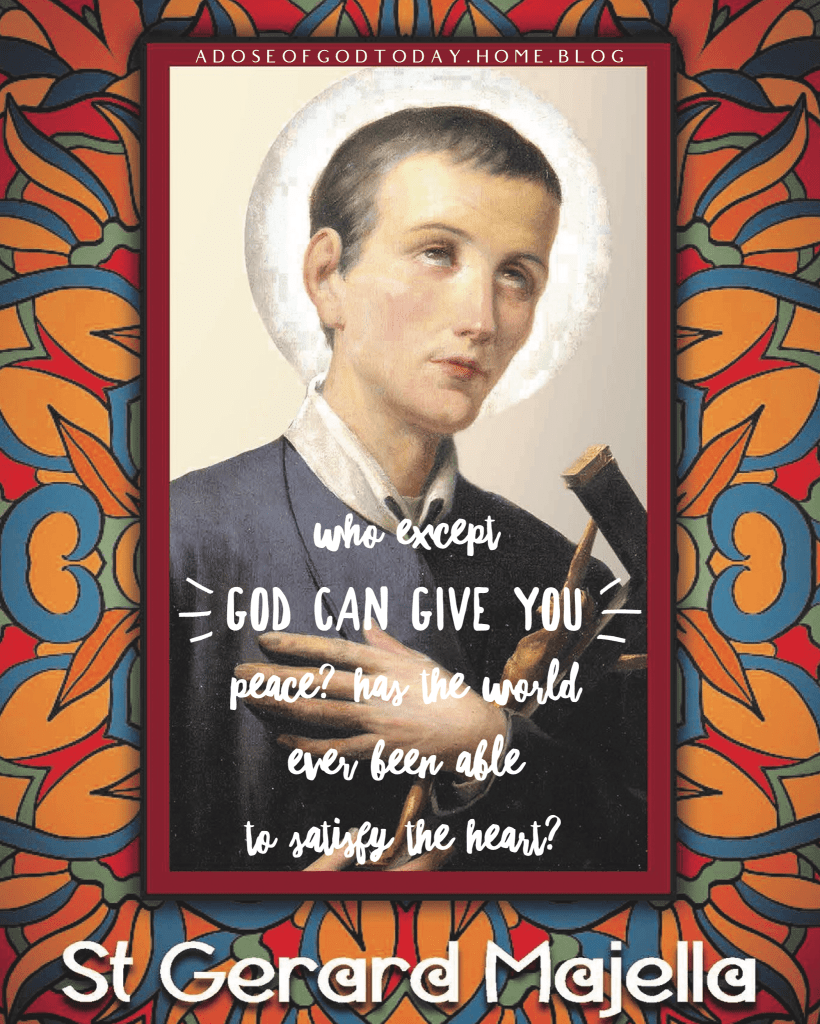
    Feast of St. Gerard Majella, CSsR

    (Patron of Mothers, particularly pregnant mothers and their infants)

    A reading from the Holy Gospel according to John (12:23-26)***

    ***readings proper to St. Gerard, Redemptorist Supplementary

    Jesus said to them, “The hour has come for the Son of Man to be glorified. Very truly, I tel you, unless a grain of wheat falls into the earth and dies, it remains just a single grain; but if it dies, it bears much fruit. Those who love their life lose it, and those who hate their life in this world will keep it for eternal life. Whoever serves me must follow me, and where I am, there will my servant be also. Whoever serves me, the Father will honor.

    Homily

    When we experience rejections and deprivations in life, is it not that we also experience discouragements and have a sense of hopelessness?

    That is why there would be people who would yield to a very low self-worth and low self-esteem because of such negative experiences. For others, this leads to depression and chronic loneliness. Others too would go to the other side that leads to a life filled with bitterness and then to that desire to always seek recognition, acceptance, and satisfaction. When these desires remain unconscious and become unsatisfiable, the person turns to be selfish, corrupt and abusive in his or her relationships.

    Yet, negative experiences also can be an opportunity for us to grow more as a person into what God desires us to be. Our painful experiences of rejection and deprivations in life are also doors that will lead us into a life filled with confidence and assurance. This is the life that was shown to us by St. Gerard Majella whose feast we celebrate today. Before St Gerard was known to be a patron for mothers and particularly in time of pregnancy and for their infants, the young Gerard experienced hardships.

    At a very young age he was deprived of a father. His father died and being the only boy, he became a father to his sisters. Though he was very young, he was forced by that circumstance to work as a tailor. Consequently, the hard work that he endured caused his health to fail. He had a very poor health as a young man. However, despite these difficult circumstances, Gerard was never bitter towards others who were better and well-off. He never blamed God for the difficulties he experienced. 

    In fact, Gerard desired that he will offer his whole life in the service of God. But then, because of his poor background and poor health he was rejected by a religious congregation that he wanted to join. Despite this rejection, Gerard never wavered in his resolved. When the Redemptorists came in his hometown, he was inspired by them and asked to join in their group. Again, because of his poor health he was rejected. But because of his persistence, he was able to join, but the Redemptorists reluctantly accepted him. He was never accepted fully, actually!

    In terms of intellectual capacity, Gerard was very far from St Alphonsus, yet, what inspired the people around him was his sincerity. In all the things that Gerard did, he was always sincere. The words that he expressed was filled with sincerity. Gerard was not after any recognition or just to satisfy his cravings because of the deprivations in his life.

    Gerard was just sincere because he was very confident with Jesus. His confidence and intimate friendship with the Lord made this poor and sickly Gerard secured and satisfied. Consequently, the very presence of Gerard uplifted and inspired others particularly those who were afflicted with illness, with loneliness, with poverty and other needs. Thus, even in his poverty, Gerard was generous; even in the midst of rejections, Gerard was most compassionate.

    This is what Jesus told us in the Gospel today. The life of Gerard was a concrete example after Jesus of a seed that dies and then bears much fruit. Those painful and negative experiences of Gerard were his experiences of dying, his choice to make others happy and to bring others closer to Jesus was his way of self-denial and denial from his personal cravings. Hence, by his sincere actions and words, Gerard’s life bore much fruit.

    This is the message also for us today. Let us not allow our negative experiences of rejections and deprivations to bring us farther away from ourselves, from others and from God. Let us rather make them as opportunities for us to grow deeper in our relationship with God and others. Let us be sincere in our words and actions so that we too will become God’s instruments in bringing miracles in the world. Hinaut pa.

    Jom Baring, CSsR 

  • Why God is essential in life

    Why God is essential in life

    October 15, 2019 – Tuesday 28th Week in Ordinary Time

    Memorial of St. Teresa of Avila, Virgin and Doctor of the Church

    A reading from the Letter of Paul to the Romans (1:16-25)

    Brothers and sisters:
    I am not ashamed of the Gospel.
    It is the power of God for the salvation of everyone who believes:
    for Jew first, and then Greek.
    For in it is revealed the righteousness of God from faith to faith;
    as it is written, “The one who is righteous by faith will live.”

    The wrath of God is indeed being revealed from heaven
    against every impiety and wickedness
    of those who suppress the truth by their wickedness.
    For what can be known about God is evident to them,
    because God made it evident to them.
    Ever since the creation of the world,
    his invisible attributes of eternal power and divinity
    have been able to be understood and perceived in what he has made.
    As a result, they have no excuse;
    for although they knew God
    they did not accord him glory as God or give him thanks.
    Instead, they became vain in their reasoning,
    and their senseless minds were darkened.
    While claiming to be wise, they became fools
    and exchanged the glory of the immortal God
    for the likeness of an image of mortal man
    or of birds or of four-legged animals or of snakes.

    Therefore, God handed them over to impurity
    through the lusts of their hearts
    for the mutual degradation of their bodies.
    They exchanged the truth of God for a lie
    and revered and worshiped the creature rather than the creator,
    who is blessed forever. Amen.

    A reading from the Holy Gospel according to Luke (11:37-41)

    After Jesus had spoken,
    a Pharisee invited him to dine at his home.
    He entered and reclined at table to eat.
    The Pharisee was amazed to see
    that he did not observe the prescribed washing before the meal.
    The Lord said to him, “Oh you Pharisees!
    Although you cleanse the outside of the cup and the dish,
    inside you are filled with plunder and evil.
    You fools!
    Did not the maker of the outside also make the inside?
    But as to what is within, give alms,
    and behold, everything will be clean for you.”

    Homily

    St Paul tells us of the danger of a conscious denial of God. God’s presence can indeed be felt everywhere and by everyone. However, the people of his time denied God’s presence and power through their wicked practices. They knew God but did not adhere God and did not recognize God’s tremendous love.

    These people continued to worship what were only beneficial to them. They worshipped material things that would only feed them with comfort, riches, power and influence.

    As a result, they favored lies rather than the truth. They preferred corruption rather than honesty. They loved to possess rather than to give. However, such life only led them to darkness and to a life that can never be satisfied. They remained hungry and dull. This truly happened as the people put God aside in their life.

    This resonates with the reaction of Jesus towards the Pharisee who tended to put more emphasis on human regulations rather than on what God intended originally. This Pharisee represented those people who elaborated the law of Moses with hundreds of laws. They believed that it was the best way to obey God’s command. 

    Nevertheless, this was not the case. Jesus confronted the Pharisees of their mistake. They, in fact, worshipped more the law rather than the Lord. By putting more emphasis on the law, they also forgot to be compassionate to the poor and to be grateful to the Lord.

    Consequently, the Pharisees became vicious in their treatment with the common people. Since they thought of themselves highly, they looked down at the poor and the sick. Because of their self-righteousness they have become indifferent to the lowly.

    This was evident in the way they presented themselves. They have become people who were merely concerned of the outside, of their physical appearance rather than of their hearts. They looked flawless outside but with a corrupt heart inside. This again was a form of putting God aside.

    With these, Jesus invites us today to rather make God as the most essential in our life because a life that continually denies God will only lead to emptiness and unsatisfied life. Making others things more important in our life other than God will bring us to a deep spiritual hunger and corruption. These things could be our own material possessions, successes and achievements, influence and fame or simply ourselves, our vices and addictions, our selfish actions and intentions. 

    Indeed, St. Teresa of Avila whose feast we celebrate today reminds us of a person who truly found satisfaction, true comfort and riches with God. Through her closeness with Jesus, Teresa would always discern and choose God’s desire for her rather than her personal desires even if that led to personal conflict and difficulty.

    She made God as the most essential in her life which made her offer also herself.  Accordingly, she had become an ‘influencer’ during her lifetime. She radiated and shared God’s presence in her life and through her actions, her works and speech. She, indeed, found what filled her and satisfied her. Teresa is known to have said,

    God alone is sufficient.”

    Thus, hopefully, we may also discover that indeed God alone is sufficient for us, that nothing can truly satisfy us or fill us but God alone. Like Teresa, we may also grow in our confidence with Jesus despite our feelings of insecurities and anxieties in life. Hinaut pa.

    Jom Baring, CSsR

  • To be honest even if others are not, to speak even if others are silent, to see even if others are blind

    To be honest even if others are not, to speak even if others are silent, to see even if others are blind

    August 29, 2019 – The Passion of John the Baptist

    A reading from the Gospel according to Mark (6:17-29)

    Herod was the one who had John the Baptist arrested and bound in prison
    on account of Herodias, 
    the wife of his brother Philip, whom he had married.
    John had said to Herod,
    “It is not lawful for you to have your brother’s wife.”
    Herodias harbored a grudge against him
    and wanted to kill him but was unable to do so.
    Herod feared John, knowing him to be a righteous and holy man,
    and kept him in custody.
    When he heard him speak he was very much perplexed,
    yet he liked to listen to him.
    She had an opportunity one day when Herod, on his birthday,
    gave a banquet for his courtiers,
    his military officers, and the leading men of Galilee.
    Herodias’ own daughter came in
    and performed a dance that delighted Herod and his guests.
    The king said to the girl,
    “Ask of me whatever you wish and I will grant it to you.”
    He even swore many things to her,
    “I will grant you whatever you ask of me,
    even to half of my kingdom.”
    She went out and said to her mother,
    “What shall I ask for?”
    She replied, “The head of John the Baptist.”
    The girl hurried back to the king’s presence and made her request,
    “I want you to give me at once
    on a platter the head of John the Baptist.”
    The king was deeply distressed,
    but because of his oaths and the guests
    he did not wish to break his word to her.
    So he promptly dispatched an executioner with orders
    to bring back his head.
    He went off and beheaded him in the prison.
    He brought in the head on a platter and gave it to the girl.
    The girl in turn gave it to her mother.
    When his disciples heard about it,
    they came and took his body and laid it in a tomb.

    Homily

    The Gospel told us about this story on how John was beheaded. Thus, today, the Church remembers the passion of St. John the Baptist.

    It was through the daughter of Herodias who danced before King Herod that the head of the prophet was requested. King Herod and Herodias, the wife of his brother, had an adulterous relationship. Even though everybody knew about this but no one would like to speak about it. The scandal and immorality of Herod and Herodias was as bright as the sun, but every one was afraid to look at it or even speak about it. 

    It was only John the Baptist who spoke about it and reminded King Herod for breaking God’s law. John spoke against it even though the rest chose to remain silent. He chose to look at it and confront it even though many pretended not to see it. John being a chosen prophet of God, had been really true to his identity. John was a real troublemaker and a “disturbance to Israel” because he disturbed the conscience of Herod and the conscience of the people.

    Consequently, being a prophet, by speaking out the truth and disturbing the conscience of the people, he was silenced by those who hated him. In the end, he was beheaded.

    Like most of the people at that time of John the Baptist, many times we find ourselves choosing to remain silent and not to speak out about the truth. We too find ourselves to pretend not to see the scandal and feel indifferent about it.

    There are reasons of course why we do this. To be an honest person is difficult. A friend once shared to me.  His conscience has been disturbed because of the corrupt practices in their office. Yet, he found it difficult to confront the people doing such corruption because almost everyone does it and their senior officers seemed to tolerate such practice. In speaking out, he thought, he might lose his job. So he remained silent about it and choose to be indifferent.

    Hence, we chose not to stand or to speak up because we are afraid that we might lose our job, our career, our position and influence, our name or our life. We are afraid because we might lose the comforts and the peace that we seemed to be enjoying. Moreover, we also choose to remain silent because we ourselves are guilty. It is indeed a risky thing to do and we dare not to take the risk.

    However, having such attitude is not what God wants us to be. God calls us to be honest even if others are not, to speak even if others would remain silent, to see even if others would tend not to see.

    Thus, through the inspiration of John the Baptist, we may find courage when it becomes difficult for us to live faithfully our Christian life. Hinaut pa.

    Jom Baring, CSsR

  • What are my hypocrite-attitudes?

    What are my hypocrite-attitudes?

    August 28, 2019 – Memorial of St. Augustine, bishop and doctor of the Church

    A reading from the Gospel of Matthew (23:27-32)

    Jesus said,
    “Woe to you, scribes and Pharisees, you hypocrites.
    You are like whitewashed tombs, which appear beautiful on the outside,
    but inside are full of dead men’s bones and every kind of filth.
    Even so, on the outside you appear righteous,
    but inside you are filled with hypocrisy and evildoing.

    “Woe to you, scribes and Pharisees, you hypocrites.
    You build the tombs of the prophets
    and adorn the memorials of the righteous, 
    and you say, ‘If we had lived in the days of our ancestors,
    we would not have joined them in shedding the prophets’ blood.’
    Thus you bear witness against yourselves
    that you are the children of those who murdered the prophets;
    now fill up what your ancestors measured out!”

    Homily

    In today’s Gospel and as it was in the past few days, Jesus pointed out the danger of self-righteousness that leads to bitterness, discontentment and insecurity. There is a need to recognize our faults and sinfulness rather than undermining them by finding the fault of others in order to cover our own.

    Jesus addressed the teachers of the law and the Pharisees who seemed to be so righteous, yet, sickly and sinful inside. Jesus compared them to “whitewashed tombs, which appear beautiful on the outside, but inside are full of dead men’s bones and every kind of dirt.” Jesus called them hypocrites. 

    Jesus demands consistency in our words and actions, in the way we relate with others and with God. Consequently, there is a need for us to recognize our own “tombs,” which also means recognizing our own sinfulness and failures. When we choose to blind ourselves from own sinfulness and failures, then, there is a danger of making ourselves distant from God, from others and from our own reality.

    It would be good then, to be reminded of the forms of denials. 

    First, we will tend to overemphasize the faults of others yet; there will be no acknowledgement of our personal defects and sinfulness. This overemphasis of the faults of others is a mere cover up of one’s skeletons hidden in the closet. 

    Second, there will be an air of self-righteousness and arrogance in our hearts; claiming that we are always right and good and the rest are stupid. When we ourselves are being criticized then we become violent to our critics and would even seek to destroy them. This kind of attitude boasts oneself of his or her good image but hungry of recognition and praise from people around him or her. 

    Jesus does not want us to become bitter, hateful and pretentious persons but rather disciples of him who are humble enough to recognize our wrongdoings, and courageous enough to speak our own unjust and oppressive attitudes. Jesus desires that each of us becomes free by being able to recognize our sins so that transformation of hearts will be possible. It is in this way that we become of help to one another, so that as parents, leaders, mentors and authority figures, we will be leading others with honesty and sincerity. Moreover, that we may become persons who are not after recognition and praise from others, but persons who express deep gratitude to God.

    And in a special way, we remember a great saint today, St. Augustine, who became a pillar in our Church doctrines. He himself struggled with his own pretentions. However, when he had the courage to face his sinful self, then, he also found God most merciful to him. His generosity, his wisdom and his commitment to be of service of others and of the whole Church sprung forth from that conversion of Augustine.

    And so for today I would like to invite you to see ourselves closer and ask, what are my inconsistencies, my bitter and hypocrite-attitudes? We will only be able to answer this when we also stop pretending and will humble ourselves before God to accept our imperfections. Hopefully, when we are able to identify our attitudes that are inconsistent with our faith then that will move us to be converted back to Christ, to be closer to him. Hinaut pa.

    Jom Baring, CSsR

  • Have you been judged because of some particular opinions about you?

    Have you been judged because of some particular opinions about you?

    August 24, 2019 – Saturday: Feast of St. Bartholomew, Apostle   

    A reading from the Gospel according to John (1:45-51)

    Philip found Nathanael and told him,
    “We have found the one about whom Moses wrote in the law,
    and also the prophets, Jesus son of Joseph, from Nazareth.”
    But Nathanael said to him,
    “Can anything good come from Nazareth?”
    Philip said to him, “Come and see.”
    Jesus saw Nathanael coming toward him and said of him,
    “Here is a true child of Israel.
    There is no duplicity in him.”
    Nathanael said to him, “How do you know me?” 
    Jesus answered and said to him,
    “Before Philip called you, I saw you under the fig tree.”
    Nathanael answered him,
    “Rabbi, you are the Son of God; you are the King of Israel.”
    Jesus answered and said to him,
    “Do you believe
    because I told you that I saw you under the fig tree?
    You will see greater things than this.”
    And he said to him, “Amen, amen, I say to you,
    you will see heaven opened and the angels of God
    ascending and descending on the Son of Man.”

    Homily

    Have you been judged because of some particular opinions about you and your background? Jesus was also a subject of such prejudice by some people. Because of his background as coming from a remote town called Nazareth and from a family who was unheard of in the whole of Jerusalem, this made others to belittle Jesus.

    The gospel story that we have today tells us about Nathanael, who is also traditionally identified as Bartholomew,  who seemed to demean the background of Jesus. His friend Phillip testified about the presence of the Messiah whom Moses wrote about in the law and prophesied by the prophets. However, the skeptical Nathanael asked, “Can anything good come from Nazareth?” For Nathanael, it was too much to believe that the Messiah would come from this insignificant town. This was not his expectation. Thus, for Philip to tell him about it, was simply ridiculous by Nathanael.

    However, despite the discriminatory behavior of Nathanael, he was persuaded by his friend Philip to come and see for himself Jesus. To come and see meant that Nathanael whose name means, the gift of God, opened up himself for Jesus. It was a welcoming attitude of allowing the Lord to touch him.

    And certainly, Jesus was able to touch Nathanael because the man allowed Jesus. Jesus knew Nathanael even before they met. The Jewish metaphor used by Jesus to Nathanael, “I saw you under the fig tree,” refers to studying the Torah or the Law. This means that Jesus, the God made flesh, have met Nathanael already. For Nathanael to study the Law of Moses, it was an encounter with the Lord. But at this moment, what was revealed to him was not anymore letters but flesh and physical presence of the Lord.

    And this surprised Nathanael and made him to drop his discriminations and doubts about Jesus. However, Jesus promised him that he “will see greater things than that.”

    Indeed, when we are able to encounter the Lord without any fears or anxieties, we too will surely be surprised of the greater things that we shall witness. God has so much more prepared for us. If only we are able to let go and drop our fears and let God reveal Himself in our life, we shall see and discover so many things, many wonderful things.

    Therefore, the invitation for us today is to allow ourselves to have an encounter with the Lord. This very encounter will not take place in a heavenly ambiance but in its most ordinary way. As Nathanael encountered the Lord in his studies of the Law and through his friend Phillip, allow also the Lord to touch you in your studies, in your work, in the things that you love most, among the people you meet every day, among and through your loved ones and friends.

    May this opportunity of encounter with Jesus make us more resolved in our faith in him and in our commitment to God’s call for us today. Hinaut pa.

    Jom Baring, CSsR