Category: Feasts

  • EASTER VIGIL MESSAGE: DO NOT BE AFRAID!

    EASTER VIGIL MESSAGE: DO NOT BE AFRAID!

    Advertisements

    April 11, 2020 – Easter Vigil Homily

    Click here for the readings (http://www.usccb.org/bible/readings/041120.cfm)

    An Easter message by Fr. Glenn Tito Pascual, CSsR – Prefect of Students, Redemptorist Formation Community, Davao City.

    I am very afraid Lord. We are afraid. I don’t know until when my courage can last, Lord. How long? 

    I dread this night that I will preach before you the Easter message. I dread it because I do not know what to say to all of you about the joy, hope and the life that Easter brings. I am afraid that someone will ask, 

    Is there joy about our situation? Is there still hope when more than a million across the world are sick because of covid-19? I am afraid if someone will say, what life awaits us when there are 4,428 confirmed cases and 247 death all over the Philippines as of tonight? When we second the highest number of cases in the ASEAN region, next to Malaysia, how long will this last? Until when shall we endure?” 

    These are the questions of many and the same questions that I also have. Honestly I do not know the answer that is why I dread this night to preach before you.

    Advertisements

    I tried to reflect and pray over and over again on the readings for today. It seems nothing inspired me. I caught myself still searching for an answer to the questions that I have and I share with others… “Until when Lord? Until when will this covid-19 last?”

    I am very afraid Lord. We are afraid. I don’t know until when my courage can last, Lord. How long? 

    As I was struggling inside myself there was just nothingness, darkness, emptiness… no answer. I messaged our Community Superior and another brother in the community this morning. I told them “I cannot preach tonight. It seems I have no inspiration from God. What words to console God’s people when I myself feel that we are in darkness.” 

    Empty. Nothing. Darkness… then fear came.

    I started to be afraid when questions came into my consciousness, “What if the lockdown continues, do we have enough food to eat? Or what if a relative, a friend a member of the family or me becomes sick of covid-19? What will happen to us?”

    Again fear came to me. I struggled in my prayer until I glanced back at the Gospel and my eyes immediately caught sight of the words “DO NOT BE AFRAID”. When I read those words there was a seeming energy that moved me closer to read the Gospel again and the words “Do not be afraid” were repeated on the same text twice.

    Click here for the video recording.

    When Mary Magdalene and the other Mary went to the tomb, the angel greeted them “Do not be afraid!” The angel told them that Jesus is not in the tomb. Then the angel invited them to enter the empty tomb. The same words are also spoken to us by the angel today, “Do not be afraid!” Just as the angel invited Mary Magdalene to enter into the empty tomb, we too are invited today to enter into the seeming emptiness of our lives. We are invited to look into our questions of “how long Lord? Until when will this last?” We are invited to enter into the darkness of our fears of ‘what if someone I love is sick? What if I am the next to be sick?” 

    Join 2,860 other subscribers

    We are invited to see that we are only people passing by on this earth. We are invited that we are nothing. We came to this world with nothing and we will leave this world with nothing except for our faith in God. This is the beauty of this Easter Vigil celebration that we started with darkness. It was dark but it is only the light of Christ that can show us back to life. “Do not be afraid!”

    The same words “Do not be afraid,” are repeated in the same gospel passage. When Mary Magdalene and the other woman were fearful but overjoyed they went back to tell others. On their way they met Jesus our Lord whose message to them again was “DO NOT BE AFRAID!” Then he added, “Go and tell my brothers to go to Galilee and see me.” 

    In a similar way Jesus gives the same consolation to all of us in the midst of our fears, “do not be afraid.” Although we are mortals, our life on this earth will end but it is the eternal life he promised that must propel us how to live a meaningful life. 

    Do not be afraid. Go tell my brothers is also a command for all of us. It is a command that we need to share the life we receive in Christ. We share Christ when we take care of each other in this time of the pandemic. We tell others about Jesus when we don’t hoard our resources but to also share them to those in need. After all, even if we have gathered so much possessions for ourselves, we can’t carry them when we die. We tell others about the Easter message of life when we help each other by staying at home and keeping social distancing. We share the hope of Easter when we act as brothers and sisters to one another and not as master-slave, superior-inferior, rich-poor, or good-sinner. Do not be afraid!

    Advertisements

    Do not be afraid because Easter reminds us that God created the world and is recreating it anew. So let us ask the Spirit of God to give us the gift of courage, faith and hope in the midst of what is happening in our world. 

    In prayer we echo the song “Spirt of God, creation is groaning: Fill the earth, bring it to birth, and blow where you will. Blow, blow, blow till I be. But the breath of the Spirit blowing in me.” Amen.

    Join 2,860 other subscribers
  • The Silence of Empty Tomb: An Invitation to seek your own Resurrection Story

    The Silence of Empty Tomb: An Invitation to seek your own Resurrection Story

    April 12, 2020 – Easter Sunday

    Click here for the readings (http://www.usccb.org/bible/readings/041220.cfm)

    Homily

    The Lord is risen! Alleluia! Alleluia!

    The word Alleluia is a Hebrew word that expresses rejoicing

    It is just right for us now to be joyful because the Lord is risen. Jesus is alive and did not abandon us at all. We might have felt fear and haunted by the anxiety brought by the Covid-19, but God remains truly faithful. He is with us and present among us. 

    Jesus’ resurrection is God’s ultimate declaration of God’s justice and mercy, for those who are oppressed, those who are in pain, for those who suffered and died.

    These past few days, we have been reflecting on the passion, suffering and death of our Lord. The Easter triduum that started on Holy Thursday prepared us to enter into the great suffering of Jesus on Good Friday. On that day, we were deeply touched as we remember the death of Jesus as God’s expression of love for us. 

    By Black Saturday, of which the Great Silence has been observed, we were invited also to continue to reflect on this great mystery of love. Last night, we anticipate the resurrection of the Lord. Today, on this Easter morn, Mary of Magdala brought the news of the empty tomb to Peter and to the beloved disciple. 

    It would be good for us then to look deeper on how these three received the resurrection of Jesus.

    Mary of Magdala was perhaps in great sadness as she came to the tomb of Jesus on that early morning. Perhaps, Mary was not able to sleep thinking that his master died and left her. What did she expect then when she went to the tomb, in that place of sorrow and pain? The Gospel tells us that Mary did not actually see the inner part of the tomb, but, she was sure that the Lord was not there. Mary brought this news to Peter and the beloved disciple that the Lord was taken away – Mary actually thought that Jesus’ body was taken away from them.

    The beloved disciple upon hearing the news ran faster than Peter and arrived first. Yet, he did not enter until Peter arrived. He just bent down and saw the linen cloths lying flat.

    When Peter arrived at the tomb, he entered and saw also the linen cloths lying flat. How will he explain this empty tomb now to the other disciples? He who denied the Lord three times might have been really confused and worried.

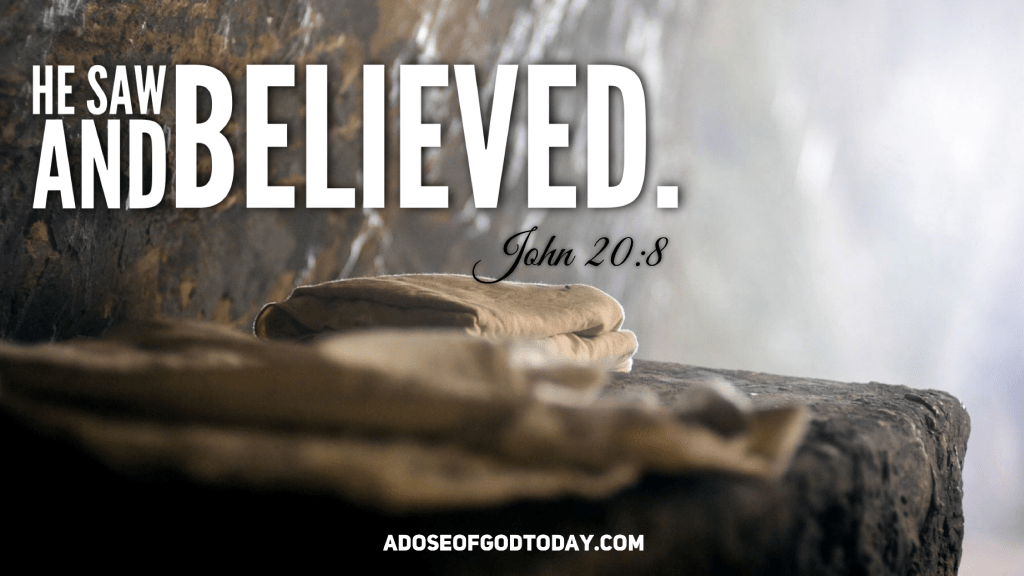
    There was no word being uttered as they saw the empty tomb and the linen cloths. There was only silence. And silence from the empty tomb. They were perhaps confused of that event. But what was interesting was the napkin that had been rolled up in its place. That napkin was used to wrap the head of Jesus.

    But when the beloved disciple entered also in the tomb, he saw and believed!

    Yes, the beloved disciple who was dear to Jesus saw the signs, the empty tomb, the folded linens and napkin. Those were the signs that indeed the Lord was risen. He is alive. However, to these three, they did not yet fully understand what had happened.

    This event triggered something in them and that is to seek their “own resurrection story.” Jesus did not appear to them immediately. Jesus allowed them to have doubts and to believe in him despite their own confusions and anxieties. Jesus permitted them to have a glimpse of his resurrection – a glimpse of the Easter joy.

    This is now the invitation for us– that is to recognize our own resurrection story with the Lord.

    We might find it difficult to find our own resurrection story because like Mary of Magdala and Peter, our hearts might still be clouded with despair and anxieties. Covid-19 has not yet left us until now despite the many weeks and even months for others of quarantine and lockdown. We have terribly missed by now the company of our friends and colleagues. Everyday the infection is rising and deaths are adding too.

    However, let us look again of that beloved disciple who was personally close to Jesus. It was him who saw and believed! 

    But take note of this, what the beloved disciple saw was beyond “physical.” He did not see Jesus rising. He did not witness that. What he only saw and witnessed was the silence of the empty tomb. And beyond that, the beloved disciple felt and realized that something glorious happened. Seeing that, he believed that God conquered death. God has taken away sadness and fear. Jesus is here and he is alive. This is what he believed.

    Therefore, let us come closer to Jesus because each one of us is dear to him too. In that way, we will be able to truly believe that the Lord has risen and has brought hope to all of us. This will help us to recognize the times where God has let us experience our own resurrection – in those times where we found ourselves in hopeless situation, yet we were given hope; in those times where we thought we were not valued, yet we were loved; in those times where we felt that we were abandoned, yet, after all we realized that we have friends and family members who treasured us.

    Recognizing our own resurrection stories will make us more open to God’s invitation to believe in the joyful resurrection of Jesus where God dared to be at the side of the oppressed and the suffering people.

    Let our faces now, be overwhelmed with our smiles and let it be translated into action by doing good things to others, by being more compassionate to your neighbor, by being considerate to those who are most in need, by being friendly and showing concern to people whom you will meet despite the “physical distancing.” Hinaut pa.

    Jom Baring, CSsR

  • God’s promise of salvation and restoration is fulfilled through our participation

    God’s promise of salvation and restoration is fulfilled through our participation

    March 25, 2020 – Wednesday – Solemnity of the Annunciation of the Lord

    Click here for the readings (http://www.usccb.org/bible/readings/032520.cfm)

    Homily

    The first reading relates to us a story of a person who refused God’s offer. Ahaz who was King of Judah was told to ask a sign from God. Yet, Ahaz refused. Why? He was asked so that he may believe in God’s faithfulness and salvation. This refusal of Ahaz was a show of not believing in God and a refusal to trust the Lord. Rather, Ahaz sought help whom he thought was another god, the King of Assyria. 

    Assyria at that time was politically and militarily powerful. Ahaz thought that by going to Assyria then he will have the certainty of protection and salvation. Judah at that time was threatened by other nations. Ahaz feared that his kingdom will end and his people will perish.

    However, despite the refusal of Ahaz, God still promised a sign of salvation. This will be through the participation of a virgin who shall conceive a son, who shall be called, Emmanuel, meaning, God is with us.

    This is tells now that even in our unbelief or refusal to believe and indifference to the Lord’s invitation, God is still in our midst. God remains faithful to us. 

    This is a message to us as we celebrate this Solemnity of the Annunciation of the Lord, to take comfort. Yes, take comfort, brothers and sisters, no matter how much fear, sadness, depression, worries, desperation and anxiety we are feeling at this very moment, God is with us!

    Moreover, this prophecy in the Book of Isaiah was fulfilled through the participation of a young woman who took the risk of trusting God despite the confusion, fear and suffering that she was to undergo. 

    The angel Gabriel, whose name means, “God is powerful,” assured this young woman not to fear for God is with her. The very presence of Gabriel was an assurance to Mary that God was working powerfully and wonderfully with her.

    This encounter has become the space for Mary to receive God’s invitation for her, to be that virgin who shall conceive a son, the greatest sign of God’s promise. The refusal of king Ahaz to God’s invitation was now being countered and redeemed through the acceptance of a simple young woman.

    Mary’s response saying, “Yes, I am a servant of the Lord, let it be done to me according to your word,” was her full expression to participate in God’s action to become closer physically with the whole creation. 

    And indeed, through the generous response and participation of Mary, the promise was fulfilled. God is truly with us!

    This tells us now that our participation is very important for God to fulfill the promise of salvation and restoration, of healing and freedom. Without our participation, God cannot also work with us and through us. God cannot just impose even though God is powerful. God is not an imposing God. This has been shown to us throughout the history of salvation. God always seeks and desires a human response so that the Divine Plan will be fulfilled.

    On this Solemnity of the Annunciation, through the person of Mary and her participation, each of us too is called to respond to God’s invitation, to participate in God’s action of fulfilling the promise of salvation, of healing and restoration particularly in these times of great crisis with the pandemic corona virus that has plagued our communities.

    This is the invitation for us today. We may ask ourselves, how is God calling me now to participate in God’s plan of healing and bringing salvation to all? We do not have to think of big things or big projects. As we stay at home at this moment, in what way I could help to control the spread of the virus? In what way I could be of help for others or bring blessings to those who are most in need particularly those who have lost their jobs, the hungry and the homeless? Or in what way I could inspire hope and give comfort to those who are afflicted, to those who sick, those who are grieving, depressed and lonely?

    These are the questions that I would like you to dwell for today and like Mary, let us also ponder and keep in our hearts God’s invitation so that we too will be able to participate in our own capacities in bringing healing and blessings to others. Hinaut pa.

    Jom Baring, CSsR

  • God is in our midst

    God is in our midst

    March 19, 2020 – Solemnity of St. Joseph, Husband of Mary

    Click here for the readings (http://www.usccb.org/bible/readings/031920.cfm)

    Homily

    When life becomes confusing, messy and overwhelming, how do I react? When a relationship is intrigued by anger or hatred or contempt over a misunderstood situation, am I easily driven by my feelings or do I withdraw from the situation and hide? 

    Today, on this Solemnity of St. Joseph, Husband of Mary, the Gospel presents to us an attitude that portrays wisdom and compassion and above all an attitude that seeks guidance from God. Joseph’s relationship with Mary was intrigued with a suspicion of scandalous betrayal and unfaithfulness.  Within the period of engagement between them, Mary got pregnant. The people in their village knew that Joseph was not the father. Joseph himself was confident that Mary’s child in her womb was not his. Joseph knew that the Jewish law would find Mary guilty of adultery.  This is an act punishable by shame and death. Their law mandated Joseph to divorce Mary.

    In a small village like Nazareth, gossip seemed to be faster than lightning. Surely, every person in their village knew that Mary was pregnant. If we would imagine Joseph, certainly, he too was hurt. He might have felt being betrayed. Joseph was most likely in darkness at that moment, confused and overwhelmed by the situation.

    But then, Joseph showed a non-reactive attitude. Instead of condemning Mary immediately, he showed compassion by divorcing her silently and avoiding to put Mary into disgrace and bullying from others. This particularly, pleased God. Joseph was a good man, righteous and thoughtful. We expect Joseph to have been really hurt by this scandal yet what Joseph showed towards Mary was mercy rather than revenge and love rather than hate and not withdrawal in the midst of his own disappointment, confusion and fear. 

    This has become the way for God to reveal the divine plan. That is why, God revealed to Joseph in the night of dreaming and pondering. Through that revelation, Joseph’s view of Mary and her pregnancy and even of himself became larger and brighter. Joseph began to see the overwhelming and scandalous situation of Mary’s pregnancy through the eyes of faith rather than his fear and disappointment; through God’s love rather than anger and hate.

    Joseph saw and felt that what has been revealed to him was truly scandalous because God revealed Himself to him, because God has become man there in the womb of Mary. It was scandalous because we thought that God is up there or out there in the heavens only, a place that no person can reach. But then, Mary got pregnant. 

    This is what blows our mind now, because through that unexpected pregnancy, God tells us the He is intimately present with us; he tells us that humanity can become pregnant with God.

    After the revelation to Joseph, he understood that Mary’s pregnancy was a statement of God’s faithfulness and commitment to us. God commits himself to be our God; He commits himself to choose us as His people. For this reason, Joseph was told to name the baby, “Jesus, because he will save his people from their sins.

    This is God’s assurance to us now that he is present and he lives in the midst of our lives, in the midst of our pain, of our failures, of our disappointments, hurts and fears and even in the midst of an overwhelming situation as we are experiencing it today amidst the Covid-19 that brought panic and fears in our global community. Jesus is in our midst in order to bring us His mercy, his love and his friendship, and the assurance of his presence and of his healing power. Hinaut pa. 

    May, Joseph, the Husband of Mary, pray for us.

    Jom Baring, CSsR

  • Our Sacred Encounter with God

    Our Sacred Encounter with God

    February 2, 2020 – Feast of the Presentation of the Lord

    Click here for the readings (http://www.usccb.org/bible/readings/020220.cfm)

    Homily

    The gospel that we have heard today reminds me of the inspiring presence of our grandmothers and fathers in our church. Most of our regular church-goers are the senior citizens. They have developed it into a habit and at the same as a devotion to meet the Lord daily in their life.

    In this mass, let us particularly acknowledge their presence in our community and thank them for the witnessing they have shown to us, the younger generation.

    The gospel of Luke tells us of these two elderly man and woman, Simeon and Anna respectively. Both of them were patiently waiting to witness the coming of the Christ. They must have experienced boredom and anxiety as they waited for the Lord to come. Yet, all those dull moments, anxiety and even disappointments in the past were all gone at the arrival of the baby Jesus. 

    Forty days after the birth of Jesus, the baby was brought to the Temple by Mary and Joseph. The coming of Jesus into the Temple was very symbolic. The arrival of Jesus’ presence consecrated the Temple. The Temple is a space where God and the humanity meet. This very space is now consecrated by the very presence of Jesus.

    The meeting was further symbolized by the encounter of the Old and the Young, of Simeon and Anna and of the Holy Family. From this encounter, God’s invitations and surprises are being unfolded to us.

    Simeon upon meeting the Lord, held the baby Jesus in his arms. He carried Jesus which promoted him to bless God. Simeon must have longed to see the Lord but what was given to him was more than seeing God. He was able to touch and carry the Lord in his arms. He must surely had been overwhelmed, felt unworthy yet drawn towards God at the same time.

    This encounter of Simeon with Jesus made him to prophesy. Yet, his vision was entirely based on memory. He remembered that God has promised to be with his people, to send the Messiah. At last Simeon had seen this to come true and seen again how Jesus will become a light for everyone. Jesus is a light who shall illumine every darkness in our hearts and lives.

    Moreover, the prophetess Anna would always go to the Temple because of her desire of seeing and meeting the Messiah. For many years, she persisted despite the dull and boring days that she had to spend while waiting for the Messiah to come. However, her faith bore fruit when Jesus arrived. At last, Anna met and encountered the Messiah. 

    It was not difficult for her to recognize Jesus because her heart was ready and open for his coming. Thus, she immediately recognized the Lord and was delighted for that encounter. That encounter too changed her life completely.

    From these encounters on this Feast of the Presentation of Lord, there two invitations for us. 

    First, like Simeon, let us allow God to encounter us that we may be able to hold him in our arms. Holding God in our arms is more than feeling his presence but being convinced of his presence in our life. To hold God in our arms also means to be in touched with God, with ourselves and with what surrounds us that include our brothers and sisters and rest of God’s creation. To hold God is to be welcoming to all.

    Second, like Anna, let us always desire to meet God whenever and wherever we are at this very moment. Let us remember, if we desire to encounter God, God desires it all the more to encounter us. And may our encounter with Jesus cast out our anxiety, boredom and doubts for his presence brings us joy, freshness and life. 

    Like them, we may become convinced in what we believe by translating our faith not just into words but also concrete actions of love and kindness. Hinaut pa.

    Jom Baring, CSsR