Category: Feasts

  • To Become Persons of Encouragement

    To Become Persons of Encouragement

    Advertisements

    June 11, 2020 – Feast of St. Barnabas, Apostle

    Click here for the readings (http://www.usccb.org/bible/readings/061120.cfm)

    People who encourage others would always bring support and growth because encouragement nurtures confidence and hope. Parents who would give generous encouragements to their growing children would find children to be happier and lively. Teachers who would also express words of encouragements to their students would find them animated to perform well in their studies. 

    This is also true among employers or corporate heads. A supervisor or manager who is generous in expressing encouragement to his/her workmates or colleagues or employees would surely find people around him or her to work confidently and competitively in a healthy way. Thus, a person who is being looked up by many as a leader and expresses words and actions that unite people, that heal division and reconcile differences, creates a space that bring people to work together. However, when a leader or any authority figure becomes vicious in his or her speech or acts unfaithfully from his or her duties, promises and words, then, he or she promotes unwarranted conflicts and stress to people.

    Moreover, when words of encouragements are expressed whether at home, at school or at work, they lessen unnecessary stress, avoid unnecessary conflicts and rather promote self-confidence, trust and hope. 

    This attitude of encouraging others had been shown to us through the person whose feast we celebrate today. St. Barnabas, an apostle, was a man of encouragement. During his lifetime, in his ministry, he never forgot to encourage people around him. In fact, it was through his encouragements, together with St. Paul, that they helped and nurtured the early Church to grow and to mature. It was in the Church of Antioch, through Barnabas too, that the Church realized that indeed, it is Catholic or universal in its nature. In Antioch, Jews and Gentiles lived together. Despite the differences in culture, language, and history, the Church became one in faith but so dynamic and vibrant in living together as Christians. 
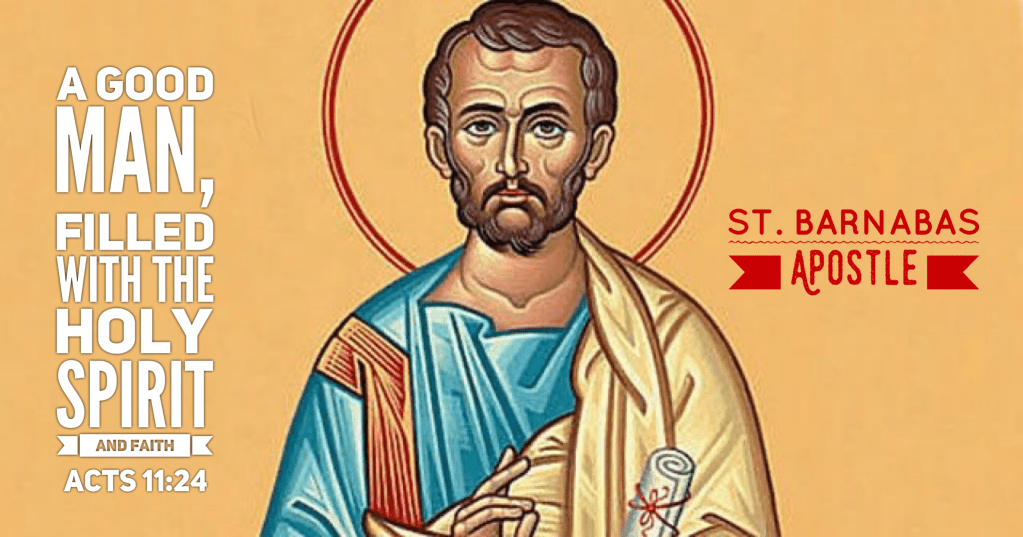
    It was in Antioch also, that we, believers of Jesus, were first known as “Christians.” Thanks to that attitude of Barnabas because his encouragements to the first Christians made them confident in living together and become reconciled with one another. In fact, the name Barnabas means, “the son of encouragement.”

    The Acts of the Apostles reminds us of the attitude of Barnabas that he was “a good man, filled with the Holy Spirit and faith (Acts 11:24).” This tells us that when we welcome and allow the Holy Spirit to satisfy us, then, we also become discerning on how the Holy Spirit works in the life of those people around us. Certainly, we become familiar to the movements of the Spirit and become welcoming to God’s invitations for us.

    This calls us now to become welcoming of others. We shall surely see more opportunities of growth and rooms for developments for ourselves and for those people around us. Accordingly, we see more value in expressing encouragement rather than in blurting out destructive criticisms that may only damage one’s self-confidence and the hope to redeem oneself after a failure. We also see more value in expressing encouragement rather than in making threats that would incite violence and indifference toward others.

    Thus, on this feast of Barnabas, each of us is being reminded and called to be more welcoming of the Holy Spirit in our life so that our hearts and minds will be filled with wisdom, understanding and compassion particularly in these trying times where this pandemic has caused so much stress and anxiety in our life. 

    We may  become then, persons of encouragements that promote growth, confidence, trust and hope in our own context; whether at home, at work, or wherever we are called to be. Hinaut pa.

    Jom Baring, CSsR

  • The Word of God nourishes and challenges us at the same time

    The Word of God nourishes and challenges us at the same time

    Advertisements

    June 5, 2020 – Friday 9th Week in Ordinary Time; Memorial of St. Boniface

    Click here for the readings (http://www.usccb.org/bible/readings/060520.cfm)

    The Holy Scriptures or the Bible is of great importance and gift to our Christian faith. The Second Letter of Paul to Timothy tells us that the scriptures will give us wisdom that leads to salvation, through faith is Christ Jesus. This means that by knowing and developing a relationship with Jesus brings us to freedom being experienced as individuals and as a community, as a church.

    Paul reminds us too that “all scripture is inspired by God.” As this is inspired by God, the Bible teaches us how God reveals the Divine Plan of Salvation. Hence, God in his great love for us has become man like us to feel what we feel, that God may be in solidarity with us.

    Moreover, the scriptures also refute error and corrects us. It means that the bible is not merely a passive literary work of some people, but it confronts us of what is wrong with us, of what is unjust and oppressive, of what is sinful. The scriptures then, bring us to be closer to God’s presence and to understand better the wisdom of God working in our life.

    Consequently, the scriptures serve as our guide to follow closely the Lord in our life. This is what Paul shared with Timothy. Following the Lord gives us peace and confidence in what we do yet this will also bring us challenges and difficulties as Paul experienced persecution from people who rejected Jesus.

    Paul was inspired by the Lord and committed his life to God. This was how Paul’s heart was captured by God. Paul’s heart gladdened at the revelation of Jesus to him which made Paul to be converted. This is what we have heard from the Gospel today, “many people came to Jesus and listened to him gladly.”

    That gladness came from that revelation of God, of God speaking to us. As Jesus spoke to Paul, Paul could not keep silent then. This was how Paul turned from being a brutal persecutor to a life-giving apostle of the Lord.

    Today, the Lord invites us that as we celebrate the Liturgy of the Word, let us also listen gladly to the Lord.

    Thus, let us allow the Lord to speak to us, to nourish us and at the same time to teach, correct and challenge us. Let the Lord confront us of our passivity and indifference towards others, of our sin and guilt, to confront us when we only settle to what is only comfortable and beneficial for us and to confront our hearts and conscience when we choose to keep our eyes blind from an unjust system.

    In this way, we may become Christians who like St Paul and St Boniface who were martyred because of what they preached, to also become a light and inspiration in this time of pandemic where our religious freedom is also being tested. Hinaut pa.         

    Jom Baring, CSsR

  • Having friends? Or being a friend?

    Having friends? Or being a friend?

    Advertisements

    May 15, 2020 Friday 5th Week of Easter – Memorial of St. Isidore the Farmer

    Click here for the readings (http://www.usccb.org/bible/readings/051520.cfm)

    How many friends do you have in your Facebook account? Or in your other social media accounts? Certainly, those who have fb account or accounts have hundreds of friends. Others even have a thousand or more friends. Well, a Facebook account has a limit of 5000 friends. But, do we really consider every person there, in our account, as a “friend?”

    Today, the word “friend” is differently understood. Our friends in our social media accounts are actually our contacts. However, having those “friends” does not mean that we have a personal relationship with them. Perhaps, to some people, but mostly, we don’t, because among the thousands of friends we have, many can be are acquaintances at school, at work, business or during our summer vacations and trips.

    It has become so common to have such tendency to accumulate friends, to make and have friends, to be socially connected with others through the internet, and to be identified by the people to whom we make contacts.

    Aside from this, there is also another form making friends which can be toxic. It means that such form of relationship is only based on advancing one’s self-interest. Such form of friendship is commonly called as “alliance.” Such alliance protect and promote one another’s interest no matter how selfish and oppressive it could be. It does not look on how one will be able to give life to other in a self-sacrificing manner. It is inclined on what and how I could benefit, gain favor and advance my interests and agenda.

    Thus, we might have become more conscious of having friends, affiliate or make an ally ourselves with others rather than “being a friend.”

    To have friends and to be a friend have different natures. To have friends has the tendency to be self-absorbed, self-conscious and selfish because this attitude looks inward. However, to be a friend is an action that comes with commitment. It is self-giving and self-sacrificing. Hence, this attitude is other-oriented and life-giving.

    This is the kind of friendship that Jesus is talking about in the Gospel. Jesus calls each of us to be his friends. The friendship that Jesus offers is self-giving and self-sacrificing. Jesus commits himself to us as our friend. His commitment is summed up in his love for you and for me by offering himself to the cross on our behalf. 

    Thus, the friendship of Jesus is not about using us or so that he may get something from us. His friendship with us is about giving oneself. Through this friendship, he calls us as his friends, not slaves, not mere acquaintances or contacts, or allies.

    This is how we remember today St. Isidore, a Spanish Farmer who was a friend to many, to humans and to animals. His simplicity and hard labor became a way where he grew in his friendship with the Lord. It was said that he would always spend much time in the Church to commune with Jesus. And as the story about him circulated, an angel would instead plow the field while Isidore was in the Church. Other miracle stories became popular also as Isidore would give his bread to the hungry without running out of supply of bread.

    These stories tell us that such friendship with Jesus makes us more aware of the needs of others. Moreover, to become a friend of Jesus makes us a friend to everybody. With Isidore, he was a great friend who gave life to people and to the nature.

    St. Isidore, the Farmer (image from Aleteia.com)

    This is Jesus’ invitation to each of us now, that you and me will grow in that friendship with Him. Thus, we are called to develop our personal and intimate friendship with Jesus through our constant “chats” expressed through our prayers and this Eucharist. Friendship grows when we come to know each other both our pain and joys, failures and dreams. 

    And because this friendship gives life, our friendship with Jesus should also inspire us “to become real friends with others.” Yes, you and me who are friends of Jesus are called to be a friend of everyone and to express the same love that we have felt from Jesus by giving ourselves too, to “shout out” the goodness that the Lord has revealed to us and “to post what’s on our mind and heart” so that others may know and grow also in their friendship with Jesus.

    In times such as this pandemic, our friendship could be one of the best comforts we could offer to those who are distressed, anxious and in need. Thus, maximize also this Community Quarantine by making sure that you parents will become best friends of your children, and children to their parents, siblings to siblings, and to the rest of the people around you.

    So, friends of Jesus – go and be a friend to others!

    Hinaut pa.

    Jom Baring, CSsR

    Join 2,868 other subscribers
  • When Love liberates and empowers us

    When Love liberates and empowers us

    Advertisements

    May 14, 2020 – Feast of St. Matthias, Apostle 

    Click here for the readings (http://www.usccb.org/bible/readings/051420.cfm)

    A friend of mine once shared to me why she became confused and distressed. She was restless and depressed because of a deep-seated emptiness within her. She felt unloved, rejected and worthless. Her parents separated when she was young, her father was so strict that she could not even express what she needed, her siblings treated her as if she’s not existing, at school she was bullied. She’s aware that she has a house to live, but she has no home where she feels being loved, supported and affirmed. This emptiness in her heart haunted her when she’s asleep even when she’s awake. Her life became so dry and meaningless. She does not know where to go.

    To feel being loved and affirmed is everyone’s need. Love gives brightness and meaning to our life even in the midst of suffering and much difficulty. That is why, when love seems absent, life becomes a horror. 

    This reality reveals the imperfection of our human relationships. Though our relationships are the source of our fulfillment and joy, yet, it is through our human relationships also that we find the deepest pain and frustrations because of rejection and at times betrayal. But, that is not the end of everything because even out of a messy relationship, something can grow.

    This is where we can find the presence of God. As God joined us in flesh in our history, God also dwells in our human relationships. Jesus was born into a family and gathered people and made them his friends. Within this context, Jesus experienced rejection as well as betrayal from people closest to him. Yet, despite this painful experiences, we also find redemption, we find forgiveness and find life.

    TODAY ON THIS FEAST OF ST. MATTHIAS, AN APOSTLE, OUR READINGS GIVE US THE COMFORT THAT WE ALL NEED WHEN ALL OUR HUMAN RELATIONSHIPS FAIL. WITH IT, WE RECOGNIZE THE NEED FOR REDEMPTION AND FORGIVENESS.

    In the Gospel, Jesus says to you and to me, “I love you!” John, who is believed to be the author of this Gospel and traditionally, as the beloved disciple,  truly felt the weight of this love. It was because of this love that made him to stand strong even in the midst of confusion at the arrest of Jesus. He followed Jesus on his way to be crucified. John was also present at the foot of the cross of Jesus with Mary and witnessed the death of his Lord. John was also the first to believe in Jesus’ resurrection upon seeing the empty tomb despite his confusion and fears. 

    However, aside from him, the rest of the disciples of Jesus were nowhere to be found. Judas betrayed his Lord and Master and killed himself. Peter denied Jesus three times. And the rest? They all fled and him themselves because of fear. However, the Lord never abandoned them. The Lord never gave up on them. The Lord will never give up on us.

    This is how we find the Gospel truly life-giving. Jesus says, “There is no greater love than this, to give one’s life for one’s friends; and you are my friends.” Jesus calls us his friends and nobody can take that away from Jesus. Hence, even with rejection, denial and betrayal, these will not make Jesus to withdraw from us. “You are my friends,” says the Lord.

    This is the same love shown by Jesus in the most concrete way, that the disciples were converted. They began to see their imperfection that though they were all unworthy, but Jesus remained faithful till the end. This is the love that made the disciples to become confident and daring. The love that they truly believed is life in itself for them. Thus, as a community, we believed that God first loved us and because God is faithful, God will always love us even if everyone and everything goes wrong.

    This love then, empowers the disciples. This is how we find the story of Matthias being chosen to be part of the 12 Apostles who were sent to continue what Jesus has started. Matthias became part of this apostolic ministry that proclaims the life of Jesus and the power of his resurrection.

    It is the same love that God tells us today. When rejections, betrayals and fears haunt us, when our relationships fail, and begin to feel unloved, then, Jesus tells each of us, “I LOVE YOU AND YOU ARE MY FRIEND.” God is totally in love with you and with me. Be assured and be confident in that love because His love is constant and faithful.

    It should be this same love that would hopefully lead us to see the light and joy even in the midst of suffering and pain in life, even in the midst of rejection and betrayal of people who are close to us, and even in the midst of worries and anxieties in times of pandemic. 

    Advertisements

    This love should also inspire us to respond in love, to express our love to God, to ourselves, and to others even to those who have hurt us and people we do not like. This is the commandment of Jesus, “love one another as I have loved you.” St. Matthias is a witness to this. This is the reason that he also committed himself to Christ that he may be able to give life to the Church even in the midst of persecution.

    Indeed, God’s love is liberating and empowering. This is how Easter becomes glorious because God’s love empowers and liberates. As we are being loved, we are also moved to love. 

    Loving and being loved certainly make our life worth living. Love gives us purpose and meaning in life and this becomes concrete as we continually reach out to others to express our love and show our kindness. Thus, hopefully, we may not become reasons for others in making their lives miserable and horrible because of our indifferent, childish and selfish desires and intentions.

    May I invite you then today, show your kindness to people around you in the most concrete way. Make that person feel being loved as God lets you feel being loved today. Hinaut pa.

    Jom Baring, CSsR

    Join 2,868 other subscribers
  • Listen. Live.

    Listen. Live.

    Advertisements

    May 13, 2020 – Memorial of Our Lady of Fatima

    Click here for the readings (http://cms.usccb.org/bible/readings/0513-memorial-our-lady-fatima.cfm)

    Did Jesus just downplay the role of his Mother, Mary by saying, “Rather, blessed are those who hear the word of God and observe it?”

    On this memorial day of Our Lady of Fatima, the Lord has actually reminded us how Mary, his mother, is indeed blessed. Mary is blessed among women not just because she carried Jesus and nursed him. Before Mary conceived Jesus, Mary listened to God. Mary welcomed the word of God proclaimed to her. By listening to the word of God, Mary observed it. Mary lived the word of God. 

    This is how Mary silently lived her life within the life of Jesus. And living in that life, Mary became life-giving for she is at the very source of life and of love.

    Hence, the conception of Jesus in the womb of Mary was made possible through her generous participation in the Divine Plan of God. Mary indeed opened her heart and welcomed God’s word. This action of Mary made God’s plan to be fulfilled in our history, through a human participation.

    As a consequence to that, Mary conceived Jesus in her womb. Mary became pregnant with God and brought the Immanuel in our midst.

    Today’s memorial of the first appearance of Mary in Fatima, Portugal in 1917 to the three children, Lucia, Francisco and Jacinta reminds us also of the blessing that we have received from God. Mary’s appearance would tell us of God’s presence in our midst. It is a reminder that God has not forgotten us. God is with us.

    Thus, the call to pray the Holy Rosary daily is a call to constantly listen to God. The Holy Rosary is not a mere memorized prayer that must be done dutifully. Rather, it must be done “prayerfully.” Doing the Rosary “out of duty” is not what Mary wanted because with that attitude, it will only make us tired and disappointed once we have not done it. The invitation is that the Holy Rosary becomes a channel for us to converse with God – in listening to God and listening to ourselves.

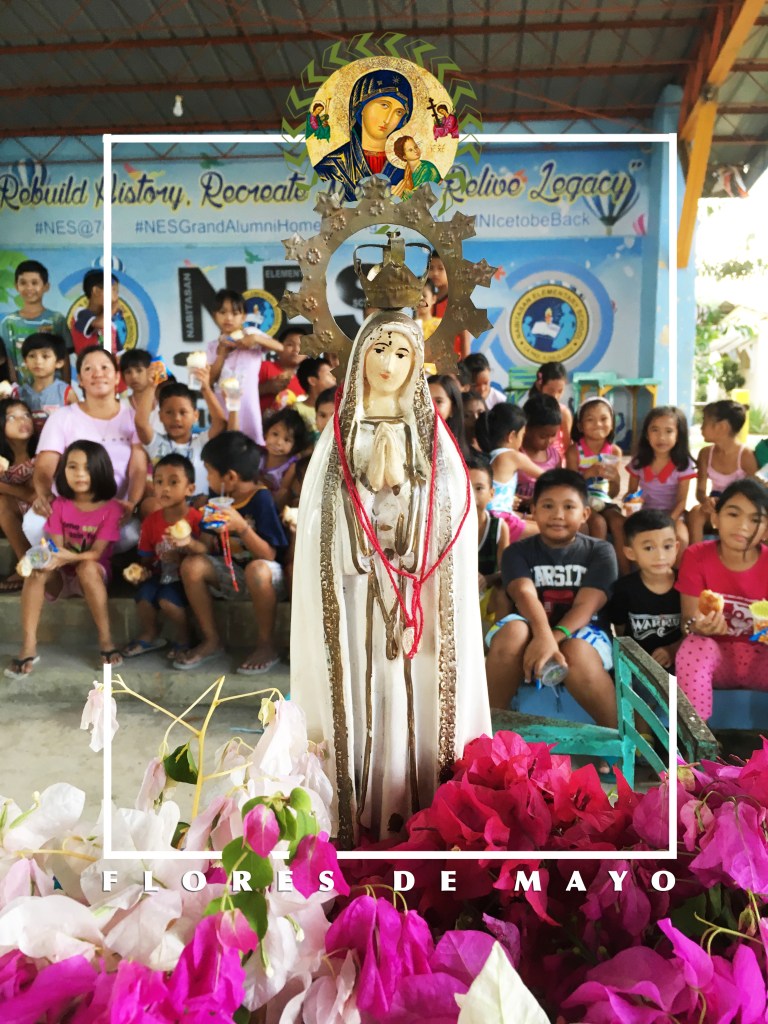
    During this month of May, children are being taught to pray particularly the Holy Rosary. Yet, due to the Covid-19 pandemic, this annual religious gathering is also suspended. (Photo from Brgy Nabitasan, Iloilo City 2018)

    The repeated prayers in the Rosary and the mysteries attached to each decade are invitations to dwell deeper in the life of Jesus. In every decade, it is an invitation to see our life, and the life of our brothers and sisters within the life of Jesus recalled in every mystery in the Holy Rosary.

    The Holy Rosary then, is a form of making ourselves more aware of God’s presence and more attuned to God’s word, to God’s many invitations for us. 

    This is where we realize how “blessed” we are, because God speaks to us. We are invited to listen to Him and to live by the word of God as Mary, our Mother, did it.

    May Mary, the Lady of Fatima, teach us how to listen prayerfully and lovingly to God’s words revealed in the Holy Bible, in our Sacraments, in our relationships and in our daily affairs with the world. By living God’s words, we may find life then, and become life-giving to every person whose life we are able to touch today. Hinaut pa.

    Jom Baring, CSsR

    Join 2,868 other subscribers