We gather tonight in the darkness, yet not without hope. Because we know that this darkness does not have the final word. And this is very real for us today. We see violence in many parts of the world. We hear of conflicts, of war, of innocent lives lost. Even in our own communities, there are fears, divisions, and moments when peace feels so fragile for us.
Recently, voices in the Church, including Pope Leo, have called on world leaders to stop the violence, to end the cycle of hatred, and to choose peace over war. Because violence only deepens wounds, and hatred only multiplies darkness. This is not the life that God desires for us as His people.
And so tonight, in this Easter Vigil, we are invited to ask very personal questions, “How is the quality of my life now? Do I live in fear? In anger? In anxiety? In jealousy? Or do I live in gratitude, in peace, in right relationship with others, in joy with Christ?
Let us remember, what we celebrate tonight is not just an event from the past. It is about life in its fullness and life that is free.
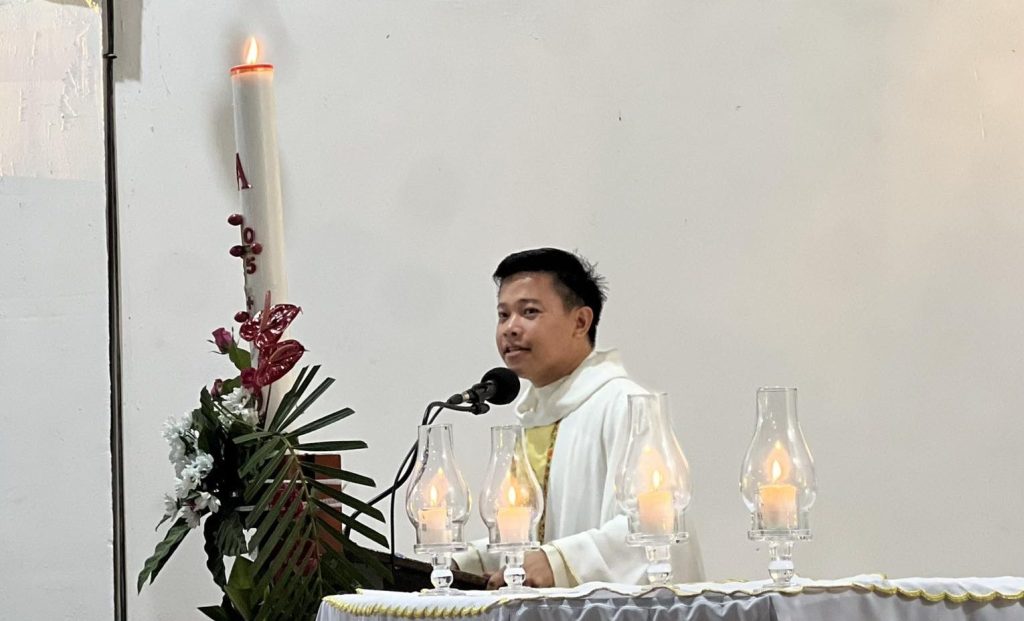
At the beginning of our liturgy, we blessed the new fire. From that fire came the Paschal Candle, the light that broke through the darkness. This light reminds us that Christ is our beginning, our Alpha and also our end, our Omega. And this same Christ now offers us light so that we may truly live.
The readings tonight unfold this story of life. In the beginning, God created life and saw that it was good. Life is a gift, indeed. In Abraham, we see a faith willing to trust God even in sacrifice. In the crossing of the Red Sea, we see a people freed from slavery and walking from death into life. In the letter of Paul, we are reminded that through baptism, we die to sin and rise to new life.
And finally, in the Gospel, we are brought to the tomb. A place of darkness. A place of grief and a place of hopelessness. And yet, it is precisely there that the greatest truth is revealed to us that the love of God is more powerful than death.
Thus, the women came expecting to find a dead body. Instead, they found an empty tomb. They found life where there was death, and hope where there was despair.
In this sacred event in our history, we also find our story. Because there is a danger we must face honestly, the sin of indifference. When we become numb to the suffering of others. When we only think of ourselves. When we ignore the needs of the poor. When we allow dishonesty, greed, and injustice to continue because it benefits us. This is indifference.
A divided community, a community that abuses the weak, a community that lives in lies and manipulation is a community living in darkness. And we see this not only in society, but sometimes even in our own hearts. This is indifference.
But tonight, the Resurrection breaks that darkness. The light we received and the water of our baptism are not just symbols. They are realities. They remind us that we are made for more. We are made for life that is free, joyful, and shared.
Only when we begin to see each other as brothers and sisters, only when we recognize that everything is a gift, can we truly experience this fullness of life.
This is why the Church calls us to reject the culture of indifference and the culture of hatred. Because these lead to division, to violence, and to war. However, we are called to something greater and that is to build a community of peace, reconciliation, and love.
Here in Marawi, where faith is tested, this message is even more urgent. The Resurrection of Christ tells us now, “Do not be afraid.” The light of Christ tells us now, “Do not remain in darkness.” And the empty tomb of Christ also tells us now that “life will always rise again.”
And so tonight, we are invited not only to celebrate, but also to choose. With that, I leave you with two takeaways.
First, choose to care. Each day, make one concrete act of concern for another person especially someone in need. Break the culture of indifference.
Second, choose to be a light. In your words, in your work, in your relationships bring honesty, kindness, and peace. Even in small ways, be a witness to the Risen Christ.
Remember, the tomb is empty and Christ is risen. And because He lives, we are called to live fully, freely, and lovingly. This is the fullness of life. Hinaut pa.
Tonight, as we begin the Sacred Triduum, we gather not only to remember the Last Supper of Jesus, but to enter into its meaning. And we do this, as we carry the realities of our lives as Christians here in Marawi. Many of you have felt uncertainty in expressing your faith freely. There are moments of fear, of hesitation, even of silence. Indeed, in the past 4 Sundays, some of us have felt terrified of even coming to the chapel for our liturgical celebrations. Yet, we continue to worship, but sometimes with caution. Though, we continue to believe, but sometimes with heaviness in our heart.
And in such a situation, we may quietly ask, “Where is God? What power do we have as Christians in a place where we feel small, vulnerable, and sometimes even threatened?”
The Word of God being revealed tonight gives us a profound answer. It tells us that true power is neither found in control, nor in force, nor in dominance. Rather, true power is found in love that serves, and in humility that gives life.
In the Book of Exodus, we hear of the Passover. The people of Israel were weak, enslaved, and oppressed. They had no political power, no military strength. And yet, God saved them not through human force, but through God’s faithful presence. The lamb was sacrificed, the blood marked their homes, and that night became a passage from slavery to their freedom.
This tells us that God’s power is not always loud or visible, but it is always saving, always faithful, and always present.
In the Second Reading, St. Paul reminds us of what Jesus did on the night He was betrayed. He took bread, gave thanks, broke it, and said, “This is my body… This is my blood.” Jesus transformed an ordinary meal into the greatest act of self-giving love.
And then in the Gospel, we see something even more striking. Jesus, the Lord and Master, knelt down and washed the feet of His disciples. Let us pause here for a moment.
Jesus had power. He knew who He was. He knew where He came from and where He was going. And yet, He chose to serve. He chose to kneel. Jesus chose to love in the most humble and concrete way.
This brings us to the heart of our reflection tonight. We ask, “What is power, then?”
Power is the ability to influence, to create, and to transform. It can be used for good or for evil. When expressed through love, it becomes service and self-giving. But when used wrongly, it becomes control, manipulation, abuse, and even destruction.
Each of us carries power. As long as we live in community, we influence others. Our thoughts, our emotions, and our actions affect the people around us. In our families, in our workplaces, in our communities and even in our silence, we shape the lives of others.
And this is where the danger lies. When we become insecure, when we forget who we are, and so, we begin to misuse power. We will try to compensate. We will try to dominate. And we will try to protect ourselves at the expense of others. This is how relationships are broken. And this is how communities are wounded.
We see this clearly in Judas. The Gospel tells us that the devil had already influenced him. His heart was already leaning toward darkness. He thought that his actions would bring him gain, security, perhaps control. But in reality, he was being manipulated. He was no longer free. Judas was no longer himself.
This is the power of evil. It slowly pulls us away from light, disguising itself as advantage, until we find ourselves lost, and away from the grace of God
But here is the beautiful and powerful truth also of tonight. Remember, even in that moment of betrayal, Jesus did not withdraw His love. Rather, Jesus washed the feet of His disciples including Judas. Jesus offered His body and blood to all of them, even the one who would betray Him.
And this is the power of God – a love that does not exclude, mercy that does not withdraw, and service that does not count the cost.
Friends, this is the power given to us as Christians. Not the power to dominate. Not even the power to retaliate. But the power to love, to serve, and to remain faithful even in difficulty and in the midst of threats.
And tonight, this becomes very concrete in the washing of the feet. Those whose feet will be washed come from different walks of life, young and old, civilians and uniformed personnel. This is not accidental. This is the Gospel made visible to us as a Christian community here in Marawi.
Because the call to love and serve is not limited by status, role, or identity. Every person, regardless of who they are, is called to share in this life-giving power of Christ.
In a place where we sometimes feel divided, misunderstood, or even threatened, Jesus shows us another way: to build relationships, to affirm dignity, and to serve one another in humility.
Indeed, as Christians here in Marawi, our faith may feel small but it is not powerless. Remember, every act of kindness is power. Every moment of patience is also power. Every choice to forgive, to serve, and to remain faithful is the power of God at work in us and through us.
As we enter the Triduum, we are invited to examine ourselves too. How do I use the power given to me? Do I build, or do I destroy? Do I serve, or do I control? Tonight, Jesus kneels before us not only to wash our feet, but to teach our hearts.
And so, let me leave you with two simple and concrete invitations.
First, choose one act of humble service each day. It may be small as you help someone, or in listening patiently, in offering time but do it with love. This is how God’s power flows through you.
Second, examine your heart each night. Ask yourself: Did my words and actions today give life or cause pain? Then, ask for grace to love better the next day.
Indeed, the world may define power in many ways. But tonight, Jesus shows us the truth that the greatest power is love that gives life. And when we live this kind of power, even in weakness, even in fear, even in our uncertainties we become instruments of God’s life in the world today. Hinaut pa.
“It is finished.” These were the last words of Jesus as he bowed down and completely handed over his spirit to the Father. The scenes of betrayal, denials, tortures, insults, humiliations and indifference towards him were overwhelming. Yet, Jesus remained silent in many instances to allow humanity to look at the growing hatred in the hearts of many and to recognize as well how God patiently gazed at each of us, calling us to that kind of loving and self-giving that is of complete madness.
Yet, in this madness, we are spared from eternal death through the life, suffering and death of Jesus. This is what makes this horrible day turned into Good, because evil and death is to be overcome by love and life. Hence, we call this Good Friday.
Indeed, Jesus suffered and Died. Jesus knew that he will suffer and die but at the beginning he did not know how he will it be. This was something that Jesus had a control but he let go of his power to have full control of his life. Jesus rather submitted himself to the will of his Father. He emptied himself, did not cling to his power and divinity, for us to be given life.
God’s commitment to us and in our covenant with him, is so deep and great. God is most willing not just to become like us but also to suffer and to die like us and for us. But what is really sad, is that Jesus was a victim of an unjust political system, a victim of manipulation of the powerful in the society. He suffered because of the greed of the powerful. He died because of the corrupted heart of those in power.
The Lord embraced suffering and death because that was his ultimate expression of “solidarity with the suffering.” His suffering and death was an insult to those who wanted to stay in power. The all-powerful God embraced human suffering and death to tell us that everything in this world will also end. No matter how much wealth and power we will have, those will come to an end.
However, let us also remember that Jesus’ death was a REDEEMER’S PAYMENT. The punishment of human sin is eternal death and misery. But because of the death of Jesus, God paid our debt, so that we won’t have that eternal death and misery.
Photo by Agree Portraits
Remember again, the sin of Adam and Eve to become like God, was the image of the whole humanity’s sin to act like God and to be like God. Thus, Jesus’ death on a shameful cross broke also that separated us from the grace of God. Jesus brought us back again into God’s presence. Nevertheless, death is never the end. Suffering and death is not everything in this finite world. There is more, even beyond death.
From here, we are called to silently gaze upon the cross, to look at Jesus and see ourselves. Yet, let us also look beyond, let us also see our families on that cross, our friends, our communities, our nation and world that is suffering and in need of redemption.
Let our silence and God’s silence on the cross, bring us more into the heart of God that constantly calls us into life and freedom. Kabay pa.
Power is an ability to influence, to create and transform. It can be either positive or negative. When power is expressed as a positive force via affirmation, then, power builds respect. When is expressed through love, then, power transforms into service and giving of oneself. However, when power is expressed as a negative force, it leads to coercion, manipulation, abuse, exploitation and even to death
Each of us is a bundle of energy, of power. We possess power as long as we live with others because power can only exist and be exercised in the context of community. Hence, power is entirely about relationship because power is an exercise of influence, which can be realized only in the context of community.
We remind ourselves that it is also in the context of our relationships that we discover who we are, our talents and capacities, strengths and potentials, as well as our weaknesses and limitations. It is in the community that we also understand ourselves the “I am.” I am – is the uniqueness of the person whatever his or her status in life. Our person regardless of our social standing, sexual orientation, age, educational attainment or role in the family or community, is called by the Lord to share in God’s fullness of life, living in a community. Our person also is gifted with THINKING, FEELING, and ACTING. These are forms of power which can be expressed positively or negatively within our community
Our thinking, feeling and acting can, indeed, influence others. Through thinking we create ideas, we make plans and decisions. Through feeling or emotions, our thinking and acting can be influenced. Our feeling may dictate our thinking and in the process also affect our actions. Through our actions we initiate movements that may directly and indirectly affect our environment, which include the people around us.
Thus, when we become anxious of ourselves and less aware and knowledgeable of who we are, there is a tendency of insecurity. Insecurity leads us to compensations, which means that what is lacking in us, we try to compensate in other forms. For example, a child who is abused physically or verbally at home, may tend to be a bully at school to exercise dominance. Or a person who is deprived of things, like food, toys, and clothes at home may tend to become a hoarder later on. The person will try to collect and possess more, to feel some sense of security. While trying to satisfy himself/herself, the person may in turn deprive others too.
These are expressions of power that are also being unfolded as we begin the Paschal Triduum of Christ beginning today and will culminate in the Resurrection of Christ. Yet, for now, what I want to focus more is on how power in its positive and negative forms give influence to people and transform us. It is good then, that we become aware on how the power of Satan suppresses life and how the Power of God gives life.
Let us look first at the power of Satan and on how it controls and brings death. The Gospel of John clearly tells us that the devil had already induced Judas, to hand Jesus over (John 13:2). In the same Gospel, it was also described that as soon as Judas took the morsel, Satan entered him (John 13:27). The intentions of the heart and actions of Judas were already leaning towards the evil spirit, hence, it was easy for Satan to get hold of Judas and bring him deeper into darkness and sin. This was how the devil influenced the mind, decisions and actions of Judas.
Judas must have thought that his desires and longings will be fulfilled through these actions and decisions of him. Yet, he was wrong. He was controlled and manipulated. He was not himself anymore. Judas was in total darkness. Satan was controlling him, perhaps, even without fully realizing that the evil spirit was already manipulating him farther away from the grace and light of Jesus and closer to darkness and death. This led him to his pitiful death. This is how the power of Satan controls us and brings us farther away from the grace of God.
However, let us also not forget how Jesus turned upside down this terrible event. Even though that happened to Judas, but Jesus turned that night of betrayal and pain through the power of love and mercy.
This was described to us as Jesus assumed the humble position of washing the feet of his disciples. It was power expressed through service and humility. Jesus tells us that being a person with power as an authority figure or leader is not about controlling others or manipulating others.
As Jesus washed the feet of his disciples, he gives a model of a life-giving way of expressing power and that is through service and love. This tells us too that the power of being a Christian is having the capacity to serve and love without pretention, without manipulation and that does not count the cost. Christian Discipleship is indeed a form of power, a life-giving power.
This call and invitation to exercise power as a Christian Disciple applies to all, regardless of our age, gender and sexual orientation, social status, educational attainment or state in life. Indeed, to be a disciple of Christ is to give life just as Jesus gives his life for us. And this is the true expression of power which is sacramentally given to us through the shared meal on that Last Supper of Jesus. This is what we powerfully remember today.
It cannot be denied that at the Last Supper of Jesus, his Body and Blood were given also to a disciple, a friend and a companion who betrayed him on that night. Yes, even Judas was in that meal. He too received the body and blood of Jesus even though he was not in the “state of grace.” Jesus gave and offered his body and blood for Judas and for us who are also potential Judases[1] today. This is the power of forgiveness, the power of unconditional love, the power self-giving. This is the power of God.
As we enter into the Paschal Triduum, let us also allow the power of serving, of loving, of caring and of compassion to be the very power we express in our relationships, in our roles and leadership, and in our life through our thinking, feeling and acting. Let the power of God transform any forms of control, manipulation, and abuse into life and into love. Kabay pa.
[1] In the words of Bishop Pablo David, DD, Bishop of Kalookan.
To see the goodness in us as God sees it, can be a struggle. It can be really difficult and might even next to impossible for others. We might recognize the innate goodness in us but we might also forget about it and so fall again into self-pity, guilt and shame.
Time and again, these feelings of shame, guilt and fear may struck us and we will realize how broken and unworthy we are. God has been so good to us and yet, we are sinners, unfaithful to God. This is how we encounter ourselves and so encounter God as well.
But such encounter with the Lord would reveal to us that each of us, does not earn God’s favor and grace. I cannot and will not earn God’s mercy because God grants it freely and generously to you and to me. Friendship with God is also offered freely. We are not forced to accept it. We are rather invited to embrace that friendship. And our friendship with Jesus, cannot be broken,[1] as Pope Francis said. Indeed, it is from this mercy and friendship with Jesus that we are also being transformed, healed and reconciled.
This reminds me of St. Paul’s realization of being transformed by mercy and of friendship. Paul said, 1 Cor 15:8-10.
Last of all, as to one born abnormally, he appeared to me. For I am the least of the apostles, not fit to be called an apostle, because I persecuted the church of God. But by the grace of God I am what I am, and his grace to me has not been ineffective. Indeed, I have toiled harder than all of them; not I, however, but the grace of God [that is] with me.
As Jesus revealed himself to Paul whose name was Saul at the beginning, Paul saw his own shadows. Paul was in fact in disgrace because as a Jew, he felt so righteous, and he persecuted those who believed in the risen Christ. He brought many Christians to prison and even to their death. But his encounter with Jesus turned his life upside down. It began when he was on his way to Damascus and Jesus appeared to him in a vision.
Yet, he found the Lord without condemnation against him, but only with love and forgiveness for him. That encounter with Jesus brought him to see how wrong he was. Moreover, that very encounter of Paul with Jesus, was also the beginning of their friendship. And that friendship led Paul to commit himself to the risen Christ to be an apostle to the Gentiles, and that through the grace of God, not earned but freely given.
Aside from friendship with Jesus, Paul also realized the value, the importance and the holiness that can be found in our human friendships. In his letter to the Philippians, Paul acknowledged how this gift of friendship sustained and saved him. In Phil 4: 13-16, Paul said,
I have the strength for everything through him who empowers me. Still, it was kind of you to share in my distress. You Philippians indeed know that at the beginning of the Gospel, when I left Macedonia, not a single church shared with me in an account of giving and receiving, except you alone. For even when I was at Thessalonica you sent me something for my needs, not only once but more than once.
Indeed, the presence of our friends in our life would truly make difference. Well, it is usually with our friends that we share our deepest thoughts and dreams, our fears and confusions, our pains and sorrows, our joys and successes. Sometimes, our friends know more about us than our immediate family members.
Why? It is because friends allow us to be who we are. We find with our friends a space to be fully accepted and embraced. Friends also unconditionally support us and understand us when our homes do not provide that for us. And this is because of our shared experiences, shared stories and shared dreams. These are some reasons that connect us intimately with our friends and that make our hearts truly grateful.
Paul in this letter to the Philippians recalled such gratitude in his heart for the gift of friendship he had developed with the Philippians. Paul who was in prison and in many difficulties, was comforted by the thought that his friends remembered him and cared about him. His friends sent material resources that he would need. This was not just the first time because even during the travels of Paul to preach in other cities, the Philippians expressed their generosity and support by providing his needs for the journey. Paul said it intimately, “it was kind of you to share in my distress.” The thought of being remembered by friends had given Paul assurance and confidence despite the suffering and persecution he faced.
More than this friendship, Paul also expressed that what sustained him was his friendship with the Lord. Paul expressed it in this way, “I have the strength for everything through him (Jesus) who empowers me.” This friendship with Jesus was the very reason of that friendship he had with the Philippians.
This gives us a picture of our capacity to give oneself, to be generous and kind in order to express our support and love for our friends. Moreover, this also makes our heart to be truly gracious for the gift of friendship we have.
Interestingly, Simon Peter had his own story of encounter also with Jesus. Luke 5: 4-10.
After he had finished speaking, he said to Simon, “Put out into deep water and lower your nets for a catch.”Simon said in reply, “Master, we have worked hard all night and have caught nothing, but at your command I will lower the nets.”When they had done this, they caught a great number of fish and their nets were tearing. They signaled to their partners in the other boat to come to help them. They came and filled both boats so that they were in danger of sinking. When Simon Peter saw this, he fell at the knees of Jesus and said, “Depart from me, Lord, for I am a sinful man.”Jesus said to Simon, “Do not be afraid; from now on you will be catching men.”
This encounter made Simon realize his own sinfulness. Simon was told by Jesus to “put out into the deep waters and lower his nets” even though they had been fishing all night and caught nothing. This tells us that Jesus invited Simon to dwell deeper into his own life and to lower down his comforts, to leave behind his uncertainties and anxieties, fears and guilt. This became possible because of that friendship between Simon and Jesus. The Lord was able to challenge Simon, and Simon trusted because the Lord was his friend. Indeed, when Simon did all those, what he found was God’s goodness and tremendous love and generosity symbolized by the great catch of fish.
This moved Simon to beg Jesus to depart from him because Simon had become aware of his sins, failures, fears and insecurities. However, this realization became the entry point of Jesus to transform Simon. This was how Simon gained another name, Peter, or Rock because he was commissioned by Jesus for a mission.
However, Simon Peter who was an impulsive man also stumbled along the way. During the Passion of the Lord, we recall how Simon Peter denied Jesus, three times. This brought deep sorrow to Peter. Because of his fears, he denied the Lord and refused to be with Jesus in those painful and traumatic moments.
With his leadership, after the death of Jesus, Peter and the other disciples hid themselves because of their fear of the Jews. They were terrified because the same fate might also happen to them. However, most of all, they were frustrated and very disappointed with what happened to Jesus. They believed that Jesus would liberate Israel from oppression and suffering from the Roman invaders. Many disciples must have expected that Jesus will raise an army and start a revolution. They could have dreamed that one day they will be seating on a golden throne near their master. However, all those dreams and desires were shattered because Jesus was condemned by his fellow Jews and was crucified by the Roman soldiers.
Peter and the other disciples left their old life to follow Jesus. But Jesus was condemned to death, what will happen to them now? Peter surely also asked this question. “What will happen now?” Jesus is dead and they have no one else to follow.
Thus, this failure that caused them so much frustrations and fears moved them to go back to fishing – to their old self, to their old habits, and not stepping forward because their dreams were shattered, expectations broken and hope was taken away.
Nevertheless, God has his own way of calling us back again. Let us remember how Jesus called back his friends after they retreated to their old selves. Let us read this Gospel passage.
John 21:3-7
Simon Peter said to the other disciples, “I am going fishing.” They said to him, “We also will come with you.” So they went out and got into the boat, but that night they caught nothing. When it was already dawn, Jesus was standing on the shore; but the disciples did not realize that it was Jesus. Jesus said to them, “Children, have you caught anything to eat?” They answered him, “No.” So he said to them, “Cast the net over the right side of the boat and you will find something.” So they cast it, and were not able to pull it in because of the number of fish. So the disciple whom Jesus loved said to Peter, “It is the Lord.” When Simon Peter heard that it was the Lord, he tucked in his garment, for he was lightly clad, and jumped into the sea.
Now, Jesus appeared on the shore but the disciples did not recognize him. That night they caught nothing. This only tells us that when we also succumbed into darkness and sin then we will surely lose our way just as what happened to Simon Peter. But Jesus would never give up on his friends. Remember that!
Lord is ready to meet us wherever we are now. The Lord shall come and meet us in our dark moments, in times of our depression, sadness and sickness, even in times of great confusion and doubts, and in times of failures and frustrations. The Lord is always ready to do that because he wants us to live free from those.
Now, what was also interesting was on how the beloved disciple recognized Jesus. In fact, it was him who first recognized Jesus and told Peter about it. This tells us also, that once we have become intimate with Jesus, our heart will always desire for Jesus. This beloved disciple of Jesus, who had become so familiar with the Lord, recognized Jesus with joy.
This inspired Peter to respond immediately and to come near to Jesus. Again, this was symbolically done. Peter let go again of his boat, that is, of his old self. He jumped confidently into the sea of past failures and frustrations because he knew that Jesus was waiting for him on the shore. This was how Peter showed us that there is indeed “grace beyond our failures and God’s mercy beyond our sins.” Peter embraced that grace joyfully by encountering Jesus on the shore. Again, it was not earned but freely given.
There is also another moving encounter of Peter with Jesus that gives us more perspective on how mercy and friendship with God will transform us. Allow me to read to you this biblical event in the Gospel of John 21:15-17.
Jesus said to Simon Peter, “Simon, son of John, do you love me more than these?” He said to him, “Yes, Lord, you know that I love you.”He said to him, “Feed my lambs.” Jesus then said to him a second time, “Simon, son of John, do you love me?” He said to him, “Yes, Lord, you know that I love you.”Jesus said to him, “Tend my sheep.” Jesus said to him the third time, “Simon, son of John, do you love me?” Peter was distressed that Jesus had said to him a third time, “Do you love me?” and he said to Jesus,“Lord, you know everything; you know that I love you.”[Jesus] said to him, “Feed my sheep.
During the funeral wake of my Papa, my mother told me about a conversation with my 5-year-old niece. She playfully asked my parents, “Tatay, do you love Nanay?” Asking my Papa if he loved Mama. And then she asked in the same way her grand mom, “Nanay, do you love Tatay?” This happened just a week before Papa died in 2019.
In the eyes of my niece, perhaps what she was doing was a mere play of asking questions and relaying the answer to both of her grandparents. Yet, the question entails commitment and faithfulness.
The question of Jesus to Peter essentially involves commitment and faithfulness. The three questions of Jesus were not of condemnation and judgment against the unfaithfulness of Peter. However, the question, “Do you love me?” was an affirmation that Peter was loved and forgiven.
Thus, the question of Jesus, “Simon, Son of John, do you love me more than these?” refers to that attitude of Peter. Jesus was basically asking Peter, “Simon, do you love me more than your fishing career? More than your fears and doubts? More than your sins and guilt? More than your insecurities? More than your dreams, desires and personal wants?”
Positively, Peter understood what Jesus was asking. Jesus asked three times to tell Peter of the great responsibility and also of the joy of the meaning of loving his dear friend, Jesus. To feed or tend the lambs and sheep basically means, “Take charge to care and love others.” This reminds us of Peter’s capacity to care and love others as Jesus did on the cross.
To each of us today, the Lord also asks us, “Do you love me more than these? More than your insecurities and fears, more than your personal wants and ambitions?” Then, the Lord also asks us to take the risk of loving him, who is our dear friend, by being able to love others, to become courageous and confident in loving others. Remember, it is in taking the risk of committing ourselves to love others that we too shall find our true selves.
The Lord knows that each of us has that capacity to love and take care of others. Never be afraid then, never be afraid to love. Never be afraid to express your care and affection towards others. It is in this way that like Peter, we will be able to follow Jesus, who invites us today, to express our love and care to others in the most concrete ways as we have experienced it from our dear friend, Jesus.
These are stories of encounter with a merciful God and of friendship that led to transformation and to a mission. Indeed, real encounter with God’s mercy and friendship would strip us from our pretensions and masks. Such encounter makes us true and without pretensions to see how sinful and unworthy we are before God.
Yet, it is in this moment of openness and honesty that we find God more merciful and forgiving to us. Let us remember this, it is when we own and claim our weakness, sinfulness and failures to God that we are also being strengthened, forgiven and empowered by the Lord.
Thus, for this second part of the recollection, these are the invitations for us.
First, we are called to be fully aware of our own sinfulness and failures, to take responsibility of our sins. Thus, stop blaming others. This, certainly, needs an amount of humility and honesty from us.
Second, we are invited to allow the Lord to transform us through his mercy, friendship and forgiveness. We can seek God’s mercy and affection then, by our constant devotion to the Eucharist, in receiving his grace in the Sacrament of Reconciliation and by reflecting and seeking wisdom from the Bible.
Third, we are called to let God empower us by allowing God to make us His own instruments of mercy, friendship and reconciliation. God calls us and empowers us in the way we live our life now. We are called to become God’s witnesses as parents, as professionals, as leaders in our community, as workers or vendors, as children and friends, as students and as young people, as senior citizens.
PRAYER
God of Mercy and Friendship, you have constantly reveal to the world your unconditional love. Through your Son, our Lord Jesus, this love is fully manifested. Grant me now the courage to love and to commit my whole life in loving and in giving so that I may become your own instrument of mercy and friendship in my own home, among my friends and in my community. Amen.






 A DOSE OF GOD TODAY