“What sign can you do, that we may see and believe in you?” I find this condition to be so bold and shameless. It is equivalent in asking, “What can you give me? What profit will I gain in believing in you, God?”It is a condition filled with selfishness.
Accordingly, the people who asked this condition to Jesus were very concerned with what they can profit or gain from Jesus. They asked him a sign that they may believe in him, yet, what they were after was actually the works of Jesus that will be beneficial for them. The people were not concerned about who Jesus was, they are not even interested in his person but on what they can get, out from him.
Many times, we have also this kind of attitude. This is an attitude similar to a “linta” (leech), a blood sucking worm. We relate and make friends with others for the sake of getting something from them. Indeed, there might be many of us who would use other people, friends and even family members, to get money from them or any material things. There are also those kind of people who like to make friends because they just want attention and so that they will feel important. People like these only serve themselves and not others. These are forms of selfishness – attitudes that only think and enrich the self and only the self. Thus, we become a parasite that takes advantage of others.
Advertisements
This is also true in our Christian faith. We might come into a point in our Christian life where we are more concerned with what God can give us, or we might be more focused on the rewards and blessings that we will receive from God. With these motivations in our mind, we tend to become more legalistic in our Christian faith. These motivations will make us people who are preoccupied with what we get from God.
Thus, this will blind us from becoming true Christians. We will miss the whole point of being a Christian too because being Christian is not about what God can give me or what our Church can give me but about a personal relationship with a person, with Jesus. Being a Christian, is first having the knowledge of God in our life that will move us to develop an intimate relationship with God through our prayer life and deeds with one another. Hinaut pa.
The Gospel reminds us today to recognize also the giver of gifts rather than the gifts and blessings only that we receive. We are called then to develop a deeper and personal relationship with God and not to material wealth and possessions to our successes and achievements or titles which will only fade away later in our life.
This is the reminder of Jesus to the Jews when they have failed to recognize him as the Lord and Messiah. The people were only after the bread but not to the person of Jesus. They were looking for him because their stomach were satisfied. Thus, they have failed to know Jesus and to believe in him.
This is what Jesus said to the people, “you are looking for me not because you saw signs but because you ate the loaves and were filled.” Meaning, the people were merely looking for Jesus because they were more inclined on what they can gain materially from Jesus.
This is an attitude that only goes towards self-satisfaction, an inward looking relationship. The problem then of this attitude is that, the self does not venture towards taking risks or to let the self be challenged. It is rather more concerned of being fed, of being given attention like a baby. However, the self does not want to commit to go beyond comfort, or to go beyond what is familiar. It stays to what is only self-beneficial.
Advertisements
Hence, having this kind of attitude and fostering this kind of self, prevent us to become who we are called to be by the Lord. As Jesus wants the people to believe in him as the one sent by the Father, Jesus also calls us to believe in him. Believing in Jesus is not just about making the sign of the cross, and saying our memorized prayers. To believe in the Risen Christ is more than that. It is about a relationship.
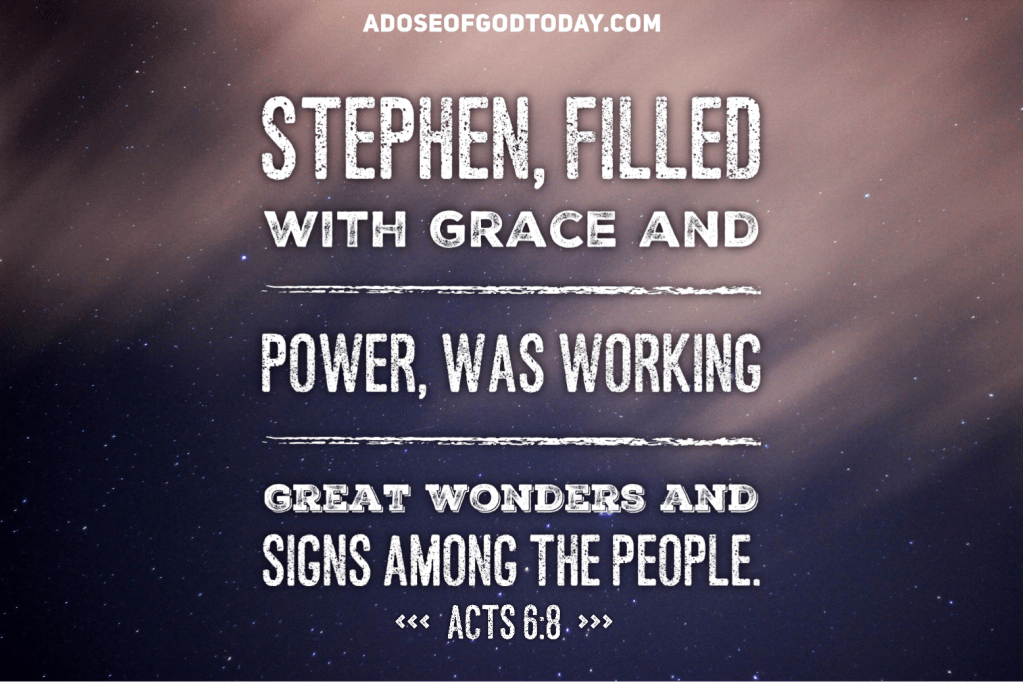
This is what the first reading from the Acts of the Apostles tells us. Stephen, who was one the chosen deacons to serve the orphans and widows of the Christian Community, was filled with grace and power. He did great wonders and signs among the people. To believe then in the Risen Christ is to be convinced of God’s power that transforms us. Moreover, Stephen’s faith and commitment to the Lord made him confident too in his ministry. This was how he exercised with grace and power because he did not serve himself, he served others.
Consequently, the Jewish leaders at that time hated him. The leaders created stories in order to condemn him. They twisted the truth because they refused to be challenged to go out from their comforts. Those leaders just wanted the community to serve them and to feed their ego.
However, through the person of Stephen, we are reminded that our faith and commitment to the Risen Christ will indeed transform us. This transformation in Jesus gives us grace and power as we allow ourselves to go beyond from our comforts and self-serving egos.
Indeed, Stephen’s friendship with the Lord became his source of strength and confidence in the midst of trials.
This is now the invitation for us today – we are called to build a closer relationship with Jesus, a friendship with Jesus, because faith is basically a relationship founded in a commitment. We do not believe in God just because we want to be treated like babies, feeding us and pampering our egos. This commitment in Jesus then, would hopefully lead us to into self-transformation that gives life to others, that works wonders in the lives of our brothers and sisters.
The very situation we are in now is an opportunity for us to work wonders in the lives of others particularly those who are in great need these days of Enhanced Community Quarantine and Lockdown. May the grace and power of Easter make us more creative and generous too in reaching out to our brothers in sisters
Having this awareness of God’s friendship in our life, this will hopefully bring us also into the assurance of God’s love and faithfulness that even in times of trials, of loss and poverty, of pain and loneliness, of illness and suffering and even death – we will be assured with our relationship with a God who is ever with us, faithfully journeying with us. Hinaut pa.
One of the great Italian painters of the Baroque period is Michaelangelo Mirisi Caravaggio. He is one of the masters of realism and foreshortening technique, and the painting style called chiaroscuro, that uses the contrast of light and darkness to create and bring out the emotion and drama of the whole painting. What you see here is one of his famous painting, Supper at Emmaus. This is the second version of the same theme that Caravaggio painted about the Emmaus story.
SUPPER AT EMMAUS
Most paintings of the Emmaus story, which we heard in the gospel of Luke today, portray Jesus and the two disciples in deep conversation while walking together on a road in a beautiful scenery. But Caravaggio’s take on the Emmaus story focused on the crucial moment of the story. It focused on the very moment when Jesus broke the bread and the eyes of the two disciples were opened in amazed recognition that it is the Lord. Notice the contrast of expressions on the faces of the figures in the composition. The innkeeper and the servant at the back look confused and are oblivious of what is happening, while the two disciples on the foreground were shocked in utter recognition of the Lord’s presence. Caravaggio somehow froze that split-second moment just before Jesus vanished from their sight. Yet the center of interest of the painting is the hand of Jesus and the broken bread. What Caravaggio was trying to tell us was that it was the very act of the breaking of the bread that allowed the disciples to recognize the risen Jesus. Jesus, the bread of life, broken and shared for humanity’s redemption.
Advertisements
The Emmaus story we have heard in the gospel today is one of the apparition stories of Jesus, eyewitness accounts of the disciples, aside from the empty tomb, that cemented the faith of early Christians that indeed Jesus is risen and alive. We are told that these two disciples of Jesus were on the road going to the village of Emmaus, walking away from Jerusalem. They were sad, grief-stricken, and frustrated, of the events that transpired a few days ago in Jerusalem. Jesus, their hoped-for Messiah, was crucified and now dead.
Then, this “stranger” suddenly appears and joins them in their walk. They did not recognize that it was Jesus perhaps because, like Mary Magdalene, sadness and grief blinded them. Yet Jesus walked along with them, and engaged them in deep conversation about the Messiah in the Scriptures. Out of hospitality, they asked the “stranger” to join and stay with them for it was almost night time. And it was while he was at table with them, that the very act of Jesus in taking, blessing, and breaking the bread, that they recognized Him. It was the risen Lord! And then he vanished from their sight.
Brothers and sisters, the Emmaus story reminds us that in our life journey, in whatever circumstance we are in, Jesus walks along with us. In this time of the COVID-19 pandemic, despite our sadness, fears, frustrations and anxieties, that may blind and numb us, Jesus is there journeying with us. He meets and encounters us where we are. And like the two disciples who acted with hospitality in inviting Jesus with them, despite them not recognizing him, we, too are called to be hospitable to His presence, to invite Him to walk along with us, even though at times we may not recognize Him at the moment.
When the two disciples finally recognized the presence of Jesus through the breaking of the bread, and despite him vanishing from their sight, this brought them such great joy and remembered how their hearts burned when Jesus walked along with them. They left with such haste and returned to Jerusalem to announce that yes, Jesus is risen! It is also the same invitation to all of us my brothers and sisters. That as we celebrate this and every Eucharist, as we witness the taking, blessing, and breaking of the bread, we may also recognize with such great joy the presence of the risen Lord in our lives. Through this act, may our hearts also burn as we remember and look back at the many blessings, moments of grace, glimpses of God’s loving and mysterious presence in our life journey. Yes, all along he was there, walking with us. Encountering us. Journeying with us. But wait, there’s more!
Advertisements
The Emmaus story also invites us not only to look and recognize Jesus at the breaking of the bread in the Eucharist, but more so to look and recognize him at the many “breakings of the bread” that is happening all around us. Especially at this moment of the COVID pandemic, we see the examples of our front-liners who are risking their lives in order to help stem the spread of this virus. Or the many acts of generosity of people, individuals, local and church groups, who reached out to people in need despite the lockdown and community quarantine, etc. etc. Acts of generosity. Acts of love. Acts that bring hope. Yes, despite Jesus’ physical absence, the very act itself makes Him present. The act of the breaking of the bread in the Emmaus story strengthened the faith and brought hope to the two disciples. We are likewise invited to find strength and hope, as we recognize Jesus in the many “breakings of the bread” happening around us.
It is good to note that archaeologists and Biblical scholars would attest that the location of the village of Emmaus is still disputed and unknown, this somehow tells us, as Pope Emeritus Benedict XVI had said, that the Emmaus story is also our Emmaus story.
Caravaggio’s genius in foreshortening technique found in his paintings, creates an illusion that parts of the figures are coming out of the canvas. This allows and invites the viewer to become part of the whole drama of the painting. As we become part of it, we are also invited to look at our own Emmaus stories. To look back at how Jesus journeyed with us, guided us, and manifested His presence in various and different ways in our lives.
Advertisements
Like the two disciples who, at the beginning journeyed blinded by grief and fear, went back and announced with great joy their encounter with the risen Lord. We, too are asked to allow the risen Lord to encounter us, in the breaking or the breakings of the bread happening around us, we will become like Peter in our first reading, who boldly proclaimed the Good News of Jesus.
In Caravaggio’s Supper at Emmaus painting, we see that subtle light coming in bringing light to the figure of Jesus and the broken bread. It symbolizes the new light, that transforming light, brought by Jesus upon His disciples. Jesus, the risen Lord, is the light of hope. As our psalms today exhorts, “Keep me safe O God, you are my hope!” And so are we, if we are truly believers of the risen Christ, must also bring the light of hope to others through our actions and deeds. Indeed, it is through our actions that the risen Christ is made present.
And so I leave you my brothers and sisters with this parting question for all of us to reflect upon: In what ways are we encountering Christ today? As Christians, is the risen Christ made present in our actions and deeds especially in these trying times?
May Jesus, the Risen Lord, bless us all. Alleluia!
Perhaps the most sensible and wise advice I could give to myself and others at this time, as we grapple with the question: “Can I still live the life I left-behind?”
It is almost a month now that we find ourselves on lockdown and quarantine due to COVID-19 pandemic. Ours now is a strange life. Almost abruptly, our normal lives had to shutdown for with the pandemic in our midst, our whole world is now rendered unhealthy, unusual, and unsafe. Our human race is under threat of disease, sickness and even death. Our lives will never be the same and as usual again. Worrisome as it is and maybe, we are confronted now with the question: “What now? What’s next? How will it be? How can we be? Will life be the same again or much better (or even worse) than before?” Whether we like it or not, we cannot help but adjust and discover new meanings in our changing world today.
Somehow our gospel today mirrors and perhaps offers us some lessons as we lived by with our experience of our changing world today.
Advertisements
Two disciples were on their way back home – tired and weary souls, beaten in life, since their promised Messiah whom they followed ever since was now dead and gone. They had to socially distance, quarantine, lockdown themselves in hiding from others, since all now are suspects and symptomatic. They were hopeless, directionless, and in despair with life. But along the way, the risen Lord, though unrecognized, joined and journeyed with them on the road. They shared to Him their current life-story, and they also listened to His story. They invited Him into their own home for the night, and had meal with Him together. And eventually they recognized Him who was all along on the road and in life with them.
Their experiences with life and with the Risen Lord along the road to Emmaus might post us some challenges & pointers now as we manage our lives in COVID-19 era.
First, RECOGNIZE IMMANUEL. Always be sensitive and believe that the Lord is with us. The risen Lord is the Immanuel – the God with us, who lives in us. This the Gospel of the Lord – the good news of our salvation, even since before, until now and always. He is with us, here all along, along the way, on journey with our lives whatever, whenever, and however it is. And we have yet to recognize Him always.
Second, INVITE HIM INTO OUR LIVES. Just as the two disciples invited Him, we too should call upon Him and say: “STAY WITH US, LORD”. Good News to us as He is, the Lord still needs our responsibility (our ability to respond to Him). He still needs our consent to Him, our acceptance and recognition of Him, our faith in Him and our relationship/collaboration with Him by inviting Him IN.
Third, ALLOW HIM TO DO HIS WORK IN US. Give Him and ourselves a chance to take care, protect and heal us. Along with Him, time now to treat our chronic spiritual disease, improve our spiritual hygiene and boost your spiritual immune system, and to tend now our tired and weary souls. In prayer and contemplation, share our story of faith-life journey to Him and allow His story be part of our story. Have a meal-time and date with Him in Eucharistic Communion (when possible). And let him disappear once in awhile, (not to be so attached), for He also needs to be with those who needed Him most.
Advertisements
But above all, ADVISE YOURSELF AND OTHERS: “Please be PATIENT. GOD is not finished with me and you YET”, since, though His last words on the cross is “It is finished”, Jesus did not say, “I am finished”, but rather He is just getting started. Our risen Lord Jesus has yet more and better great things to do, and more miracles yet to show us in life. So, be patient for God is yet unfinished with us.
May we have a blessed Easter now and always despite (and even with) the pandemic in our midst. Amen.
(By: Fr. Aphelie Mario Masangcay CSsR, a Filipino Redemptorist Missionary stationed in Gwangju South Korea, though now still stranded in Cebu until further notice for available flights.)
St. Mark was converted to the faith by Peter, who journeyed with Peter to Rome and served as his secretary or interpreter. When St. Peter wrote his first pastoral letter to the churches in Asia, he called him affectionately as “my son Mark.” Mark is considered as the author of the Gospel of Mark. According to tradition, he was sent to Egypt and founded the Church of Alexandria. One day he was seized by pagan authorities, dragged by ropes over stones and thrown into prison and died as a martyr. (Source: ibreviary)
Today is the Feast of St. Mark, believed to be the author or the person behind the Gospel of Mark. The Gospel of Mark is believed also to be the earliest Gospel among the four. One evident characteristic of the Gospel that would tell us about this, is that it is the shortest. The Gospel is more direct in telling the story of Jesus. There are less elaborations or if there are explanations, then, those are short and simple.
This tells us too that the community of St. Mark to whom this Gospel was addressed had that consciousness to preserve the story of Jesus through writing. It is through writing, then, that the memory of the Risen Jesus will be preserved and will be handed down from one generation to another. True indeed, that memory has been preserved and we today, share that memory of the early Christian community.
What actually moved them to do this? Or what made Mark to decide to write what had been told to him by his mentor St. Peter?
We will find the answer at the end part of the Gospel of Mark. Jesus said to the apostles, “Go into the whole world and proclaim the Gospel to every creature.”
The followers of Jesus were now ready. They have become firm in their faith and so were all sent by Jesus to share and proclaim the joyful message who is Jesus himself.
Yes, the Gospel that they were about to proclaim is the person of Jesus, the God-with-us, who died and restores us through his resurrection. Mark being an assistant to St. Peter had become a witness of such joy. Mark himself experienced the joy of being with Jesus and being loved by the Lord just like Peter.
This joy of being with Jesus is what made Mark and his community to write down their memory of Jesus so that others will also be able to experience the joy that they have tasted.
Today, for all of us who have been the recipients of this great joy proclaimed to us in the Gospel of Mark, each of us is also called to “proclaim Jesus to every creature.” Each of us who have been able to experience the “goodness of God is called to to sing it for ever,” as our Psalm proclaimed to us today.
Advertisements
May I invite you then to be more aware of this invitation from Jesus – to go and share Jesus to every person we meet, to every creature that we will touch and encounter.
Despite the physical distancing, the call of staying home and enhanced community quarantine, sharing Jesus to our brothers and sisters in the most concrete ways is still very possible. Expressing concrete actions of kindness and generosity to your neighbors in need is a way of sharing Jesus. Comforting an anxious and troubled friend is a way of making Jesus alive too. We do share Jesus not just as a mere memory of the past, but making Jesus alive in flesh through us. Thus, go and share Jesus today! Hinaut pa.






 A DOSE OF GOD TODAY