Christmas is a joyful season. The music, decorations, the variety of food and the many gatherings during this season give the festive and joyous atmosphere. Yet, the liturgy today, just a day after the birth of Jesus reminds us how faith and commitment to the Word-made-flesh will make us a contradiction to many.
Indeed, yesterday we celebrated the joyful birthday of a child and today we celebrate the cruel death of an innocent man. In some ways, the birth of Jesus led to the death of Stephen, one of the first deacons of the church and the first Martyr. Stephen was put to death because of his faith in Jesus, declaring him to be the glorious Son of Man standing at the right hand of God.
St. Luke describes Stephen dying with two prayers on his lips. First, a prayer of surrender, “Lord, Jesus, receive my spirit.” Second, a prayer of petition for his executioners, “Lord, do not hold this sin against them.”
When Jesus was dying on the cross, he had two similar prayers on his lips as well, a prayer of surrender, “Father, into your hands I commend my spirit” and a prayer of petition for his executioners, “Father, forgive them for they know not what they are doing.” We can see that Jesus prays to the Father while Stephen prays to the risen Lord.
Mary’s child is now the risen Lord and can be prayed to as we would pray to God. In the church, we often pray to the Father through Jesus, but we are also invited to pray directly to Jesus. Stephen died as Jesus died because he was “filled with the Holy Spirit.”
We have been given the gift of the same Holy Spirit, and it is the Spirit who empowers us both to live like Jesus and to die like Jesus. On this feast of Saint Stephen, we pray for a fresh outpouring of that Spirit into our lives in this Season of Christmas that we may also be filled with grace and power like him. Hinaut pa.
During confession, we also make an act of contrition by saying these particular words: “I firmly resolve, with the help of thy grace, to confess my sins, to do penance & amend my life. Amen.” In saying these words, we are not only regret our mistakes but we are also making a resolution to change & improve our ways. Meaning, it is not enough just to be sorry of our mistakes, but we have to do something about our mistakes by doing our best because we know that we are much better than our sins, faults & shortcoming, and that God’s mercy is much better than our sins, faults & shortcoming,
Making an act of contrition then reminds us that the Sacrament of Reconciliation is not only about being sorry for our sins, but moreso giving oneself & God a chance to do things right & do the right things for the better than we usually do. It is useless then to do monthly individual confession if & when we don’t change our ways & resolve to improve, but rather go back to our sinful & corrupt ways. Salvation is all about God’s grace in us rather than our sins. Reconciliation then is allowing God’s mercy & forgiveness work in us, rather than finding & counting our woes, sins, faults, mistakes, shortcoming & others. It is all about receiving God’s grace than accounting our faults.
Today, we celebrate the feast of Epiphany. This is our celebration of our remembrance of God’s loving act of reaching out to us (God making himself known to us) and our acceptance of Jesus, as God’s self-revelation. We, Christians believe that God has given us His only Son, Jesus Christ, as His first gift to us for our salvation. By sharing us His Sons, we become related to Him and become His adopted sons and daughters, and sharers of His divine life. Indeed, Jesus is God’s greatest gift to us. God’s offer of salvation & our reception of Jesus into our lives give another alternative meaning, directions & ways in our life. Because of Jesus, we are blessed & graced by God
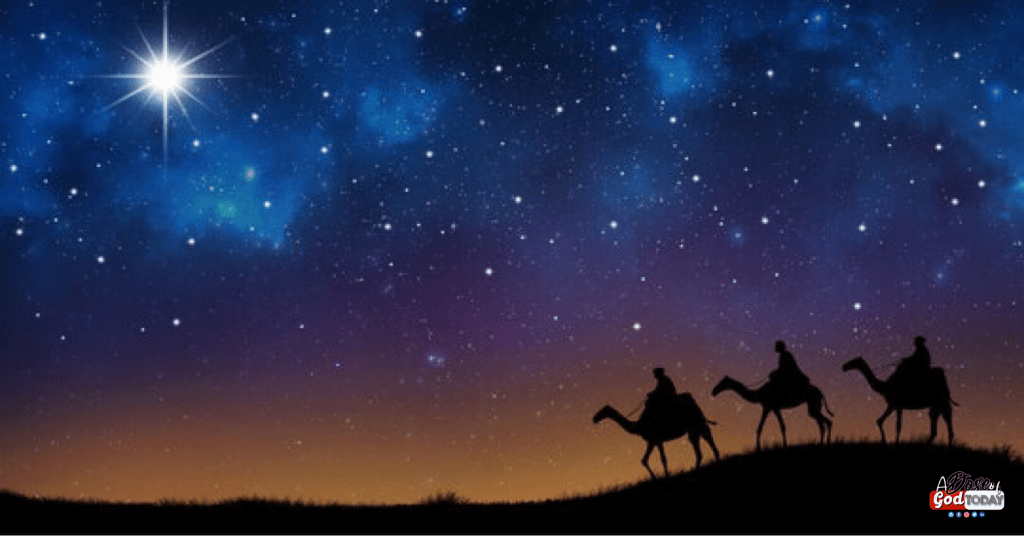
Here in our gospel today, we are reminded us of what happened when the three kings found the child Jesus lying in the manger in Bethlehem. Guided by the star, in great joy, they saw the child Jesus and they did him homage. Their encounter of Jesus and the Holy Family in Bethlehem brought the three kings great joy for they have finally found what they are searching for. The birth of Jesus brought new promise & purpose, not only to the local Jews, but also to the migrant magis & to the whole world. With this, like us now, they are grateful, and offered their gifts in homage and thanksgiving to God’s greatest gift to all.
But let us not forget that after they have witnessed & accepted the Son of God into our lives, they returned by a different alternative way. This is not because they were afraid of Herod, but because of their encounter with Jesus has also changed their lives. Because of their experience with the baby Jesus, their lives were never the same again. They did not follow the usual path, but they now tread an alternative way, perspective, and attitude to life. After they have recognized God in the child Jesus, the lives of the three kings were never the same again. The child Jesus brought them great joy as well as great changes in their way of life.
The same with our experience of God’s mercy & forgiveness during confession. After celebrating the Sacrament of confession, we know deep inside that life now & ahead could & should not be the same again. We have to change our ways & paths. Like the three kings, we have to take an-other, an alternative path of life-journey, much better than our usual lifestyle. The usual King Herod-road to Jesus, our sinful corrupt ways are not anymore safe to tread through again. We cannot help but change our normal ways, or else we find ourselves again with our usual unhealthy drama, blame & excuses – away from God’s grace.
As we are beginning a new year, we make an act of contrition. We give ourselves another chance to grow & do better than last year life. As we again receive Jesus, God’s greatest gift for us, let us diminish our tendency to account& highlight our mistakes & faults, but be more conscious of God’s grace upon at work in us. And above all, let us amend & improve our lives for the better than our usual normal ways, and seek a new – an alternative path, roads, & ways for God’s blessing to be always with us today & our near future.
In other words: “We firmly resolve, with the help of thy grace, to confess our sins, to do penance, & amend our life.”
How many of you here have experiences with adopted children? Be might you an adopted child yourself, or have adopted a child in a family as son/daughter, or brother/sister or relatives. Child adoption has never been an easy experience within the family. It entails a lot of adjustments and complications not only to the adopted child but also to the parents and the whole family as well.
I remember once I counselled a couple who have no child of their own and have decided to adopt a child. As the child grew and eventually learned that she is adopted, they observed that their child becomes problematic and difficult. I advise them to try to take care of the child even more, as well as to acknowledge the child not as adopted- someone taken on, which connotes someone who is “sabit o sakay lang” but as chosen “pinili”, as someone they have chosen as their own among other abandoned children. The child might not be their own but the child is whom they have personally chosen as their own. Essentially, the child then is chosen – the one they have chosen, not only adopted.
Either by natural birth or adoption, as a child, we are not only taken and accepted but moreso Chosen “Pinili” by our own parents and family. Thus as parent, your child then might be or not be your own, but basically you choose your child. We are chosen children then, not only of God but also by our own fathers and mothers, and our own family as well.
Christmas reminds us that God comes into our lives as a Child – not as fully grown man or as superman or as god, but as a poor child on a manger. For a child to live and grow, God’s child needs a human parent and family like any other child. Jesus Christ, God’s son has to be taken, accepted, adopted and above all chosen by human parents and family. He grew up then in, with, through his family who adopted and chosen Him to be their own. And In a Family Jesus was born, loved, lived and have grown as a Person. Not in a Monastery or Convent. Once I receive a Christmas card that say: “A child is born in our midst”. Well that’s okay because that is the core message of Christmas. But what made me suspect then was that card was sent from the sisters’ convent. Imagine sisters’ sending me a message that a child is born in their midst”. Me batang ipinanganak sa kanila. Hmmm??? Yes, God’s son has a family, a foster parents and family who chose Him to be their own.
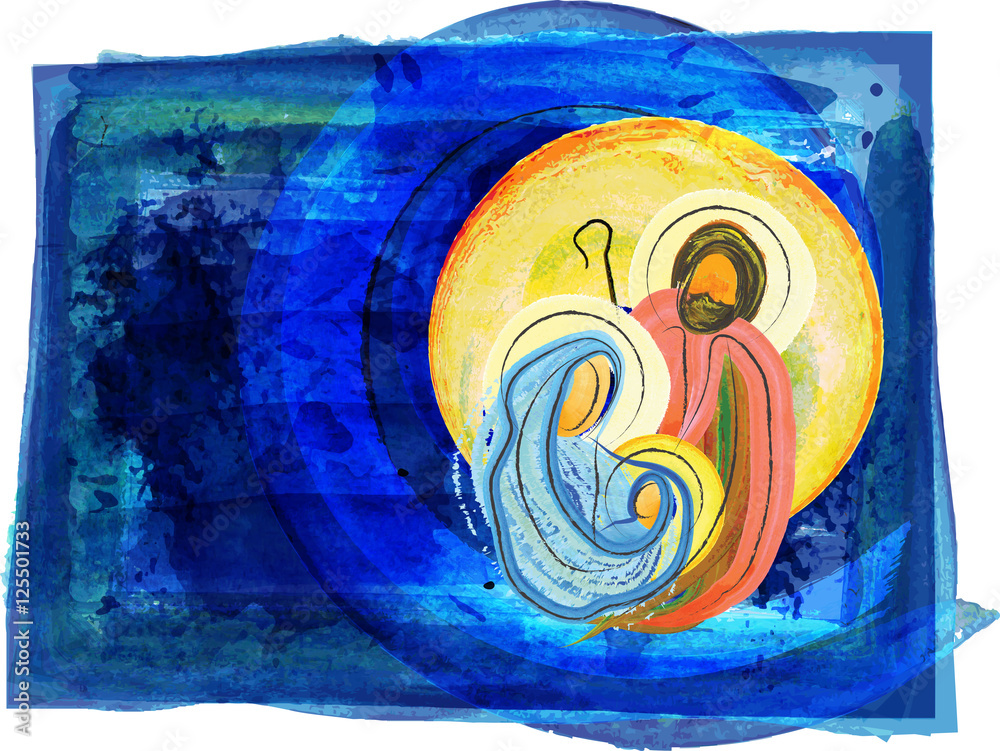
Today we honor the Holy Family, the very first family who welcomes and willingly accepts the Immanuel “the God with us” into our lives. Mary and Joseph are the very first parents who adopted and chosen the child of God Jesus to be their very own as member of their family. Our gospel today gives us a description on how Mary and Joseph do their best to parent the child Jesus into their own lives as they observe their own local cultural and religious traditions, while conscious of the mysterious unique experience of adopting and choosing God’s blessing into their lives. Yes, with Mary and Joseph they are and become a normal human family; but with the child Jesus, they are and become a HOLY family – now member of God’s family.
Honoring the Holy Family on Christmas season posts the on-going ever-present challenge for us, like Mary and Joseph to adopt and parent Jesus, God’s child by choice into our lives now and always. By willingly accepting Jesus into our lives to be our own, part of our own lives as family and community, we come to know also that we also are and becoming God’s adopted and chosen children and people, part of His Holy Family. Sa ating pag-angking kay Hesus na ating kapamilya, tayo ay naging at maging ka-anak rin ng Dios at kamag-anak ng anak ng Dios. As we consider Jesus as our chosen family member, we are and become God’s children and Jesus family.
With the Holy Family, this Christmas season, and the coming New Year remind us always that God comes to us as a Child, who can brings us a lot of joys as well as uncertainties, but above all another chance to live our lives for the better, as His willing chosen parent and family. Have a Grace-filled Christmas and New Year to all us. Amen.
Many decades ago as we were growing up, January 6 was celebrated by the Christian world as the Feast of the Three Kings. The event being celebrated was the arrival of Melchor, Gaspar and Balthazar in Bethlehem to offer gifts of gold, frankincense and myrrh to the newly-born child whom they came to worship.
Today, liturgically this is known as the Feast of the Epiphany (referred to as Theophany for Eastern Christians). Epiphany means the manifestation of a divine or supernatural being and for us Christians this feast celebrates the revelation of God incarnate in Jesus. Instead of referring to the three visitors as Kings, they are now more popularly known as Magi or Wise Men. Across the world the celebration can range from January 6 to whatever is the Sunday nearest this date. Thus in our country, it would be celebrated on January 8.
Except for Matthew (Mt 2: 1-23), the narrative involving the three Magi does not appear in the accounts of the three other Evangelists. It is a very brief account where the tyrant ruler Herod is also mentioned. There are very few details that help us know the wise men better except that they were from the East and that their journey to Bethlehem was guided by a star. Otherwise, the narrative ends up as a mythical story shrouded in mystery thus leading to all kinds of conjectures.
Consequently, many have deconstructed the text and provided a deeper meaning to this narrative. Just this year on the Feast of Epiphany (celebrated at the Vatican with Cardinal Luis Tagle presiding and Pope Francis giving the homily), the Pope provided us his own reflection of the meaning of the Epiphany. Thus, his words:
“The Magi’s restless questioning and continuous journeying in dialogue with the Lord finds its end in the worship of God… Like the Magi, let us fall down and entrust ourselves to God in the wonder of worship. Let us worship God, not ourselves; let us worship God and not the false idols that seduce by the allure of prestige and power… let us love God and not bow down before passing things and evil thoughts, seductive yet hollow and empty.
The purpose of everything is not to achieve a personal goal or to receive glory for ourselves, but to encounter God. To let ourselves be enveloped by his love, which is the basis of our hope, which sets us free from evil, opens our hearts to love others, and makes us people capable of building a more just and fraternal world.”
We can further reflect on how this narrative relates to our contemporary life in our own society and focus our reflection on who were these wise men? The biblical reference indicates they were from the East, which should make it interesting for us Filipinos as we are in this part of the world – the East or the Orient. Some writers theorized that they came from the nearby countries of Israel, namely Persia (now Iran) even as far as India.
But why were they referred to as wise men? Relying on ethnographic data providing us data on the Oriental civilizations existing long before the West entered into its Industrial Revolution, there were advanced societies already existing in the Orient from China to India to the Arab countries. They had developed the various fields of philosophy and science, much earlier than the Western world.
Thus, we can conjecture that Melchor, Gaspar and Balthazar – as they were guided by the star – had knowledge of astronomy if science had developed to that extent during that era. There is, however, one better explanation that anthropologists would posit. Could they be shamans who had developed the gift of communing with the supernatural?
If they were coming from the East, what faith traditions have evolved in their societies? While there were established religions already during the reign of Herod in other parts of the world and in Israel (Hinduism, Judaism, etc.), Islam and Christianity were still to evolve. But were the magi also shamans who served as ritual officiants of their communities which were ensconced within an indigenous belief system? We know for a fact that across the world and through the centuries, shamans have developed a keen sense of understanding the mystical realm. Could this have been the case of the three wise men?
Perhaps it is futile to have the answer to this question even if there theologians who would like to pursue this question in dialogue with anthropologists. However, we can expand the search of meaning and link it with our attempts to better pursue some of the pastoral challenges in our post-Vatican II Church especially in the discourses of inter-faith dialogue and inculturation.
A fundamentalist reading of the Matthew text would insinuate that as the magi worshipped the child as God, they had abandoned whatever faith tradition they belong and embraced a new faith. On the other hand, a progressive reading of the text allows for an encounter of faith traditions in dialogue with each other. Thus the Matthew narrative would be very useful for advocates of inter-faith dialogue, as one of the first events in Jesus’ early life pointed to the possibility of faith traditions entering into a dialogue with each other.
In this day and age, when there are still countries where different groups of believers – Christians, Jews, Hindus, Muslims, Buddhists and others – are engaged in conflicts leading to the eruption of violence, the encounter of Jesus and the Magi provide the hope that a day will come when all faith traditions would learn to embrace the gift of an encounter that brings peace!
When that moment arises, all of earth’s people of goodwill can truly celebrate all together a feast of the Epiphany no matter what faith tradition they worship God (in whatever God’s name is invoked!).
A woman once asked me to bless her new Rosary beads she got from her recent pilgrimage in the Holy Land. So, after blessing, I said: “This must be very precious and would be a good companion with your prayer life.” She replied, “Yes, father, this is very dear to me. But, no, I will not to bring it with me. This might be misplaced or lost. So, I will just put this Rosary on my altar at home, along with my other valuable rosaries. It would be much safer if I keep it there. Anyway, I rarely use and pray the rosary.”
Christmas has just ended. We are starting a New Year. This would be the time for us to see again the gifts we received during the Christmas season, and to sort out those gifts we happily received, from the gifts that are of no great value to us. Usually in doing this, we give importance to the gifts that are pleasing and less demanding. Then, we put aside gifts, which are not-so-urgent, time consuming and demanding, but still important. It is like receiving a rosary. We know that praying the rosary is important to our Christian faith and life. But because having a rosary bead demands us to set a time to pray the Holy Rosary. Sometimes it would be easy to use the beads, as decoration on our altar rather than as a means for prayer – an aid to encounter the Lord. Yes, using the beads as altar decoration is a valid expression of faith but surely, it lessens the very purpose of Rosary beads, which is to lead us into prayer.
Today, we celebrate the feast of Epiphany. This is our celebration of our remembrance of God’s loving act of reaching out to us (God making himself known to us) and our acceptance of Jesus, as God’s self-revelation. We, Christians believe that God has given us His only Son, Jesus Christ, as His first gift to us for our salvation. By sharing us His Son Jesus, we become related to God our Father, and we become His adopted sons and daughters, and sharers of His divine life. Indeed, Jesus is God’s greatest gift to us.
And like rosary beads, Jesus, as God’s gift, is given to us with a purpose, that is to bring us closer to God. Accepting Jesus is not only accepting him as a valuable gift which we can put aside and decorate, but moreso letting ourselves be influenced by the grace Jesus can offer and we choosing to become His responsible witnesses. To accept Jesus, as God’s gift to us, is also to choose to accept with total commitment the responsibility of continuing His mission – which is to present and bring all people closer to the Father.
Like the three wise men in our Gospel, we are called to wholeheartedly accept Jesus, and to choose to become responsible witnesses of God’s love. This would mean to let our lives be changed and renewed by the presence of Jesus, and to share and make Jesus and His mission known to the whole humanity.
Here in our gospel today, we are reminded us of what happened when the three wise men found the child Jesus lying in the manger in Bethlehem. Guided by the star, in great joy, they saw the child Jesus and they did him homage. Their encounter of Jesus and the Holy Family in Bethlehem brought the three wise men great joy for they have finally found what they are searching for. With this, they offered their gifts in homage and thanksgiving to God’s greatest gift to all.
We may learn two things from their experience. First, like Herod, those who are comfortable & established – (those who have enough & even more than) in life, fail to recognize the value but just accept the gift of Jesus as decoration & interruption. But like the three wise mens, the searchers, travellers, & strangers of life (those who have less & lacking enough) appreciate & give great value to the blessings & responsibilities the gift of Christ being offered us. In other words, we choose to receive God’s gift to us from our needs & not just from our wants. Those who are in need willingly choose to accept the gift-given, while those who have enough & plenty undervalue & reject God’ gift for us.
And this is also to remind us, that after they have witnessed the Son of God, the wise men departed for their country by another way. This is not because they were afraid of Herod, but because of their encounter with Jesus has also changed their lives. Because of their experience with the baby Jesus, their lives were never the same again. They did not follow the usual path, but they now tread a different way, perspective, and attitude to life. Like our experience with a newly born baby, after they have recognized God in the child Jesus, the lives of the three wise men were never the same again. The child Jesus brought them great joy as well as great changes in their way of life.
We all believe that the birth of Jesus has brought great joy as well as great changes in our lives because when Jesus became part of our lives, life has never and will never be the same again. Jesus, God’s gift to us, is not like the gifts we receive this Christmas, like shirt or pants that we will sometimes use, or books that we may never read at all, or good food we will eat, or a figurine or rosary beads we will just decorate. God giving us the gift of His son is like having a new baby, a new member in your family. Inasmuch as it brings great joy in our family, it also entails a lot of responsibilities and a lot of changes, making our lives different and never the same again. In the same way, the moment we recognize and choose to accept the Lord, life will & should never be the same again.
As we receive and welcome Jesus into our lives now, may we choose to be responsible beneficiaries of God’s gift of revelation as well as sharers and witnesses of God’s offer of salvation to the whole world.







 A DOSE OF GOD TODAY