“Be shrewd as serpents and simple as doves.” This is what Jesus said to his disciples and now addressed also to us. What does Jesus really mean about this? In biblical understanding, the serpent is an image of Satan or of the devil. We remember, that it was the serpent that tempted the humanity to commit sin as told to us in the Book of Genesis. However, there are also other characters that the serpent possesses. The serpent is also believed to be wise, resourceful, flexible, adaptable, observant and cunning.
This means that a serpent adapts to its situation in order to survive. It finds ways as it observes its environment. It is in this way that Jesus invites us to be wise as the serpent, that is, to have the character in us that is wise, resourceful, has the quality to adjust to a given situation, observant and discerning. Like the serpent, Jesus invites us not to react immediately out of our emotions only, or to make decisions imprudently.
The dove is also understood to have the characters of being innocent, gentle, relax, peaceful, understanding and meek. The dove also represents the Spirit of God that brings comfort and peace, enlightenment and freedom. The dove reminds us of the gentle presence of God, never intimidating yet powerful, never imposing yet forceful.
It is in this way too that Jesus invites us to be as innocent and simple as the doves. Like the doves, we are called to keep calm and to always claim our peace so that we may be able to respond to life with wisdom. We are also called to be gentle and to be simple in order to bring encouragement and hope to others around who are already troubled and anxious. Kabay pa.
Here in our gospel today, Jesus summoned his disciples, gave them authority to heal every disease and sickness. He made his disciples share his authority and mission to preach the good news of salvation to all. He commissioned them and gave them the tasks to be preachers and evangelizers of God’s kingdom. Jesus added however that they should start, not elsewhere, but at home.
Since then and until now, as followers of Christ, we share the same authority and commission with the disciples to preach and witness the reign of God’s kingdom to all in our world today. And in the same way, we are to begin in our own homes, families, and communities.
In doing our tasks and mission as evangelizers and preachers of God’s kingdom, there is always a tendency or even a temptation for us to blame the evil in the world on others, and to reach out for our poor brothers and sisters in need who are far-away from us. But as Jesus would insist, we start to live our faith and practice what we preach in our own homes, in our own neighbors and communities. In other word. Charity begins at home.
For who are our neighbors? Our neighbor is the immediate person we live with, who needs our immediate attention and care. We don’t have to go out to help others; we start with our kasambahay, kapamilya. We start to correct and clean the evils and sinfulness in our homes before we deal with our world outside. Remember it was only later, during Jesus’ ascension that the disciples where sent to all the nations of the world. Start locally and then globally. Begin in your own homes nearby and then, into the world.
Being called & sent to be His missionaries today, with Our Mother of Perpetual Help, let this be our prayer : “Lord, grant me the grace to be what You want me to be, and to do what You want me to do, not there & later, but here & now at this very moment.” Amen.
Exercising authority in our community gives us the opportunity and capacity to serve others. This is how we understand it in a Christian perspective. This means that when we have authority over other people, this does not give us the right to belittle or put people down just because we have power over them.
Thus, in any community, organization or even in our workplaces, when we are given authority, it is rather meant to give us the ability in empowering others and facilitating others to be more productive, growing and maturing.
The giving of authority is what we have also heard in today’s Gospel. Jesus gave authority to his Twelve disciples. This authority has two functions. First, to drive out unclean spirits that terrifies and imprisons people. Second, to cure every disease and every illness of the people to whom they were sent. Through the authority given by Jesus to the Twelve disciples, the Lord gave them the opportunity and capacity to serve others by setting people free and bringing healing to the sick.
The Gospel tells us now that authority is a gift. It is given to us as an opportunity and giving us the capacity to serve others and not to serve ourselves or to serve those who are only close to us. Thus, exercising authority is a form of a loving-service. And we will know that it is a loving-service when in exercising authority it sets people free, inspires freedom, brings healing and creates a space for growth.
However, when authority is also used as a means to serve oneself by manipulating and overpowering others, then, authority discourages and oppresses people just like unclean spirits or demons would do. Moreover, in this case, authority will also be the cause of divisions, wounds and toxicity in our community or organization just like a disease or illness would bring suffering to a person.
Hence, Jesus calls us today that as we exercise authority in our own context and life-situations whether at home, at work or in our communities and organizations, we may always be able to inspire freedom, to allow others to be free and be agents of healing and growth. Kabay pa.
Is it not that we long for peace and prosperity for our family and for our community? Who would not want and hope for a peaceful home and a comfortable life? I am sure, each of us desire this kind of life. With all the troubles that we experience in life such as personal problems, failures and struggles; family demands, conflicts and grudges; crimes, disasters and corruption in the community, we want peace. If only we have peace within ourselves, in our homes and communities, then, our life would be very different. Life would surely be harmonious and more productive.
The hope and dream of peace and abundance in life had been already imagine long time ago. In fact, this was prophesied by Isaiah. We have heard it from the first reading how Isaiah had seen the day when Jerusalem will be comforted with peace and prosperity. The people longed for this because of the suffering they went through. The people of Israel agonized so much from oppression and slavery. Wars had been waged left and right and the people suffered greatly from these devastations.
Yet, God is not blind of our human suffering. In God’s goodness, peace and prosperity will be upon the suffering people. That is why, the message of Isaiah is to “rejoice and be glad.” God will see to it that He will comfort the grieving and suffering people. God’s comfort will surely bring joy, peace and contentment in the life of God’s people.
This is what we also discover in the life of St. Paul in which God’s comfort was revealed to him. Indeed, Paul in his letter to the Galatians expressed his experience of peace and confidence in Jesus. Despite the many trials that he underwent, Paul found peace and confidence in Jesus. Even the conflicts within the Christian communities at the time of Paul can never destroy the peace that he received from the cross of Jesus. And Paul was boasting about it. Nothing will trouble Paul because he has Jesus with him.
In that cross of Jesus, Paul experienced tremendous love and forgiveness. Because of this, Paul also found his true self and became a witness of Jesus. This moved Paul to preach the Gospel, and in fact, to preach to others the peace and confidence that he received from Jesus.
Preaching and bringing peace to others was actually done even earlier. This is what we have heard in the Gospel. Jesus sent 72 people in pairs to bring peace to the many homes that they will visit. Jesus is, certainly, aware that our homes are in need of peace. This was the mission of the 72 people sent ahead, to bring peace and to bring Jesus himself to their homes.
This is the promise fulfilled in Jesus as what has been prophesied by Isaiah. Jesus is the peace, the comfort and the confidence that God promised. This peace brings openness to God’s friendship and God’s healing.
But let us remember, Jesus needed the help of his disciples to bring peace to many homes. This reveals to us now that preaching and being a witness of Jesus is not just limited to the closed group of the 12 apostles. This means that everyone of us is being sent by the Lord to preach, to bring peace and to bring healing wherever we are.
Indeed, the promise of peace, confidence and prosperity are not fulfilled outside of us but, through us and within us. The confidence and peace that Paul was telling about was not an outside experience, but rather, Paul himself experienced it personally. It is through his personal encounter with the risen Jesus.
The 72 people were able to bring peace to many homes, not because of an outside influence but it was coming from their personal relationship with Jesus. The presence of Jesus in their life allowed them to become agents of peace and healing.
This is where we now find the invitations for us this Sunday.
First, Jesus calls us and sends us to be part of that fulfillment of the promise of peace and abundance in our families and communities. The Lord, certainly, fulfills his promise through us and with us. Peace is achieved not outside of us. Confidence is attained not apart from us. This tells us again that God’s wonders are made through us and with us.
Indeed, God desires that we become part in making and working wonderful things in this world. This involves bringing peace and healing to our troubled and wounded homes, relationships and communities.
Second, Jesus reminds us too that by being part of God’s work, let not material things and our other insecurities trouble us, limit us and hinder us.Paul also did the same thing. He did not allow anyone and anything to trouble him and remove him from the peace that he experienced from Jesus. Let us not allow our complains and anger, hate and bitterness with one another and even our insecurities to steal from us the peace that Jesus has given to us. Let us rather allow the joy of having Jesus in our life to empower us in bringing peace and healing. Kabay pa.
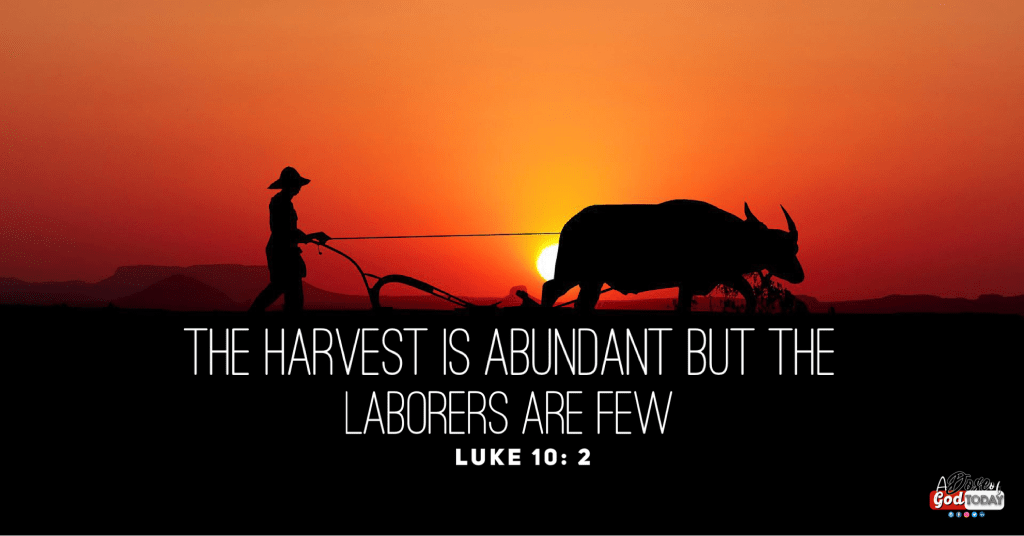
“The harvest is great but the laborers are few. Pray that the Lord of the Harvest to send out more laborers to gather in his harvest.”
Easy for us to think that this particular scriptural passage in our gospel today is a call for us to pray to God to grant us more laborers for His vineyard, so that we may enjoy the fruits of His harvest. In a sense, we acknowledge and enjoy the abundant bounty of God’s salvation in our lives. But, we also need to ask God to send us somebody to hand such blessings over for us. For us then to fully enjoy the harvest of God’s salvation in our lives, we must have to pray that God will send us more laborers at our service, and that we just wait for these laborers to come and share us the fruits of the harvest. In other words, we are mere the passive recipients and benefactors of God’s grace – begging God to call and send somebody, other than ourselves, to share us the fruits of His redemption.
But this passage is more than just an appeal to pray to God that He will send us others to save us the day and have a share of such blessings. But this is Jesus’ invitation for us to become the Laborer, ourselves. He calls us to be sharers rather than mere takers.
As the Lord of the harvest Himself, Jesus did not only ask his disciples to pray, but also invited and sent them as laborers in His vineyard. After saying, “Pray that the Lord of the Harvest to send out more workers to gather in His harvest”, he said, “Go, I am sending you…” This would mean that recipient-benefactors we may be, we are also active participants and sharers of God’s salvation. Not only that, in prayer we recognize God’s grace but also we declare that we are sent to be sharers, promoters of such grace to others. As we are called to follow Jesus and to pray for more disciples, we are also challenged to become His laborers & missionaries ourselves – sent to extend His invitation to be laborers to others so that all may have a share and can fully enjoy in the blessings of God’s kingdom.
This is an extension of Jesus’ invitation: “Follow me.” Yes, he calls us to be his disciples but he also wants us to be a missionary disciple, to be his follower who is also called and sent to bring & share the good news to everyone. All of us are called to be His disciples. But to be His disciple, it is not enough just to believe and passively follow Him. It would also mean that to be his disciple is to participate in His missionary work of salvation. We must also contribute and take part in sharing and preaching the Good news to others by our words and action, and in building His church.
We might ask ourselves, “What can I do or contribute for God’s Kingdom?” You may not be convinced that you can do much, but each of us can effect some change in one way or another in our lives for God’s reign. Just like the attitude of this little child.
Years ago, a gentleman stood outside admiring a newly-build magnificent cathedral. Standing beside him was a little girl of ten years old, who suddenly asked him: “Mister, do you like that church?” “Yes, my dear, I think it is quite lovely.” “Well, Mister, I’m glad you like it because I helped in building it.” “You? You helped to build it?” The child proudly nodded. And the man continued: “But you are only a little girl. How did you help to build it?” “Well, my daddy is a construction worker,” came the reply, “and he worked on this church ever since it began, ….and every single day I brought him lunch.” A simple contribution of loving kindness made a difference. It helped build a church for everyone.
Remember Jesus first calls us to “Follow Him” and as we follow, only then we are invited to “Do this”. As last Sunday gospel suggests, Following the Lord calls for our availability first and then our capacity. If we prove our dependability and faithfulness, only then He will increase our capability. Like that girl, Be part of the building and sharing of God’s grace in life rather than like that gentleman, just benefiting from it.
We pray that our faith in Jesus Christ moves us to remain available and actively participate in the harvest of God’s graces and blessings for us all as now & always. Amen.






 A DOSE OF GOD TODAY