We seek and enjoy what is fun and entertaining. We take delight and feel happy when the moment brings excitement and pleasure to our senses. This is how the market also captures what we are looking and seeking for. From music, to movies, short funny videos, mobile games and the different social media and entertainment apps and websites, they provide and give entertainment to us though temporary. This is also how we see the surge of social media influencers who bring funny, captivating, intriguing and exciting videos to us.
And more than these, there are also those who seek self-satisfaction at the expense of others by abusing, maltreating and depriving the weak. Women, men and even children have become a commodity to sex and human traffickers. Others continue to crave with addictive substances and behaviors in order to fill the deep emptiness in their life though these only led many to oblivion and losing oneself in the process.
These are the realities of life. Yet, more than these we are called to embrace life in its fullness together with its pains and joys, shadows and lights. This is the very reason why the words in the Book of Ecclesiastes in today’s reading make more sense.
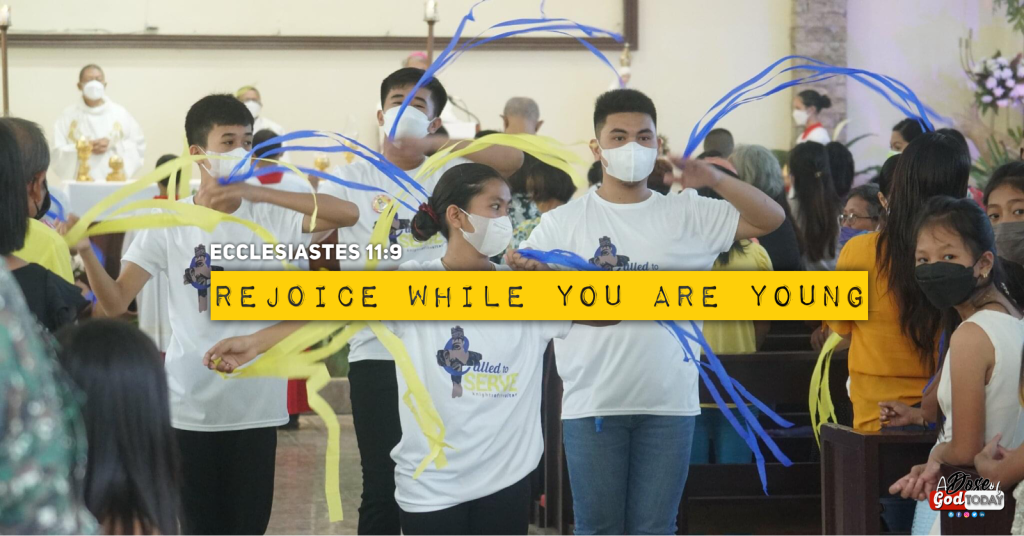
The author of the book tells us, rejoice while you are young and let your hearts be glad in the days of your youth. Indeed, there is so much to enjoy and be thankful for in life especially in our youth though this is transitory. However, it is in our youth that we discover more and understand better ourselves and the world around us. It is in our youth that the Lord allows us to have more failures and disappointments so that we may learn, grow and gain wisdom.
Although the Book of Ecclesiastes may sound pessimistic in life for everything, as he said, vanishes like a vapor, for all things are vanity. However, he also acknowledged how the Lord unfolds His Divine Presence and blessings for us in the many events and moments of our life. The Lord will judge us then, based on our capacity in fully embracing life and rejoicing our youth in its fullness.
Therefore, rejoicing one’s youth and letting our hearts be glad in the days of our youth calls us to be more attuned to God’s way of life. Let us remember, God is life-creating, life-redeeming and life-sanctifying. Thus, anything that destroys life, abuses life and suppresses the fullness of life, may it be in our life or the life of others, is contrary to God’s way of life. This is the author wants us to ward off and put away from our presence.
In the same way, Jesus tells us today in Luke’s Gospel, “pay attention to what I am saying.” The disciples did not pay attention to him when Jesus told them of suffering and death he will undergo. It was either the disciples cannot understand or refused to understand the life of Jesus and his mission. All they wanted was to be just amazed and be entertained by the miracles that Jesus has been doing. However, Jesus is life-redeeming and this is not found in mere amazement and entertainment but in giving oneself for the many.
So, let us all rejoice while we are young and let our hearts be glad as we make our life attuned in God’s way of life. Kabay pa.
We could easily lose track of time when we are overwhelmed by our workloads, business engagements, study loads and many other responsibilities in life. This makes our day tiring, stressful and hectic to the point that time has become so short in order to respond to all the things we have on our hands. And when we cannot meet all the demands, then, we also lose ourselves. We get sick psychologically and physically. Relationships tend to be left behind and not given more importance.
Aside from these, people also lose time from hiding from their unfounded fears because our anxieties could eat up most of our time to think and discern. Others are perhaps petrified by their traumatic past unable to move and go beyond and losing the opportunity to grow and mature. Meanwhile, others could be busy in indulging themselves in compensating what have been deprived from them in the past to the point that their self-satisfaction is what only matters. All of these would certainly make our life unbalanced and our time disturbed and losing many chances to take life at a time.
Indeed, there is an appointed time for everything, as the author of the Book of Ecclesiastes tells us. An appointed time that would allow us to breathe, to relax, to begin, to be renewed and to be surprised by the many things that God has prepared in time.
When we race against time or even take for granted time, then, we shall surely miss those surprising and wonderful things that are happening around us. We shall also lose the chances to behold the beauty and the goodness of people around us.
That is why, Jesus in today’s Gospel teaches us a simple lesson. The Gospel of Luke tells us that Jesus was praying in solitude while the disciples were with him. His friends were there, but Jesus was in solitude, meaning, he was praying alone. We see from here that Jesus took the time to rest, relax, to gather his mind, to pray and to commune with his Father in heaven. Jesus was setting the example to his disciples to have a time for everything and especially a time to pray and a time to behold God’s presence.
Indeed, such time and encounter allowed Peter to recognize that Jesus is the “Christ of God.” Peter in that opportune time understood that God has revealed the Divine Presence to him.
This calls us now as well to have time for everything and to allow ourselves to have a quality time with the Lord. In the midst of our overwhelming demands in life, or in the midst of the chaos and internal conflicts we are suffering from, we may find time for Jesus to reveal his challenges and blessings to us. Find time to breathe. Find time to rest. Find time to pray. Find time for Jesus. Kabay pa.
Life? What is it? What do we have in life? Life can pretty be difficulty and overwhelming when one races to what only gives him or her pleasure and satisfaction. We may search for the meaning of our life, for the purpose of our life and mission of our life. Yet, life can be puzzling and confusing especially when we are faced with the painful realities of life.
This is what the author of the Book of Ecclesiastes wants to tell us. All things in life is vanity, meaningless like a vapor that disappears in the wind. He may have sound pessimistic yet, true in his perspective. Nothing remains under the sun for everything passes away even life itself.
However, not all actually. There is more in the suffering of life, there is more in the pains of life. But this is neither found in pleasure, in comfort, in riches, in power nor in any material possession we have accumulated.
This was something Herod the tetrarch was after and looking for. He too was puzzled and perplexed at what life was revealing to him precisely because he was after vanity. He was after power and wealth. He was after pleasure and comfort. Such attitude made his heart hardened and cruel. As a result, John the Baptist who called him to repent and embrace life as it is, was beheaded by Herod. Thus, Herod became uncomfortable with the presence of Jesus whom he must have believed would take away his pleasure and privileges.
What limited Herod was his belief that he will be satisfied with what he possessed and can accumulate in his life. Nevertheless, everything is vanity. Qohelet also says, “What profit has man from all the labor which he toils at under the sun?” All that Herod had vanished like a vapor.
What is rather more in life is in giving life itself to others which we can find there in the relationships we have built, in the friendships we have created, among our families, communities and friends.
As Herod kept trying to see Jesus, we may also keep trying to meet Jesus, to encounter Jesus in our human relationships, in our many encounters with people and have the courage and faith to give life as Jesus does. Kabay pa.
A REVIEW: A VISION OF A CHURCH RENEWED, Living The Ecclesiology of Vatican II and PCP II
Fr. Amado L. Picardal CSsR, Claretian Publications, Foundation Inc., 2022
Amidst the disturbing news that the highly esteemed Holy Father, Pope Francis’s health is deteriorating (most of his photos these days show him seated in a wheelchair and needs to be lifted up), there are all kinds of speculations as to the consequences if he decides to resign.
First, there is the question who can then be elected in the papal conclave where cardinals all over the world gather in Rome to elect his successor. Luis Cardinal Tagle has been named as one possibility along with a few others. Only time will tell, however, who the next Pope will be and if he will be continuing the reforms that Pope Francis has earnestly pushed despite objections from the Roman Curia. Or following – the usual pendulum that takes place with social institutions – the movement will be to return to the conservative mindset of an institutional Church characterized by the likes of St. John Paul II.
Since he got elected on March 13, 2013 – almost a decade ago – replacing Pope Benedict XVI who resigned from the papacy, Pope Francis has opened the windows of the Vatican so that the Church can co-exist with the complexities of the post-modern world. He has issued some of the most important pastoral documents to come out of the Vatican from the Apostolic Exhortation of Evangelii Gaudium to Laudato Si! to Fratelli Tutti.
There was even a rumor earlier that he was set to convene Vatican III in the hope that all the recommendations that were approved by Vatican II can be more seriously pursued by Local Churches especially those who have remained indifferent to the concerns of Vatican II. As it proved to be far too controversial to organize, Pope Francis shifted two years ago to convening a Synod on Synodality.
In order to facilitate the active participation of the laity – including those who are not practicing Catholics or even those who may feel completely alienated from the institutional Church – all Local Churches (BECs, parishes and dioceses) across the globe were tasked to hold local consultations on the theme “Journey with the Church in the Contemporary Times.” This Synodality asks the question – what does God expect of the Church in the 21st century? A ten-minute report was to be submitted by BECS/parishes to their Diocese and all dioceses around the world are to submit to the Vatican their 10-minute summary report.
October 2021 to April 2022 was the allotted period for the Diocesan Phase. A second continental phase began in September 2022 until March 2023. And finally, the third or the universal phase will begin with the XVI Ordinary General Assembly of the Synod of Bishops on the theme “For the Synodal Church: Communion, Participation and Mission” to be held in the Vatican in October 2023. An Apostolic Exhortation will then be issued by the Pope. The question remains: can Pope Francis hold on to his Chair until then to preside over this Assembly?
Meanwhile, organizers for the 17th Mindanao Sulu Pastoral Conference (MSPC) on the theme – THE GIFT OF FAITH AND NEW EVANGELIZATION AS A SYNODAL CHURCH – are gearing up for the Conference to be held from November 7 to 11, 2022 at the Chali Beach Resort & Conference Center, Cugman, Cagayan de Oro. Once more the delegates will again assess where the Local Churches are in their quest towards their continuing renewal. Once more the focus will be what is happening at the level of the grassroots Church, namely the hundreds of BECs spread across Mindanao.
Now comes, Fr. Amado L. Picardal’s continuing effort to provide the Philippine Church with a textbook on understanding its ecclesiological in these contemporary times. As the author writes in the book’s Prologue: “Ecclesiology is the discipline that reflects in a systematic manner the self-understanding of the Church in the light of faith. It seeks to answer the question about the Church’s identity, nature and mission. It is a theological reflection on the mystery of the Church which is distinct from Church history. While it is possible to study the history of the Church even without faith, Ecclesiology requires a faith-perspective. It is the work of a believer for the sake of the community of believers.”
The author contends that this book does not promote new and radical ideas about the Church. What he intended to do was “to explicate the vision of a renewed Church espoused in Vatican II and received by PCP II and explore its meaning and implication in the Philippine context.” The writing of this book goes back to when the author was doing his dissertation – An Ecclesiological Perspective – with the Pontifical Gregorian University in Rome way back in 1995. Most of what appears in this book is the product of his research and the updating and revisions he has made through the years.
There are 11 Chapters in this book, covering 377 pages. Before presenting again his thoughts of BECs, the first chapters involve an explanation of the ecclesiological models of the Church (Church as Communion, Institution, Herald, Sacrament and Servant); the Church as People of God (Prophetic, Priestly and Kingly People) and The Church of the Poor. After the Chapter on the BECs, the remaining Chapters include an explanation of the Family as a Domestic Church, the Church in Dialogue (with the world, Inter-religious Dialogue, with the poor) and a Renewed Clearly in a Renewed Church.
Across the pages of this book are quotes from the Decrees of Vatican II, various apostolic exhortations issued by the Popes and CBCP statements. At the end of each Chapter there is a long list of citations, a testament to the persistence of the author to do rigorous research before writing the manuscript. Concrete examples of pastoral practices cover all corners of Mindanao and the rest of the world.
There are, however, Church workers – especially in Mindanao who were witnesses to the glory days of the Mindanao-Sulu Conference – who could not help but compare how the Local Churches and BECs were in the 1970s-80s compared to how they function during the contemporary period. Then most of the bishops, clergy and religious – and a growing number of lay leaders – were actively collaborating to make their BECS truly kingly and prophetic. As a result, a number of lay leaders and priests and religious got red-tagged by the military, consequently a number of them were arrested, imprisoned and even killed.
Today one can hardly hear of any single story of a BEC or a lay leader being harassed by the military in the same manner that indigenous communities opposing mining and other development projects have been subjected to. What is this indicating? That the State has become more tolerant of a militant Church or the fact is that the militant Church has disappeared to give way to a conservative model interested only in providing spiritual care to the faithful? For gone are the days when BECs were in the forefront of struggles for justice and peace and the integrity of creation!
Towards the end of this book, the author contends that: “The pre-Vatican II model of the Church appears to still persist in the mind of many… There is still a gap between the vision and the reality. There are still some dioceses and parishes where Vatican II and PCP II vision of the renewed Church has not yet been fully implemented. For the new generation, Vatican II seems to be ancient history and the documents remain unread, gathering dust in the libraries.”
The book offers some suggestions to pursue the project of a renewed Church, but it will require a pro-active commitment on the part of all – from bishops down to the BEC leaders – to break the impasse that seems to make the members of the Church complacent and apathetic to the social and ecological issues that are only worsening. The economy is in shambles and poverty levels are again on the upsurge. Indigenous communities remain at the periphery with little assistance from the State.
While there is peace in Mindanao for the moment, there are still conflicts that cause the eruption of violence. Corruption remains well entrenched in the State agencies demanding good governance practices. Our place in the planet remains precarious as mining, logging, expansion of plantations and inefficient waste management combine to worsen climate change.
For the BECs to once more become fully alive and contributing to the transformation of our society, we need to double our efforts at renewing the Church. Otherwise, the future may not be too bright for Roman Catholicism in this country if and when the general population think of the Church as irrelevant in responding to the challenges of a complex society today and the days still to come!
Consoling it is, for us to hear Jesus saying to us today in our gospel; “I did not come to call the righteous but sinners.” This is because admittedly deep inside we feel that we are not righteous before Him. But in our sickness, despite our brokenness & (above all,) because of sinfulness Jesus still calls us. Meaning beyond our seeming but faltering righteousness and our chronic shortcomings & failures in life, our faith story with Jesus is a story of SECOND chances. Our faith-life story with Jesus is a pilgrimage story of being invited, called & given another chance to do better in life – a faith journey not of being victims & condemned but of survivors and given another chance anew.
This is the story of St. Matthew. He was just an ordinary tax-collector despised & already victimized & condemned by his community as being corrupted. However, when Jesus invited him to follow Him, Matthew’s life was & has never been the same again. He was called to a life not same as usual as before, but to another chance of life anew.
Same way with terminal dying patients given another chance to live, or an ex-convict, a reformed rebel or a rehabbed drug-addict given a chance to be re-integrate to the community, our being Christian – being disciple & follower of the Lord is a story of being broken yet being called, invited, and given another chance to do better in life anew. Ours now is not to go back & be victimized by our usual sick, corrupted & sinful lives again, but ours now is to survive & to do better in life anew as we follow Jesus in our daily lives, as Paul says: “to live in a manner worthy of the call we have received.”
Today marks the golden anniversary of the 1972 Martial Law in the Philippines. Undeniably such event has a tragic repercussions & effects in our history as a society & nation then & until now. However, we should not only view Martial Law as our story of our brokenness & our being victims as a nation. Sad times in might have been to us, above all, we should remember that ML is also the story of us, Filipinos our story of surviving hard-times, of rising above the occasion, of given and giving another chance to do better in life & to live life anew in Christ – worthy of Jesus. In other words, our ML history is not only a history of being victims & condemned, but a God-story of being survived & given another chance in life anew. As we remember our sad history of ML, may we not forget that like with Matthew, in whatever & however life situation may bring us in (sickness, poverty, brokenness, corruption), we are always called, invited & given another chance by the Lord to “Follow Him” in life – not again as before, but ANEW. Amen.






 A DOSE OF GOD TODAY