A couple who was about to be married shared to me their thoughts and plans. They were surely in loved with each other and wanted to live as husband and wife. Yet, as a couple they planned not to have a single child. They just wanted to live as husband and wife. I asked them why. The confirmed that, to have a child is impossible for their individual careers. Both of them were at the peak of their careers and their individual profession was so important that losing such opportunity in their life was not a choice. Thus, even having a single child would be a threat to their careers.
However, Christian marriage is not just limited between the union of husband and wife. This love and union should also overflow towards the possibility of having children. Completely closing the doors to the possibility of having children, rearing, loving and nurturing them is after all, a non-commitment to Christian marriage.
Thus, our attachments in life can prevent us from totally committing to a relationship. It is indeed difficult when we are called to let go of our attachments that have become so dear to us. These attachments could be our careers and jobs, positions and influence, power and wealth, or unfulfilled dreams and desires, our traumatic experiences or past broken relationships.
These attachments prevent us to fully commit to a relationship because we are being held back and we allow ourselves to be caught up. This happened to those whom Jesus invited to follow him.
Jesus said “follow me.” The person certainly wanted to follow Jesus, BUT, in following Jesus, there were conditions attached. Jesus emphasized the urgency of following him but then the person was being held by his attachments. These attachments prevented him to follow the Lord by making conditions.
This is something Job realized also in the first reading. The story of Job tells us about the human suffering of those who find themselves righteous and good. Yet, life is not under our control. God remains the author of life and decides about our life. Job here slowly realized the he was not the master of life. All the things that he possessed are not his, including the life of his family and his very life. His suffering was a proof that attachments in life bring no security and that he cannot set conditions in his relationships with God, the almighty.
Today, Jesus also calls us to follow him freely and without conditions. Each of us is being invited, wherever we are and whoever we are – the Lord calls us to commit ourselves to Him. When we commit ourselves, then, we too are challenged to let go of our attachments that may prevent us from fully following Jesus.
This is what we also remember today in the life of San Lorenzo Ruiz, our own Filipino Saint, who followed the Lord despite the suffering and persecution he endured in Japan. He gave his life as his greatest sign of that commitment to the Lord. Though the grace of martyrdom may not for all of us, but may the example of this ordinary man, Lorenzo, give us the courage and generosity to fully commit in our relationships and in our Christian faith. Kabay pa.
Desperation and hopelessness in life may push us to the brink of giving up and of total retreat. It would be very difficult also to find meaning, purpose and sense of what is happening especially when what we see is a surmounting suffering. People who have reached such kind of situation in life would somehow wish to be dead rather than continue enduring such meaningless suffering.
This is the very situation that the author of the Book of Job is trying to bring to us today. The story of Job reveals to us such human misfortune and unimaginable tragedy in life. Job found the meaninglessness of his suffering and going through all those tremendous tragedies in his life. Those left him speechless perhaps he was looking for understanding and explanation on why such tragedies should happen to him, a righteous and good person. This difficult moments in the life of Job really pushed him to that brink to give up. He cursed the day of his birth and just wanted to die in order to end his deafening suffering.
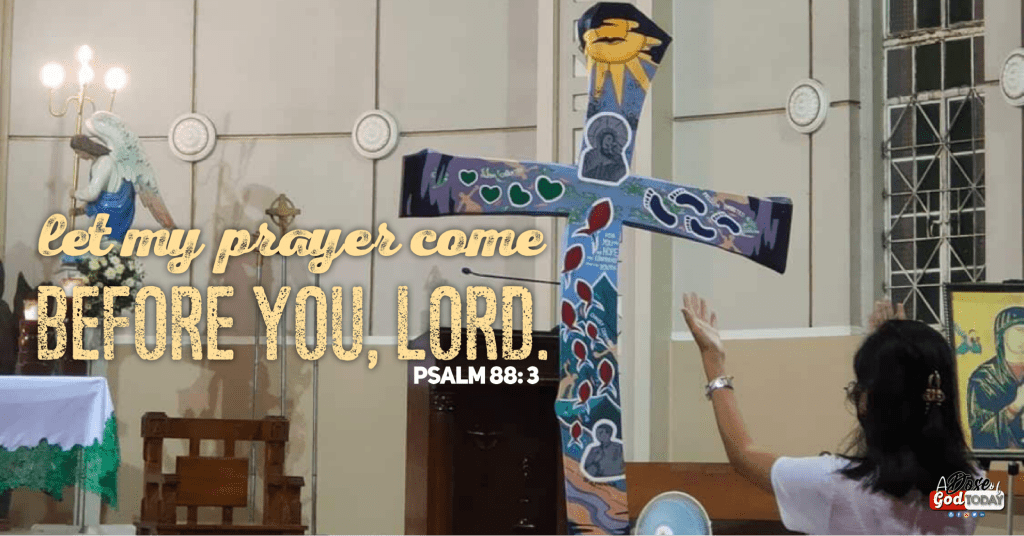
However, despite this human experiences of suffering, the prayer that we find in the Psalm gives hope and comfort to our heart, “Let my prayer come before you, Lord.” This is a prayer of a person who is already at the bottom of the pit, into the dark abyss of hopelessness. The person was overwhelmed with so much suffering in his life yet, he also recognized that the Lord was his only help. In spite of hopelessness, he continued to HOPE for God to rescue him.
This prepares us now how the Lord allows us to realize and see how God works in our messed up life in order to bring healing and the fullness of life. However, God’s ways may not be easy to understand and may be totally different the way we want it to be. What we need then is to tune in our heart and mind into the ways of God and to be more trusting in God’s ways. Moreover, we can take confidence and be more certain that God’s way will not bring us to harm. The way of the Lord is not towards non-life, not towards violence against life as Job wished it to be. God’s way will always be to save life, to renew life and to heal life.
This is how we find Jesus’ way as what the Gospel of Luke revealed to us today. A Samaritan village refused to accept Jesus. They did not welcome Jesus because he was on his way to Jerusalem. These Samaritans because of their social and religious differences with the Jews became hostile since the Jews also treated them with contempt and hostility. It was because of this that John and James wanted to call down fire from heaven to consume and punish these unwelcoming people. But then, Jesus rebuked them because God’s way is not of violence, not of death. This was how the two got their title as the Sons of Thunder.
The rebuke of Jesus towards James and John against their violent response tells us that God has indeed his own way of calling us and his own way of saving us even when we have become unwelcoming of his presence. Jesus’ way is indeed not of violence.
This calls us now that as we face difficulties, great suffering and hopelessness in life we may be reminded that God’s desire is to rescue us, to bring healing and freedom to us so that we may also have that fullness of life with him. We may become more trusting also of God’s ways even when these may become beyond our demands and beyond our human understanding. Kabay pa.
How accepting and welcoming are we of others? Of our life situations both the difficult and joyful ones? As we grow older the more we encounter and meet people and experience different life situations. Yet, with all of these we could also display an attitude that does not take delight with what comes to us or ignore people, things and events that have become usual and ordinary.
We could become less aware of God’s revelations and invitations because of the many demands we have in life, or because we are feeling bored with life, or because we have become so anxious of what will be there for us tomorrow. We could also grow rejecting of anybody and anything because it does not excite us or give us benefits and advantages.
This is somehow what Jesus wanted to warn for his disciples who have grown cold with one another. Their relationship with each other seemed to become centered on the self, on what they will enjoy and on what they will accumulate. In fact, their relationship has become materialistic and based on self-interest.
This was how Jesus found the intentions of the hearts of the disciples. They were arguing who was the greatest among them because they must have thought that being the greatest, then, they would become the closest to Jesus. They believed that Jesus would become king, inherit an earthly and materialistic kingdom and enjoy political power over many peoples. They wanted to be the greatest and the closest to Jesus so that they too will receive great material rewards.
However, such intention of their hearts turned them to become bitter with each one. There must be malice and greed in their hearts for they cannot recognize that the presence of Jesus himself is already the greatest reward. This was the reason why Jesus brought a child by his side to set an example to them. The child, now the closest to Jesus is the greatest in the kingdom because of the child’s capacity to receive God, to welcome God and to be delighted with God’s presence.
The child who is considered one of the least in that community, was indeed the greatest, because the child does not relate base on benefits but on the child’s dependence to God’s providence. This is evident on how a child completely trusts his/her parents and the goodness of others around him/her.
This is what the story of Job also reveals to us today. In this first part of the Book of Job, he was blessed with many good things in life, property and good family, yet everything was taken away from him. Job remained trusting to God’s providence and goodness even when his life turned bitter and the events traumatic and depressing. Job prayed, “The LORD gave and the LORD has taken away; blessed be the name of the LORD.”
Thus, the Lord calls us today to grow in our capacity to receive God, to welcome people and events in our life like a child who completely trusts the goodness and kindness of others. As we grow in that capacity, may we become more welcoming also of others in our life, and receptive of God’s invitations and revelations even when our life gets rough. Kabay pa.
How serious do you think is the economic inequality in the world today? According to Oxfam International’s findings, the economic inequality has cut the income of 99% of the global population and this pushed for over 160 million people in the world into poverty.[1] In fact, according also to World Inequality Report2022, the poorest half population in the world only owns 2% of the world’s wealth. However, the richest people who comprised 10% in the population possess the 76% of the world’s wealth.[2] This inequality has deepened in the midst of this pandemic in which those who are in the poverty line have suffered the most. As a result, it contributed to the 21,000 people dying everyday or equivalent to one person dying in every four seconds who suffered because of severe hunger or lack of access to life-saving healthcare.[3]
There is so much wealth in the world, yet, the suffering of many seemed to be endless as well. The economic and wealth inequality in the world has indeed widened the gap between the rich and the poor to the point that a culture of indifference and lack of concern has crept in the hearts of many. This is something that Pope Francis has already pointed out and wants us to be more aware.
Being reminded of this global situation, our readings on this 26th Sunday in Ordinary Time shed light and challenge to us Christians today. So, allow me to journey with you together with our youth sharer and let us discover how God reminds us and calls us.
Thus, in the first reading, Prophet Amos denounced such culture of indifference and the gap made by those in power and the rich. The Prophet’s voice echoed, “Woe to the COMPLACENT in Zion!”
The complacency of the rich and the privilege in their society turned them to become INDIFFERENT AND BLIND to the suffering of the people. They were unaware of the suffering of many. Yet, if they have seen the pain of the people but they refused to reach out, refused to help though they can, refused to be in solidarity with the suffering for fear of discomfort.
Complacency is an attitude that settles to what is only comfortable for the self. Hence, a complacent person is a self-satisfied person who does not what to be disturbed or to go out of the comfort zone. That is why, a curse was given to the complacent and indifferent. They will be the first to go into exile when Assyria will strike Israel and destroy their Temple, which indeed happened.
Meanwhile, our Psalm this Sunday sings to us God’s very character. The Lord secures justice for the oppressed, food to the hungry, sets captives free, gives sight to the blind and raises up those who were bowed down. This image of God tells us that God is not blind and not indifferent to the suffering of the people and the pain inflicted to the weak and powerless.
God, indeed, does not delight when people are oppressed, when women, men and children go hungry, when people suffer and die because of greed and abuses of others. In God’s time and justice, those who abused, manipulated, maltreated and burdened the weak, the poor and the powerless will be punished.
Certainly, Prophet Amos’ words and the Psalm’s message echo in the Gospel today which we find in the story of Mr. Rich Man and the suffering Lazarus.
While Mr. Rich Man enjoyed his daily lavish meal and luxurious way of life, there at his door was a poor man covered with sores and was surviving through the scraps that fell from the Mr. Rich Man’s table.
However, there was a turn of events when both of them died. Mr. Rich Man, who pretended not to see the poor situation of Lazarus ended in hell while Lazarus was carried by the angels.
With this, the Gospel reminds us that success and security in life are not about what we have accumulated or about the material possession that we have amassed. We are only truly successful and secured when we have built lasting and true relationships with people around us and with God, when we have learned to bridge the gap between one another and begin to see each other as brothers and sisters. Only then, that we shall break our sin of indifference, of our lack of concern for others, of our complacency.
Thus, let us remember that the sin of Mr. Rich Man was not actually of being rich, but of being complacent and indifferent to the suffering of people around him and especially of his neighbor, Lazarus. He could have done something for Lazarus, but chose not to. He was blinded by his own possessions and the luxury he enjoyed. He did not care to offer any help to the poor man. The rich man had no relationship whatsoever with Lazarus. He was only concerned of himself, of his comfort, of his benefits, a sign that he was truly being possessed by his possessions. He hoped and trusted only his wealth and himself.
This was how Mr. Rich Man had grown ungrateful to God for the gifts he received in his lifetime. He was ungrateful because he felt entitled that only him should enjoy the richness in his life. He did not open his eyes and hands to give others a chance to live a better life through his help. Thus, Mr. Rich Man had certainly grown to become an entitled-privileged that even though he was already in the netherworld but then he had still the nerve to make Lazarus serve him. What a self-serving man, indeed!
With all of these, there are three invitations for us in order to break that culture of indifference and bridge the gap between each of us which Pope Francis also calls us to do.[4]
First, to be in the service of others rather than to dominate others. The Lord calls us to show our concern and kindness especially to people who are most in need. Our material resources or even our talents and strengths can be best expressed at the service of others.
Second, to look at others rather than looking out only for one’s own interest. The Lord reminds us not to become indifferent and unconcerned with the realities of suffering around us and not to think only for ourselves and our own good alone. As a community, we are called to take care of each other.
Third, to have a renewed awareness of the dignity of every human being. We are created in the image of God. We may also see and recognize always that each one is God’s image. Only then, that we are also able to acknowledge that we are all sisters and brothers and not treat each other with contempt and hostility because of our differences but in compassion and respect that allow life to nourish as God desires it. Kabay pa.
Once a very rich man approached their parish priest for an advice. He said to the priest, “Father, I have a problem that is bothering me a lot. You know how rich I am. I have everything I need. I get everything I want. But how come I feel I’m not fully satisfied? There is always that emptiness & missing in me that do not satisfy. I maybe rich outside, but I am actually poor inside. What do you think of my problem, Father?” The priest invited the rich man in his living room and brought him near the glass window. And the priest instructed him, “Look out into the window and tell me what you see.” He said, “I see people walking around the plaza.” Then, the priest brought him in front of a large mirror and said, “Look into the mirror and tell me what you see.” “I see myself,” he replied. Then the priest explains, “You know what, both the window and the mirror are made of glass. But their difference lies in the silver paint. As you may notice, the mirror is glass coated with silver paint & the window is just a plain see-through glass. So, whenever you look through a plain glass window, you see people – you see others. But whenever you looked at silver-coated plain glass mirror, you will only see yourself – not others. You cannot see other & you even stop seeing others, but only yourself. So, whenever we start to only concern ourselves with wealth and riches, i.e. coating our plain glasses with silver-money, we start to become blind to see others but only see ourselves.”
Reflecting on this story and our parable today, we can say that it somehow echoes our day-to-day life experiences. Conscious of the hard times we are going through these days – not only in our country & in our world but with ourselves, sometimes we wonder what causes the great gap between rich and poor. What makes poor poorer or desolate? What makes rich richer? What makes life difficult nowadays? What makes me poor or rich? What makes my life difficult or easy these days?
This is what Jesus is trying to teach and convey us today.
First, Jesus describes us that our self-centeredness makes us blind, insensitive, & unconcerned to the needs of others. Just like the rich man in our parable today, he was too full of himself that he was unconcerned about the poor Lazarus at his doorsteps. He was too full of himself that even before God, he was more concerned with himself – his own thirst and salvation that he only perceived Lazarus as his errand to quench his thirst and to warn his own family about his fate in heaven. “Send him..” the rich man said, to command even God for Lazarus to do his wishes. So full of himself… conceited, & self-centered. Here Jesus warns us of the consequence of our self-centeredness. It makes us only see our own selves, making us blind to the needs of others, most especially the poor.
Second, Jesus maintains also that our silver-coatings taints our plain glasses. Meaning, our material possessions, wealth, and riches make us self-centered and greedy. Like the rich men in our story and in our parable, money, and earthly possessions taint and distort our perceptions of others. Our materialism makes us selfish and blind to the needs of other people, making us only view life from our selfish mirrors.
At the same time, Jesus is telling us today that all of these, our greed, self-centeredness, and earthly possessions do not give us meaning in life and promise us our salvation. For Jesus, God has endowed us with a lot of blessings not only for own sake but also for others. It would mean that we are not the sole owners but just stewards or managers of God’s graces. The blessings & graces we have now are meant not only for ourselves but to be shared with & to others. We are called therefore to be partakers & sharers of God’s blessings to others. In God’s Kingdom, sharing not hoarding is the name of the game, & the way forward.
In a sense, God has already given us looking glasses to see. It is up to us then how we use our glasses – either as mirrors for our selfish interest or as windows for further growth in our relationship with God and concerns for others. In other words, our mirrors – our self-centeredness makes life poor, difficult & empty, as well as our windows – our other-centeredness makes our life rich, easy, & meaningful.
May the Lord continue to grant us the wisdom and audacity to make use of our God-given blessings be shared with others for the sake, not of ours alone, but mostly for God’s glory & other’s good. Amen.









 A DOSE OF GOD TODAY