Category: AUTHORS

  • AM I SEEKING TO PLEASE PEOPLE? 

    AM I SEEKING TO PLEASE PEOPLE? 

    October 3, 2022 – Monday of the 27th Week in Ordinary Time

    Click here for the readings (https://bible.usccb.org/bible/readings/100322.cfm)

    Do I do good to seek the affirmation of others? Do I do things for others in order to gain their recognition and acceptance? Our past experiences of rejections, not being affirmed, not being recognized and accepted by others, could give us the anxiety. In order to compensate what has been deprived from us such as our childhood need for acceptance, affirmation and recognition could become our hang-ups even when we are already a grown-up.

    We would tend to please others by being good and kind, by doing any demands from others to us, by meeting every expectation from us just to gain their approval and affirmation. We could also display such attitude that would praise another person through our flattery words and extra attention given in order to seek to gain favor. Or, we could be more aggressive by directly demanding from others that we should be affirmed and recognized by soliciting such honor from others.

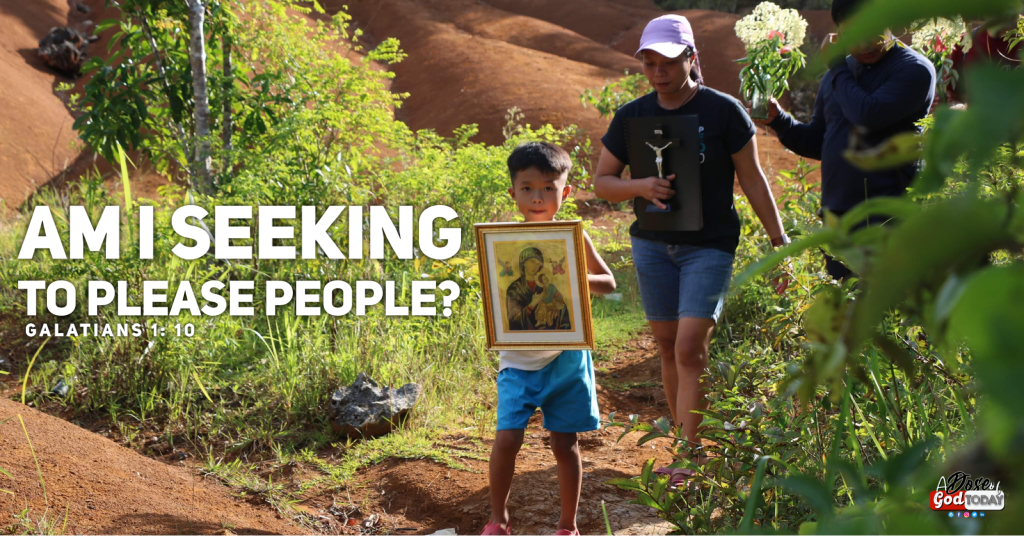
    What St. Paul asked, “Am I seeking to please people?” sheds light on this attitude of the heart. Paul wrote to the Galatians and reminded them that his presence among them and his ministry to them in preaching the Gospel of Christ was not about seeking their attention or even to please them or any other person. The Galatians who after receiving the Gospel of Christ from Paul was about to seek the approval of Jewish Christians who demanded that the new Christians and not Jewish before should accept first the Jewish Law and its religious practices. Only then that the Galatians will be considered as good Christians and be accepted.

    However, Paul did not agree with this. Such intention is a perversion of the Gospel. Faith in the Risen Lord is not about being able to please another culture and religious belief just to be accepted. The Gospel of Christ being received by Christians is not about pleasing another in order to be welcomed in the community. Faith in the Lord and the Gospel of Christ are the elements that constitute the life of a Christian.
    This is what we have also heard in today’s parable in the Gospel of Luke. The Samaritan did not seek to please others but he did what he should do as a human person to another human person who was in need of help. Jesus used this parable in order to respond to the question of a scholar of the Law on what to do to inherit eternal life.

    Thus, it is by being able to love God though our expression of loving one’s neighbor that we inherit eternal life. The good deeds, kindness and mercy that we do to a person in need is not about pleasing another but an expression of faith and devotion, of love and hope in God. To inherit eternal life is, therefore, also not about to please God in order to gain that favor but in showing mercy. Mere strict observance of religious practices and traditions could become our way of pleasing another like our flattery words and actions to another. If mercy does not flow from our religious traditions, prayers and devotional practices, then, these become our mere attitude of currying favors.

    May our actions, our thoughts, our kindness, goodness and mercy shown to others be our expression of that love of God and not in simply seeking to please others. Kabay pa.

  • Increase our Faith     

    Increase our Faith     

    October 2, 2022 – 27th Sunday in Ordinary Time

    Click here for the readings (https://bible.usccb.org/bible/readings/100222.cfm)

    “I am losing my faith,” these were the words of my friend who has been in so much difficulties in her life recently. The pandemic affected so much their business and lost their investments. Then, her husband who was her inspiration and strength, her comfort and dearest friend, died of covid-19. She is left alone to take care of their three children and a burden to pay a surmounting debt.  She was frustrated, in deep sorrow and angry at God for letting all these happen to her and her family. She felt lost and confused if God is listening to her and truly present.

    “How long must I endure this?” This was a question from my friend that I cannot also answer. I dare not offer any advice to her because I realized that my words would not be enough to bring comfort to her. I was afraid that I might bring more confusion to her. And so I listened to her and prayed with her to rediscover faith in the midst of those great trials and to find God in her most depressing and grief-stricken moments in life.

    Prophet Habakkuk in our first reading also expressed such distress and hopelessness in the midst of an overwhelming suffering. “How long, O Lord? I cry for help but you do not listen!” Habakkuk seemingly felt the absence of God amidst the misery and violence he had witnessed.

    At this time, the tragedy and suffering of the people were caused by themselves. Prophet Habakkuk lived during the time when their political leaders, their kings, committed grave sins against God and the people. In particular, King Jehoiakim led his people into evil. He was a corrupt and a godless tyrant who murdered his own people, violated the wives of the men who were against him and then seized their properties to be his own.

    This was the situation of their nation under such ruthless leader. And with this, there was also an overpowering foreign kingdom of the Babylonians who threatened smaller kingdoms. There was a coming destruction that Habakkuk had already seen.

    Thus, the prophet prayed in behalf of the people, “How long, O Lord?” The suffering of the people, the violence and misery that they were enduring seemed to be endless. Yet, the prophet still hoped and held on to his faith. This is what we have heard at the end of first reading, “and for the just one, because of his faith, shall live.”

    The invitation of faith is what we have also heard in today’s Responsorial Psalm, “If today you hear his voice, harden not your hearts.” Indeed, God speaks to us and God remains present even in the darkest and most painful story of our lives. That is why the Psalm calls us to sing songs of thanksgiving in God’s presence, to come to God and recognize that God is our God. We are the people he shepherds, the flock he guides. Therefore, we are not the one who is in total control of life, but God, something that could be very difficult for us to understand.

    Such realization is what we also find among the apostles of Jesus, who asked the Lord, “Increase our faith.” The apostles realized the their faith might not be enough to become worthy of Jesus. They became concerned that they might not be in control of their lives and lose their way.  Before this request, Jesus told them of the significance of a person who has faith and that is to be able to lead others to God’s presence and to be able to forgive.

    This was the very context of that plead from the apostles. Their faith might not be enough to lead the people closer to God and might even lead many to evil just like Jehoiakim, the corrupt and godless tyrant. Their faith might not be enough to forgive others because they might turned to become bitter, hateful and vengeful. Their faith might not be enough when great suffering and persecution will come in their life. They might lose their faith.

    Yet, the Lord assured them that even when faith is just as the small size of a mustard seed, that can make wonders in us. This is something that Paul also reminded in his second letter to Timothy. Paul who was already old and was in prison became more confident and assured in his faith despite the persecutions and the suffering he was enduring.

    Paul reminded and comforted the young Timothy of the gift he received. Timothy was gifted with faith. Thus, Paul said, “stir into flame the gift of God that you have through the imposition of my hands” (speaking of the gift of ordination). God gave Timothy power, love, and self-control. This was how Timothy was told neither to be ashamed nor to be a coward to become a witness of the Lord, a witness of God’s presence and of God’s goodness even in the midst of evil and suffering.

    With all of these, this 27th Sunday in Ordinary Time tells us and reminds us that…

    First, faith is our loving response to the Lord who is ever faithful to us and ever present even when we feel that he is not.

    Second, faith is our power and our strength especially in times of hardships or in times of miseries and in times of confusion and great trials.

    Third, faith is not just a mere adherence to creeds or traditional religious practices that we have. Rather, faith is our active response to God who has called us to be his witnesses, to become Jesus’ present-day apostles who shall bring others closer to the Lord through our own experiences of God working in our life. Kabay pa.

  • FOR Love than benefits

    FOR Love than benefits

    October 2, 2022 – 27th Sunday in Ordinary Time

    Click here for the readings (https://bible.usccb.org/bible/readings/100222.cfm)

    Once a boy approached his mother and demanded: “Mom, may I ask now for your payment. Give me now my rewards and prizes”. The mom asked, “Payment, rewards, prizes? For what?”  The boy replied, “for cleaning my room, for preparing the table, for washing the dishes, for passing all my grades, and for tending my brothers and sisters”. “Ahh, see”, the mother continued, “Son, for nine months I bore you in my wombs, for many sleepless nights worrying and taking care of you in your sickness, for washing all your clothes, for cooking your food, for making both ends meet for your food, clothing, and education – all of these things are done for free. I don’t expect payments, rewards, or bonus prizes, from you; not out of obligation but out of my special love for you.

    Perhaps some of us may be like that boy, thinking and considering God – not as our Father or parent, but as our master or boss, whom we work for & who should repay and compensate us of all the good things we have done for Him in life.

    We sometimes do find ourselves – consciously or unconsciously, demand from God payment or rewards for every good deed we have done, and punishment for every wrong or bad deeds we have done. We sometimes think that God should grant us bonus, payments, and rewards for every service we rendered, at the same time should judge and punish those who fail and done disservice. We cannot deny that we do have this kind of mentality – that salvation is due to rewards and punishment based on our deeds and services.

    Jesus in our Gospel today wants to correct this kind of mentality and perceptions. In Jesus times, this mentality of reward and punishment for human deeds and action has been a dominant theology of the Jews. When his disciples asked Him to increase their faith, here, Jesus clarifies to them that their requests must come and base from their deep faith and trust in God, and not in their expectation and aspiration to be rewarded and compensated for their good endeavors.

    For Jesus, it is not right for us to put God in a situation that He is indebted to us, that He has the obligation and responsibility to repay us for our good deeds and to punish us for our wrongdoings. We cannot force or coerce God to grant us His gift of salvation. We have no right to demand payment, bonus prizes, or rewards for our deeds, because the salvation He grants us is not payment or even our wages for our performances & deeds, but His grace, His free voluntarily given gift to us. Meaning, our salvation does not depend on our deeds, but on God’s generosity – not on our performances but on His great love for us.

    Consider then, Brothers and sisters, that God is our Father, our Parent – not our boss, our employer. We are His children, not His employees or workers. We know that children obey their parents because of their deep love and trust in them. We obey and love our parents not because of rewards and punishment but we choose to reciprocate the special love for us. Meaning, we don’t have to earn God’s love, because, like parental love, God has already loved us even in our sinfulness or even if we fail Him with our wrongdoings, and in whatever our performances in life maybe. We obey God’s commandments, we serve Him, not to earn His love, but because He already loves us, and because we love Him back in person and not out of benefits, payments, or rewards.  

    Brothers and sisters, our loving and generous God, as Parent always longs and hopes that we love and serve Him out of our love and faith, not out of obligation, fear and rewards or punishment. Our task now is to reciprocate God’s love with and by our deep love and faith for Him in person than just by services & functions.

    Lord, grant us the grace to be contented with our Father’s Great Love for us His children, and of our child-like faith and love for Him. Keep our hearts & mind free to love & serve Him as we should & as we choose to be now and always…

    Amen.

  • God favors the Childlike

    God favors the Childlike

    October 1, 2022 – Saturday of the 26th Week in Ordinary Time

    Click here for the readings (https://bible.usccb.org/bible/readings/100122.cfm)

    The attitude of children, that is, of being trusting, dependent and open to surprises makes them more welcoming. Such attitude of the heart is empty of any judgment and biases, of any pretensions and entitlement. These are the reasons why Jesus would make a child as an image of those who belong to the Kingdom of Heaven because God’s favor truly belongs to the childlike.

    In contrast, a heart that has grown old and has become unwelcoming of what is new and to surprises becomes judgmental, pretentious and entitled. This is an expression of an arrogant heart that refuses the Divine Presence and the call of God for a change of heart.

    This is where we find the significance of Jesus’ words today in the Gospel. Jesus gave praise to his Father in Heaven for the revelation given to those who are childlike like the disciples. The wise and the learned who claimed knowledge of the world and mastery of life and faith have refused to recognize God’s presence among them through the person of Jesus. Only to these ordinary men and women who followed Jesus that they recognized the great presence of the Lord God in their midst.

    This is also the story of Job revealed in the last chapter of the Book in the first reading. Job, though, he could not fully understand the ways of the Lord became more trusting to God. He stopped justifying himself for being righteous and good and insisting that God should be God according to his own beliefs. At the end, Job allowed the Lord God to be God and be more surprised at how the Lord works wonders on earth and in his life. Job realized the importance of growing in confidence with God just like a child.

    This is what St. Therese of the Child Jesus also exemplified in her life. Therese was indeed a dear child of God who constantly desired the Divine Presence in her life. Her childlike heart allowed her to see things differently from others. She saw goodness and kindness of every person despite the fact that she too was misunderstood by her co-nuns. Therese’s heart that was most confident in the presence of the Lord made her contemplative life to be more active by reaching the hearts of others even when she was just staying in their monastery. Indeed, her childlike heart that belonged to God touched the hearts of many and brought them to also see Jesus, and encounter Jesus through the young Therese.

    Today, as Christians, we too are called to become childlike and not let our hearts grow old, bitter and be filled with pretensions. As we grow in our confidence and trust in the Lord, then, allow the Lord also to surprise us with his Divine Presence, to see what the Lord wants us to see and to hear what the Lord wants us to hear. Kabay pa.

  • Unrepentant and Unbelieving

    Unrepentant and Unbelieving

    September 30, 2022 – Friday of the 26th Week in Ordinary Time

    Click here for the readings (https://bible.usccb.org/bible/readings/093022.cfm)

    The words of Jesus seemed to be filled with dismay and pain over the three cities of Chorazin, Bethsaida and Capernaum. The people in these cities remained unrepentant and unbelieving despite the presence of Jesus in these cities. Jesus walked on their streets, preached to the people and healed the sick. However, the people’s hearts remained closed and hardened.

    The Lord has come and made his dwelling among them, yet, still they refused to change their way of life and refused to come closer to the Lord. Though they had many opportunities to respond to the Lord’s invitations and teachings, yet, they were lukewarm, tepid and passive. What the people did in these cities was ultimately a rejection of God. They rejected Jesus and so of the presence of God in their midst. “For whoever rejects me, rejects the one who sent me,” Jesus said.

    However, we have heard a different response in the story of Job in the first reading. Job who was overwhelmed with tremendous sufferings in his life questioned the Lord God for allowing those evils to happen in his life. Job actually thought that God is dependent on his goodness and righteousness. Job’s thoughts were grounded on the belief of Divine Retribution, of punishment and reward. Job believed that God was not being God because the evils that he experienced did not fall under this belief of Divine Retribution. Job has been a good and righteous man, hence, he must only enjoy rewards, blessings and the good things in life.

    However, in all this quest and unbelief of Job against God, the Lord spoke to Job telling him, that God is beyond what Job thought of. God is not dependent on what we can think and would like to think about him. God is after all the one in control of everything. The wisdom of the Lord is so much beyond our human understanding. This is how Job realized his smallness and his futile belief that God is dependent on his goodness and righteousness.

    With this encounter, Job began to focus his heart and mind on God rather than himself alone. Job redirected his thoughts and faith to the Lord rather than on his goodness and righteousness. And so, Job repented and believed.

    Today, Jesus’ encounter with the unrepentant and unbelieving three cities and of Job’s encounter with the Lord, we too are called to redirect our focus, our mind and our heart to the Lord. May we become more welcoming of God’s presence and of God’s many challenges for us and allow the Lord to change our ways, our thoughts and even our own beliefs into God’s wonderful ways. Kabay pa.