Truth can indeed be easily manipulated or even covered especially when those who are faced with truth become threatened and disturbed by it. This is what we have heard on this Easter Monday as told to us by the Gospel of Matthew. The truth about the resurrection of Jesus was manipulated by people in power who also desired to advance their personal agenda. The soldiers who were witnesses of the Resurrection were paid not to tell what really happened but to create another story. These soldiers must have been captivated with awe and wonder in the event of the resurrection. Light must have pierced into their unbelieving hearts. However, what was sad in their story was when they were presented with the immediate comfort of money.
They were willing to cover the truth of the resurrection and create fake news for the sake of money. They accepted a corrupt offer to spill the untruth to people rather than to tell others of God’s power and mercy. Why was that? Is money more powerful than God? Certainly not. It is just deceiving and very tempting especially when people need it.
Nevertheless, apart from this sad story, we still have the women who showed to us how the resurrection of Jesus changed their life. The Gospel tells us that they were still fearful yet overjoyed. This means that despite the darkness they have experienced in the past days and the fear that enveloped them, the presence of Jesus filled them with so much joy.
The women did not succumbed to despair and fear unlike the soldiers who succumbed to money and corruption. The women continued to believe in Jesus in spite of the confusions and even in pain and suffering that they witnessed. They never lost their hope in Jesus.
This kind of attitude in them was showed in their action as they went to the tomb early in the morning. The tomb surely would remind them of the death of Jesus, meaning, of sadness and failure, of pain and disappointment. However, even in the midst of all of these, they found a reason to find light in the midst of darkness, to find hope in the midst of hopelessness and to find life in the midst of death.
And true enough, as they desired to see Jesus, they indeed saw and witnessed the glory of resurrection. This was how they also found their mission, and that was to be Jesus’ witnesses to others.
Now, as Jesus called them to tell other disciples about him, each of us now too is called to tell others of Jesus’ presence in our very life. With this, there are two invitations for us on this Easter Monday.
First. Money is not everything though money and riches can be deceiving and tempting when we are in need of it, that it will lead us to become dishonest, corrupt and abusive. This happened to the soldiers who exchanged for money the truth. They settled for their own comforts. However, that did not made them truly rich or satisfied with life. In fact, they are now seen like the “paid trolls” who merely repeat lies and fake news to deceive others and bring others to corruption and death.
Second, preach Christ and preach what is only true. Never be afraid to tell what we have seen, what we have heard and what we have witnessed. Tell others not just through our words but also through our actions that Christ is truly alive. Even a simple gesture of generosity to a person in need or a simple act of kindness to others is a way of sharing that Christ is truly alive in us. Kabay pa.
When we walk, we hardly take cognizant of the footsteps we take unless – like the Buddhists – we are so mindful of the here and now, the precious present moment. It is only when one focuses on the movement of his feet while walking down a path, that one is struck with the importance of taking footsteps. For as the Chinese proverb posits: A journey of a thousand miles begins with a single step!
As we celebrate Easter Sunday today, it might do as good to reflect on the value of taking footsteps vis-à-vis our faith as followers of the Risen Lord. After all, his admonition – “Come follow me!” – involves literally moving our feet as we go after the Redeemer!
Jesus lived on earth at a time when people could only move from place to place by walking. In some cases, horses and donkeys assisted them as they travelled. Unlike today when the advancement of transportation technology allows us to travel long distance through planes, boats, trains, buses, cars, even the lowly habal-habal, those living in the first century had to rely on their feet if they wanted to be in another place.
Being an itinerant preacher-healer, Jesus himself walked practically all over Israel. While born in Bethlehem, he grew up in Nazareth. When his public life unfolded and he went out to preach the Good News, he travelled from Nazareth to Bethany, Bethesda, Capernaum, Cana of Galilee, Jerico, reaching the Jordan River and the Sea of Galilee. In his three-year public life, he walked more than a thousand miles.
Some of the footsteps he took would take on biblical significance! Among these were those footsteps traversing the desert for forty days when he needed to get ready for his mission, his walk cum ride-the-donkey from the countryside to Jerusalem, his walk across the seashore as he met the fishermen who would become his loyal followers and later when he appeared to them after rising from the dead, and his walk with two forlorn followers on the road to Emmaus.
The most dramatic, of course, were the footsteps he took from the garden of Gethsemane to the palace of King Herod, to the court of Pontius Pilate until he ended up on Calvary Hill. This route – now labelled the Via Dolorosa – has become the focal point of interest for tourists who fortunately find their way in Israel on Good Friday.
On top of this mournful hill, the carpenter from Nazareth – reviled by the Pharisees as a false prophet; who hobnobbed with drunks, sinners and prostitutes; who the powers-that-be considered a rebel out to subvert the established regime and tortured by the Roman soldiers as a means to warn other potential would-be “terrorists,” – was subjected to a crucifixion on a cross, fit for criminals!
That last step Jesus took as he faced death, eventually ended his earthly life.
At dawn of Eastern morn, the sound of footsteps echoed across the graveyard where Jesus and others were buried. These were footsteps first of women, later followed by a few of the more courageous apostles curious as to the women’s testimony that the tomb was empty! And most interesting, it was a woman – Magdalene – to whom Jesus first appeared as the Risen Lord!
After Jesus appeared to more of his main followers and trusted disciples, he gathered them together for what is now known as the Great Commission (Matthew 28:19-20) and left them with these words: “Therefore go and make disciples of all nations, baptizing them in the name of the Father and of the Son and of the Holy Spirit, and teaching them to obey everything I have commanded you. And surely I am with you always, to the very end of the age.”
Gifted with the Holy Spirit on Pentecost, many of them, including a new convert – Paul of Tarsus – walked to many directions beyond Israel to give witness to the life and teachings of the Lord. And despite the passage of time and the great advancement of transportation technology, in many Third World countries today, those who bring the Good News to the hinterlands, follow the way of the early disciples. They walk miles to reach the isolated villages.
It is thus, very appropriate that in 2021 Pope Francis inaugurated what would be a synodal Church for these present times. To be a synodal church involves getting all the baptized to journey together as one in the footsteps of the Lord, with great effort exerted to make sure that those who for so long have not been afforded a place in the Lord’s banquet, can finally find themselves in the place of honor!
This was Jesus way; moving from village to village, his focus was to journey with his society’s excluded, the sinners considered unclean and worthless. He avoided the elite, the powers-that-be, the ones who oppressed the poor even as he did not exclude them from his circle if they showed an openness to repent and make amends! He disdained pomp and pageantry, he lived simply without benefit of having a place to stay, comforted the widows and healed the sick. In the process, the Good Shepherd smelt like the sheep!
Alas, when Christianity shifted to Christendom and the Church’s memory of the way of life of Jesus faded, the ugly head of institutionalization and clericalism penetrated the walls of churches, monasteries and convents. Patronized by kings and emperors. ensconced in palaces to enjoy the perks of power, the Church’s heads veered away from the footsteps of the Lord! And the Gospels they preached held no relevance anymore to the lives of the majority who remained in the margins and disenfranchised of their human rights.
If the Church today hopes to return to the dangerous memory of Jesus’ act to save humanity, she has to embrace Pope Francis’ synodal agenda. The question is: how many of our church leaders and engaged laity are making sure that this agenda is not lost in the quadmire of a Church’s struggle to remain relevant in these post-modern times?
In the VUCA (Volatile, Uncertain, Complex and Ambiguous) reality of the world today, Christianity is faced with a major challenge to return to its roots. Jesus presented the model of a synodal church – his footsteps made possible his journeying with society’s excluded – which challenged an established religion that was hijacked by those who would promote a faith that was blind and obedient to those in power. It was in this context that Christianity was born. If we are to redeem what Jesus founded, we, too, in our times will need to do our best to help build a synodal Church, in spite of the reluctance of our leaders to forge this kind of journey with the rest of us!
Along with Pope Francis, we take the footsteps towards this goal buoyed by the Risen Lord! Happy Easter everyone!
What is the purpose of life? What is life all about? Why do we have to suffer through life? How can we move on with life? Where is God in all these?
During pandemic times & even now in the New Normal period, I have been confronted with these questions from people, especially young people, who are looking and searching for meaning and directions in life. To be honest, I too had raised these questions and have grappled with finding answers. Not without difficulty however I somehow discover an answer that makes sense and suits me. I found it from a book called The Gospel according to Peanuts by Robert Short that was based on Peanuts comic strips with characters like Charlie Brown, Snoopy, Lucy, Linus and others, created by cartoonists Charles Schulz. In one of its comic strips, it simply says: We are like a bottle of medicine where God puts a label on it to make sure: “Shake Well Before Using”.
If we really come to think of it, such simple line says a lot about these questions in life.
Yes, indeed we are like a bottle of medicine. On our own and for our own sake, we are no one… we are nothing. But with others and for the sake of others, we are someone…we are something. And to be and remain something effective and someone important in life, we have to go through a lot of shaking and moving. Even we like it or not, we need to be shaken and disturbed once in a while,… or else we remain nothing and worthless. So to make sure our value and sense in life, God has to shake us, not for the sake of shaking itself, nor only for our own sake, but for the sake of Him and others – that we may be a medicine to others and each other. The spiritual guru Henry Nouwen calls this “wounded healers”, in which, with and through our wounds and woundedness we also become healers & medicine of others and for others.
If we also come to think of it, being shaken well by God has always been part of the story of our faith and life.
Last night’s review of our salvation of history in the scriptures reminds us that shaking and to be shaken well has always been part of our growth in faith and life. Ever since the creation of the universe from chaos to order, the rescue of Israelites from the power of Egypt, the building of Israel as nation, the establishment of covenant with Israel, the empty tomb and the resurrection of the Lord, and our baptism now and again in Christ, we are continually been moved and shaken by God well, not for our own sake but for the sake of Him and others. The symbol of Fire and Water, the reading of scriptures and the celebration of Eucharist in our liturgy last night are witness to the whole passage of shaking we go through in life for us to have meaning, direction and worth in life.
Today we proclaim Jesus has risen, Alleluia. We Christians remember, celebrate, and believe that Jesus has risen indeed in our lives. We can even dare to proclaim that He has risen Again and Anew in our life today. Again, because in almost every year of our Christian faith and life, we celebrate His resurrection.
But he has also risen Anew with us now, because our encounter of His resurrection will never be the same as before. Yes, Jesus always resurrects in us, and He reveals to us as uniquely as before. Nabanhaw siya kanunay kanato apan lahi ra sama kaniadto. He is still Jesus, but He is now Christ, the risen Lord.
Every Easter seasons, we may say then, are God’s time of year of shaking us before using. Just as the women & the disciples found an empty tomb and met the Lord on their way back, and the way we struggle & cope with the trying times of Covid-19 pandemic these recent past years, during this years’ Easter season, same as ever, there will be more shaking going on, and more to happen in our Christian faith and life.
Let us not forget then whatever happens and how the shaking ever happens, all of these will not be on our own and for our own sake but with and for the sake of Him and others. Remember, We are part of His great plan of scheme. Let us be open and allow ourselves to be shaken, to be moved, to be disturbed again and anew, for in this way, we participate in His work of salvation in our lives. If and when however we get lost along the way and find life meaningless and without direction, perhaps we may be consoled by Charles Schulz words: We are like a bottle of medicine where, God puts a label on it to make sure: “Shake Well Before Using.”
Happy Easter to All. At Abangan ang susunod na kabanata.
In the popular Netflix Series, The Sandman, an episode portrays how the Lord of Endless Dreams (Morpheus) went to Hell to retrieve his tools. In Hell, Morpheus faced Lucifer in the duel through the “Oldest Game” where each one has a turn to use a concept from their imagination to defeat the other. As each one used a concept, Lucifer at the end, used Anti-Life. In this, Morpheus was down and weak. He was asked by Lucifer, “What can survive the anti-life?” Yet, slowly, Morpheus tried to speak, until he was able to utter, “I AM HOPE.” With hope, Lucifer was defeated for nothing kills hope.
On this Easter Sunday of the Resurrection of Jesus, we are reminded of HOPE. However, we as Christians now, do we really believe in the resurrection?
Well, on that Sunday morning, as the Gospel of John told us, when the women wanted to visit the tomb of the dead Jesus, his body was nowhere to be found. They believed that the body was stolen. However, the other disciples whom Jesus loved, when he saw the cloth that covered the head of Jesus was rolled up in a separate place, HE SAW AND BELIEVED! The Lord indeed, rose from the dead!
Jesus’ resurrection sums up everything in the Sacred Scriptures. The resurrection of Jesus is the very essence why the Church continues to live until today. If not because of the resurrection, there is nothing to believe, nothing to hope for. Hence, the resurrection of Jesus is the “DEFIANT HOPE, a hope, hoping against hope.”
With all those suffering and gruesome death of Jesus, the disciples ran away, hid and believed that that was the end, and there was nothing more. However, the Lord is more powerful than death, more powerful than our frustration and disappointments, or of our failures, more powerful than human sin, more powerful than human violence and greed.
God’s commitment to us and his love for you and me is so great that it makes the dead back to life, to the glory of resurrection, to new life, to a blessed and joyful life.
Thus, friends, remember too, if you find yourself at the brink of giving up, or at the edge of losing your desire to live and to dream, or when you are at the end of hopelessness and despair, God will never let go of us. God will never surrender on us. Remember that! Believe in that!
Jesus went through all those suffering and even the loneliness on the cross, because Jesus believed that there is more in you and in me, in each of us, and that there is more in our broken and wounded world caused by human sin of greed and indifference. We may also consider ourselves as terrible sinners, or others may condemn and think that we are hopeless and worthless, but the Lord will always see hope in us. God sees a joyful and blessed life in each of us, in all of us, as a community.
Thus, the power of the resurrection tells us now of the Church’s mission and commitment to life and to freedom. The Church, and that is US, is a believing community who is being moved, touched and taught by the Lord.
As the Lord dwells in each of us and in our community, we are now called to become EASTER PEOPLE or PEOPLE OF THE RESURRECTION. This means that what we preach and what we live is the joy and hope that the resurrection brings. But, remember too, that to be become a people of the resurrection, we also become a contradiction to those who want to act like God and become like God and those who are anti-life, like Lucifer. Just as Jesus was a threat to them, we too shall be. Yet, the glory of the resurrection will bring us into hope and joy which can be experienced not just after our death but can be tasted, felt and lived even today.
How would that be possible? By becoming the presence of Jesus today to people around us through our very life that gives and expresses hope for others. Kabay pa.
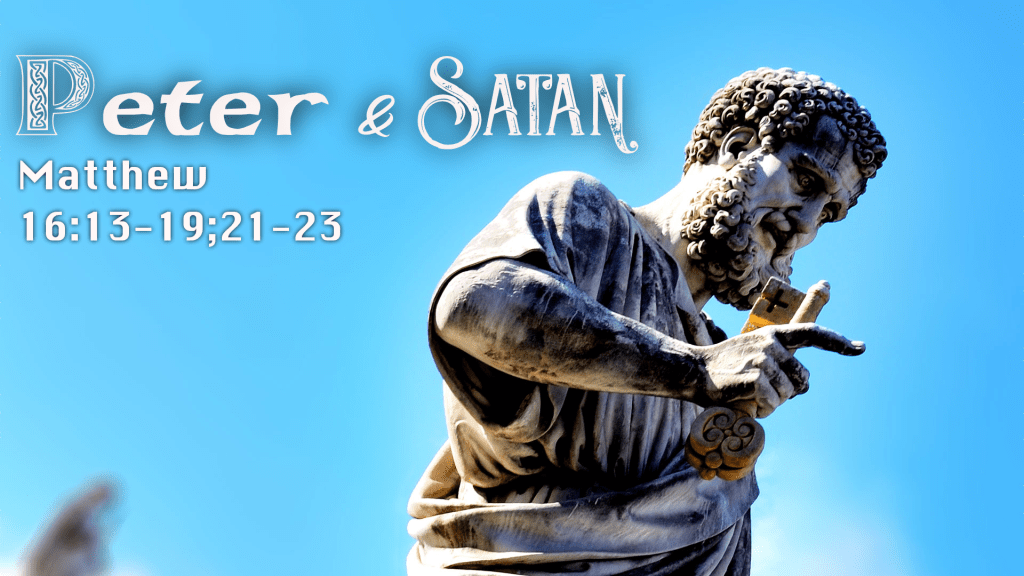
Peter was a man who have many inconsistencies. If you remember, it was him who first realized that Jesus was the Messiah, the Son of the Living God. Because of the close friendship with Jesus, Peter knew in his heart that this man Jesus is someone bigger. Yet, it was Peter also who was scolded by Jesus and was told, “Get behind me Satan!”
After confessing that Jesus is Lord and the Messiah, Peter also wanted to prevent Jesus from doing the will of the Father by not undergoing pain and suffering. Peter wanted Jesus to escape from pain and suffering. This was how he was named Satan at that time because Satan will always tempt us to take a short-cut, to prevent us to go through pain and suffering. Yet, at the end, Satan will only bring us to destruction and death.
With this particular attitude of Peter, let me ask these questions to you.
Who wants a life without suffering, without sacrifices and difficulties? That would be nice, right?
We dream of a life that knows only comfort, that is easy, and that we’ll always feel good. Today, we are actually being offered with different ways to make our life comfortable, fast, easy and smooth.
There is actually nothing wrong of dreaming a life filled with comfort and without sacrifices and difficulties, to always feel blessed and good. This is a desire from us to feel secured. Nevertheless, the danger lies within the heart that denies sacrifice and suffering as part of our life, and as part of our Christian way of living.
I remember a story being told to me when I was in college. There was a boy who went out into their garden and found a cocoon. It was so timely that he saw how the cocoon moved. The butterfly was about to come out from its cocoon. However, the butterfly was struggling. The boy felt pity for the butterfly. And so, the boy immediately, ran back to his room, got a pair of scissors. He wanted to help the butterfly and so, with scissors in his hand, he cut the cocoon carefully in order not to wound the butterfly. He was so successful that the butterfly was in her perfect shape and out of her cocoon.
But then, something was wrong with the butterfly. She did not fly. Why? She couldn’t fly because her wings were too weak. When the boy cut the cocoon, the butterfly lost the opportunity to make her wings strong. She was supposed to go through in that struggle, in that difficulty of coming out from her cocoon. Because of the easy way out, her wings were not made strong to enjoy the wind as she was supposed to fly.
You know, Jesus scolded Peter when he denied that Jesus should suffer and die. Even though, Peter confessed that Jesus is indeed the Messiah, the Christ sent by the Father, but then, Peter did not understand the commitment of being sent by the Father.
Peter only knew of the victorious image of the Christ who will bring salvation and glory. Peter held on to his belief that in Jesus, there will be only blessings, power, and praises. This means that to follow Christ is not just about feeling good, feeling blessed, with abundance and material prosperity.
This was the mistake of Peter. He couldn’t accept that Jesus will undergo suffering, persecution and death. He couldn’t accept of a vulnerable and weak God. This caused Peter to be scolded by Jesus and even called Satan because Peter only wanted an easy one, an easy life. Peter only considered what he wanted, not what God desired.
This is also the consequence when we encounter Jesus. Before Peter was being rebuked by Jesus, the Lord actually asked the disciples, “Who do you say that I am?”
This question of Jesus was a question of commitment. And Peter responded this question with conviction. Peter said, “You are the Christ, the Son of the Living God.” Like Peter, if we confess that Jesus is the Christ, our Lord and Savior, then, this confession implies commitment and risk.
After all, when we commit ourselves to somebody we love, risks and sacrifices are implied. We are reminded neither to fear nor deny the reality of making a sacrifice, of experiencing pain and difficulty in our life. Life is found when we go through the process of struggling. Never cut the cocoon or else there will be no life. When we experience pain, struggles, and difficulties never lose those opportunities because those are ways where we too shall find life, meaning and purpose.
When we are called to make a sacrifice for others, never fear, because life is brought forth there. Take the example of parents and to mothers especially, giving birth is painful and excruciating, but the beauty of life is found when the baby finally comes out.
Hence, do something concrete this Holy Week that would best express your faith and knowledge of Jesus. Hopefully, having this consciousness, this will further help us in knowing Jesus all the more because it is in knowing him that we also grow in our faith, in our commitment and relationship with God and with one another.
Peter and His Denials
When Jesus was arrested, Peter was confronted by the people and recognized him as a disciple of the Lord. However, Peter denied Jesus three times which can be found in all four Gospels (Mt. 26:33-35; Mk 14:29-31; Lk 22:33-34; Jn 18:15-27).
He denied the Lord because he was afraid of going through the same pain and suffering of Jesus. But then, Jesus never condemned Peter. Jesus only looked at Peter in the eyes.
In the same way, Jesus also looks at us lovingly. Individually, he looks at our eyes, calling us by our name. The gaze of Jesus is an assurance to us that we are not judged and we are not condemned.
Even though we might consider ourselves as unworthy and useless, yet, Jesus would never point his finger on us condemning us for being sinful and unfaithful. Rather, Jesus looks at us with affection and love, wanting us to be with him.
With that look of Jesus, Peter realized what he had done. He denied the Lord because he was afraid and did not have the courage to stand and be true to his faith. Peter was filled with shame and guilt. But then, Peter also realized that he was sorry.
With that look of Jesus, he found not condemnation nor judgment from the Lord. Peter only saw forgiveness from Jesus. This moved Peter to come out from his fear and accept God’s forgiveness. That is why, Peter was given the gift of Jesus after the resurrection to lead the Church because Peter acknowledge his failure and sins, but also he accepted God’s forgiveness. With this, it transformed Peter into a better person.
[1]Matthew 16:13-19;21-23 (He said to them, “But who do you say that I am?” Simon Peter said in reply, “You are the Messiah, the Son of the living God.” Jesus said to him in reply, “Blessed are you, Simon son of Jonah. For flesh and blood has not revealed this to you, but my heavenly Father. And so I say to you, you are Peter, and upon this rock I will build my church, and the gates of the netherworld shall not prevail against it. I will give you the keys to the kingdom of heaven. Whatever you bind on earth shall be bound in heaven; and whatever you loose on earth shall be loosed in heaven.” n From that time on, Jesus began to show his disciples that he* must go to Jerusalem and suffer greatly from the elders, the chief priests, and the scribes, and be killed and on the third day be raised. Then Peter took him aside and began to rebuke him, “God forbid, Lord! No such thing shall ever happen to you.” He turned and said to Peter, “Get behind me, Satan! You are an obstacle to me. You are thinking not as God does, but as human beings do.”)








 A DOSE OF GOD TODAY