In Merriam-Webster dictionary, the word governance is synonymous to the word “stewardship”. This is to signify that to be involved with governance is to be a steward. Stewardship is a charge and responsibility entrusted to someone, an office appointed to or a mission delegated to a person who is to manage, administer and supervise the affairs of the master or superior individuals or community. A steward then is not the Lord master-owner himself but the OIC- the officer in charge, administrator, piniyalan, sinaligan, inkargado – acting in behalf of the superior Lord, body or institutions.
St. Paul knew his place. His tasks and charge is not to lord over but to be God’s steward for the gentiles. He is God’s OIC – officer-in-charge for the gentiles with the task of making known to all that the gentiles are our coheirs, co-members of God’s body and co-partners in the promise of God’s salvation.
Jesus in our gospel today reminds us also that we are not lords, earls or señoritos/señoritas but just mere stewards-OICs of God’s salvation. Everyone of us who follows Jesus is the servant-in charge of His affairs & mission. In whatever capacity, talents and vocation, we are tasked to manage, entrusted to govern, commissioned to administer and charged to steward God’s concerns & blessings for All. Freed from sin, like Paul, as Christians we are responsible now to become disciple servant-witnesses of our Lord’s righteousness.
And Jesus is quick to teach us that as God’s steward, more are required and demanded, and much is expected of us for we are not to abuse such charge since great power, blessings & talents come with great responsibility.
Beyond then our preoccupations with being first in life, be reminded that we are mere servant-stewards task to be able “to drink the cup that has been prepared for us”. Ours then is to be responsible for our special charge to perform & our mission to fulfill what we are & ought to do in this life.
We pray that we may be always truly and diligently responsible for our charge and mission as God’s stewards of redemption to all and for all.
Do we find it difficult not to move forward from our past? Does our past experiences affect greatly how live today? Indeed, some might find themselves trapped in this kind of situation when one cannot let go of our past.
Our thoughts and actions and even our perspectives in life may have been tightly tied up by our painful memories or by our glorious past. When this becomes our way of life, we also become detached from the realities of the present.
Our perception of the reality in the present may become distorted because what we see and recognize were always in the past. Our relationships could suffer greatly because we will fail to appreciate and affirm what we have at present. We would always compare what was before or we could also be suspicious with an air of mistrust to others because of something ugly that happened in the past. It will be a challenge also to correct our misconceptions and wrong practices because we are so disconnected with reality. We refuse to listen, to believe to what others see and thus, refuse to change.
This is the image of finding ourselves in the difficult situation of moving forward, finding healing, peace and freedom. When we are trapped in the cycle of the past we might believe that we are beyond hope. This is precisely how a psychological trauma can also affect a person.
Now, the invitation for change and transformation, for healing and forgiveness can be quite challenging because such actions can also be interpreted as threats to what we have been used to. This was how Jesus’ call for conversion was actually treated by those in power and the influential. The Pharisees and the scholars of the law were threatened by the call of Jesus and so they too denied him and did not recognize the presence of God in Jesus. In fact, they too became hostile towards his presence.
Yet for Jesus, this kind of reaction can still be forgiven. But, when one blasphemes against the Holy Spirit, then, this is beyond forgiveness.
What does it really mean? Blasphemy against the Holy Spirit is a conscious denial or rejection of the presence of God. This is a willful act of rejecting God. This is not even about the belief in the non-existence of God. In fact, the person believes in the presence of God but deliberately denies God’s presence and also of God’s grace.
The person chooses to be separated and alienated from the grace of God, thus, becoming indifferent towards God. This surely is blasphemy because such decision and action worship not God but something or someone else. It cannot be forgiven because the person does not ask or welcome the grace of forgiveness. Total indifference, indeed! However, being separated from the grace of God will only bring us into oblivion and endless misery, to meaninglessness and hopelessness.
However, the Lord does not want this for us. God’s desire for us is to live life in its fullness. This will only be possible when we too our open and welcome the Divine Presence to work in and through us, to challenge and change us.
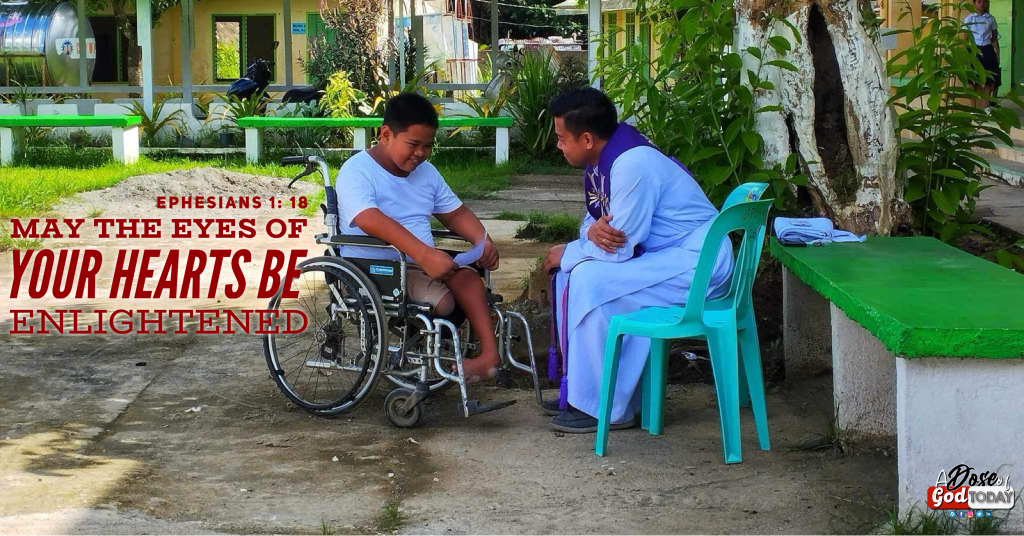
This is what Paul means in his letter to the Ephesians, as he said, “ I pray that the God of our Lord Jesus Christ, the Father of glory, may give you a spirit of wisdom and revelation as you come to know him, so that with the eyes of your heart enlightened, you may know what is the hope to which he has called you…”
The call and invitation for us today is to allow the Lord to reach out to us and so allow our hearts to be touched by the grace of the Holy Spirit. May our hardened and callused hearts caused by pains and hurts, anger and hatred, be renewed by the power of the Spirit that we may be able to bring transformation and healing, forgiveness, freedom and peace. Hinaut pa.
When another person confronts me because of my mistakes and failures, how do I respond? When a friend or a colleague tells me of my weaknesses, how do I feel? When we are confronted of our wrongdoings and sins, how do we react?
Being confronted, corrected or even reminded of our failures and weaknesses may not be easy to accept and embrace. It is even more difficult when the one who does it is someone who is not superior to us. When we too feel that we are superior and above others in many ways because of our achievements, entitlement or position in the company or community, the more it becomes difficult to accept such criticisms.
Moreso, when our heart becomes arrogant, believing that we are far better than others and that our ideas, decisions and actions are superior, then criticism are almost unwelcomed. Our mind and heart will be rigid and unwelcoming and at the same time will also become vicious and violent towards those whom we believe are threats to our image and person.
We experience this even at home from own parent or sibling. The family will then feel tensed and any other voice is suppressed because of one family member who believed that he or she has the monopoly of making decisions and making actions. This also is a reality even at our workplaces, organizations or communities – civic or religious. A colleague, or co-worker, or co-member or confrere, who think highly of himself/herself finds it difficult to accept feedback. It becomes a tension as well in our relationships. This is how manipulations, violent words and actions and malice towards those who would dare to confront them will be experienced.
This is not far from what Jesus did and experience among the leaders of that time. Some of the Pharisees and scholars of the law who grew entitled and influential at that time thought and believed of their superiority and righteousness. Because of their meticulous observance of the law and superior knowledge, they thought that they were perfect enough.
Nevertheless, their hearts where filled with malice. Hence, Jesus confronted them how their actions were inconsistent with what they taught and believed. Like their forefathers, these men remained hostile towards the prophets whom God had sent in order to correct and bring them back to God. They murdered all those who confronted them of their sins and failures precisely because they did not want to be corrected.
Likewise, Jesus did again what the prophets did in the Old Testament, and in the same way, the hearts of these men were filled with malice. The Gospel reminds us that they were hostile against Jesus.
Indeed, the Lord continues to confront us not in the sense of humiliating and bringing us down, but to correct us and brings us back to the grace of God. Thus, humility and honesty are very important as well in our Christians life. To be humble and honest enough to recognize our failures, mistakes, and sins would even help make ourselves better and our relationships healthier.
Today, Jesus comes to us to confront us and the Lord does it in many ways. We are, then, called to be welcoming of others who would dare to confront, correct and give constructive feedback and criticism to us. We ask the grace from the Lord that we may be humble and honest enough.
Everywhere we look at, there are many signs around us. Depending on its intended us, a particular sign will tell us what it is about. For example, a red light in an intersection, would tell us that cars should stop and let those other side of the intersection pass through since they have the green light. In a water dispenser, a red colored faucet means hot water while the green or blue means cold water.
There are also natural signs around us. When we see thick and dark clouds above us, most likely rain will come in few minutes or hours. After an earthquake, when the sea would recede quickly, surely, there will be a tsunami after.
Aside from these, there are also human emotional signs that we have to be aware of. When a person who withdraws into the recesses of his/her room, feeling sad or anxious and lonely, the person might be already undergoing depression. A person who feels afraid and terrified over particular another person, event or place, the person might have a traumatic experience associated in those things.
These are just few examples of different signs around us and of their meanings. And it is also important that we are able to understand them and so respond appropriately to every particular situation.
In today’s Gospel, we too are reminded of signs. Jesus was asked by the people to give them sign before they believe in him and in what he showed them. The people seemed to believe rather that Jesus was like a magician who would do out of this world signs that would entertain them. Their demand to give them a sign was rather, a sign as well, that they have not able to understand the greatest sign already given to them.
Jesus was the greatest sign ever revealed by the Father. Yet, their unbelieving and malicious hearts made them close-minded. Even when the sign was in front of them, they refused to see and recognized God’s greatest sign of love and salvation.
St. Paul in his Letter to the Galatians reminds us that such attitude and way of life is a sign that these people still like with the yoke of slavery. It was slavery of hatred and indifference, the slavery of malice and selfishness. Hence, they were not free.
However, Jesus desires that we indeed become free. Again St. Paul told us, “for freedom Christ set us free.” The very presence of Jesus in us brings us to freedom!
Thus, as we come to understand the many signs around us, may we also become more attuned and familiar to the signs the Lord gives us. These signs from the Lord, and his presence revealed to us may not be extra-ordinary or spectacular, but simple and ordinary. Let us be discerning and patient then and make ourselves free from anything that would prevent us from recognizing and embracing God’s many manifestations in our life and relationships. Hinaut pa.
Have I settled down? Have I found what I am looking for? Do I find fulfillment and contentment with what is happening in my life now? With my work? In my relationships? Or am I restless and still searching, unable to settle down? Do I find emptiness and meaninglessness with what I do and with I have?
Indeed, when we have reached an age of maturity and finds ourselves still searching and longing for something worthwhile and meaningful for our life, we might find ourselves restless and anxious. As a result, we could be shifting a course one after another, or changing jobs one after another or ending a romantic relationship and starting a new one without any fulfillment in those relationships. Our mind keeps changing. We are confused what we really like and what we don’t like. At times, we would just let others tell us what to do but later on regret because we never wanted it.
However, such restlessness would also allow us to refine our intentions and see better ourselves. This also means that we need help from others to accompany and guide us in searching and finding what we are meant to be and to do. In fact, St. Irenaeus famously said, “the glory of God is a human being fully alive.” Having our full potentials, expressing and giving fully and freely what we are meant to be and to do would reveal the glory of God in us.
In today’s readings, this need and reality is revealed to us. And so, let us see how God unfolds his invitations and challenges for us.
Jesus, in the Gospel of Mark, encountered a man who in his heart knew already what he wanted. He asked the Lord, “What must I do to inherit eternal life?” This man must have been respected and adored by many. He was a good man, religious and a pious Jew. He followed the commandments of God. He too was rich. Having such kind of character and wealth, people must have looked up to him. However, he too was restless. He was in search of something more meaningful and more worthwhile perhaps, over his routine in life.
The Gospel told us, that Jesus looking at him, loved him and said, “You are lacking in one thing. Go, sell what you have and give to the poor, and you will have treasure in heaven; then, come and follow me.”
Nevertheless, the words and demands of Jesus were too radical and difficult for him to accept. He must have understood that and knew that that was the way, yet, he couldn’t. This made the man sad. He went away and did not follow Jesus because he had many possessions. The many things he possessed prevented him to be free.
This makes us realize now that what we have achieved, accumulated, gathered or saved in this life won’t give us the true assurance of contentment in life. We may have the best job and position in our company, but remains unhappy. We may have gained many degrees and have spent a number of years in our profession but we feel empty. We may be so comfortable in life, doing so well with our business, yet, we feel restless when we are alone. Or we may have also been married or committed ourselves to religious life, having spent a number of years, yet, at the end of the day we couldn’t deny that our heart is still longing for something more. And this can be tiring or at times overwhelming.
When we are in this kind of crossroad in life, this is also an opportunity for us to see clearly ourselves and see God. What we need is a heart that seeks wisdom able to discern and choose what to keep and what to let go.
This is what the first reading calls us today. The author of the Book of Wisdom says, “I pleaded, and the spirit of wisdom came to me.” Wisdom is proven to be better than power and wealth, even with health and beauty. With wisdom, it leads us to what is lasting and fulfilling.
This is what we also discover with the Word of God, filled with wisdom, as revealed in our second reading. The Letter to the Hebrews tells us that “the word of God is living and effective, sharper than any two-edged sword, penetrating even between soul and spirit, joints and marrow, and able to discern reflections and thoughts of the heart.”
Hence, there are three points that we can bring today as our take-aways.
First, come closer to Jesus. Like the man in the Gospel, take the courage and the boldness to come closer to Jesus, to encounter him, that we too might be able to look at his eyes and realize how much Jesus loves us. This should give us the assurance and confidence above everything else. We can do this as we come closer to the Sacraments of the Church. The Holy Eucharist and the Sacrament of Reconciliation would surely bring us closer to Jesus and to ourselves.
Second, seek for wisdom. Wisdom is a gift and through the Word of God revealed to us this gift is given. There are also people who can help us and seek wisdom for us to be able to see and understand better our heart. This may help us to discern well and choose what will give us true fulfillment.
Third, let go of those that are possessing us. As wisdom will help see and discern our heart, let wisdom allow us to take action by letting go whatever is possessing us, of those that prevent us to be free. Unlike the man in the Gospel, we may not go away feeling sad because we are unable to let go, but rather take the risk of letting go and following Jesus freely and gladly.
May these challenges bring us closer to Jesus and allow us to create and develop lasting relationships as we tread the path of life God calls us to be, wherever we are now and whatever is our status. Hinaut pa.





 A DOSE OF GOD TODAY