Category: AUTHORS

  • Convicted Judge

    Convicted Judge

    March 2, 2025 – Eighth Sunday in Ordinary Time

    Click here for the readings (https://bible.usccb.org/bible/readings/030225.cfm)

    Once in a monastery, the whole community of monks gathered together for a meeting in order to give their final judgment on a particular monk who made a mistake. Each one of them expresses their own different opinions and verdict on the monk on-trial. They even have some conflicting opinions as to what would be the proper verdict for the monk on-trial,…while Bro. Felix, the oldest of them all remained silent.

    When they finally asked for his opinion, Bro. Felix quietly came forward with a sack and a basket, and filled both with sands. They were all shocked and asked Bro. Felix to explain himself. Bro. Felix finally say: “This sack of sands are my sins, which are full and heavy. I carry this on my back so that I could not see, be mindful and be sorry about my own sins and mistakes I am guilty of. While this basket of sands are the mistakes of our brother on-trial in front of us so that I could easily see, condemn, and judge him. But this is not right and just. Better for me to carry and mind my own mistakes and ask the Lord’s pardon, mercy and forgiveness than to mind and judge the mistakes of others.” Eventually all came to realize their own sins and mistakes in life, and became forgiving to their brother on-trial as they also needing God’s mercy and forgiveness.

    Try to be more a forgiven convict, than to be a convicted judge.

    Why is it that it is easy for us to see the shortcomings and limitations of others, but we are blind in seeing our own wrongdoings? Usually, it is easy for us to blame others than ourselves. Easy for us to criticize the faults of others. Not difficult for us to look for the sins and dirt of others, but only ourselves to blame.

    In our life-difficulties, like during election campaign period, easy for us to blame others and say, “Because of my parents… our leaders… our government… our church.” We are however blinded or hard for us to accept that we are part of the problem because we don’t care and take responsibility of our own actions for the common good of our community and our country. Easy also for us to elect corrupt popular politicians and leaders as we allow ourselves to be deceived by their promises and to sell our own rights to vote. Blaming, judging, and condemning others than ourselves, make us unconscious and blind of our own mistakes and accountability.

    Our gospel today reminds us of the song “Lupa” of Rico Puno, “Bago mo linisin ang dungis ng iyong kapwa, hugasan mo ang putik sa mukha”. (Before you clean the dirt on other’s face, wash the clay in your face first.) As Jesus would say “Remove first the wooden beam from your eye first; then you will see clearly to remove the splinter in your brother’s eye. This is the advice and direction Jesus have given us all His disciples. These are His words and message not only for others but for all of us, you and I, as His disciples.

    True indeed, as Christians, we are challenged to preach and share the Good News of Jesus to all people. But these Good News are not only for others or all who have not heard of Jesus, but moreso, onto ourselves who are already believers of Christ. God’s word is intended for the salvation and transformation of all people, but above all for ourselves who are Christians, His followers.

    Meaning, we have first to practice what we preach, live what we believe God’s words and messages in our own lives, before and so that we can proclaim and share it to others. Good News is thus Jesus’ message if and when we practice and live its command in our own lives rather than using it as a standard in judging others.

    As PCP II reminds us that for us to be Filipino Christians today is to re-tell (tell again & again) the Jesus story into ourselves so that we can proclaim Jesus Christ with authority to others. In other words, “Kung gusto mo ng pagbabago, simulan mo sa sarili mo.” If you want change in life, begin with yourselves. Thus, have a good look at yourselves first before judging, condemning and blaming others. Remember, never is it the intention of Jesus to preach us the Good News of God’s salvation to mind and judge others & ourselves but to change ourselves for the better.

    In tune with examples and message of our Lord Jesus Christ, may His Gospel first reign in our hearts so that we may become worthy to be called followers and disciples of Christ and proclaimers of His Good News of salvation, and thus, less becoming judging & condemning of others.

    So Be it. Amen.

  • LET THE CHILDREN COME

    LET THE CHILDREN COME

    March 1, 2025 – Saturday of the Seventh Week in Ordinary Time

    Click here for the readings (https://bible.usccb.org/bible/readings/030125.cfm)

    In our liturgical celebrations, we find the children most noisy. Some would be running around making their parents or guardians running around as well. There would be some of who feel annoyed at this, some are more tolerant. Yet, despite the children’s seemingly annoying behavior to us adults, it is our call as a church that our children find a welcoming and embracing church for them.

    Children are very special to Jesus because the Kingdom of heaven belongs to them. Although at that time, people believed that children had no social status. Children did not have anything to play in the Jewish society. This was the reason why the disciples tried to stop those who brought the children near Jesus. The disciples believed that there was no reason for Jesus to waste his time with these insignificant children.

    Yet, what we have heard from the Gospel was the other way around. Jesus became “indignant” at the treatment his disciples showed to the children. Jesus despised that kind of treatment towards children because in his heart, the children takes a very special place.

     Thus, Jesus made that event to teach something very important to the people at large. The Lord said, “Let the children come to me, do not prevent them!” This expressed the affection of Jesus towards the children. It also showed His affection towards all those who had been despised and mistreated by others. Jesus knew that the very innocence of the children desires nearness with God. Children who are most dependent to adults also manifest our dependence to God.

    This is how Jesus teaches that children are more open and trusting, hence, “the Kingdom of God belongs to them.” Children are open to the surprises of God. Their humility, simplicity and innocence make them sensitive to God’s presence.

    This is the invitation and call for us today, as Jesus reminds us, “whoever does not accept the Kingdom of God like a child will not enter it.”

    Let us make our hearts be free from hatred and indifference. Let us remove discontentment and condemning attitude towards others. Let us also allow ourselves be surprised by God because we become open and welcoming of God’s presence. Our sensitivity to God’s presence shall move us too to become welcoming and aware of the needs of others. These childlike attitudes make us self-giving and life-giving to others where the Kingdom of God grows in us.  Hinaut pa.

  • Finding a Faithful Friend is Finding a Treasure

    Finding a Faithful Friend is Finding a Treasure

    February 28, 2025 – Friday of the Seventh Week in Ordinary Time

    Click here for the readings (https://bible.usccb.org/bible/readings/022825.cfm)

    Do you have friends? Do you have a true friend? We have many friends. Yet, among them, there would only be a few we find most comfortable with. These friends sometimes know our deepest secrets. They understand our hurts and pains. These friends also know our true dreams and aspirations in life.

    The very presence of our friends, especially those who are closest to us make so much difference in life. In times of our joys and success in life, we have our friends celebrating with us. It warms our hearts knowing that there are people who are also happy of our own happiness. In times of pain, loneliness, sickness and failures, we find friends who are faithful and supportive to us. It gives us comfort and assurance that we are not alone.

    The Book of Sirach today speaks so well of beauty. It captures the warmth of having true and faithful friends.

    Sirach says, “A faithful friend is a sturdy shelter; he who finds one finds a treasure. A faithful friend is beyond price, no sum can balance his worth. A faithful friend is a life-saving remedy…”

    Friendship is a gift. Having a true and faithful friend even when we only have one, is a treasure. This calls us to cherish and nurture that friendship. Remember, we need to invest in our friendships with our presence. Emotional investment is also crucial to develop healthy relationships with our friends.

    Emotional investment is fundamental to relationships and to friendship. Being open and honest with the people around us allows us to build TRUST, CONFIDENCE, AND LOVE. Without emotional investment in our relationship, we focus only on how the person is useful for us. This benefits only our ego. Yet, such relationship brings out toxicity, an unhealthy relationship with others.

    This is what the Book of Sirach warns us about. We should be on guard against those who pretend to be friends. These individuals are not with us in times of distress. Beware of those who tell others about us only to bring shame on us. Be cautious of those who abandon us during sorrowful times. They approach us solely when they stand to gain something.

    This toxicity in friendship can also be found in marriage life. Because of the selfishness in one or both spouses, marriage will fail. When one is being used only for personal gain and gratification, then, the relationship is corrupted. The question of divorce became an opportunity for Jesus to confront the hardness of the hearts of men. The discontentment and abuses in a relationship were the reasons of breaking up marriage. Yet, at the very beginning God joined the wife and husband to be together for better or for worse. They were to be together for richer or poorer, in sickness and in health. They were to be together in joy or in sorrow. God intended them to live a life committed in love and faithfulness.

    And so, as we are reminded today of the treasure of friendship, there are two invitations for us.

    First, be a true friend. We recognize and thank our true friends. Let us, in turn, be true friends. Remember, friendship involves give-and-take. Sometimes, we are the one giving support, and other times we are on the receiving end. Being a true friend is to let our friends know that we care about them and appreciate them. This can help strengthen our bond and develop a healthy and life-giving friendship.

    Second, have the courage to confront. Another way to develop a healthy friendship is to confront a friend when needed. It is important to challenge them constructively. We do this constructively. This is a sign of maturity in our friendship.

    And so, we pray that the God of Friendship bless our friends and our friendship with one another. Hinaut pa.

  • As Instruments of Goodness not Evil

    As Instruments of Goodness not Evil

    February 27, 2025 – Thursday of the Seventh Week in Ordinary Time

    Click here for the readings (https://bible.usccb.org/bible/readings/022725.cfm)

    Human as we are, we fail and sin. However, this is not an excuse not to desire perfection and holiness before God. In fact, the Gospel of Mark today reminds us to be more aware of our selfish tendencies and evil desires so that we will be able to respond to the temptations that may come to us.

    What Jesus told us in the Gospel is not meant to be understood literally. “if your right hand causes you to sin, cut it off… if your foot causes you to sin, cut it off…  If your eye causes you to sin, pluck it out,” – if this is to be understood literally, then, each of us here will have no hands or feet or eyes or even more than that.

    Jesus actually wants us to cut off sin from our system that only separates us from Him and from others.

    The Book of Sirach also reminds us of the danger to solely rely on human strength, power and wealth that feed our selfishness. Having such desires to only cloud our mind and heart will make us indifferent to the needs of others.

    Thus, when our thoughts are filled with lust and evil thoughts, then, Jesus wants us to stop that, and instead fill our thoughts with God’s Living Word that will inspire, challenge and confront our hearts. Read the bible, then.

    When our heart is filled with anger, hatred and bitterness, fill it with God’s forgiveness and peace in the Sacrament of Reconciliation.

    When our hands remained close to those who need our help, then, open them and express your gratitude to God by extending help and kindness to people around us.

    When our feet remained paralyzed with fear in taking risks, then, be embraced and be confident in God’s love for you so that your feet will be free from fear and take the risk of building close and intimate relationship with others. Go and come nearer to your loved ones, spend more quality time with them.

    When our eyes will only tend to see what is ugly, negative and imperfect, then, open our eyes wider to see and realize the beauty of others, the wonders of the world and the goodness of our neighbors.

    In this way, we lessen our tendency to nurture our insatiable desire for self-gratification. We begin to see others rather than ourselves alone. We become more self-giving rather than self-serving.

    This will hopefully allow us to deepen our relationships, whether in marriage, or in the context of a family with children, or among our friends and colleagues.

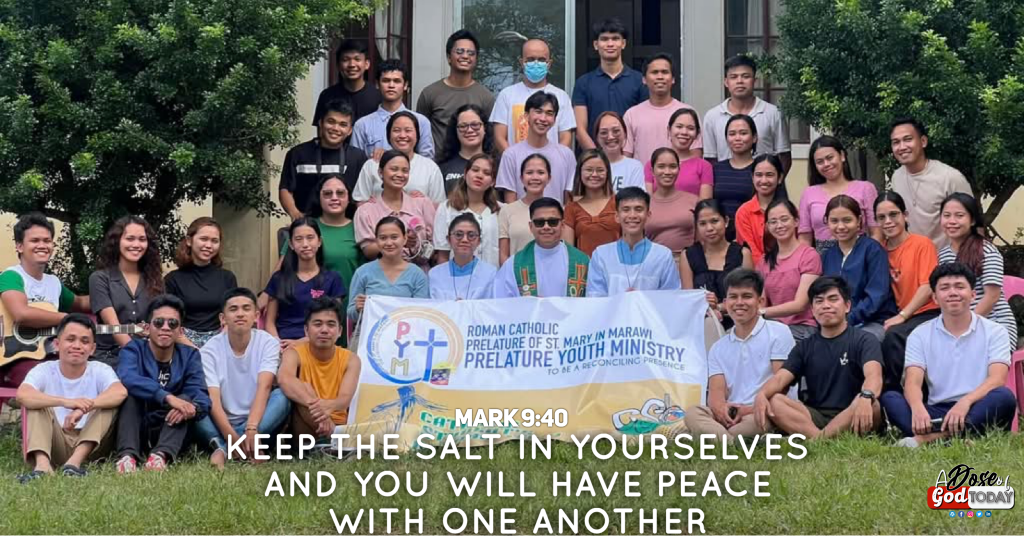
    Indeed, Jesus calls us to become persons not driven by selfish desires, but to become persons driven by the desire to love and to give oneself for the sake others. In this way “we keep the salt in ourselves and have peace with one another” because Spirit of God dwells in us and among us. Hinaut pa.

  • How would I feel at the success of others?

    How would I feel at the success of others?

    February 26, 2025 – Wednesday of the Seventh Week in Ordinary Time

    Click here for the readings (https://bible.usccb.org/bible/readings/022625.cfm)

    How would you feel at the success of others? Of a friend or classmate who is so popular in your group? Or with your spouse who has been receiving a lot of appreciation from your relatives? Or sibling who has been so successful with his/her business? Or a colleague or workmate who was just promoted recently?

    When we are truly secured and grounded as a person, we will surely be happy at the success of others and celebrate with them. We will be inspired and excited particularly with people who are close to us. Yet, it can also happen that at the outside we express happiness, but inside having a feeling of insecurity, jealousy and worst resentment and envy. While looking at the success of others, we could have wished and believed that “it should have been me” or “that should be mine.”

    This becomes a reality in us when what we saw in others was something we really want for ourselves. Others have enjoyed it, while we don’t. This becomes more intense when we too have the tendency to “compare ourselves and compete with others.” To some degree, it’s okay, yet to some extent as well, it can be damaging to ourselves and to our relationships with others.

    With this, let us explore our readings today and discern how God’s invitations are revealed and manifested in our human experiences.

    In the Gospel of Mark, the disciples seemed to be worried that there was another man who was capable of healing others through the name of Jesus. They stopped the man because they felt that it was not right since he was not ‘one of them’ and did not belong to their special group. Their worries reached to their feeling of insecurity. They value so much their reputation and image before other people. Thus, the disciples seemed to be entitled by the fact that they were Jesus’ disciples. It was their own way of asserting that they were the only persons who were knowledgeable and capable.

    Remember, days before this event, the disciples also felt troubled because they were unable to heal a boy who was possessed by a mute spirit. Jesus himself had to intervene to heal and free the boy from the evil spirit. He reminded his disciples that it can only be done through prayer.

    With that failure and brewing insecurities and self-entitlement of the disciples, these made them to be unwelcoming and jealous at the success of others, of those who were not part of their special group. Other people seemed to go to that person because he was able to drive out demons in the name of Jesus. The disciples felt uneasy because of this. As a consequence, they failed to recognize how God also works in the life of other people.

    Yet, as a teacher and Lord, Jesus constantly formed his disciples to purify their intentions and their hearts. The response of Jesus to them came from a heart that was secured, confident and most especially, wise. In Jesus’s wisdom, he was not worried about the man who did healing miracles in his name. Jesus was more worried for his disciples who felt insecure, entitled and envious.

    Hence, Jesus wanted them to understand that God’s favor and grace is not limited to a particular and special group of people. God reveals the Divine-Self even to those whom we do not expect. For a disciple to understand this, he or she needs wisdom and not entitlement or mere recognition. This is what we have heard from the first reading. The Lord will embrace those who seek wisdom, says the Book of Sirach.

    As the Word was made flesh, and so is wisdom, personified in Jesus. This was the reason why the man who did the healing miracles was actually wise, because he sought Jesus in his life. By seeking wisdom, God embraced him by making him a healer in the name of Jesus. Jesus wanted also his disciples to realize this, and that was to always seek Him because he is wisdom.

    Wisdom, then, helps us to see how God works not just through us but also through the people and the whole creation around us. Wisdom makes us more aware of God’s presence among us. Wisdom makes us welcoming of God and others.

    Thus, Jesus invites us today to learn from him, from his wisdom that constantly seeks the presence of God. This wisdom is not envious at the success of others but sees it as God’s revelation of Divine-Self in others. This wisdom allows us to recognize the face of God in the lives of our brothers and sisters, whoever they may be.

    There are two invitation for us today.

    First, learn to celebrate the success of others – that we may be able to truly express our joy by acknowledging the hard work and sacrifice that others have to make or the grace that God has given to that person. Yet, when we feel jealous about it, then, learn to accept it and to sleep over it.

    Second, seek wisdom rather than praise. This also begins by humbly recognizing and owing our own inadequacies and inconsistencies. This will hopefully lead us to understand better ourselves and able to discern Jesus’ invitations to growth and maturity for us.

    May Mary, Our Mother of Perpetual Help, guide us to Wisdom and brings us closer to Wisdom. Hinaut pa.