What keeps us going? What keeps us dreaming and hoping? Joy as a deep-seated contentment and peace, plays a very important part in our lives as Christians. It is that profound joy that will keep us going, dreaming and hoping. It is joy that will make us not just surviving, but in truly living.
Jesus addressed his disciples and reminded them of this important desire of the Lord for them. Jesus said, “I have told you this so that my joy might be in you and your joy might be complete.” The Lord addressed them when later on he will undergo such painful and shameful death of the cross. There was so much suffering to come. This was the time to make his disciple see better what joy was all about.
Although, only later on as well that the disciples, now Apostles of the good news of Jesus, have understood well what this joy from Jesus meant. In the Acts of the Apostles, the first Christians faced with dilemma because of their difference in doctrines and cultures. In the midst of conflict and tensions, they too have realized that at the center of everything should always be the Risen Jesus and their well-rounded relationship with each one.
Joy is fully discovered not when we are alone. Joy is fully manifested in our relationship with God and shared commitment to love each other. As we begin to see lesser ourselves, lesser of our biases and personal comfort, we too begin to see more Jesus and our brothers and sisters.
In this way, the Apostles together with the first Christians learned to adjust with one another and not to impose their old belief system upon each other. What had become more important is their faith in Jesus, of their love for each other.
This makes joy complete. We realize also today that our joy is basically founded in our confidence of being first loved by the Lord. No matter who we are and what dirt we have because of sin and guilt we have committed, this love of God will never diminish. Such love brings us to respond in love and show such love in most concrete ways of loving. This is how joy becomes full in us, with Jesus and with our commitment to love each other. Hinaut pa.
Having married to his childhood sweetheart for only a year & a half, in fear & anxiety, a man told his father: “Dad, marriage is not FOR me.” After few minutes of silence, the father gave this advice: “Son, I make this really simple. You marry not to make yourself happy, but to make someone else happy. Marriage is not for you because you are married for a family & your future children. Marriage is not about you, but about the person you married & the life you have chosen.” So, marriage is more than just for your sake, but for the sake of your beloved ones.
Easy for us to think that ordained priests and consecrated religious people are married to God & church. Rightly so, for they dedicate their lives to & for God & the church. It does not mean however that lay Christian couples & family are not married to & for God & the church. Christian marriage & family life is a
discipleship – a way of following Jesus & loving God through & in His people. Like ordination & religious professions, marriage is not about & for oneself but for your beloved whom you love in life, and above all for God.
Christian couples do have their marriage in the church because they consider their love & marriage to each other as sacred & holy, and they wish to make their life now & always as their sacred offering to God & His church. Their marriage then is not about themselves but about each other living their love life for God & His Church through their own family & Christian community. Same way with ordained priest & consecrated religious people, Christian married couples are also thus married to God & His Church. And above all, being Christian is being married to God, and being in marriage to our Lord Jesus Christ.
Jesus in our gospel today said: “I give you a new commandment: love one another. As I have loved you, so you also should love one another. This is how all will know that you are my disciples, if you have love for one another.”
Here Jesus reminds us that it is not enough just to know the commandment to love, but most of all we must live & practice Love. And Love then is for one another than oneself. Meaning, love is basically not for and about oneself (not for and about you), but Love is all about & for one’s beloved & others. In other words, love is our marriage of one another to God.
Ultimately then, marriage is not for the sake of Me and about Me, but for the sake of and about An-other than Me. Love lived in Christian discipleship then is not self-centered, self-serving & self-oriented but more so other-centered, other-serving & other-oriented. If & when we love this way, as Jesus says: “We are not far from God’s kingdom.”
And above all in & our loving one another, by our marriage to God, as we love same way as Jesus loves us, we are known to be His disciples and known to be Christian, …because as it was said, “marriage is not for me, but for one another than me”. By our love & loving, then we are known to be Christians.
In this mass, we pray that our love for our beloved & others in life be our way of following our risen Lord, and be our marriage to God & His Church as our fitting sacrifice & worship to God’s goodness for us now & always.
Once the late-Philippine lady senator Miriam Defensor-Santiago while giving a graduation speech made this joke. She said…
Beside a swimming pool, two girls are having this following convo. G1 said to G2: Know what? You are going to float (Alam mo. Lulutang ka). G2 to G1: Why? Is it because I’m getting slim, light & sexy? (Bakit? Dahil ba, magaan, slim at sexy ako? G1 replied: No, it’s because you are Plastic (Dahil plastic ka). Funny & rude it maybe, but it tells a lot.
Now, we might ask nowadays, how do we distinguish a GOOD parent, teacher, friend, politician, leader, mentor, or coach from a BAD one? How do we know if that person is real, true, deep, honest & trustworthy? How do we know that person is fake, shallow, liar & unreliable? In other words, how do we discern authentic from artificial?
Nowadays it is normal for us to suspect things, simply because it is not easy to know whether it is real or fake. Because it is difficult to detect the authentic from artificial or plastic, the durable from disposable, nowadays we do tend to be suspicious of things & even of one another.
Same way with our relationships with others, we rather suspect, doubt, and distrust one another, than believe and trust others because it is more challenging to distinguish who are real, honest & smart from fake, deceitful, & shrewd people.
Jesus in our gospel today introduced and made Himself known to us as The Good Shepherd who knows His sheep and His sheep follows Him. As Jesus distinguished Himself from a Hired Worker who work for pay and no concern for the sheep, He reminds us here that as OUR good shepherd, He is a hands-on and committed caretaker/caregiver of His sheep who maintains a personal intimate relation with His sheep, and will commit His life to live and work with His fold in life & we, His sheep has a deep faith in Him, our Good Shepherd.
Be reminded the risen Lord reveals Himself in Person & in Flesh for real. Jesus then is authentic, not artificial.
In the Gospel few Sundays ago, as the risen Lord reveals Himself in the midst of the disciples, he showed and asked them to touch and see His wounded hands and feet.
Thus, the risen Lord reveals Himself not as ghost but in flesh and bones with wounds. The risen Lord, our Good Shepherd thus knows us & we know Him personally for real, & not for fake or as plastic.
We Christians proclaim that our risen Lord Jesus Christ is OUR good shepherd. We believe that He is our Shepherd, who knows and loves us personally. We also believe that we know Him personally for we know His voice & we follow Him faithfully in life.
Particularly For us Filipino Catholic, we do have special or unique take in knowing our Good Shepherd personally. We know Him not only because Kilala natin siya but because Dama Natin siya – not only because we know Him but moreso because we feel Him.
Culturally sense-feeling perceptions are important to us, Filipino Christians. Like,… I may know you, but I may not feel you. I may feel you though I may not know you. (Kilala kita, pero di kita ramdam. Ramdam kita kahit di kita kilala). This is how we distinguish real from fake – authentic from artificial or virtual & how we discern good & bad person.
Same way as we Filipinos have this natural felt-instinct & sense to distinguish the real from fake, to discern the good from evil, we also come to be familiar with & know more the shepherd’s voice through our gut-sense and feelings.
Same way as the mother knows the child instinctively & the child knows the mother by sense & instinct, we do come to know the risen Lord as our true Good Shepherd in life not only by our volition, consent & reasonings, but most of all through our sense & feeling perception (damdamin at kalooban).
Feel/Ramdam ko Siya/Bati Nako Siya. Feel/Ramdam natin Siya/Bati nato siya. By our sense-perception & feeling-gut insights, we come to know the risen Lord with us – in person & in flesh. Knowing the Shepherd is thus not only for us an intellectual or cognitive familiarity but moreso a deep felt-sense knowledge and insight of His presence, love & blessing.
Same deep-sense knowledge and insight would also guide us in tomorrow’s National & Local Election as we choose & vote for our coming political leaders. By the same gut-feeling insight, we know who will be good or bad, real, or fake, sincere or corrupt for the future ahead of us.
We pray then that the Easter Season this year be our moment to enhance and improve our special felt-sense of knowing our True & Good Shepherd, so that we may not be gone astray from His fold but rather have a much deeper relationship with Him, and be always attuned with His will & plan for us now, for the future of our society, nation & world ahead.
So Help Us, God. So May it Be. Hinaut pa unta. Amen.
In this day and age it is unavoidable to meet people who maintain: “To see is to believe”, i.e. to base their faith on facts, sciences and evidences. In other words, they only trust and have confidence on what are sensible, logical, and scientific. Nowadays, it is not easy for others (& even ourselves) to believe. We ask usually for signs, proofs, or evidences in order to trust and have faith on others. We need some credentials first in order for us to believe. Many at times we claim, “We will never believe until we see it”. Others would even say, “Show me the money first before I believe & trust you”.
However, signs, facts, proofs and evidences are not the basis of our Christian faith – not even on the empty tomb of Jesus, but on the testimony and faith of the disciples and of us who experience & witness the risen Lord as He reveals Himself in our normal ordinary lives and such witness has totally transformed us.
Like the disciples in our first reading, faith in the risen Lord makes us experience the risen Lord in our lives, and make us witnesses (sharers of the Lord’s presence) to others. Such Christian faith and witnessing of our risen Lord make us Christian different & unique from other religions.
Now, what does it entail, to witness Jesus and to be witnesses of Jesus today? What does it mean, and how it is to be today’s Christian witnesses of the Lord’s resurrection? How do we believers witness the risen Lord to others?
Same way as being a witness in the court, Christian witnessing entails and requires us:
1st, to experience the events, or what is going on or happening, as it happens or unfolds in our ordinary day-to-day life. This would mean we should Be there present, and not absent like Thomas, at the moment when Jesus reveals Himself to us.
2nd, Be conscious or aware of what is going on. Physical presence is not enough. We must pay attention to ordinary miracles that are happening in our midst. Thus, our total self must be present and sensitive with His revelations.
3rd, Let the events happen in its own course. Let things be and happen as it unfolds. Savor the moment without controlling and programming. Don’t interfere or else we become accessory & not anymore a witness.
4th, be affected by the event – be transformed by the events. Be moved, surprised, amazed, awed, inspired, and shaken by the experience.
5th, share and testify our faith- encounters with others, as we have experienced and been affected by the encounter.
How to witness then our Christian faith? Be present, Be aware, Savor the moment, Be affected & Share your story with others.
The same process of witnessing happened with the apostles in our gospel today.
1st, while going back to their ordinary lives of fishing and catching nothing, a man appeared and suggested them to fish in the other side of the boat.
2nd, having a great catch, they eventually recognized and became aware that the man is the risen Lord Jesus Himself.
3rd, as no one dared to ask: “who are You?”, they let Jesus invite and serve them a breakfast.
4th, with their first breakfast with the Lord, once again they are moved, transformed, and inspired to continue with their faith and mission.
5th, their very meeting and sharing bread and fish with the risen Lord inspired them to follow Him and in serving the Lord’s lambs and sheep in faith and life. In other words, we witness the risen Lord to others, by our being present and conscious of the Lord’s appearances in our ordinary life, meeting him naturally and intimately, and passionately share to others our stories of faith-encounters of the risen Lord in our daily lives
Again, Easter is all about the risen Lord continuously meeting us in life – appearing and making himself known to us. As the Lord meets us in our day to day lives, our experience of Him challenges us to believe, i.e. to recognize and trust Him and His ways, as well as to witness Him, i.e. to taste and see (savor) His being with and acting in us, as well as to share our experience of Him with others.
Easter season also reminds us not only of Eucharist as our last supper, but moreso, as our usual first breakfast with the risen Lord in our day to day witnessing of our Christian faith and life. The Lord’s resurrection is thus God’s offer of life and meaning to the whole world – appealing us to believe, witness and share His son Jesus Christ, as we meet Him in our ordinary daily lives. May our Christian faith and celebration of Eucharist, as community continually inspire us to believe, witness & share the risen Lord to ourselves, others and to all in our lives, now & always.
When you come to church, when you pray, and beg the Lord – what do you ask? What attitude do we have in asking the Lord for grace? What inner desires do we foster as we beg the Lord?
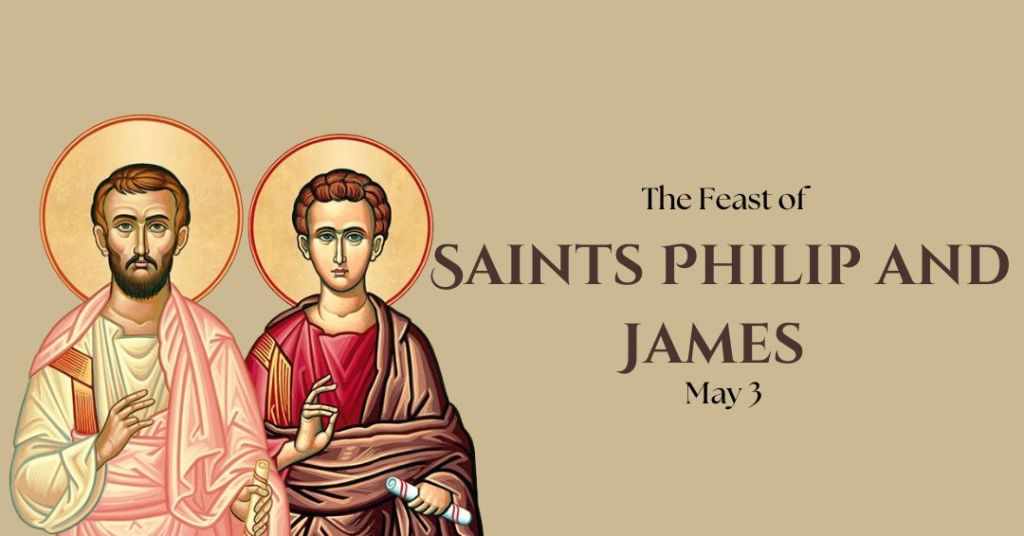
On this feast day of Sts. James and Philip, Jesus tells us, “if you ask anything in my name, I will do it.” But, what does it mean anything? And what does it mean to ask in Jesus’ name?
Does Jesus mean that we can just ask anything we want? Does it mean that I can also ask Jesus to give me a lifetime premium subscription on Netflix with an unlimited supply of popcorn and bottomless four-season juice drink? Or can I also ask Jesus to make me Summa Cum Laude this coming graduation? Is this the kind of prayer that Jesus invites us?
Today, Jesus tells us to ask “in his name.” The beauty lies in the prayer that considers the desire of God for us. It means that in our prayer we do not forget Jesus. We do not forget Jesus’s desire for us and his will for us.
This tells us of our relationship with Jesus. This should not be understood as a mere limitation with the options we have in asking. Instead, “asking in his name” widens our perspective in asking grace from the Lord.
This invites us to a deeper awareness of Jesus’ heart, of Jesus’ desires and of Jesus’ plans for us. It is certain that what Jesus desires for us is always good, always for our growth, always for our freedom.
Therefore, to ask in Jesus’ name is to allow letting go on what we only want. We let go also of our own preferences which may be influenced by our selfish desires, guilt, sin and evil.
Instead of praying – “this is what I want and wish Lord,” ask and pray rather first in this way, “what is your desire for me Lord?”
Only then that we will be able to get away from our selfish tendencies and intentions because we shift our focus from ourselves to God. We begin to shift from praying that comes only from personal wants to praying in his name.
This is now our prayer and our desire that in asking grace from the Lord, we may also grow more in our knowledge of Jesus. Know Jesus not just on our head level but also of the heart.
Through the intercession of St. Philip and St. James, may we dare to encounter the Lord among our brothers and sister; to encounter the Lord in our human experiences; and to encounter him in our daily struggles in life. Hinaut pa.





 A DOSE OF GOD TODAY