Category: AUTHORS

  • HAIN KA NA IGSOON: REMEMBERING FR. RUDY ROMANO, CSsR

    HAIN KA NA IGSOON: REMEMBERING FR. RUDY ROMANO, CSsR

    + Emmanuel T. Cabajar, C.Ss.R. D.D.

    Fr. Rudy Romano was abducted by the military in the outskirts of Cebu City. He became a ‘desaparecido’ victim among so many in the country during the Martial Law regime. After fruitless years of struggle to find him, it was felt that, for the sake of his agonizing relatives and friends, a closure had to be made. Without proof of his death the Redemptorists decided to celebrate a funeral Mass for him.

            Thirty-six years have gone by since his disappearance. But many still remember him as a missionary priest who felt for the poor, especially the most abandoned and marginalized. To be poor is to be voiceless and Rudy offered himself to be their voice and courageously advanced their valid cause and noble aspirations. That is why many regarded him as a martyr for the cause of the poor and oppressed. He was willing to pay the price in taking sides with them.

            I have fond memories of Fr. Rudy. He was two years ahead of me at St. Alphonsus Theologate in Cebu City but we were classmates in some subjects. Common interests often brought us together. Instead of taking a midday siesta we would often do carpentry work or develop photographs in the dark room or give some haircut to a confrere. We used to call him affectionately ‘the scientist before his time’ due to his inventiveness and creativity. The many gadgets he invented attested to that. Out of copra sacks he made backpacks for us and assembled portable cooking tripods for our excursions and long treks in the hills of Busay, Mt. Manungal, Balamban and Toledo.
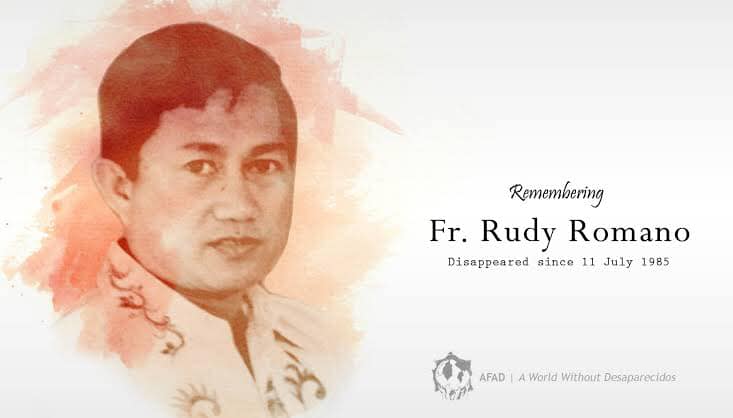
            However, more than anything else, I personally remember Fr. Rudy as a preacher of the Word of God. He dedicated a large part of his pastoral work to the ministry of the Word. He was engaged in the rural missions. He tried to develop Fr. Fil Suico’s visionary intuition into some concrete missionary method. I saw some of his missionary footprints in Northern Mindanao, from Iligan to Gingoog. One early morning, as I was jogging in Mambajao, Camiguin Island, I saw a stone marker at a junction. Engraved on it was an expression of local people’s sentiments, ‘Handumanan sa Misyon” with Fr. Rudy’s name on it.

            The preaching of the Word of God has the capacity to act as a light of truth that illumines the concrete situation that the people live at the moment. Being rooted in the Redemptorist tradition of prophetic announcement of the Good News, Fr. Rudy preached like an artist, knowing how to make simple and ordinary words come to life in the people’s here and now. That is why the Word of God springing from his inner conviction touched the wounds, the injustices, the victims, the exploited while causing the ire of powerful arrogant perpetrators. If we must keep the memory of Fr. Rudy alive, the reason must be that the prophetic preaching he tried to practice is still very relevant today.

            Our mission is never simply to preach on majestic pulpits billowing with incense as if the Good News were floating on the clouds. We have to proclaim the Word in a way that enlightens, awakens, challenges even if it annoys and opens up wounds and surface conflicts so long as it brings healing to people who hunger and long for the experience of God’s saving power. This kind of preaching pierces real human life but cannot get along with the powers of darkness and evil. This is the kind of preaching we must do and this has to be rooted in prayer and trust in a compassionate God.

            This commemoration of Fr. Rudy Romano offers the Redemptorists a timely and relevant challenge. Are we prepared to shake ourselves up and force us to look honestly at our own preaching in parishes, shrine churches, and retreat houses today? Are we willing to wrestle with the Word of God and be fully engaged with the world’s complexities and be open to the ongoing revelation of God in the signs of the times? Are we willing to ensure that the Word takes on flesh as Good News for the poor and the needy? Are we prepared to always speak and stand for the truth even if it would mean losing our privileges and financial stability and security?

            Undoubtedly, this stance would find echo in those who love the truth and who truly love the poor. Blessed are we if we are true to the Gospel!

    (A song composed by Bishop Manny Cabajar for Fr. Rudy)

    HAIN KA NA IGSOON

    Hain ka na igsoon ning dugay nang panahon?

    Hain ka na igsoon? Gamhanan patubagon!

    Nganong ikaw gidumtan, gisakmit sa dautan?

    Mao ba ni ang bayranan paglaban sa uban?

    Nganong ikaw igsoon gidid-an sa katungod?

    Nganong gipasipad-an, gidan-ok sa kalisud?

    Dili gyud mi moundang kon di ka makaplagan.

    Kalingkawasan barugan: pangandoy sa tanan!

         Bangon mga igsoon,  tanlag ang pagasundon!

         Nasud pagamugnaon, kaisog magbaton!

         Asdang mga kauban, lihok sa katarungan,

         Nasud may kagawasan, padulngan sa tanan.

    Nganong ikaw gidumtan, gisakmit sa dautan?

    Mao ba ni ang bayranan paglaban sa uban?

    Nganong ikaw igsoon gidid-an sa katungod?

    Nganong gipasipad-an, gidan-ok sa kalisud?

    Dili gyud mi moundang kon di ka makaplagan.

    Kalingkawasan barugan: pangandoy sa tanan.

         Bangon mga igsoon, tanlag ang pagasundon,

         Nasud pagamugnaon, kaisog magbaton.

         Asdang mga kauban, lihok sa katarungan.

         Nasud may kagawasan padulngan sa tanan.

         Hain ka na igsoon, hain ka na igsoon,

         Hain ka na igsoon, hain ka na?
  • PROPHETS IN OUR MIDST

    PROPHETS IN OUR MIDST

    July 11, 2021 – 15th Sunday in Ordinary Time

    Click here for the readings (https://bible.usccb.org/bible/readings/071121.cfm)

    Being rejected is a terrible experience. When someone you love, a friend or family member rejects you for being who you are and for what you have done, is painful. This experience creates emptiness in us and feelings of not being loved and not being accepted. This makes us feel worthless and useless, thus, traumatic. This can also be experienced in workplaces when a co-worker and/or your employer gets angry at you and shows sour attitude towards you. Or when your work has been rejected or a proposal has not been approved because of their biases with you.

    In our community, there are many forms of rejection also that sometimes we are not aware of. We could just reject those whom we think are useless. We could easily not pay attention to those who do not belong in our circle of friends. We could just dismiss a person just because of appearance, education, family background or culture.

    Moreover, there is another form of rejection also that can be traced in the Bible. This is the rejection experienced by people who spoke in behalf of God, who preached and taught what God wanted for the community. Prophets are usually rejected by people because their words and presence disturb the peace and comfort of the rich and the powerful.

    This is what our first reading from the Book of Amos told us. Amos was rejected by Amaziah, the priest of Bethel because Amos was prophesying the destruction of the Northern Kingdom of Israel. Amos prophesied this by also pointing out the reasons behind. The Northern Kingdom who enjoyed prosperity and abundance also turned out to be oppressive to the poor and the weak in their society. Thus, Amos spoke of the injustice committed by the rich and the powerful against the poor.

    Consequently, Amos irked the Amaziah who enjoyed influence and wealth from this kind of life. That is why, Amaziah wanted Amos to go back to Judah, the Southern Kingdom and do his prophesying there while earning income. For Amaziah, being a priest of the temple and being a prophet was just about earning something and enjoying privileges.

    However, being a true priest or a prophet is not about earning something or enjoying the comfort of wealth and influence. A prophet is God’s voice that penetrates the heart of every man and woman, that penetrates and disturbs the heart of the community that has become indifferent and complacent, unjust and oppressive.

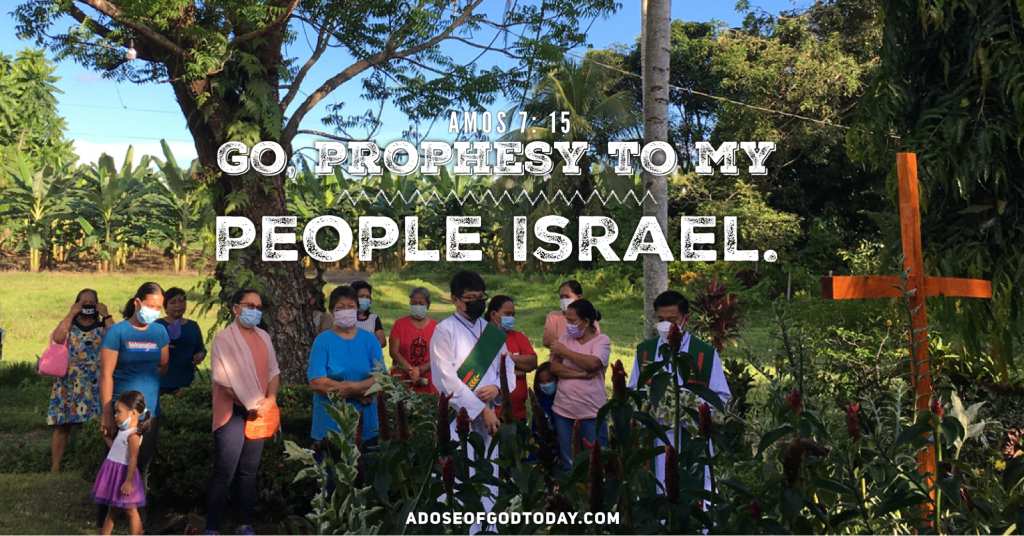
    That is why, Amos who was a shepherd was called by the Lord to speak on God’s behalf and deliver God’s message. He was commanded to “Go, prophesy to my people, Israel.” Though he did not come from a family of priests or from a lineage of prophets, yet, God chose him. Being God’s prophet after all is not about what we have attained or achieved and not about an excellent family background.

    This is what the Gospel of Mark also revealed to us. Jesus sent out the twelve Apostles, two by two, whom he chose. These men where not from any family background that one would expect. Yet, Jesus saw something beyond the ordinary life of these men. This was how God worked wonders in them. And thus, Jesus gave them authority to free people burdened and oppressed by the unclean or evil spirit and to cure the sick. This means that they have been given the gift to heal and free people.

    However, they have “to take nothing” for the journey. This calls every Apostle to fully trust in God’s providence expressed through the generosity of the people around them. To take nothing for the journey will allow them to be free from any unnecessary burden whether physical, material, psychological or spiritual.

    Yet, as they proclaim peace and grant blessing to many homes, it is expected that not all will accept. Rejection is part of life of a preacher and of a prophet who proclaims what God wants to be proclaimed. People won’t easily accept God’s invitation and God’s presence.

    And the reason? God demands change or transformation of our heart and of our whole life.

    Change can be thought by many of us as a mere “disturbance” to what we have already become comfortable and familiar. But then, the danger of complacency and indifference could grip our hearts to the point that we become unmoved in from of the suffering of those around us.

    This reminds us of the life of Fr. Rudy Romano, CSsR, a Redemptorist Missionary who spoke about the crimes of injustices committed against the poor in Cebu. His voice and presence became a “disturbance” to the powerful, the rich and the privileged. Like Amos and many prophets in the Holy Scripture, he too was rejected and martyred. He was even told by his own father to only focus on his sacramental duties as a priest. But, Fr. Rudy responded to his Dad’s letter, that he won’t be a worthy priest anymore if he would follow his father’s advice.

    Fr. Rudy chose to stand with the oppressed and committed himself to speak what God wants him to speak and to live the life of a prophet as God called him to be.

    In consequence, Fr. Rudy was abducted on this day, July 11, in 1985 in Cebu City. For the past 36 years, his body was never been found. Such is the fate of a prophet yet relentless in his words and eternal is his spirit.

    The confidence and the faith that Fr. Rudy showed must have been what St. Paul spoke about in his letter to the Ephesians. Paul proclaimed that God the Father blessed us with every spiritual blessing and this was made possible because of His Son, Jesus Christ our Lord.

    These spiritual blessings must have grown in the heart of Fr. Rudy. These spiritual blessings which St. Paul proclaimed are the grace of being chosen by God, the grace to be holy and without blemish, the grace of being an adopted child of God, the gift of redemption and freedom, the gift of forgiveness of sins and the grace to share in the mystery of God.

    For us today, each of us, regardless of our background or profession or achievements and failures in life is called to be God’s prophet in the bigger picture of our society and even within our small sphere of influence like our homes, schools, workplaces or organizations.

    As a prophet shall arose in our midst, hopefully, we too shall welcome now and learn to discern the words and the presence of the prophet among us whoever he or she may be. May the prophet’s voice and life disturb our complacency and indifference.

    Let our conscience then, be guided also by our faith in God, be inspired by love and be moved by our hope to bring change and transformation into our life and in our community that will bring healing and freedom. Hinaut pa.

  • Trust in God

    Trust in God

    July 11, 2021 – 15th Sunday in Ordinary Time

          + Emmanuel T. Cabajar, C.Ss.R. D.D.

    Click here for the readings (https://bible.usccb.org/bible/readings/071121.cfm)

    Jesus sends his disciples to announce the Good News of God’s Kingdom and cast out demons and heal the sick. With a great deal of trust and courage they obey Jesus and venture into the unknown. They take nothing and go two by two in their mission. The disciple is never alone as the Lord chooses another to accompany him. Because of their “yes” the Lord’s message spreads and the world begins to change.

           Evaluating the dismal results, a parish evangelization team realizes that focusing on mission logistics leads to the message becoming buried. Getting engrossed with the means leads to neglect of the Good News!     

          Fidelity to the core of our baptism allows God to carry out His mission through us. We don’t have to worry about material needs. The almighty opens the hearts of believers to provide for His preachers. The important thing is to obey the Lord and proclaim the Good News. We preach His Cross and find consolation and joy in our trials. 

           We accomplish God’s work as community and always with reference to His will to preach the Kingdom of God. In His name, we cast out demons and heal the sick!

           Heavenly Father, we do not rely on human resources in our ministry. You will always provide for whatever it takes to be Your humble and faithful disciples. We trust You in word and deed as one Body of Christ, united in spirit and in truth. We receive communion with fervor and allow You to make us channels of Your healing love so that others may find hope, freedom and life in the Kingdom You prepare for all of us.


    Brothers and sisters, we witness to the joy of the Gospel in word and in deed. Amen.

  • TO BE HELPED AND TO BE OF HELP

    TO BE HELPED AND TO BE OF HELP

    July 8, 2021 – Thursday 14th Week in Ordinary Time

    Click here for the readings (https://bible.usccb.org/bible/readings/070821.cfm)

    Days before the departure for our Parish Mission in Balabagan, Lanao del Sur, I made sure that all I need were in my ‘bags’. I doubled checked my things to be sure that I have not forgotten anything. My bags were full and heavy as I loaded them into our mission vehicle. When I arrived in the area, I realized that I brought a lot of useless things.

    At home and at school, I was trained to be prepared and self-sufficient. Hence, it became natural to me to make myself ready, prepared for anything to happen, and independent.

    Yet, Jesus reminded his Apostles to bring what was only most essential as they were sent to cure the illnesses of the people, to bring life and forgiveness, to bring blessing and peace to many homes.

    I find this quite harsh and truly difficult. However, there is wisdom behind the words of Jesus. Our desire to be prepared, to be independent and self-sufficient would sometimes come from our deep anxiety of what would come next.

    But what if a circumstance would not allow us to have any preparation? What if an event would surprisingly come and we have nothing to bring but go ahead with nothing? Surely, this will make us insecure and helpless.

    This reminds me of Joseph who was stripped of anything he had. He was sold as a slave to the Egyptians by his own brothers. He was seduced by the wife of his master and then, imprisoned unjustly. He was forgotten in the prison for 13 years.

    Nonetheless, Joseph remained faithful and trustful to God despite those terrible and horrible events in the life. Joseph remained calm and discerning as a person. As Joseph had nothing with him in his journey to Egypt as a slave, Joseph also did not hold any grudges and bitterness in his heart. He did not let his anger, resentment and hatred to burden and overpower him and prevent him from discovering and doing what God prepared for him. This is how Joseph found himself to be the savior of his own family and of many peoples when famine hit the world. God prepared him for this so that in Joseph, forgiveness shall be granted and life shall be given.

    Jesus invites us today also, as he urged also his disciples in the Gospel, to take what is most essential in life by having a childlike trust in the providence of God. We are called to get rid of our unnecessary baggage behind whether physical, emotional, psychological or spiritual so that we will be able to welcome the goodness of God through other people.

    This is the reason why Jesus told the Apostles not bring anything so that they too will be able to welcome the generosity of God through the generosity of the people. Joseph was also grateful for those people who helped him and especially to the Pharaoh who gave him freedom and responsibility to bring life to many peoples.

    Let us allow ourselves then, to be helped by others. In return, let us also allow ourselves to be of help to those who are in need so that through us, God’s generosity will overflow. In this way, we shall be able to bring healing, life, forgiveness and peace into our homes and communities. Hinaut pa.

  • LOOK AND FIND

    LOOK AND FIND

    July 7, 2021 – Wednesday of the 14th Week in Ordinary Time

    Click here for the readings (https://bible.usccb.org/bible/readings/070721.cfm)

    Egypt as a wealthy nation at that time, responded to the needs of the known world. Many nations and peoples came to Egypt for they have prepared themselves to face the great famine in that age. Joseph played an important role for the world at that time and for Egypt in particular.

    Despite the bitter and painful experiences of Joseph of being sold by his brothers as a slave, being maltreated and imprisoned in Egypt, Joseph remained free. His heart was free of bitterness and revenge. If Joseph had remained his heart imprisoned in bitterness and anger, he would not be able to gracefully and generously help Egypt and all other people. Because of such grace in his heart, Joseph became a dispenser of grace.

    Through him, God worked miracles and wonders so that people will be saved from the suffering of famine. And Joseph proved this as he met his brothers who committed a grave sin against him. Though he appeared unmoved by the situation of his brothers, but deep inside Joseph missed them.

    The tears in Joseph’s eyes as he wept could have been from the pain in his heart of being hurt by his brothers, but he must have understood also that that painful memory in his past, became God’s way to work wonders through him. Indeed, this happened. Joseph became the savior to his brothers, to the entire family.

    As Joseph was able to share their abundant resources to the refugees at that time, Jesus also sent his apostles to go and gather to lost sheep of the house of Israel. The apostles whom he called were given authority to drive out demons, to cure every disease and illness. This means that they were about to give freedom and healing to those burdened by sin and sickness and oppressed by the power of evil.

    Through Joseph, the people found sustenance in the midst of food and economic crisis and through the apostles those who are lost, sick and oppressed shall find healing and freedom.

    God’s invitation for us today is to look and find that will give us true sustenance in the middle of our crisis and difficulties. The celebration of the Holy Eucharist may become our source of spiritual nourishment then. Look and discover too that will bring us back closer to the Lord, that will give us healing and true freedom. Let the celebration of the Word of God become our help to bring healing and freedom in our hearts.

    In return, we may also become like Joseph, to become graceful and generous in sharing what we have to the needy for everything that we have are not ours but gifts from God. May we also become daring as the apostles to take the risk in going as the Lord invites us – that our person and presence will become God’s sign of grace to bring freedom and healing in our homes and communities. Hinaut pa.