Peter was asked by the Lord, “Do you love me more than these?” And Peter responded that his love for the Lord was beyond his failings, beyond his fears, beyond his denials, beyond his doubts. His love was a response of a greater love he received from God who despite his human failings, he was blessed and called.
Such love moved Peter to respond fully and offer completely his whole life and to let go of other things in his life. Those things include his hurts and pains, his personal dreams, career and even family, moved him to be completely available for God and for others.
This is a story that totally changed a person’s understanding of himself, a person’s perspective of life and relationships, and of a person’s belief in God. Remember, Peter was hopeless after the death of Jesus. He was filled with guilt because of his denial of Jesus. He was in darkness. This was the reason why we went back to fishing, going back again to his old self, old way of life and old ways of coping from problems and trials in life.
Yet, we also find the presence of Jesus, who never surrendered on Peter. There was the Risen Lord calling again Peter and the other disciples to find and recognize the Lord even at that disappointing night of catching nothing.
Love then is beyond our human feelings. Love is beyond our light and joyful moments in life even beyond our failings and pains. Love entails our daily commitment and generous response. It calls us to care for others, to look and tend for the welfare of others and to be able to give life for others.
This was how Peter was asked three times and was told also three times to tend and feed Jesus’ sheep, that is God’s people, God’s Church. Peter in return understood that he was loved by the Lord beyond his failures and inadequacies. Peter saw his potentials and gift to become a loving and a life-giving person to be expressed in his ministry.
In the same way, the Lord also calls us today, to respond in love that we way also be able to recognize that despite our failures, we are being loved unconditionally. And that despite our other attachments in life, we are asked to make it clear that God is our priority, that the Lord takes the central part of our thoughts and hearts.
May this allow us to constantly change our selfish and fear-motivated thoughts and actions into a free, caring and life-giving act of love wherever we are at this moment, and whatever is our status today. Kabay pa.
Three days that remain between the Ascension Feast and Pentecost Sunday. Before the curtain falls on the Ascension, we still linger on the drama of Jesus leave-taking, waving his last benediction before ascending to heaven. It is not difficult to imagine what the disciples must have felt then. It did not matter to them then that he had promised he would be back. What mattered now for them was that a moment ago he was standing before them and now he was gone. Their eyes followed him rising until he had disappeared behind the clouds. It took two angels from heaven to shake them from their reverie and rebuke them saying: “Men of Galilee, why do you stand here gazing up to heaven. This Jesus will come back…” The heavenly messengers reminded them to go back to Jerusalem because they had a job to do.
As we reflect on this drama of leave-taking at the Ascension, we are led to ask how we ourselves deal with the inner pain of saying good bye. Whether we are the ones who leave or are the ones left behind, saying good bye to those we care for or who care for us will not be easy. As air travel becomes so common, airports become scenes of touching goodbye dramas.
As a writer, Bob Perks, shares his experience: yet I do see more than my share of airports.
“I have great difficulties with saying goodbye….When faced with a challenge in my life I have been known to go to our local airport and watch people say goodbye. I figure nothing that is happening to me at the time could be as bad as having to say goodbye. Watching people cling to each other, crying, and holding each other in that last embrace makes me appreciate what I have even more. Seeing them finally pull apart, extending their arms until the tips of their fingers are the last to let go, is an image that stays forefront in my mind throughout the day.”
A few faith-seasoned thoughts will help us cope with the drama of saying good bye.
We have to accept in faith that we are a pilgrim people and that “we have here no lasting city but we seek the one that is to come.” (Heb 13:14). So, we have to school ourselves to accept the separations and departures that are part of our life here on earth. At the same we have to keep our hearts strong, focused in hope for that city that is to come. In there, “God will wipe away every tear from their eyes.” (Rev. 7:17)
While we are going through the pains of separation and departure, let us draw strength from the experience of Mary as the lifeless body of her son lay on her lap. She is called the Comforter of the Afflicted to help us bear our griefs with courage and peace.
It will help us carry our sadness if we ourselves become instruments Christ’s comforting presence to those in need of comfort. This reminds me of an experience I had of faith sharing on a night bus in the US. As a woman fellow-passenger opened up her problems, her cheeks flooded with tears. She apologized for “baring her life with a complete stranger.” I offered her some words of comfort and faith and she calmed down. We parted ways after a short prayer on the bus. A few weeks later, I got a card from her saying she had found peace. Then she added briefly, with a remark that touched me deeply: “I have tried as you said to become a living instrument of the presence of Christ to others.” This she did, among other things, by giving comfort and first aid to elderly women passengers in an accident in the park where she was working as a guide and accompanying them to the hospital. To tend to them, she stayed in the hospital with them for a while, sharing her faith in Jesus with them. She also volunteered to work as teacher for the children of a poor neglected Indian tribe. Her ministry of faith and comfort provided her the peace that she had lost when she left a home where care was badly missing.
On the human side, besides drawing strength from the wells of our faith to cope with the pains of departure and separation, we can:
Draw comfort from the fact that not all our goodbye departures here on earth are permanent. Our OFWs leave while the family left behind await their return for vacation in a couple of years. If the goodbye is made permanent by bereavement, it will be for those who remain to find comfort in their faith, as Martha the sister of the dead Lazarus was comforted by Jesus who said: “Whoever believes in me, even if he dies, will live forever and I will raise him up on the last day.”
To keep alive the longing for the homecoming of the one who has left, regular communication between the one leaving and the one left behind, should be maintained. We live in an age of easy instant communication so there is no reason why the exchange of messages cannot be maintained. When this regular keeping in touch is not maintained, gradually the bonds between those who have left and those left at home is weakened, if not altogether severed.
The pain of separation is assuaged by recalling the good things people separated by distance have shared in the past. This will help keep alive the hope that they can be together again sharing similar blessings.
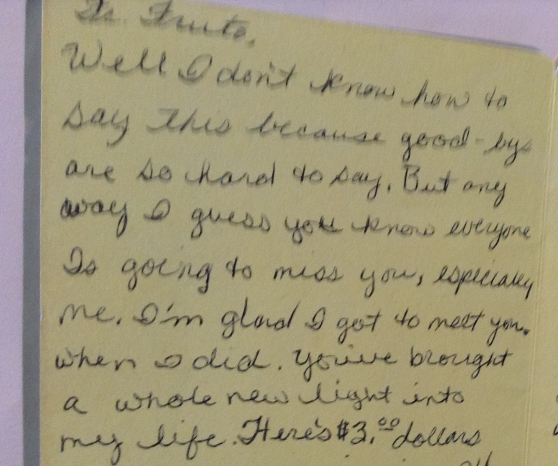
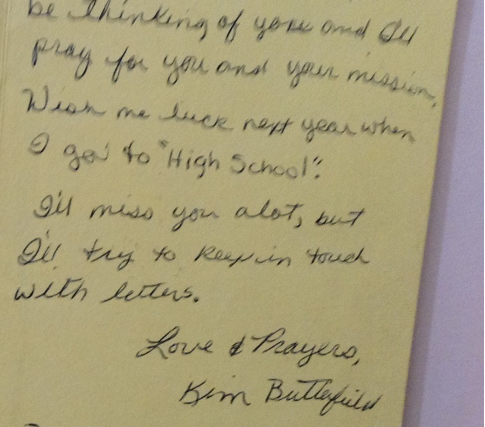
(A personal note from a friend sent to me expressing her goodbye.)
Here is a story shared by Bob Perks who has written above of the sad feelings that overwhelmed him when witnessing people saying goodbye to each other at airports.
Recently I overheard a father and daughter in their last moments together. They had announced her departure and standing near the security gate, they hugged and he said, “I love you. I wish you enough.” She in turn said, “Daddy, our life together has been more than enough. Your love is all I ever needed. I wish you enough, too, Daddy.”
They kissed and she left. He walked over toward the window where I was seated. Standing there I could see he wanted and needed to cry. I tried not to intrude on his privacy, but he welcomed me in by asking, “Did you ever say goodbye to someone knowing it would be forever?”
“Forgive me for asking, but why is this a forever goodbye?” I asked.
“I am old and she lives much too far away. I have challenges ahead and the reality is, the next trip back would be for my funeral,” he said.
“When you were saying goodbye I heard you say, “I wish you enough.” May I ask what that means?”
He began to smile. “That’s a wish that has been handed down from other generations. My parents used to say it to everyone.” He paused for a moment and looking up as if trying to remember it in detail, he smiled even more.” When we said ‘I wish you enough,’ we were wanting the other person to have a life filled with just enough good things to sustain them,” he continued and then turning toward me he shared the following as if he were reciting it from memory.
“I wish you enough sun to keep your attitude bright.
I wish you enough rain to appreciate the sun more.
I wish you enough happiness to keep your spirit alive.
I wish you enough pain so that the smallest joys in life appear much bigger.
I wish you enough gain to satisfy your wanting.
I wish you enough loss to appreciate all that you possess.
I wish enough “Hello’s” to get you through the final “Goodbye.”
He then began to sob and walked away.
When the Apostles left the hill of the Ascension transfixed gazing up to the clouds that had hidden their Lord, Angels appeared reminding them that this Jesus would be coming back to them. This would have brought back to their benumbed minds the blessings of which they had had more than “enough” in the company of their Master. They returned with joy to Jerusalem where he would come to them. It did not dawn on them that he would not come in the same physical form that vanished from them at the Ascension. He would come to them in the person of the Holy Spirit. But they would deeply experience his presence fulfilling his promise “I am with you till the end of the ages.” They would go out into the world fired with Pentecostal zeal announcing the presence of their Risen Lord. This presence would mean that there is no “good bye forever” between the Lord and all who await his coming.
In the past few days, we have been following the prayers of Jesus just before his passion and death. Most of these prayers of Jesus speak of oneness and of friendship. Jesus speaks about these because he has most probably felt already the suffering that he will undergo. There will be great feelings of fear, confusion, of loneliness and abandonment.
In this prayer of Jesus, he expresses his gratitude to the Father for giving him the gift of friendship with his disciples. This friendship gives comfort to Jesus. Yet, he also feels that his friends are afraid, confused and insecure. Thus, Jesus prays that his friends may be one with him, may never leave him but will accompany him in his suffering.
However, these friends of Jesus turned out to be overwhelmed by their fear and insecurities. They fled and hid themselves for fear of being persecuted. After all, they left Jesus alone.
But this attitude of the disciples never made Jesus to surrender on them. Jesus remains grateful to the Father because he saw something beyond the imperfection and unfaithfulness of his friends.
Indeed, Jesus trusts the wisdom of the Father for giving him these kinds of friends. These friends are also the very sign of the Father’s love to him. Beyond the unfaithfulness and fear of the disciples are the image and the presence of God in them.
The disciples realized this after the resurrection of Jesus. This event gradually changed them completely. Indeed, it was in this way that they have become one with Jesus. And true indeed, they were the Father’s gift to Jesus because each of Jesus’ friends became his witnesses to all the nations.
This is the experience of Paul, who was a true witness of Jesus, as described to us in the Acts of the Apostles. What sustained Paul from those accusations and persecutions was his friendship with the Lord and the friendship he developed with the other believers of Jesus. This is how the Lord himself assured Paul and told him, “Take courage.” The Lord stood by him. This is friendship!
We, too, are the Father’s gift to Jesus. As gifts, we are very precious to Jesus because we are his friends. We may also find ourselves weak, fearful and insecure like the disciples, but remember, Jesus will never surrender on us because he sees something beyond our weaknesses and fears. Jesus sees himself in us!
As Jesus wishes that we may be one with him to see his glory, we are invited to remain firm in our faith and conviction as Christians. But, when we find ourselves going away from Jesus, let us come to him again, to come closer to him. It is only in being with him that we too shall find our true peace and comfort.
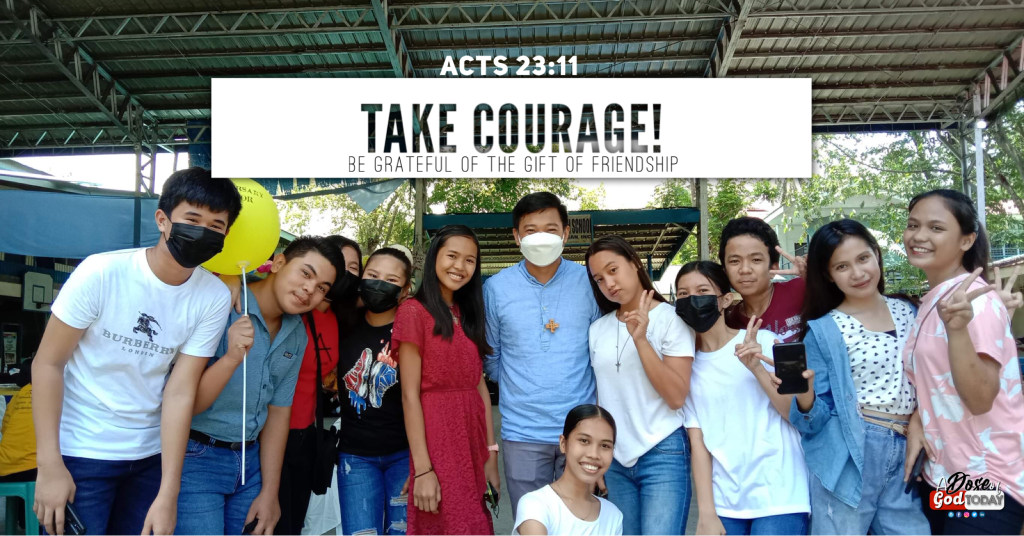
Today, let us be grateful of the friendship we have with Jesus and of the friendship we have developed with other people. Like Jesus, we may also see the person of Jesus in our friends, to see Jesus beyond the imperfection and weaknesses of our friends. Take courage, then, because we have friends. Kabay pa.
It was in the summer of 1972 when the Ordinary Council assigned me to Dumaguete as assistant in our Perpetual Help parish after returning from a year’s post-graduate course in Chicago. This short stint was an experience I welcomed, a change to active pastoral ministry after ten unbroken years as teacher and director in our minor seminaries in Iloilo and Cebu. The missions (Redemptorist parochial missions) was a ministry that had attracted me to the Redemptorist Congregation whose priests were popularly known as “mga Paring Misyon” although there were other foreign missionaries in the country. After just two years fully engaging in the parochial missions side by side with our Irish missionaries, I was without warning assigned to teach and then be director of our minor seminary. Teaching or directing minor seminaries was never my first love, although in time I got to adjust and even to live happily with the change. But still, any chance I got during the summer vacation, I would go out and join the mission teams in the rural areas for direct involvement in their mission ministry.
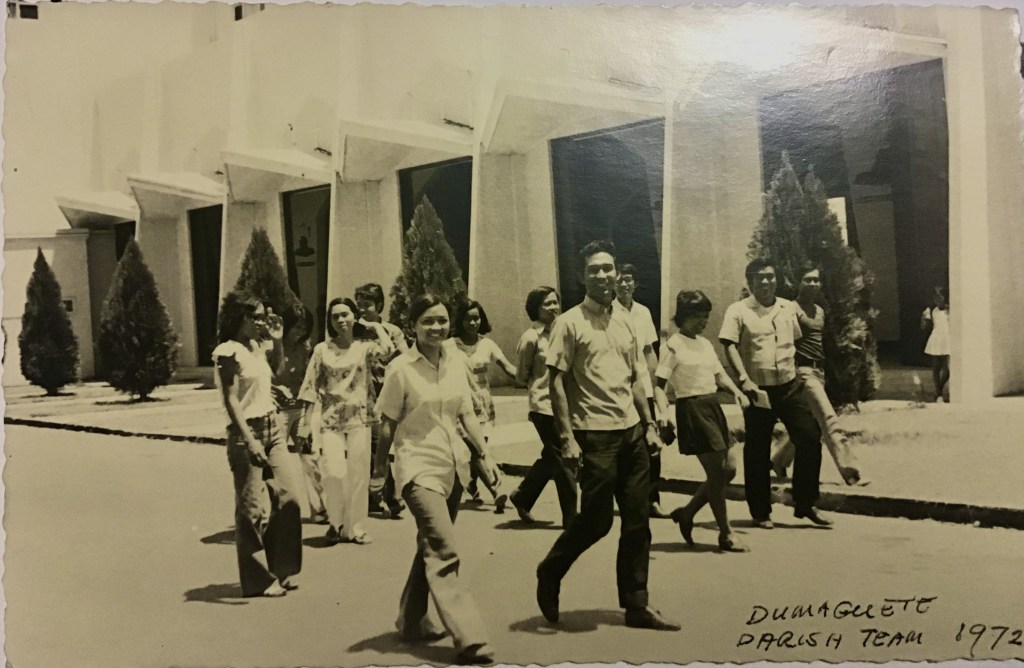
So when I got assigned as assistant in the parish in Dumaguete, it gave me breathing space from academic to pastoral work. While in this work I worked with the parish team. This was a full time lay team newly recruited, the very first full-time lay team in the vice-province. (Note: the first full-time laycollaborators team in the vice-province was here in the parish, contrary to the usual belief that it was with the missions that the first full-time lay team wasorganized.) When I arrived in Dumaguete, the acting parish priest, Fr. Fonso Walsh, upon my asking him what I was to do there, just said,” go with the parish team.”
The team composed of three women and one lay man, was waiting for me and just didn’t know what to do with themselves. So, I suggested we go around the parish on a getting-to-know and getting to be known routine. We selected three pilot areas in barrio Pulantubig, which we called Zone 1, Zone 2 and Zone 3,to set up as the beginnings of small communities. At that time, the term BEC and its program in the local Church were hardly known. We started going house to house and started gathering them wherever we could gather them, since not all these “small communities” had chapels. We started to move away from the traditional idea of just the parish priest visiting a barrio for mass and disappearing forthwith. We spent all our waking hours visiting them in their homes, mission visitation style. When we met them in the designated meeting place, we had reflections and exercises for building up the community spirit. We had separate sessions with the youth who were more eager to be “organized”. We had no community masses until after some months, when a more cohesive spirit would have developed. The community liturgy got underway then.
It was not ripe yet to start action for justice. That was to come later At this time, we focused more on developmental rather than liberational community activities. We ourselves as Church pastoral workers were hardly touched by the challenge of the ministry for social justice.
Limited as our knowledge and practice were to community –building and “developmental” orientation were, we continued our day-to-day pastoral ministry of house visitation and group reflections with the residents of the organized zones.
Some five months after we started this community building work, our parish team got an unexpected boost from heaven: the entrance of three pre-novitiate candidates into our circle.
This turn of events is a story unto itself. It happened when the vocation-director of the vice-province, Fr. Noel Bennet was looking around the vice-province for a community that would welcome these candidates into their midst until they were to enter the novitiate in a few months. Normally young men interested in becoming Redemptorist priests would be sent to our minor seminary in Cebu. But Fr. Noel felt that the three young men he had among the applicants would be too old to be sent to the minor seminary which was the formation program for mostly high school boys. The applicants Fr. Noel had on hand were either college graduates or under-graduates. The stage of formation for them would have been a “postulancy” program. But at that time, the vice-province did not have a postulancy program.
So, Fr. Noel ended his search for a “home” for his candidates by leaving them in Dumaguete community with me as their guide or, in effect postulancy director, without being formally assigned. I ended up being director to Jovencio (Ven) Ma, Wilfredo (Fred) Jundis and Jose (Joe) Roca. I would have them accompany me and the parish team in our community building apostolate in the three zones. At the same time, I would hold three sessions with them each week on learning about the Redemptorist life and tradition.
We followed this informal program for more than three months. During these months, we were able to work together – the lay workers and these pre-novitiate candidates, together with the youth of the organized zones who had become willing and active parish collaborators. The three young men, by being with us in our parish rounds day by day had developed a good rapport with the team and the parishioners. But more important was that the three pre-novitiate candidates had grown in the spirit of the Redemptorist missionaries.
With all these active collaborators working with a team, our work proceeded fast. From the three organized zones, we had extended the community building work to four other zones: one more in Barrio Pulantubig, two in Barrio Bunao and one in Barrio Motong, these four new zones becoming Zones, 4, 5, 6, and 7. Our three pre-novitiate candidates and the parish team got eager help from the youth of the organized Zones
Before long, the summer break would be upon us. It would be time for the three pre-novitiate candidates to start preparing for entrance to the novitiate. At the same time, I was also asked to take up a new assignment – as Prefect of Students (that is, of our major seminarians) in Davao.
Two weeks before the summer break, we decided to hold a general mission in the seven organized zones. The idea was to strengthen the spiritual-faith dimension of the community spirit that had been built up in the small communities in the organized zones. This would eventually be the nucleus of the BECs in the parish. The result of the ten months we had spent in building up the spirit of Christian community in the zones was an almost palpable feeling of family and community among the people, young and old, in the organized zones.
The mission concluded with a field mass in the St. Paul’s College grounds in the morning and a program in the evening. The youth and parents and lolas eagerly took part in it. Months after the mission, people would talk and reminisce nostalgically of those Pulantubig-Bunao-Motong days.
Short as my assignment in Dumaguete parish was, lasting less than a year, I treasure my apostolic assignment there.
First, even though I was no longer on a mission assignment there, I found that one can exercise a parish ministry as a mission just as those assigned on mission teams are doing. It was an experience that brought me as close to the common people as I had experienced on my mission assignments. It helped me work closely as mission partner with a lay team.
Secondly, my Dumaguete experience re-introduced me to the formation ministry in a way different from my assignment in a minor seminary. Guiding the pre-novitiate candidates in their pre-novitiate preparation helped me give formation a missionary experience while at the same time keeping in touch with our Congregation’s spirit and tradition.
Looking back on that assignment, I find that in those short months, we had sown the seeds of two programs; the BEC program and the postulancy program. In those days, the BEC “way of being Church”was hardly known in the local Church in the Visayas although the promoting of BEC was also starting in Mindanao and in some parts of Luzon. On the other hand, the postulancy program would only become formally established in the then, Vice-Province of Cebu, after that Dumaguete experience.
You never know what learning-surprises God has in store for you as you turn the next corner of your Redemptorist journey.
How blessed really are those who give than those who merely receive? Most of us actually think that we are more blessed when we receive something. It is wonderful to be a recipient of some goods from others because we don’t have to exert effort but only to open our hands. How nice would that be!
Yet, there are interesting different attitudes between a constant receiver and a generous giver. People who are constantly receiving gifts, or those who demand to receive may they be material or not would tend to have low self-esteem, or insecure and unsatisfied with what they have already in this life. Thus, if this becomes our attitude, we too grow to become self-entitled and demanding towards others for our own benefit and advantage. Because of these attitudes, when we become people who constantly seek the generosity of others, we also tend to keep things for ourselves alone but ungenerous to others.
These affect how we see ourselves, believing that we don’t have enough compared to others. We also become negative in our dealings and relationships with other people because we are inclined to see what is only ugly and unpleasant for us. And so, when people like these, initiate to give something to others, their gifts or good deeds have always hidden motives. This means that we only give because we expect something bigger in return. This attitude rather seeks what is only good and comfortable for ourselves because at the very first place, we are motivated by a selfish desire.
On the other hand, persons who are truly generous of their gifts, of their presence and of their person, are confident. Yet, it does not mean that their confidence comes from the many things that they have acquired in this life. This confidence rather comes from faith because that person truly believes in God’s generosity and providence. That is why, a true generous person is always grateful. Yes, generosity springs forth from a heart that is grateful to God and the act of giving is a response of a grateful heart.
This is what St. Paul told us in the Acts of the Apostles – “It is better to give than to receive.” Paul was called by Jesus and was given freedom. It led Paul to faith and his faith made him grateful and thus, a generous person expressed in giving himself for the proclamation of the Good News. He was not after silver or gold, to enrich himself but to give generously his presence for the people to whom he was sent as a minister. Indeed, this is an expression that giving is a blessing.
Such act of giving that grants blessing reminds us too of St. Justin, a martyr and philosopher. It was by giving witness to faith that he too gave himself even if it would cost him his life. He never wavered even when there was a threat to his life. That act of St. Justin was founded on his confidence and faith in the Risen Jesus.
This has been expressed by Jesus in the Gospel. Jesus showed his gratitude to the Father because of the love that sustained him in his ministry. Jesus’ prayer for his followers was his generous act, asking the Father to protect and bless them. This generous action of Jesus culminated in giving up his life on the cross for our sake while the resurrection is the Father’s generous action for our sake because the Father is grateful for the Son.
This is God’s invitation for us today.
We are, first, called to be truly grateful with what we have, to be confident with what we are enjoying which includes material things, people and relationships, talents, skills and our very “person” too.
Second, let us allow our heart to grow in gratitude and confidence in God’s generosity that will hopefully mold us to become “blessed givers.” Remember, what we can give is not limited to material things, but even our talents, capacities, knowledge and our presence to people who are truly in need.
Indeed, blessed are the generous givers because they portray God’s character and make God’s presence ever more present. Kabay pa.








 A DOSE OF GOD TODAY