Category: AUTHORS

  • The Rise of Decolonial Theology in the Philippines to Promote Climate Justice

    The Rise of Decolonial Theology in the Philippines to Promote Climate Justice

    (Introduction: I am delivering this talk on June 9, 2022 (at a panel from 6 to 8 PM Philippine time) for the World Theology Forum. The theme of this international conference is – ACTION AND PROMISE: STRUGGLING AGAINST VIOLENCE, BUILDING JUSTICE AND RETHINKING RELATIONALITY IN THE TIME OF CLIMATE CHANGE. It is simultaneously translated into English, Spanish, French and Portuguese).

    Today the Philippines is third in the list of countries with the most number of Catholics. Of a total of 105 million people, 89% are affiliated to the Roman Catholic Church in terms of their faith. To include those among Protestant denominations, there would be 93% of the entire population who are Christians. The rest would be Muslims and those who continue to adhere to their indigenous faith tradition and a sprinkling of Buddhists, Hindus and Sikhs. 

    In 2021, the Philippines celebrated the 500th year anniversary of the arrival of Christianity to the islands when a tribal settlement in Cebu (in central Philippines) agreed to take part in a mass baptism initiated by the captain of the colonizing expedition, led by Fernando Magellan whose journey constituted the first to circumnavigate the globe. 

    However, it was the expedition led by Miguel Lopez de Legazpi in 1565  that cemented Spanish colonial rule in the central and northern parts of the archipelago leading to the establishment of the institutional/hierarchical Church across the colony. Taking into context the close interfacing of the Vatican and Madrid (as manifested in the passage of Papal Bulls establishing the legitimacy of Patronato  Real) – in what can today be considered the union of Church and State – there was a close collaboration between the processes of colonization and evangelization.

    The colonial rule was abusive in regard to how the colonizers treated the native population. First they established the reduccion system, patterned after their colonial strategy in Central/Latin America to hasten proselytization. This led to the setting up of the encomienda with its in-built mechanisms to force the people to pay tributes, be constricted to do forced labor and be subjected to the iron rule of their colonial masters. Even the friar congregations were also provided land grants converted into haciendas.

    Unfortunately the friars (mainly the Augustinians, Recollects, Dominicans, Franciscans and the Jesuits) served as conduits of the Spanish King and rode on the colonial governance system for conversion purposes. In many pueblos, the friars served as the alcalde de mayor. Given the theological and pastoral praxis of the medieval Church, this meant an aggressive drive to vanquish all aspects of the indigenous belief system practiced by the indigenous communities for thousands of years. Worst hit were the indigenous babaylans (shamans) seen by them as Enemy No. 1.

    Eventually as a result of their brutal subjugation, there erupted hundreds of revolts across the archipelago. Some of these were led by the babaylans who had very strong influence over their constituencies.  In the course of history, a greater sense of unity evolved among some of the lowland peasant communities – especially in central Luzon in the north (the area today closest to Metro Manila) –  that consolidate the collective will of the oppressed to rise up against their oppressors.

    This led to the establishment of a grassroots revolutionary movement that eventually coalesced with those in urban Manila along with a group of intellectuals – many who were educated in Madrid including native clergy – to form the Union of the Humblest and Highest Group of  Sons/Daughters of the Nation (Kagalang-galangan, Kataas-taasang Katipunan nga mga Anak ng Bayan or KKK).The Union waged a revolutionary war against the Spanish colonial forces for five years until finally the Spanish rule was vanquished which led to the establishment of a Republic, the first to be declared in Asia.

    However, in the late 1890s, the nascent colonial power of the United States of America was in search of their own colonies which led to their interest to occupy both Cuba and the Philippines. Despite the resistance of the Filipino rebels, they were defeated by the more superior American military forces which led to the establishment of the American colonial rule in the Philippines which lasted for half-a-century (1898-1946). But this is another story.

    The colonization-evangelization campaign by Spanish colonizers in the Philippine archipelago would eventually led to the mass conversion of the indigenous people mainly in the central and northern parts of the country, which explains why today the majority of Filipinos are Catholics. The Islamized population in the south resisted Spanish rule and thus remained Muslims. Whether or not, the friars were abusive, and no matter whether they may have used coercive means in their proselytization goal,  they did manage to convince the natives to embrace the Catholic faith. This unfolded despite what can be referred to as a “chauvinist Christianity” resulting from an evangelization process which interfaced with the manner the colonizers violated the natives’ rights.

    The first seeds of what could be referred to as the beginnings of a “native liberation theology” arose in various forms with some of the insurrections that erupted against Spanish colonial rule. The one that has been fully documented by historians and now appropriated by Filipino theologians is what took place leading to the establishment of the KKK in the 1840s. Confradias were established by some of the prophetic local leaders of Christian peasant communities who began to “theologize on their oppressed situation and read the Passion narrative as a justification of their engagement in the struggle to end colonial rule” (c/o a book written by Rey Ileto – Pasyon and Revolution: Popular Movements in the Philippines 1840-1910 and Vicente Rafael’s Contracting Colonialism: Translation and Christian Conversion in the Tagalog Society under early Spanish Rule).

    This constituted the nascent decolonization of the manner of interpreting the Bible highlighting its liberation content which would reach a new height in theological circles in the Philippines in the wake of the Second Vatican Council (Vatican II). In the 1960s, the political-economic-social structures of the Philippines – which were in the hands of the native elite or the oligarchy that arose in the post-colonial rule – worsened in regard to its governance system. This led to the worsening poverty situation of the majority and the lack of social justice in all fronts. Vatican II and eventually the declaration of martial law by the late dictator Ferdinand Marcos who ruled from 1972 to 1986 heightened the development of what would be decolonial theologizing.

    The Marcos dictatorial regime was eventually vanquished through a People Power revolution which erupted in the streets of Metro Manila in February 1986 which led to the restoration of democratic practices in the Republic. However, despite the reforms which began with Mrs. Cory Aquino until today, the poverty situation worsened owing to the neo-liberal policies  imposed by the State apparatus. This was further worsened with gross human rights violations and in-attention to the need to push for ecological justice under President Rodrigo Duterte who won the elections in 2016.

    Owing to the persistence of this kind of socio-eco-political situation, a movement within faith-based institutions has once more arose with a strong decolonial with a theological perspective advocating for a militant response that listens to both the cry of the  oppressed poor and the harassed planet!

  • Being In-SPIRIT

    Being In-SPIRIT

    June 5, 2022 – Pentecost Sunday

    Click here for the readings (https://bible.usccb.org/bible/readings/060522-day.cfm)

    Perhaps you have had experiences of a moment when you were so caught up with the wonders of the moment that inspired you to say how great it is, in your own language. And then, a foreigner caught up with the same experience of the moment, utter words of how great it is… and also in your own native language.

    Like once, my Pilipino friend and I were walking sight-seeing in a street of Brussels, Belgium. We caught sight of a beautiful painting being done in the plaza. In our amazement, we both loudly utter words: Ang Ganda, ano. “Ohh, Such a beauty”. And then a Belgian guy also in wonder say: “Oo nga, napakaganda” (Oh Yes, Beautiful).  All of us (Pinoy and Belgian) where not only caught up with the beauty of the painting, but also with the beauty of the moment where we can communicate and understand each other our appreciation of the experience.

    Perhaps the same experience could be said about a French man who tries to eat Batchoy inside a restaurant amidst Filipinos, and tasting it, said: “Namit Gid”. All present understand how great the batchoy is, that even a foreigner is able to appreciate its taste in our own language and native tongue. In other words, Napa-Ilonggo/Hiligaynon sa Sarap. O Napa-Tagalog sa Ganda.

    Our shared experiences of wonders and mutual understanding among diverse cultures somehow describes us the experiences of the disciples and the faithful of Pentecost.

    Church tradition has it that fifty days after His resurrection (ten days after His ascension), on the day of Pentecost, the disciples received the promised gift of Holy Spirit to the church, and inspired them to speak in different languages to proclaim the Good News of God’s salvation. Through the gift of the Holy Spirit, people from different cultures then and until now are able to speak, hear and understand each other’s faith in their own native tongues. Because of such experience, today marks the birthday of the Church – the day of birth, the day when the church becomes alive. The gift of the Holy Spirit is thus very essential in the life of the Church. Like a soul to a body, the church is dead without the movements of the spirit, as well as the spirit cannot inspire our faith-life without the church. We, the church needs the Holy Spirit to live, as well as the Holy Spirit needs our Church to offer us salvation, meaning and direction in life. For how does the Holy Spirit may work in our lives?

    First, the Holy Spirit makes us experience and witness the present moment. Like being caught up with the beauty of a painting or scenery, with the delicious taste of food, with the wonders of the building, cooking, or working processes, with the intensity of a good book read, a good drama play or movie, and like the risen Lord made Himself known to his disciples, the Holy Spirit inspires us to situate and appreciate ourselves in the present experience. In other words, the Holy Spirit offers us PRESENCE in the here and now.

    Second, the Holy Spirit compels us to share our inspiration of the present moment with others. Our inspiration then is not ours to keep but to be shared with others. Like falling and being in love, the Holy Spirit moves us to proclaim and communicate our life and inspiration with others in a way that we can understand each other. In other words, the Holy Spirit provides us the LANGUAGE to express and communicate our inspiration of the present moment.

    And lastly, the Holy Spirit makes us respond rightly and accordingly to the inspiration-given and shared. Like Jesus giving us the mandate and mission to witness and proclaim our faith to all nations, the Holy Spirit encourages us to lead our lives according to our faith-life inspirations. In other words, the Holy Spirit obliges us a LIFESTYLE – a way of being and becoming human in life.

    Like, as Love is one of its gift, the Holy Spirit inspires us to love and be loved, to express humanly such love with “an-other” and others, as well as to live our lives as loving and beloved person. In the same way with Faithfulness, the Holy Spirit inspires us to have faith and trust in the risen Lord in life, to express, proclaim, and share our faith with others (regardless of culture and race), and to practice and live out such faith in our daily lives. The Holy Spirit thus concretely offers us PRESENCE – LANGUAGE – LIFESTYLE of Love and Faith in life. That is how essential Holy Spirit is into our daily lives as Christian and as Church.

    We can only receive what is being offered. We can only share what we already have. It will be given to us whenever we allow and invite the Holy Spirit into our very lives now. We welcome then the Holy Spirit into our lives now so that others may feel its presence, relate with its language, & live its lifestyle in our new-normal world today.  As we celebrate the birthday of the Church, we invite the Holy Spirit into our lives as we pray: “Come Holy Spirit, fill the hearts of your faithful and kindle in them the fire your love. Send forth your Spirit and they shall be created. And you shall renew the face of the Earth.” Amen. 

  • GOD DOES SO MANY WONDERS WITH US

    GOD DOES SO MANY WONDERS WITH US

    June 4, 2022 – Saturday of the Seventh Week of Easter

    Click here for the readings (https://bible.usccb.org/bible/readings/060422.cfm)

    There would be times in our life that we cannot help but compare negatively ourselves with others. We begin to see more defects, more failings, more pain and more insecurities in our life especially when we are also going through something and when life gets rough for us. That helplessness must have come from our desire to understand our situation and to cope up with the struggle we are going through.

    Thus, we compare our insecurities against the fortunes and blessings of others to justify our situation. This must be our way of coping. Yet, we also know that it does not help us see beyond and move forward. The more we compare ourselves with others, the lesser we see ourselves and belittle our worth. This only brings us into a dead end.

    This is how our relationships and understanding of oneself affect us when we grow in this kind of perspective and attitude. It can be a plague not just among young people but even among professionals, siblings, neighbors and colleagues. The bitterness of comparison and insecurities can poison our relationship with one another.

    However, it is always God’s desire that we discover our full potentials, develop more our capacities and grow maturely in our relationships and become life-giving. This is what Jesus wanted for Peter to realize also.

    In today’s Gospel, Peter expressed his anxiety to Jesus over the beloved disciple. Peter was anxious and perhaps also curious on what would happen to the beloved disciple. Peter asked, “Lord, what about him?” He must have other questions in mind like, “What are your plans for him? Do you have something in mind for him aside from me?” That anxiety of Peter must have come from jealousy because of the fact that the disciple was called “beloved,” meaning, the favorite of Jesus. This was how also word (gossip) spread among the brothers that the beloved disciple would not die.

    Yet, Jesus said, “What concern is it of yours?” Jesus wanted Peter to recognize his potentials, to fully embrace what he was capable of, and to respond generously to Jesus’ call for him and not be distracted by what others have. Jesus wanted Peter to trust him completely because Jesus shall work many wonders with Peter and in each one of them according to their talents and personalities.

    In fact, the Gospel told us today, “there are so many things that Jesus did, but if these were to be described individually, the whole world could not contain the books that would be written.” This, indeed, is a statement how the Lord worked wonders with Peter and in each of the disciples.

    In each of us too, Jesus works many wonders with us if we would allow him to. Hence, these are God’s invitation for us today.

    First, when we begin the cycle of comparing ourselves from others, catch that mentality and attitude then begin to shift our perspective. Let us begin recognizing our own worth, reclaiming our potentials and talents. This will surely help us to become confident with ourselves by becoming more grateful.

    Second, to trust fully the Lord. Trusting the Lord does not mean that we will not be able to feel frustrated and disappointed anymore. The Lord may bring or call us to situations that we personally do not want. The Lord may work wonders with us in the way we do not expect it to be that way. Thus, trusting fully the Lord is allowing ourselves to become confident with ourselves and confident in God’s presence doing many wonders with us and through us. Kabay pa.

  • DO YOU LOVE ME MORE THAN THESE?

    DO YOU LOVE ME MORE THAN THESE?

    June 3, 2022 – Friday of the Seventh Week of Easter

    Click here for the readings (https://bible.usccb.org/bible/readings/060322.cfm)

    Peter was asked by the Lord, “Do you love me more than these?” And Peter responded that his love for the Lord was beyond his failings, beyond his fears, beyond his denials, beyond his doubts. His love was a response of a greater love he received from God who despite his human failings, he was blessed and called.

    Such love moved Peter to respond fully and offer completely his whole life and to let go of other things in his life. Those things include his hurts and pains, his personal dreams, career and even family, moved him to be completely available for God and for others.

    This is a story that totally changed a person’s understanding of himself, a person’s perspective of life and relationships, and of a person’s belief in God. Remember, Peter was hopeless after the death of Jesus. He was filled with guilt because of his denial of Jesus. He was in darkness. This was the reason why we went back to fishing, going back again to his old self, old way of life and old ways of coping from problems and trials in life.

    Yet, we also find the presence of Jesus, who never surrendered on Peter. There was the Risen Lord calling again Peter and the other disciples to find and recognize the Lord even at that disappointing night of catching nothing.

    Love then is beyond our human feelings. Love is beyond our light and joyful moments in life even beyond our failings and pains. Love entails our daily commitment and generous response. It calls us to care for others, to look and tend for the welfare of others and to be able to give life for others.

    This was how Peter was asked three times and was told also three times to tend and feed Jesus’ sheep, that is God’s people, God’s Church. Peter in return understood that he was loved by the Lord beyond his failures and inadequacies. Peter saw his potentials and gift to become a loving and a life-giving person to be expressed in his ministry.

    In the same way, the Lord also calls us today, to respond in love that we way also be able to recognize that despite our failures, we are being loved unconditionally. And that despite our other attachments in life, we are asked to make it clear that God is our priority, that the Lord takes the central part of our thoughts and hearts.

    May this allow us to constantly change our selfish and fear-motivated thoughts and actions into a free, caring and life-giving act of love wherever we are at this moment, and whatever is our status today. Kabay pa.

  • THE ASCENSION AND LEAVE-TAKING

    THE ASCENSION AND LEAVE-TAKING

    Three days that remain between the Ascension Feast and Pentecost Sunday. Before the curtain falls on the Ascension, we still linger on the drama of Jesus leave-taking, waving his last benediction before ascending to heaven. It is not difficult to imagine what the disciples must have felt then. It did not matter to them then that he had promised he would be back. What mattered now for them was that a moment ago he was standing before them and now he was gone. Their eyes followed him rising until he had disappeared behind the clouds. It took two angels from heaven to shake them from their reverie and rebuke them saying: “Men of Galilee, why do you stand here gazing up to heaven. This Jesus will come back…” The heavenly messengers reminded them to go back to Jerusalem because they had a job to do.

    As we reflect on this drama of leave-taking at the Ascension, we are led to ask how we ourselves deal with the inner pain of saying good bye. Whether we are the ones who leave or are the ones left behind, saying good bye to those we care for or who care for us will not be easy.  As air travel becomes so common, airports become scenes of touching goodbye dramas.

    As a writer, Bob Perks, shares his experience: yet I do see more than my share of airports.

    “I have great difficulties with saying goodbye….When faced with a challenge in my life I have been known to go to our local airport and watch people say goodbye. I figure nothing that is happening to me at the time could be as bad as having to say goodbye. Watching people cling to each other, crying, and holding each other in that last embrace makes me appreciate what I have even more. Seeing them finally pull apart, extending their arms until the tips of their fingers are the last to let go, is an image that stays forefront in my mind throughout the day.”

    A few faith-seasoned thoughts will help us cope with the drama of saying good bye.

    1. We have to accept in faith that we are a pilgrim people and that “we have here no lasting city but we seek the one that is to come.” (Heb 13:14).  So, we have to school ourselves to accept the separations and departures that are part of our life here on earth. At the same we have to keep our hearts strong, focused in hope for that city that is to come. In there, “God will wipe away every tear from their eyes.” (Rev. 7:17)
    2. While we are going through the pains of separation and departure, let us draw strength from the experience of Mary as the lifeless body of her son lay on her lap. She is called the Comforter of the Afflicted to help us bear our griefs with courage and peace.
    3. It will help us carry our sadness if we ourselves become instruments Christ’s comforting presence to those in need of comfort. This reminds me of an experience I had of faith sharing on a night bus in the US. As a woman fellow-passenger opened up her problems, her cheeks flooded with tears. She apologized for “baring her life with a complete stranger.” I offered her some words of comfort and faith and she calmed down. We parted ways after a short prayer on the bus. A few weeks later, I got a card from her saying she had found peace. Then she added briefly, with a remark that touched me deeply:  “I have tried as you said to become a living instrument of the presence of Christ to others.”  This she did, among other things, by giving comfort and first aid to elderly women passengers in an accident in the park where she was working as a guide and accompanying them to the hospital. To tend to them, she stayed in the hospital with them for a while, sharing her faith in Jesus with them. She also volunteered to work as teacher for the children of a poor neglected Indian tribe. Her ministry of faith and comfort provided her the peace that she had lost when she left a home where care was badly missing.

    On the human side, besides drawing strength from the wells of our faith to cope with the pains of departure and separation, we can:

    1. Draw comfort from the fact that not all our goodbye departures here on earth are permanent.  Our OFWs leave while the family left behind await their return for vacation in a couple of years. If the goodbye is made permanent by bereavement, it will be for those who remain to find comfort in their faith, as Martha the sister of the dead Lazarus was comforted by Jesus who said: “Whoever believes in me, even if he dies, will live forever and I will raise him up on the last day.”
    2. To keep alive the longing for the homecoming of the one who has left, regular communication between the one leaving and the one left behind, should be maintained. We live in an age of easy instant communication so there is no reason why the exchange of messages cannot be maintained. When this regular keeping in touch is not maintained, gradually the bonds between those who have left and those left at home is weakened, if not altogether severed.
    3. The pain of separation is assuaged by recalling the good things people separated by distance have shared in the past. This will help keep alive the hope that they can be together again sharing similar blessings.

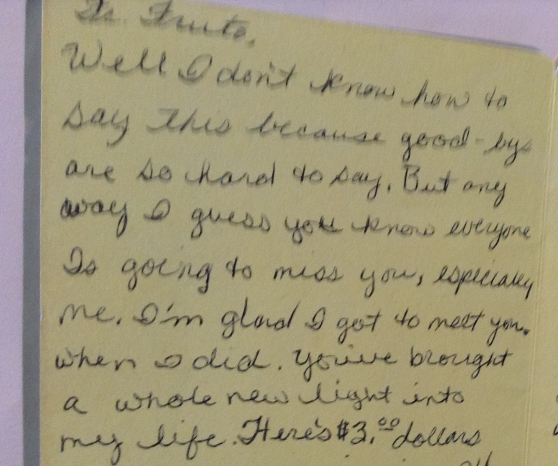
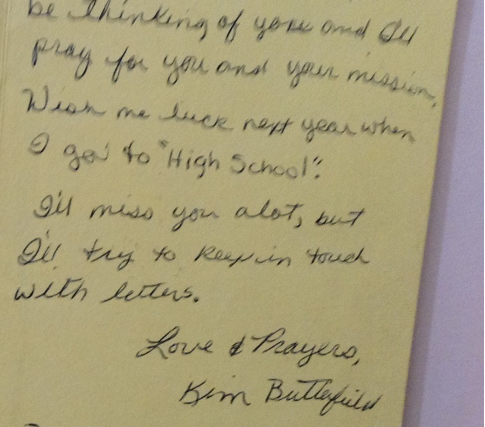
    (A personal note from a friend sent to me expressing her goodbye.)

    Here is a story shared by Bob Perks who has written above of the sad feelings that overwhelmed him when witnessing people saying goodbye to each other at airports.

                         Recently I overheard a father and daughter in their last moments together. They had announced her departure and standing near the security gate, they hugged and he said, “I love you. I wish you enough.” She in turn said, “Daddy, our life together has been more than enough. Your love is all I ever needed. I wish you enough, too, Daddy.”

                         They kissed and she left. He walked over toward the window where I was seated. Standing there I could see he wanted and needed to cry. I tried not to intrude on his privacy, but he welcomed me in by asking, “Did you ever say goodbye to someone knowing it would be forever?”

                         “Forgive me for asking, but why is this a forever goodbye?” I asked.

                         “I am old and she lives much too far away. I have challenges ahead and the reality is, the next trip back would be for my funeral,” he said.

                         “When you were saying goodbye I heard you say, “I wish you enough.” May I ask what that means?”

                         He began to smile. “That’s a wish that has been handed down from other generations. My parents used to say it to everyone.” He paused for a moment and looking up as if trying to remember it in detail, he smiled even more.” When we said ‘I wish you enough,’ we were wanting the other person to have a life filled with just enough good things to sustain them,” he continued and then turning toward me he shared the following as if he were reciting it from memory.

    “I wish you enough sun to keep your attitude bright.

    I wish you enough rain to appreciate the sun more. 

    I wish you enough happiness to keep your spirit alive.

    I wish you enough pain so that the smallest joys in life appear much bigger. 

    I wish you enough gain to satisfy your wanting. 

    I wish you enough loss to appreciate all that you possess.

    I wish enough “Hello’s” to get you through the final “Goodbye.”

    He then began to sob and walked away.

    When the Apostles left the hill of the Ascension transfixed gazing up to the clouds that had hidden their Lord,  Angels appeared reminding them that this Jesus would be coming back to them. This would have brought back to their benumbed minds the blessings of which they had had more than “enough” in the company of their Master. They returned with joy to Jerusalem where he would come to them. It did not dawn on them that he would not come in the same physical form that vanished from them at the Ascension. He would come to them in the person of the Holy Spirit. But they would deeply experience his presence fulfilling his promise “I am with you till the end of the ages.” They would go out into the world fired with Pentecostal zeal announcing the presence of their Risen Lord. This presence would mean that there is no “good bye forever” between the Lord and all who await his coming.