Category: Fr. Mario Masangcay, CSsR

  • MISUNDERSTOOD GOD

    MISUNDERSTOOD GOD

    March 22, 2021 – Tuesday of the Fifth Week of Lent

    Click here for the readings (https://bible.usccb.org/bible/readings/032321.cfm)

    A motivational speaker Terry Mark once said, “The world today is ruined more by misunderstanding than by hatred. Hatred is born out of misunderstanding”.

    Misunderstanding is something we are most familiar with in life. True indeed we know how bad it is when we misunderstand things. And we know how much worse it is when we are being misunderstood and to be misunderstood by others. Misunderstanding is indeed dangerous, can caused havoc and hatred among us people and can even jeopardize our faith in God.   

    Our readings today are also about misunderstanding.

    Worn out by their journey, the Israelites misunderstood God’s intentions and actions of saving them from slavery in Egypt. They resorted instead to complaining & grumbling against God & Moses. Thus, they were punished for their lack of faith & trust in God with pestilence of poisonous & deadly snake bites. As they understood & realized their own mistake, they begged for God’s mercy & received God’s protection from the punishment of death, by gazing towards the bronze serpent mounted on the pole whenever they are bitten by the deathly snakes.  Take note, God did not erase their punishment & misfortunes, but required them instead to gaze upon & believe in God’s cure or antidote to protect & spare them from pestilence death.

    In our gospel today, Jesus is also very much misunderstood by the people. The people simply cannot and did not get to understand Jesus. Jesus already explicitly said: “For if you do not believe that I AM, you will die in your sins… When you lift up the Son of Man, then you will realize that I AM.” Yes, Jesus is the “I AM” – the one lifted up & must be believe and trusted so that we might not die from our sins. He is the God’s cure and antidote to our sins & punishment. He is the bronze serpent mounted on the pole that will save us from the curse of our sins if & when in life we gaze upon & believe in Him.

    Those who believed Jesus understands. Those who understood Jesus believes. But those who cannot believe misunderstood Jesus… those who misunderstands cannot believe Jesus.

    And the more we misunderstand God & one-another, the more we cannot believe in God & the more we ruin our own lives & each other’s lives. And that is why we should be conscious of the danger misunderstanding in our lives. It can cause havoc to our world & to our faith in God.

    Consider this… Since last year, we have been praying for a medicine for Covid-19 pandemic. We have been praying for God’s intervention to save & spare us from this pandemic & to protect us from the spreading virus. Now that vaccines are available, misinformation & misunderstanding abound as to the efficacy of the said available vaccines. Doubts, fears, concerns, questions are on the rise. God is already intervening & has intervened but we still cannot believe because we miss to understand. Pope Francis said that to be vaccinated is our moral obligation, “morally everyone must take the vaccine… it is the moral choice because it is about your life… but also the lives of others.” In other words, take the vaccine not only to protect & cure oneself but to help protect & cure our world. And regardless how politicized and economized it is, understand & believe then that what we have now is God’s intervention & action for us now.

    Pardon our grumblings & foolishness, Lord. Make us understand that as you said, I AM – that you are God’s saving acts for our healing & redemption, and that we may believe & have more trust in God now & always.

    So Help us God. So May it Be. Amen.  
  • Lesson from Langka

    Lesson from Langka

    March 21, 2021 – Fifth Sunday of Lent

    Click here for the readings (https://bible.usccb.org/bible/readings/032121-YearB.cfm)

    Fruit-bearing process of Jackfruit tree is indeed amazing.

    Summertime during my childhood days, my parents used to ask me to strike with a bolo the trunk of the jackfruit tree, (we call langka), so that its tree would bear much fruits. It had always been a mystery to me why, if you scratch or peel off its trunk’s skin, thus, releasing white juices (in a way inflicting pain or wounds around its trunk), would a langka, jackfruit tree bears much fruit. Simply put, why would a jackfruit tree bear much fruit, if one cut and injure the jackfruit tree? Bakit ba namumunga ang puno nga langka pagsinugatan mo ito?“Nganong mamunga man ang punu-an sa langka kon imong samad-samaran ang lawas sa iyang punu-an?”

    For us Filipino, this has been a common practice – for jackfruit to bear much fruit, we cut or scratch the skin of its trunk.   And most of the time, our parents or elders could not explain why it happens. Usually, they would just rationalize that it has been done before and it worked, and it will be like that always. Well, it does work & we definitely enjoy its fruits.

    But if we try to observe closely the fruit-bearing process of a nangka tree, we realize that in order for it to bear much fruits, it is necessary for the nangka tree to undergo such painful process of scratching & peeling off some of its trunk’s skin. Because if you notice, a langka tree normally grows with a lot of leaves, leaves that usually blocks the sunlight to get in. We know then that less sunlight, there would be less chance of growing flowers, thus less chance of bearing fruits. For the sunlight to get in, thus letting flowers to grow and bear fruits, one need to lessen or trim down the volumes of leaves around the nangka tree without damaging its branches, by scratching off the trunk’s skin or inflicting wounds around the tree. Thus, when its leaves fall and sun then comes in, time will come new flowers will bloom and then will produce new fruits.

    Sometimes we do need to go through process of legitimate sacrifices & sufferings for the promise of new life to flourish in our life again & anew.

    In the same manner, our readings today have the same message. The Lords says in our first reading, “the days are coming when I will make a new covenant with them where I will place my law within them and write it upon their hearts, I will be their God, and they shall be my people.” Meaning, the time is near for a personal covenant with God.  Jesus in our gospel today is proclaiming us that God’s glory is about to be revealed, “the hour has come for the Son of Man to be glorified.” – the good news of God’s glory is near and our salvation is at hand.

    However, for God’s glory to be revealed and our salvation to realized, we must experience legitimate sacrifices and dying. Jesus said: Amen, amen, I say to you, unless a grain of wheat falls to the ground and dies, it remains just a grain of wheat; but if it dies, it produces much fruit. Whoever loves his life loses it, and whoever hates his life in this world, will preserve it for eternal life. St Paul said, Jesus himself experience sacrifices for he offered prayers and supplications with loud cries and tears. He learned obedience from what he suffered. Like jackfruit tree, we must shed off our sins and be naked & properly exposed before the Lord, so that His glory and life will be revealed to us, & will be received by us.  

    The psychologist Karl Jung says that most mental sickness comes from the avoidance of legitimate suffering. The neurotic maneuvers we make to avoid the legitimate suffering that is part of our reality become much more painful than the original suffering would have been. Avoiding suffering & pains thus hinders us to grow fruitfully in life. For a woman to fully enjoy motherhood, she must go through and endure the sacrifice of childbearing, and suffering of childbirth. Just like the fruit-bearing process of the langka tree, our life must also undergo pain and shedding of sinful ways so that God’s light will ignite and prepare our faith for a new life. In all spheres of life, the secret of deeper joy is in delayed satisfaction and legitimate suffering.

    Season of Lent is usually the moment for our legitimate sufferings and necessary sacrifices to prepare ourselves once again to recognize and receive God’s glory into our live, that we may bloom and be fruitful anew in our Christian life.

    In review, Ash Wednesday calls us to repentance & faith, “Repent & Believe the Gospel”. 2nd Sunday of Lent, God challenges us to Listen to His Beloved Son. 3rd Sunday of Lent Jesus insists that we cleanse & consecrate our lives as God’s temple as we “stop to make His father’s house a marketplace”. 4th Sunday reminds us that we rise above ourselves to these Lenten challenges so that we may have Life eternal with God. And now on the 5th Sunday of Lent, through legitimate process life-sufferings & pains, we are to prepare & expose ourselves to openly receive & accept God’s gift of salvation for us here & now at this very juncture of our life.

    As we are now nearing towards our observance of Holy Week & celebration of Easter Triduum, may these challenges of Lent properly dispose us for the coming flower-blooming & fruit-bearing of the coming life-promises of Easter. So Help us God, So May it be. Amen.

  • Work for God OR Do God’s work?

    Work for God OR Do God’s work?

    March 17, 2021 – Wednesday of the Fourth Week of Lent

    Click here for the readings (https://bible.usccb.org/bible/readings/031721.cfm)

    Thomas Green, a well-known Jesuit spiritual director once pointed out that for those who are in one way or another involved with apostolic work and ministry, there is a big difference between working for God and doing God’s work. Though working for God and doing God’s work are both noble and good as well as might mean the same, the difference lies on the doer, worker, or actor of the work.

    Working for God is based from OUR own initiative and creativity. It is service-done designed according to our own will so that God and others will be pleased with us. God and others then, becomes a passive recipient of our good works. However, doing God’s work is based not on our own but on God’s own initiative and creativity. It is service-done, patterned according not to our own will but to God’s will and done in partnership and collaboration with God. Here, God is the author and actor of the good works done. We become then just participants and instruments of God’s work as well as all will be the beneficiaries of God’s work. Simply put, Working for God is OUR work for God, while Doing God’s work is God’s work for us & done with Us.

    Jesus in our gospel today gives us a description of the relationship or tandem between himself and his Father. Jesus said: I can do nothing of myself, because I seek not my own will but the will of Him who sent me. Meaning, the attitude of Jesus toward his mission and good work is not working for God but doing God’s work. He sees himself as active participant not a passive recipient, and as collaborator or partner, not conspiring plotter, of God.

    As followers of Christ, we are called to be involved with the good work of salvation. But in doing so, we must be like Jesus in doing God’s work, and not working for God.

    Though we do our part in God’s work, Lent Season challenges us to be more in sync & at tune with God’s will, plan, & ways of leading & guiding us, rather than insist our own plans, will & ways for what is best for us in our lives nowadays.

    So Help us God. So may It be. Amen.

  • TO HAVE LIFE WITH HIM

    TO HAVE LIFE WITH HIM

    March 14, 2021 – Fourth Sunday of Lent

    Click here for the readings (https://bible.usccb.org/bible/readings/031421-YearB.cfm)

    We are now on the 4th Sunday of Lent. Meaning, we are already half way through the Season of Lent, the preparation time for us to celebrate the Paschal Mystery of Christ once again.

    Today, we are invited to review – to view again our past weeks of Lenten journey. We began the season of Lent during Ash Wednesday when we hear the first Good News Jesus preached, “Repent and believe in the gospel”, as we received the ashes and bore the sign of the cross on our foreheads. Then on the first Sunday of Lent, we reflected on the temptations of Jesus as real as our experience of occasions of sins in our lives – that human like us, Jesus also have struggled with temptations, as occasions of sin in our life. Again, calling us in the midst of our life-trials & difficulties to “Repent and Believe the Gospel.” Then on the second Sunday of Lent, we heard of the Transfiguration of Jesus, calling us to deeper faith and hope in Him, as even as the Father Himself proclaiming to us, “This is my beloved Son. Listen to Him”. And last Sunday the third Sunday of Lent, we came to know the confrontational Jesus who was angry, making trouble in the public and making enemies along the way in order to stand for what he believes, and to set things right before God & us, as God’s temple.  

    All of these words, the call to repentance and belief, to be steadfast in the midst of temptations and occasions of sin, to listen to God’s beloved Son and to set things right & sacred before God, are demanding challenges for us. Based from our experience and perspectives, we might say those are nice challenging words to hear but difficult to heed and practice. Nice to hear and say but Difficult to do, for these words of God really challenge us to do something to change our lives.

    However, our readings today are more on sober tune. It is a respite, a breathing space from demands and challenges of Lent. It invites us to see the demands and challenges of Lent from God’s perspective, and provides us the context for & the reason behind our need for conversion & upgrade of our faith in our life now.

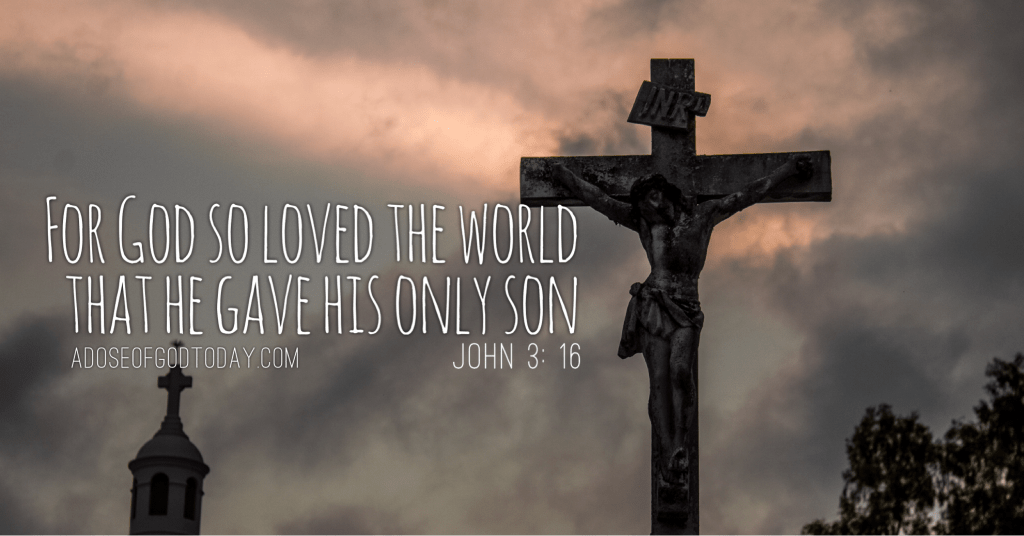
    We hear Jesus proclaims to us, “God so loved the world that he gave His only Son, so that everyone who believes in Him might not perish but might have eternal life.” This is to remind us of God’s deep love for us to the point of sacrificing His son, so that we might believe in Him. Meaning, God suffered a lot for our Faith at the price of His son. He wants us to heed and do those challenging words of believing again & anew in His Son, so that He could always love and forgive us again.

    And above all, Why? He challenges us now & always because God wants to share His eternal life with us, His beloved children. God wants us to have Life with Him.  

    As we begun Lent, we considered Judas & Peter, as to how and why the sin of Judas is more serious than Peter’s. We come to realize that Judas’ is more serious than Peter’s sin, because Judas did not give the Lord the chance to love and forgive him again & anew, instead he ended his life by killing himself.  Yes, Judas repented but he did not believe anymore. Peter on the other hand, yes, have hidden himself but stayed on until the Lord’s resurrection and got the chance to be forgiven and loved again & anew by the Lord. Peter repented & still believes in God despite what happened. In other words, Judas’ sin is more serious compared to Peter’s because Judas, by committing suicide, did not give the Lord the opportunity, the chance to forgive and love him again. Both may have repented but unlike Judas, Peter believes and remains to have faith in Jesus’ resurrection, in effect, made him experience life – eternal life with God. So also if & when we still believe despite of what happened to us, we could share in God eternal life through the Lord’s resurrection.

    It was also once told a story that in God’s kingdom when everyone lives blissfully in the everlasting life, Peter finds Jesus standing near the heavenly gate. He goes near Jesus, and said, “Well, everyone is looking for you. How come you are here near the gate?” The Lord replied, “Actually, I’m waiting for someone. I hopefully waiting for my dear Judas to come back…. The Lord is thus still & always waiting for our coming home in repentance & faith.

    Remember then that God loves us not because and after we are forgiven, but rather God forgives us because we are loved beforehand and eternally.

    Lent is the time for us to come back home to Him and believe in Him anew. And like Father in the Prodigal Son, the Lord is always waiting for us so that He could always love and forgive us again. So, at this time, as we do our best to respond on the challenges of Lent, let us give God now through Jesus a chance to forgive and love as again and anew, so that we experience eternal life with Him.

    May the fruits of our honest repentance, righteous attitude & deeper faith in the Lord be upon us, & so prepare us to experience & celebrate Easter, as our foretaste of eternal life with God.

    So Help us God. So May it be. Amen.

  • PRIDE & HUMILITY

    PRIDE & HUMILITY

    March 13, 2021 – Saturday of the Third Week of Lent

    Click here for the readings (https://bible.usccb.org/bible/readings/031321.cfm)

    WHAT (than Who) is Right, Matters most.

    Certainly pride & humility does not come together. It is said that pride & humility are opposite to one another. But what is the difference between Pride & Humility?

    A wise man once said: “Pride is concerned with Who is Right. Humility is concerned with What is Right.” True indeed, Pride is all about the person being correct, great & better than others, regardless of what he thinks & have done. Humility, however, is all about the person’s right relations, attitude & influence towards others, great or small he may be. Pride is about oneself and thinking more about & of oneself. Whereas humility is not thinking less of oneself but more about thinking oneself less.

    Surely our Gospel today is all about Pride & Humility. The Pharisee is full of himself. He prides & exalts himself compared to the tax collector. He lauds himself for his greatness & merits for doing what is required. He is more concerned about himself than others & even than God. It is all about himself. Whereas the tax collector pays his humble homage due to God, despite his unworthiness & sinfulness. He is concerned about God’s mercy in his life more than his being a sinner. He prays: “Lord, Have Mercy on Me, a Sinner” while the Pharisee is not concern about thanking God “I thank you Lord” but more on “I am not like the rest of humanity.”

    And who is justified & finds favor with God? The one who humbles himself – the one who thinks oneself less, will be exalted and the one who exalts himself – the one who thinks oneself more, will be humbled.

    What God then requires of us is our Righteousness – WHAT is right before God & others, Not our Greatness – WHO is right amongst us. Humility, not Pride matters most in our faith & life, as Hosea reminds us “God desires our love & knowledge of Him, not our sacrifices & burnt offerings.” Simply put, Be HUMBLE than proud. Realize that that Life with God is all about God & not about oneself & ourselves. Consider then oneself less & do whatever is right before God & others, rather than considering oneself more & insist on who is right.

    So Help us God. So May it Be. Amen.